
MET Bhujbal Knowledge City, Adgaon, Nashik, Maharashtra, India - 422003.
Native to New Zealand, kawakawa (Macropiper excelsum) is an important part of the area's ecological, medicinal, and cultural fabric. Long utilized by the M?ori people for its healing properties, Kawakawa is increasingly recognized in modern herbal medicine for its anti-inflammatory, pain-relieving, and antimicrobial benefits. This review offers an in-depth examination of Kawakawa, covering its historical importance, both traditional and contemporary uses, geographical spread, and the biological impacts of its key compounds. The paper also addresses sustainable harvesting methods and the conservation issues facing this important plant. By integrating historical and current insights, the review underscores Kawakawa's lasting significance and its potential future roles in natural medicine.
History : Known as the New Zealand Pepper Tree, Kawakawa (Macropiper excelsum) is an important aspect of New Zealand history and culture, especially in M?ori customs. This plant, which is indigenous to New Zealand and some parts of the South Pacific, has long been prized for its many therapeutic and spiritual uses. Kawakawa is highly valued in rongo?, or M?ori herbal medicine. Its leaves were frequently consumed or applied as poultices to treat a range of conditions, including pain, inflammation, wounds, and digestive issues.Kawakawa's therapeutic qualities made it a vital component in M?ori health practices, promoting both bodily and spiritual wellness. Apart from its therapeutic applications, kawakawa has a strong spiritual connection to M?ori culture. Because it was thought to ward off evil spirits and repel negative energies, it was often utilised in ceremonies and rituals. The plant's heart-shaped leaves, which are frequently punctured by bug holes, represent resiliency and healing. This is in line with the idea that, just as the plant can mend itself, it can also help humans heal. Kawakawa's essential position in M?ori culture is highlighted by its dual function as a spiritual protector and physical healer. In addition to its historical and cultural value, kawakawa is still significant today because it is used in herbal therapy and natural health products, which link M?ori traditional wisdom with contemporary medical procedures. ((Jayaprakash et al., 2024)(Abughazala, n.d.)
Biological Source:
In the lowland and coastal forests of the North Island and the milder northern parts of the South Island, the kawakawa subspecies *P. excelsum ssp. excelsum* is frequently found as a small shrub or tree. It has a significant role in M?ori culture's physical (mauri) and spiritual (wairua) spheres. The kawakawa plant belongs to the Piperaceae family and is biologically known as *Macropiper excelsum*. This species, which is indigenous to New Zealand and some parts of the South Pacific, usually grows as a tiny tree or shrub in lowland and coastal forests. *P. excelsum ssp. excelsum* is the subspecies that is most frequently identified. The plant is known for its heart-shaped leaves, which have great cultural importance and are essential to traditional M?ori healing.((Ca Butts, n.d.),(Salehi et al., 2019)
Various Sections Of A Selected Plant With Therapeutic Uses:
For New Zealand's indigenous M?ori, kawakawa (*Piper excelsum*) has great culinary, medicinal, and cultural significance. It is being used more and more in tea and other commercial food and medicinal items. The kawakawa plant (*Piper excelsum*) has several sections that are valued for their therapeutic qualities and contribute to its wide range of therapeutic uses. Being the most often utilised, the leaves are particularly well-known for their potent analgesic, antibacterial, and anti-inflammatory properties.
Kawakawa leaves have long been used as poultices to heal wounds, reduce inflammation, and lessen pain. To improve general health and aid in digestion, they are also chewed or brewed into teas. Although they are used less frequently, the plant's stems and bark have therapeutic properties and are employed in traditional treatments for a variety of illnesses. These ingredients could be used in infusions or tinctures. All of the kawakawa plant's parts work together to form traditional M?ori medicine, emphasising the plant's vital significance in both cultural practices and medical healing. ((Tautuiaki et al., 2024),
GEOGRAPHIC DISTRIBUTION, COLLECTION & CULTIVATION:
The kawakawa plant (*Piper excelsum*) is indigenous to New Zealand and is also found in various parts of the South Pacific. It flourishes in coastal and lowland forest settings, particularly throughout the North Island and the warmer northern areas of the South Island. Kawakawa thrives in subtropical to temperate climates and prefers moist, well-drained soils under the cover of native forest canopies.Regarding collection and cultivation, kawakawa is traditionally harvested from its natural habitats. However, it is increasingly being cultivated in gardens and nurseries for both commercial and personal use. Successful cultivation of kawakawa requires providing adequate moisture and protection from frost, as the plant grows best in sheltered, shaded environments. It is commonly propagated through seeds or cuttings, and effective cultivation depends on maintaining suitable soil conditions and local climate to replicate its natural growing conditions. (Takooree et al., 2019),(Lei et al., 2015).
Place Where Kawakawa Plant Is Located
PHYTOCONSTITUENTS:
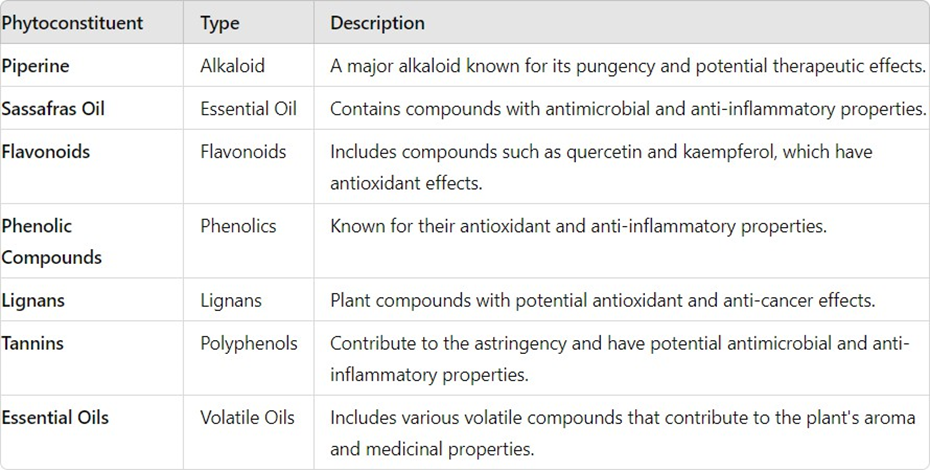
Chart No :1 Phytoconstituent of kawakawa
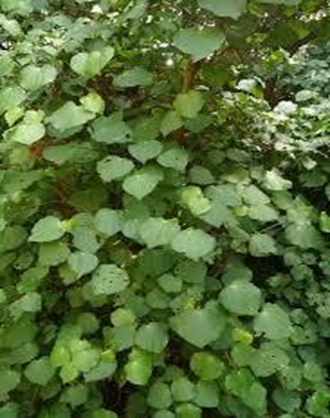
Figure no: 1 kawakawa plant
USES:
The kawakawa plant (*Piper excelsum*) has several uses, indicating its significance and wide range of uses. Kawakawa leaves are valued for their antibacterial, analgesic, and anti-inflammatory properties in traditional M?ori medicine. In addition to being chewed or brewed into tea to aid with digestive problems, they are commonly used as poultices to treat wounds, lower inflammation, and relieve pain. Additionally, the leaves are used in skin care products, where their extracts are applied to relieve a variety of skin irritations and disorders. In the culinary arts, kawakawa leaves are used to make tea because of their unusual flavour and potential health advantages, as well as to impart a distinctively spicy flavour to traditional M?ori foods. The plant holds cultural significance in M?ori rites and rituals, representing fortitude and protection. Additionally, kawakawa's essential oils are utilised in aromatherapy and natural cures, and the plant is becoming more and more prevalent in commercial health goods, such as herbal supplements and skincare formulas. This wide variety of uses highlights the plant's importance in commercial, cultural, gastronomic, and medical contexts. ((Ca Butts, n.d.))(Hodge, n.d.).
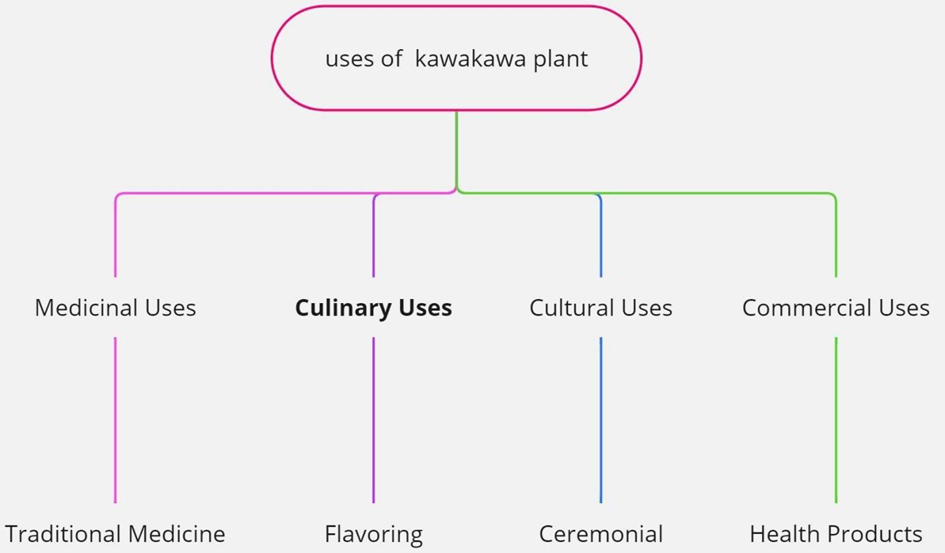
Chart No: 2 Uses of Kawakawa Plant
ADVERSE EFFECT:
Given the anti-hyperglycemic properties of several of Kawakawa's phytochemicals, consuming it may also have an impact on the release of insulin from the pancreatic β-cells. (11) Kawakawa (Macropiper excelsum) is generally considered safe when used correctly, especially in traditional M?ori medicine. However, improper or excessive use can lead to adverse effects. For example, topical use of Kawakawa leaves or extracts may cause skin irritation or allergic reactions in some people. Consuming large amounts of Kawakawa can result in gastrointestinal discomfort, including nausea, vomiting, or diarrhoea. There is also the potential for Kawakawa to interact with medications, particularly those that influence blood pressure or have sedative properties, which could cause unintended consequences. Although rare, overuse of Kawakawa, especially in non-traditional forms, may carry a risk of liver toxicity due to certain compounds that can impact liver function at high doses. Additionally, some individuals may experience mild neurological symptoms, such as dizziness or headaches, when consuming large quantities of Kawakawa. (Hodge, n.d.; Ramzan et al., 2022).
ADVERSE EFFECT OF KAWAKAWA:
MARKETED FORMULATION:
|
Types |
Brand Name |
Company Name |
Dose |
Price |
|
Powder |
Manuka and Kawakawa Blended Tea, |
Mauka kingdom |
1 spoon |
?1,460.40 |
|
Balm |
Kiwiherb Kawakawa Soothing Balm 50 G |
Australian Organic Products |
Apply 2-3 times a day |
?1,581.22 |
|
Olives |
Lemon Myrtle & Kawakawa Infused Olives 150g |
Analisa Burgio |
Eat daily |
?728.49 |
|
Extract |
Kava Extract 4 oz |
KIWLA |
5-6 drops |
?9,706. |
HOMEMADE REMEDIES:
1.Kawakawa Tea:For five to ten minutes, steep a handful of leaves in hot water. To ease digestive problems like indigestion or cramping in the stomach, strain the tea and drink it. To taste, you can add lemon or honey.
2.Kawakawa Poultice:For small cuts, bruises, or bug bites, crush a handful of fresh leaves to release their juices and apply straight. Wrap securely and leave on for a few hours. This poultice aids in healing by reducing inflammation.
3.Kawakawa Infused Oil: Put the leaves in a jar and pour carrier oil over them. After sealing the jar, place it in a warm, bright position and shake it once or twice a week. After straining the oil, keep it in a dark bottle. Apply the infused oil to your muscles to ease soreness or stiffness.
4.Kawakawa Tincture: Put some dried leaves in a jar and pour alcohol over it. Tightly seal, then place in a cool, dark place and shake every day for two to four weeks. The tincture should be strained and kept in a dark bottle. For sore throats or respiratory problems, use in small dosages; nevertheless, speak with a healthcare provider before usage.
CONCLUSION:
Kawakawa (Macropiper excelsum) holds significant cultural, historical, and medicinal importance in New Zealand. The M?ori people have traditionally used Kawakawa for its therapeutic properties, which include anti- inflammatory, antimicrobial, and pain-relieving effects. The plant's historical significance and its distribution across New Zealand highlight its crucial role in both local ecosystems and traditional health practices. However, it is important to exercise caution due to possible adverse effects such as skin irritation, digestive issues, and interactions with certain medications. Adhering to traditional preparation and usage guidelines is essential to fully benefit from Kawakawa while minimizing potential risks. Ongoing research and sustainable management will be key to unlocking Kawakawa's full potential and maintaining its value in contemporary herbal medicine.
REFERENCES


Darshan Shejwal*, Kshitija Ahire, Mayuri Sali, Aarya Gawali, Examining the Historical, Therapeutic, And Ecological Functions of the Multifaceted Kawakawa, Int. J. of Pharm. Sci., 2025, Vol 3, Issue 12, 1562-1567 https://doi.org/10.5281/zenodo.17862992
 10.5281/zenodo.17862992
