
Shri Sambhaji College of Pharmacy, Khadkut
Cancer, a complex and devastating disease, continues to plague humanity. There have been great advancements achieved in conventional treatments such as chemotherapy and radiation; however, these treatments frequently come with serious adverse effects and limited efficacy against certain types of tumors. In the relentless pursuit of more targeted and effective therapies, nanorobotics has emerged as a promising frontier. This article explores the potential of nanorobots in revolutionizing cancer treatment, drawing upon recent research and highlighting the key findings that underscore their transformative potential. Cancer treatment is currently limited by systemic toxicity and a lack of precise targeting. Nanorobots, nanoscale devices capable of performing specific tasks, offer a novel approach to overcome these limitations. This article reviews the potential applications of nanorobots in cancer treatment, including targeted drug delivery, tumor ablation, and early detection. Nanorobots can travel through the bloodstream, detect cancer cells, and deliver medicine directly to tumors, reducing harm to healthy tissues. They can also help track how well a treatment is working in real-time and detect cancer recurrence at an early stage. Although there are still challenges like compatibility with the body, large-scale production, and regulatory approval, progress in nanotechnology is bringing nanorobots closer to becoming an important part of future cancer treatment.
Nanorobotics includes sophisticated submicron devices constructed of nanocomponents that are viewed as a magnificent desired future of health care.
It has a promising potential in medication delivery technology for cancer, the top cause of mortality among those under the age of 85 years.
Nanorobots might transport and distribute vast volumes of anticancer medications into diseased cells without hurting normal cells, decreasing the adverse effects of existing therapies such as chemotherapy damage.
Nanorobots are miniaturised machines that have the ability to perform work at par with that of current existing machines, having applications in the aspects of medicine, industry, and other area.
Organic nanorobots, also known as bio-nanorobots, are created by combining virus and bacterium DNA cells. This type of nanorobot is less harmful to the organism. Diamond structures, synthetic proteins,anomotors employed for the conservation of energy;
The possibilities presented by nanorobotics are virtually limitless:
Medicine: This field is arguably the most discussed and potentially transformative area. Nanorobots could revolutionize drug delivery, enabling targeted therapies with minimal side effects.
They could also perform microsurgery, clear blocked arteries, and even repair damaged DNA. Imagine nanobots patrolling your body, detecting and eliminating diseases before they even manifest
Manufacturing: Nanorobots can be used for precise assembly of nanomaterials, leading to the creation of stronger, lighter, and more efficient materials. They could also be used in surface coatings and fabrication of microchips, pushing the boundaries of technological advancement.
Environmental Remediation: Nanorobots could be deployed to clean up pollutants in water and soil, targeting specific toxins and breaking them down into harmless substances. This could revolutionize waste management and environmental protection.
Data Storage: Nanorobotics could be used to create extremely dense data storage devices, storing vast amounts of information in a tiny space.
New advances in medication delivery have resulted in greater quality in targeted drug delivery that uses nanosensors to detect particular cells and regulate discharges through the use of smart medicines Traditional chemotherapeutic drugs act by eliminating swiftly replicating cells, which is a primary feature of malignant cells. Most anticancer medications have a limited therapeutic boundary, often resulting in cytotoxicity to normal stem cells that proliferate quickly, such as bone marrow, macrophages, gastrointestinal tract (GIT), and hair follicles, causing adverse effects like myelosuppression (lower synthesis of WBCs, producing immunosuppression), mucositis (inflammation of the GIT lining), alopecia (hair loss), organ malfunction,
Thrombocytopenia/ anaemia, and haematological side effects, among other things. Doxorubicin is used to treat numerous forms of cancer, including Hodgkin's disease, when it is combined with other antineoplastic medicines to minimize its toxicity . Paclitaxel is a drug that is injected intravenously and is used to treat breast cancer. Some of the significant side effects include bone marrow suppression and progressive neurotoxicity. Cisplatin is an alkylating drug that results in the intra DNA binding filament. Its negative effects include giddiness and severe vomiting, and it can be nephrotoxic.
Advantages :-
Disadvantage :-
PLAN OF WORK
Steps in Nanobot-Assisted Cancer Treatment
Nanorobot Deployment: Nanorobots are introduced into the bloodstream to navigate the body and locate tumors.
Targeted Activation: Nanobots may use active propulsion mechanisms, such as flagella or magnetic fields, and can be activated by external light or magnetic fields to trigger their actions.
Therapeutic Intervention:
Drug Delivery: Nanobots deliver drugs directly to cancer cells, improving treatment efficiency and reducing side effects.
Photothermal Therapy: Nanobots generate heat upon light activation to destroy cancer cells.
Photodynamic Therapy: Nanobots create localized reactive oxygen species (ROS) under light stimulation to kill cancer cells.
Gene Therapy: Nanobots deliver therapeutic genes or RNA interference molecules to target and modify cancer cells.
Enhanced Radiotherapy: Nanobots increase the sensitivity of tumor cells to radiation therapy.
Surgical Applications: Nanobots can be used for minimally invasive tumor removal, precise identification of tumor margins, and microsurgery on tumor-feeding blood vessels..
Monitoring and Diagnosis: Nanobots can also serve as biosensors to monitor the tumor, environment, detect cancer cells, and differentiate between aggressive forms of cancer, providing valuable information for treatment decisions
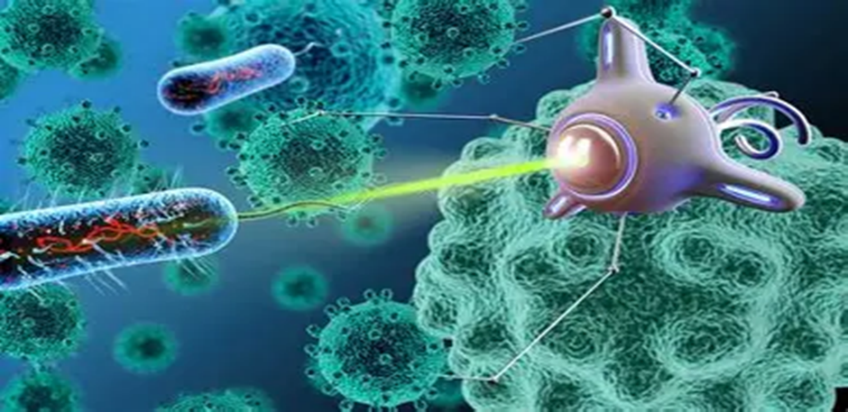
As a miniature structure, nanorobots are capable of executing predetermined missions and bear stark differences to their macroscale robotic counterparts. The primary challenges in the development of nanorobots or nanomechanical components lie in their construction and control. These devices operate within a microenvironment that exhibits physical characteristics distinct from those encountered by conventional components. The composition and structure of nanorobots are not uniform and can vary depending on their intended function and the materials and technologies utilized in their creation. The field of nanorobotics is an ever-evolving one, with ongoing advancements and breakthroughs. In this regard, we have presented a general outline of some of the crucial components and structures commonly found in nanorobots and provided a summarization of typical examples of medical nanorobots based on the study by Suhail et al. Currently, most nanorobot experiments are conducted under conditions akin to those found in human microenvironments. To ensure that nanorobots can effectively eliminate cancer cells within the human body, scientists have set stringent standards for their fundamental design elements. It is noteworthy that medical nanorobots are still in the nascent stages of development and are yet to be widely implemented in medical treatments. The specific composition and structure of these devices may greatly vary based on their intended application and the necessary requirements for safety, efficacy, and scalability.
The energy source of driving forces is vitally important for nanorobots to work in the body autonomously. The type of driving force can affect the moving speed of a nanorobot, controllability and biocompatibility to a great extent and thus subsequent applications in a biosystem. It is not possible to apply the conventional macroscopic batteries and power supply components to these nanorobots.
In the design phase, it should be ensured that a nanorobot could move freely and has sufficient power to offset the resistance from TME (tumor microenvironment). The power sources of nanorobots are innovatively divided into exogenous dynamics and endogenous dynamics. Exogenous dynamics usually include magnetic propulsion, ultrasound propulsion, and light-driven propulsion, whereas endogenous dynamics are usually achieved by chemical or biological reactions . Locomotional control also represents an important challenge in micro- and nanoscales. In vivo operations of nanorobots have been demonstrated their abilities to enhance tissue penetration and payload retention. But viscous forces dominate over inertial forces at nanoscopic scales. Therefore, it is necessary to take into account the environment effects while designing an efficient nano-machine. For example, it requires different swimming strategies that allow nanorobots to operate under these low Reynolds number constraints, as well as various kinds of navigation strategies for nanorobots to overcome the Brownian motion
Recently, blood glucose, urea and other bodily fluid constituents were utilized as the power sources for enzyme reaction-derived nanorobots, but the stability of these enzyme reactions-driven nanorobots requires further improvements before practical implementation can be possible . However, new alternative fuels and propulsion mechanisms are needed to achieve safe and successful operation in the human body, although different fuels and external stimuli have been explored for nanorobots in aqueous media.
INTRODUCTION TO NANOMATERIAL
Nanoscience and nanotechnology have been regarded as the next big wave that could hit this fast-moving world. The manipulation, engineering and study of particles, structures and matter are termed as nanoscience. The optical, electrical, mechanical, and other properties are studied on nanoscale. In a paper by Wang et al., they have also inferred that materials have different properties in nanoscales while comparing them with their bulk counterparts
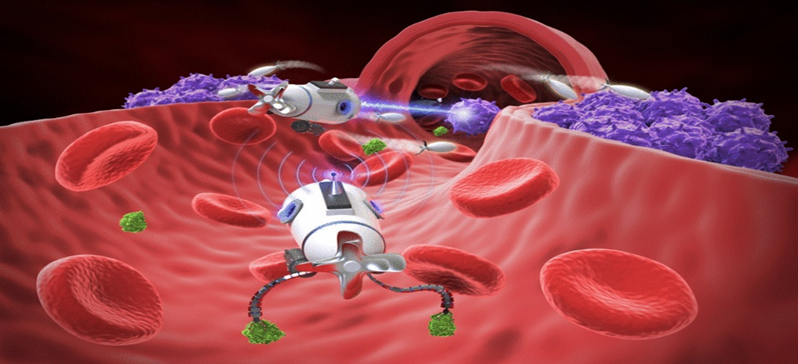
As cancer continues to take a toll on human beings worldwide, a more advanced and complex treatment method is nothing but, the need of the hour. Taking such a concept into consideration, the proper interpretation of nanoscience and the right use of nanomaterial could be the way forward. Nanomaterial-based therapeutics are believed to have numerous merits over old-school treatments such as Radiation Therapy, Chemotherapy, and so on, including their bioavailability, responses of cancerous cells on treatments, and reduction in side effects among patients. Based on the physiology of the abnormal state and anatomical characteristics of solid tumor tissues, nanomaterial could probably take advantage of the enhanced permeability and retention effect, which could accumulate and penetrate the affected cells. Other properties like its size, which is capable of moving away from the fixed macrophages and of resisting rapid leakage into the tiny capillaries, its surface characteristics, and passive and active targeting of tumors, are some of the vital properties of nanomaterial in cancer treatment (especially for drug delivery and further mechanisms). Parts of DNA and RNA, silk fabrications, and liposomes, are engineered into nanomaterial and hence used for delivering drugs, and other therapies. Certain inorganic nanomaterials are combined with Cancer photothermal therapies, which show us how inorganic nanoparticles will be useful in treating Cancer.
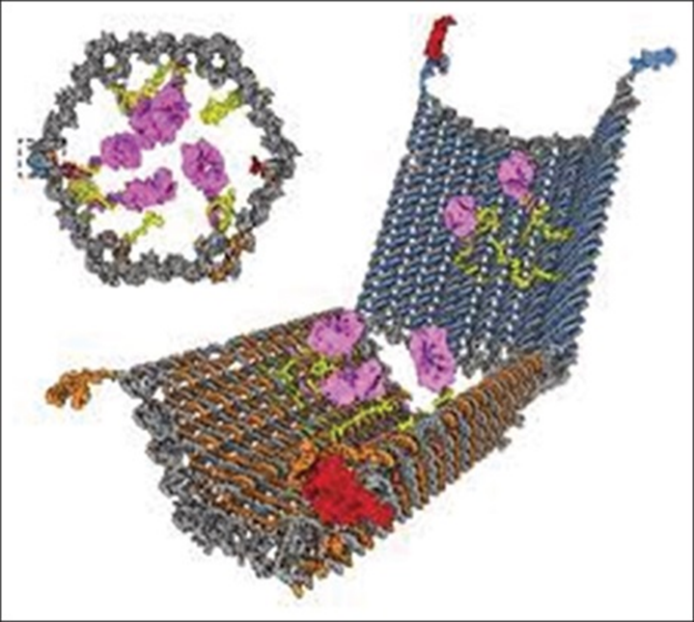
Concerning the work done by Douglas et al., we can have a glance at the construction of nanobots, made using DNA strands. It is known that the software used for the construction of nanobots was a software called “Cadnano,” which was an open-source programmable software. DNA Origami, a technique of making tiny components of DNA, was used to create these nanobots. A part of the DNA was cut into the desired small scale, as strands, and then, these tiny strands were attached to make a long and desired strand of essential dimensions.As in the case of DNA stranding, the desired shape and size are obtained when the two strands, interact with each other among the complementary base pairs. These bots consist of two halves which are openable and closable, as directed by the operator. These two halves are not separate as they are connected by a molecular hinge.They are bound together by laches or molecular locks made of DNA double helixes. The aptamers are attached outside. The payload, which carries the drugs and pharmaceuticals secured by molecular anchors, as mentioned earlier, is placed inside the nanobots. The aptamers hold the payloads inside the nanobots tightly and once the target is obtained, it opens itself and deposits the payload on the targetshows the design and construction of the nanobot.
APPLICATIONS
Nanorobotic pharmaceutical Applications
CONCLUSION
The main target of writing this review was to provide an outline of the technological development of nanotechnology in medicine by making a nanorobot and introducing it in the medication of cancer as a new mode of drug delivery. Cancer is described as a collection of diseases characterised by the unregulated development and spread of malignant cells in the body, and the number of people diagnosed every year keeps adding up. Cancer treatment is most likely the driving force behind the creation of nanorobotics;
It can be auspiciously treated using existing medical technology and therapeutic instruments, with the major help of nanorobotics. To decide the prognosis and chances of survival in a cancer patient, consider the following factors: better prognosis can be achieved if the evolution of the disease is time-dependent and a timely diagnosis is made.
Another important aspect is to reduce the side effects of chemotherapy on the patients by forming efficient targeted drug delivery systems. Programmable nanorobotic devices working at the cellular and molecular level would help doctors to carry out precise treatment.
In addition to resolving gross cellular insults caused by non-reversible mechanisms or to the biological tissues stored cryogenically, mechanically reversing the process of atherosclerosis, enhancing the immune system, replacing or re-writing the DNA sequences in cells at will, improving total respiratory capacity, and achieving near-instant homeostasis, medically these nanorobots have been put forward for use in various branches of dentistry, research in pharmaceuticals, and aid and abet clinical diagnosis.
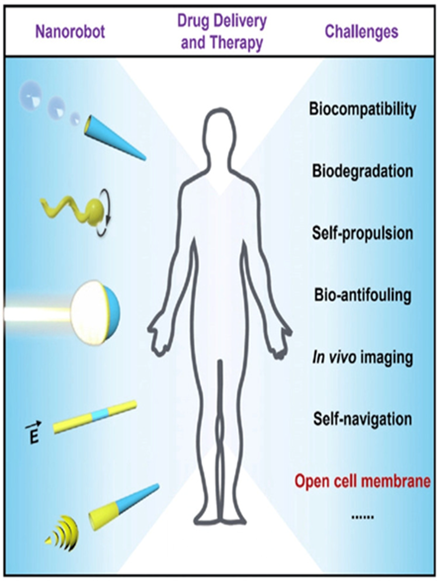
When nanomechanics becomes obtainable, the ideal goal of physicians, medical personnel, and every healer throughout known records would be realized. Microscale robots with programmable and controllable nanoscale components produced with nanometre accuracy would enable medical physicians to perform at the cellular and molecular levels to heal and carry out rehabilitating surgeries.
Nanomedical doctors of the 21st century will continue to make effective use of the body's inherent therapeutic capacities and homeostatic systems, since, all else being equal, treatments that intervene the least are the best.
In conclusion, nanoparticles and especially nanorobotics are not just incremental improvements; they represent a paradigm shift in oncology, offering the potential for more effective, patient-friendly, and precise cancer care that can increase survival rates and drastically improve the quality of life for patients. The future will involve a greater integration of these nanotechnologies with fields like Artificial Intelligence (AI) to design and control the next generation of "smart" nanomedicine systems
REFERENCES


Mayuresh Ganjewar, Pradnya Kshirsagar, Nanotechnology and Nanorobotics in Cancer Treatment, Int. J. of Pharm. Sci., 2025, Vol 3, Issue 12, 3164-3172. https://doi.org/10.5281/zenodo.18005924
 10.5281/zenodo.18005924
