
Oriental College of Pharmacy, Sanpada, Navi Mumbai.
Nanotechnology is the creation of functional materials, devices and systems through control of matter on the nanometer length Scale, and exploitation of novel phenomena and properties (physical, chemical, biological, mechanical, electrical…) at that length scale. In The area of cosmetics and anti-aging, in particular, as well as in the pharmaceutical arena, nanotechnology has played an important role in Delivering active ingredients to the skin, in both patch delivery and timed release application. Nanoparticles/nanospheres, nanospheres Sounds like futuristic technology. The revolution they triggered is apparent from the fact that cosmetics are no longer visualized as Products that cover up or camouflage imperfections in personal appearance. The latest trend in these products is to combine clinically Proven ingredients with patented delivery systems and the aesthetics of fine cosmetics. Cosmeceutical products are those poised on the Gap between cosmetic products that simply cleanse and beautify and pharmaceuticals that cure and heal. According to The Freedonia Group Inc. Cleveland Ohio, the demandsfor formulated appearance-enhancing products is projected to increase by more than 12% per Year up to 2007 to reach $2.5bn, making cosmeceuticals one of the most dynamic sectors within the cosmetics and personal care markets. Cosmetic industries rank high among the nanotechnology patent holders in U.S.; L’Oreal which devotes about $600 million of its annual $17 billion revenues to research is the industry leader on nanopatents. This report directly addresses the science behind the use of Nanotechnology for the development of cosmetics. Further, the products launched by àvarious cosmetic giants will be discussed at length. (1)
“It’s probably on your face or in your body right now; it’s definitely somewhere in your home. You can’t see it, but it’s there just the same.” This quote by Brindy McNair perfectly captures the invisible yet powerful presence of nanotechnology in our everyday lives. From cosmetics and medicines to food packaging, electronics, and even sports equipment, nanotechnology is quietly shaping the world around us. At its core, nanoscience studies materials on an incredibly tiny scale—a nanometer is one billionth of a meter, and atoms themselves are only about one-third of that size. At such dimensions, materials don’t behave the same way they do in bulk. Instead, they follow the fascinating rules of quantum mechanics, which can change their shape, crystalline structure, and even their magnetic, optical, and electrical properties. When it comes to skincare, this technology opens up entirely new possibilities. Human skin is a complex, three-layered organ: the epidermis (outer layer), the dermis (middle layer), and the hypodermis (deepest layer). As we age, collagen and elastin—the fibers that keep our skin firm and supple—begin to break down. This leads to visible signs of aging like wrinkles, sagging, and loss of elasticity. Interestingly, these changes begin not at the surface, but deep in the dermis, where most of the skin’s rejuvenating cellular activity takes place. For years, creams and treatments only worked on the surface, but nanotechnology now offers a way to deliver active ingredients deeper, targeting the very source of aging from within. (1)

HISTORY OF NANOCOSMETOLOGY
The concept of nanotechnology was first introduced by physicist Richard Feynman in 1959 in his famous lecture “There’s Plenty of Room at the Bottom.” However, it wasn’t until the 1980s that nanotechnology began evolving as a practical science with the invention of tools like the scanning tunneling microscope. The application of nanotechnology in cosmetics — termed Nanocosmetology — began gaining traction in the early 2000s. The first notable nanocosmetic product was L’Oréal’s use of nanoemulsions in sunscreens and anti-aging creams. Around 2005, global cosmetic brands like Estée Lauder, Shiseido, and Nivea began incorporating nanomaterials like liposomes, nanoemulsions, nanocapsules, and solid lipid nanoparticles into their formulations. These innovations allowed for better skin penetration, enhanced stability, controlled release, and targeted delivery of active ingredients. Today, nanocosmetology is a fast-growing field that combines nanoscience with dermatology, pharmacology, and cosmetic chemistry, aiming to improve the efficacy and aesthetics of skincare and beauty products.
LITERATURE REVIEW / BACKGROUND OF NANOCOSMETOLOGY
Nanocosmetology is the integration of nanotechnology into cosmetic products to enhance their performance, safety, and sensory appeal. Researchers and companies have been exploring how nanoscale materials can: Increase skin absorption of active ingredients Provide long-lasting effects Improve the texture and appearance of formulations Protect active ingredients from degradation
KEY NANOSTRUCTURES USED IN COSMETICS:
Liposomes: Spherical vesicles used to encapsulate both water- and fat-soluble actives.
Nanoemulsions: Tiny oil-in-water or water-in-oil droplets used in moisturizers and lotions.
Solid Lipid Nanoparticles (SLNs): Used for controlled release of active compounds.
Niosomes & Dendrimers: Provide targeted delivery and skin compatibility.
Fullerenes & Nanogold/Silver: Antioxidant and antimicrobial properties.

GLOBAL MARKET
Potential of Nanoparticle Products Nanomaterials are ultrafine materials, ranging from 1–100 nm in size. They can be synthesized through two processes, ie, Biogenic or physiochemical. There are beyond 1000 products based on nanotechnology that can currently be procured From the market. Bruker Nano GmbH, Karlsruhe, Germany (https://www.bruker.com/en/ landingpages/bna/bruker-nano-Analytics.html), Advanced Diamond Technologies, Romeoville, IL, USA (http://www.thindiamond.com/ company/team/); Altair Nanotechnologies, Reno, NV, USA (https://altairnano.com/), Nanophase Technologies Corporation, Romeoville, IL, USA (http://nanophase.com/), Nanosys, Milpitas, CA, USA (https://nanosys.com/) and are a few dominant players in The field of nanotechnology who market products entailing nanotechnology.25 Some noteworthy mentions of nanotechnology could be made in biomedical diagnostics, healthcare, textile, and food processing industries. An Investigative report presented by the BBC considered the international trade for nanotechnology-based commodities And remarked that the value of these nano-tech products in 2013 was $US22.9 billion, that expanded to approximately $US26 billion in 2014. By 2019, this marketplace was anticipated to stretch to around $US64.2 billion. The stated growth statistics show that 19.8% was the CAGR (compound annual growth rate) from 2014 to 2019.26,27 In A study conducted by Grand View Research in 2015, there would be an expected upsurge in the global capitalism curve regarding Ag-NPs by 2022 to ~ $US2.54 billion. The statistics uncover that the CAGR will exceed 25% forecast by 2022, along with the Global capitalism that surpassed $US1.30 billion in 2014. Contributing beyond 30% of the Ag-NP world market, the health care Industry marked the largest implementation of NP technologies in 2014.28 With the inflating demands in technology and related Commodities due to the booming research and development in North America and the European region, these countries dominate The global NP technology, as stated by the Grand View Research. The standard-bearer in research innovation and the NP market Is the United States. A recent increase in expenditure on R&D in biotechnological industries of Asian countries, India and China, In particular, anticipates fortifying the progress in the international Nanotechnology market in the Asian continent. The research And development expenses of Asian manufacturers are likely to increase as a consequence of trying to acquire a more capitalistic Advantage in the worldwide Nanoparticle technology market in the upcoming years.29 Increased expenditure on R&D by Companies will expand the augmentation of novel Nanoparticle production techniques involving harmless microbes. Additionally, further investigations would enhance the development of unprecedented Nano-tech-based products, particularly In the field of cosmeceutical and medical industries.
APPLICATIONS OF NANOMATERIALS IN COSMETICS AND DERMATOLOGY
4.1. Nano Sunscreens Nanoparticles are highly effective for UV protection due to their small size. Traditional UV f ilters like titanium dioxide and zinc oxide in micro or nano form make sunscreens transparent instead of leaving a white residue. At the nanoscale, these particles reflect, absorb, or scatter UVA and UVB rays more effectively while providing a smoother texture. Recent innovations include safranal-loaded solid lipid nanoparticles and pomegranate seed oil nano-emulsions, both of which enhance sun protection and antioxidant activity with reduced toxicity.
4.2. Nanotechnology in Barrier Creams Barrier creams protect skin from irritants such as chemicals and allergens. Nano formulations improve skin protection by reducing water loss and lowering the risk of irritant eczema, outperforming conventional high-lipid moisturizers.
4.3. Anti-acne Nanocosmetics Neem oil solid lipid nanoparticles have shown sustained antibacterial effects against acne-causing microbes. Products like Nano Cyclic Cleanser combine nanosilver with natural ingredients to target bacteria, fungi, acne, and sun damage. 4.4. Nano Moisturizers Nano-emulsions can restore essential skin lipids like ceramides, especially in conditions such as eczema and psoriasis. Examples include cactus extract nano-emulsions and ascorbyl palmitate-loaded lipid nanoparticles, both improving hydration, elasticity, and penetration.
4.5. Anti-aging Formulations Nanocarriers like isotretinoin-loaded lipoidal systems and soy isoflavone nanoparticles enhance penetration into deeper skin layers, improving firmness, reducing wrinkles, and protecting against photo-aging.
4.6. Nano-antioxidants Nano-delivery systems improve the stability, penetration, and activity of antioxidants such as quercetin, resveratrol, and idebenone, helping protect skin from oxidative damage and UV-induced aging.
4.7. Nanomaterials in Antiseptics Nano-formulations of silver, chlorhexidine, and titanium dioxide enhance antimicrobial activity, offering better protection against infections.
4.8. Nanocosmetics for Hair Disorders Nano-emulsions can deliver active ingredients deep into hair follicles, aiding in the treatment of alopecia and dandruff. Garlic-based antifungal solid lipid nanoparticles have shown superior anti-dandruff effects. (2)
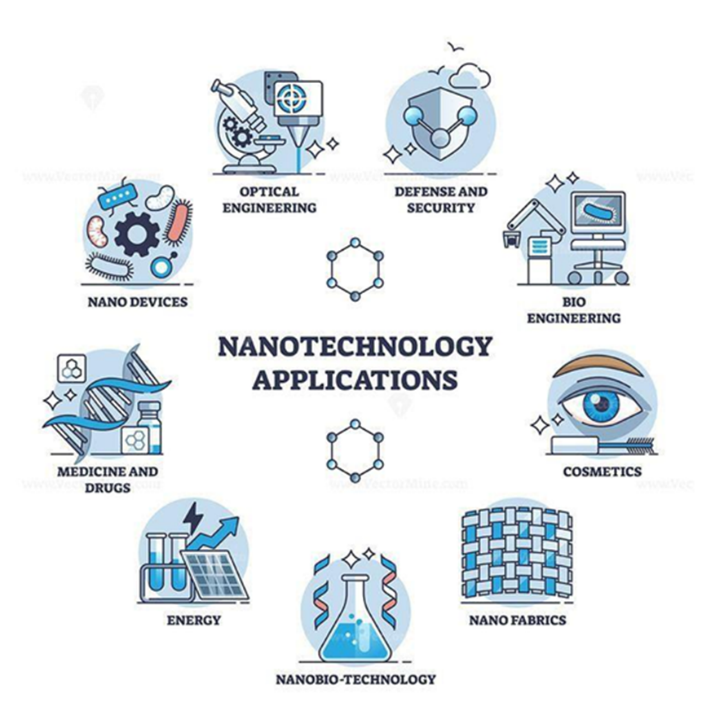
Advantages of Nanotechnology in Cosmetics
1. Longer-lasting fragrances Nanotechnology can encapsulate perfume molecules, allowing them to be released slowly over time. This makes fragrances last longer without the need for frequent reapplication.
2. More effective sunscreens Nano-sized titanium dioxide and zinc oxide create transparent sunscreens that block UVA and UVB rays without leaving a chalky white residue, making them more cosmetically appealing.
3. Enhanced anti-aging creams Nano-carriers can deliver active ingredients deep into the skin, improving the effectiveness of anti-wrinkle and firming treatments.
4. Better hair care solutions Nanotechnology is used to prevent premature greying, reduce hair loss, and strengthen hair follicles by delivering nutrients directly where they’re needed. 5. Preservation of active ingredients Nano-encapsulation protects sensitive compounds like vitamins and antioxidants from degradation caused by light, heat, and oxygen, ensuring they stay potent longer.
6. Improved UV protection with reduced chemicals When combined with organic sunscreens such as 2-hydroxy-4-methoxy benzophenone, nanoparticles enhance sun protection, allowing manufacturers to use lower concentrations of chemical UV absorbers. (3)
Disadvantages of Nanotechnology in Cosmetics
1. Increased chemical reactivity Smaller particles have a much larger surface area, making them more chemically active. This can cause unwanted side effects in the body.
2. Potential oxidative stress Nanoparticles can produce reactive oxygen species (ROS), leading to oxidative stress, inflammation, and damage to proteins, cell membranes, and DNA.
3. Toxic effects on human cells Studies show that some nanomaterials can be toxic to human tissues and cultured cells, sometimes causing cell death.
4. Photo-activation risks Titanium dioxide nanoparticles, when exposed to UV light, can generate free radicals that damage DNA, skin fibroblasts, and even certain cancer cell lines.
5. Respiratory hazards Inhalation of ultrafine particles (like quartz, coal dust, silicates, or asbestos) can cause lung inflammation, fibrosis, cytotoxicity, and in severe cases, cancer. (3)
FUTURE PROSPECTIVES
Nanocarrier-based cosmetics hold immense promise for the future of the beauty and skincare industry. With the integration of nanotechnology, cosmetic manufacturing has already taken a significant leap forward. However, the next big transformation will come from combining these advancements with omics sciences—such as genomics, proteomics, and metabolomics. These technologies will allow researchers to deeply understand how bioactive ingredients interact with the body at the cellular and tissue level, paving the way for highly targeted, personalized skincare solutions. By pairing this knowledge with machine learning and big data analysis, future cosmetic products could be designed to deliver precise preventive or corrective effects based on an individual’s unique skin profile. This shift will also be driven by social media, where beauty trends spread rapidly and directly influence consumer preferences. Increasingly, customers are seeking products that blend cutting-edge science with natural bioactive ingredients—offering anti-aging, antioxidant, and cell-reviving properties. In this vision of the future, cosmetics will not just enhance appearance but also actively improve skin health, preventing damage before it happens and repairing it more effectively when it does.(4)

CONCLUSION
The current state of nanoparticle technology is definitely in its Infancy. Some of the purported benefits of these products include Improved performance, convenience, lower cost, as well as other Desirable features, when compared to the conventional products that Do not contain nanoscale materials. Although there are numerous Likely consumer advantages from products containing nanoscale Materials, there is very little information available regarding Consumer exposure to the nanoscale materials in these products or Any associated risks from these exposures. The nanocosmeceuticals Offer the advantage of a better cover of a greater area, increased Bioavailability of the active at a much lesser dose and probably a Better pharmaceutical and therapeutic activity. The only limitation Is the requirement of a specialized technology. Later is not much of A problem considering the aesthetics of the end product and the Capacity of the 21st century society to spend money to look good. Moreover, cosmeceutical offer a more affordable and less invasive Alternative to plastic surgery. Advanced miniaturization is a key Thrust area and so we foresee that very soon the market of cosmetics Will be captured solely by the nanoproducts. (1)
REFERENCES



Dr. Sudha Rathod, Anjali Rai, Zainab Khan, NanoCosmetica: The Next Dimension of Beauty Science, Int. J. of Pharm. Sci., 2026, Vol 4, Issue 2, 1591-1596. https://doi.org/10.5281/zenodo.18600735
 10.5281/zenodo.18600735
