
LSHGCT'S Gahlot Institute of Pharmacy, Koparkhairane, Navi Mumbai, Maharashtra, India - 400709
Atorvastatin is potent statin in the management of hyperlipidaemia. It helps in prevention of cardiovascular diseases and extensively analysed using a wide range of advanced analytical techniques. Atorvastatin is a bad cholesterol lowering lipoprotein and recognised as pioneer to show efficacy in reducing triglycerides level in individuals with elevated triglyceride levels in the blood. This review presents a systematic and thorough examination of the current methodologies employed for the quantitative and qualitative determination of atorvastatin in pharmaceutical formulations and biological matrices. Various instrumental techniques are utilized to detect and quantify atorvastatin, including but not limited to HPLC, mass spectroscopy-assisted chromatography, spectroscopic approaches in ultraviolet and visible ranges, capillary electrophoresis, advanced thin layer and ultra performance chromatography as well as Raman and infrared spectroscopy. Each technique is evaluated based on its sensitivity, specificity, robustness, and suitability for pharmaceutical quality control, pharmacokinetic studies, and stability testing. The review highlights recent advances in instrumental analysis and provides a critical comparison of these techniques, guiding researchers and analysts in the selection of appropriate methods for atorvastatin assessment in diverse contexts. The consolidation of these approaches reflects the evolving landscape of pharmaceutical analysis for this vital drug.
Atorvastatin belongs to the class of medications called statins. It is primarily used as an antilipidemic medication for heart-risk conditions. It is employed to reduce cholesterol. The enzyme that determines the rate of cholesterol biosynthesis, hydroxymethylglutaryl-coenzyme A (HMG-CoA) reductase, is competitively inhibited by atorvastatin through the mevalonate pathway. HMG-CoA is converted to mevalonate by HMG-CoA reductase. The liver is where atorvastatin predominantly operates. Lower plasma cholesterol levels and increased hepatic absorption of cholesterol are the results of decreased hepatic cholesterol levels (1).
Studies indicate that increasing doses of atorvastatin can progressively reduce levels of triglycerides, total cholesterol and LDL cholesterol in people diagnosed with high cholesterol or high triglycerides. Compared to other commonly prescribed statins like lovastatin, pravastatin, and simvastatin, atorvastatin has consistently shown greater effectiveness in lowering not only cholesterol and triglycerides but also apolipoprotein B concentrations among patients with elevated cholesterol. Colestipol and atorvastatin together tended to lower triglyceride levels more than atorvastatin alone, while lowering LDL cholesterol levels more than atorvastatin alone in patients with primary hypercholesterolemia (2).
Long-term clinical trials have shown atorvastatin to be well tolerated. In placebo-controlled trials, 1122 patients using atorvastatin up to 80 mg/day saw the same rate of side events (18%) as those taking a placebo (18%; n = 270). In these investigations, no increase in adverse events was shown to be dose related. In general, the most reported side effects included headache, myalgia, constipation, flatulence, dyspepsia, and stomach pain. Atorvastatin side effects have been found to be minor and temporary (3).
Analysis is critical as it confirms the drug's stability and integrity over time. It ensures quality and effectiveness throughout its shelf life. Accurate detection of API helps to ensure the right dose is administered to patients. A Validated analytical method helps to meet stringent regulatory standards, reinforcing the safety and efficacy of the pharmaceutical formulation. Analytical methods are quality control tools, capable of performing this verification.
Analytical approaches commonly chosen to examine pharmaceuticals such as atorvastatin range from advanced separation techniques like high performance chromatography, thin layer chromatography, spectrophotometric analysis in ultraviolet, visible and infrared regions, to alternative methods such as capillary electrophoresis, various voltametric assays and potentiometric titrations, and In vitro release. These tools provide precise and reliable options for quantifying drug ingredients and assessing their purity. Among them, liquid chromatography, coupling with mass spectroscopy, and Ultraviolet spectroscopy are most techniques mentioned in the literature for analysis of atorvastatin and represent almost 70%. HPLC method mostly used to analyse pharmaceutical formulation and samples whereas HPLC-MS used for analysis of biological samples such as Plasma (4).
This paper describes different analytical methods to detect pharmaceutical samples as well as biological samples of atorvastatin viz., solid dosage form, bulk drug, its impurities, nano emulsion, nanocrystals and human plasma etc.
Atorvastatin:
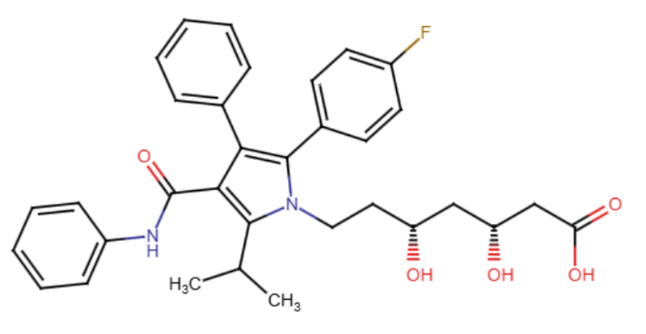
Figure 1: Structure of Atorvastatin
Atorvastatin is a lipid lowering drug. Represents chemical formula C33H35FN2O5 and Chemical name [(3R,5R)-7-[2-(4-fluorophenyl)-3-phenyl-4-(phenylcarbamoyl)-5-propan-2-ylpyrrol-1-yl]-3,5-dihydroxyheptanoic acid] with molecular weight about 558.65 g/mol. (5). Reported maximum wavelength (λmax) of atorvastatin calcium in methanol is approximately 246 nm. (6)
Physicochemical properties of Atorvastatin (5):
|
Physical description |
Solid |
|
Boiling point |
722 ºC |
|
Melting point |
176 °C |
|
Solubility |
Practically insoluble |
|
Log P |
6.36 |
Analytical Methods
Compendial Methods
Atorvastatin is included in IP and USP. The method is focused on assay by HPLC (Reverse phase), related substances, and key system suitability parameters:
|
Parameter |
USP Method |
IP Method |
|
Assay Principle |
Reverse phase HPLC; UV detection (244 nm); Gradient mobile phase- ACN, THF, ammonium acetate buffer (pH 5); Column L7, 5 µm |
Reverse phase HPLC; UV detection (unspecified 240–254 nm); acetonitrile: buffer gradient; C18 column |
|
Mobile Phase |
Two solutions: |
Often acetonitrile–phosphate buffer (ratios per monograph) |
|
Sample Preparation |
Dissolve in N, N-dimethylformamide; sonicate if needed |
Dissolve in methanol or diluent; sonicate |
|
Detection Wavelength |
244 nm |
246 nm (common), or within 240–254 nm depending on version |
|
Column Details |
0.46 cm × 250 mm, 5 µm L7 (C18 equivalent) |
Typically, C18, detailed dimensions per latest edition |
|
Pump rate /Temp |
1500 µL/min, 35 °C |
1000–1500 µL/min, ambient or specified |
|
System Suitability |
Resolution ≥ 1.5 (atorvastatin & impurity B), tailing ≤1.6, RSD ≤0.6% |
Resolution ≥ 2, tailing ≤2, RSD usually <2% |
|
Related Substances |
Separate gradient/HPLC conditions for impurities; identification by retention time (various compound RS) |
Similar approach: details vary as per latest IP edition |
|
Acceptance Criteria |
Assay: 98–102% (anhydrous, solvent-free basis); Impurities: individual ≤0.3–0.1%, total ≤1.0% |
Assay: 98–102%; Impurities: individual ≤0.3%, total ≤1.0% |
Reported Methods:
Research exploring atorvastatin assessment employs a diverse range of instrumental and chemical methods. These encompass liquid chromatography—with or without the integration of mass spectrometry—absorbance measurements in both the ultraviolet and visible light regions, electrophoretic separation approaches, and various types of advanced chromatography such as thin-layer and high-performance thin-layer formats. Additional methodologies include scattering techniques like Raman and X-ray analysis, separation based on mobile phase velocity like ultra-performance liquid chromatography, and specialized detection practices incorporating infrared light or fluorescence. Other processes utilize electrokinetic movement, surface ionization, dissolution experiments, and assessments reliant on electrical current responses. These methods are summarized in Table 1 within the referenced sources.
Table 1: Reported analytical HPLC methods used for quality control of Atorvastatin
|
Chromatographic Conditions |
Wavelength |
Sample |
Reference |
|
Methanol: Acetonitrile: Phosphate Buffer (45:45:10) |
246nm |
- |
(7) |
|
Column C18, 0.005 mm, mobile phase - ammonia acetate, ACN, and Tetrahydrofuran buffer (pH 4) (25:70:5 %v/v), Pump rate- 1000 µL/min |
The detection wavelength was set at 248 nanometres |
Tablet |
(8) |
|
Stationary phase- 15 cm × 4.6 cm, 0.005 mm, Eluent – A solution prepared using 30% methanol and 70% of the second solvent (by volume), with the solution maintained at pH 4. |
247 nm |
Plasma
|
(9) |
|
Column C18, 15 cm × 0.46 cm, 0.005 mm, Mobile phase - 40:60 acetonitrile: aqueous solution of hydrogen tetrabutylammonium sulfate regulated to pH value of 3, Pump rate- 1000 µL/min |
386 nm |
Plasma |
(10) |
|
C18 used as stationary phase with dimensions 15 cm × 0.46 cm, 0.005 mm, Mobile phase - ACN: 30 mM phosphate buffer (pH 2.9) (55:45 %v/v), Pump flow- 1000 µL/min |
240 nm |
Tablets |
(11) |
|
Stationary phase- Column C18, Mobile phase- Water: ACN (48:52 %v/v) pH 2 Adjusted with 80% O-phosphoric acid) |
245 nm
|
Tablets
|
(12)
|
|
C8, Mobile phase - phosphate buffer: ACN (pH 2.3), Pump rate- 1000 µL/min, Volume of injection: 5 μL, Temperature: 60°C |
210 nm
|
Tablets |
(13)
|
|
C18 column 25 cm × 0.46 cm, 0.005 mm, Mobile phase: 50% of 10 mM aqueous solution of ammonium salt of acetic acid, adjusted to pH value of 3: 50% of ACN(by volume) Pump rate- 1000 µL/min |
254 nm |
Pharmaceutical formulations |
(14)
|
|
Stationary phase- C18, 15 cm × 0.46 cm, 0.005 mm, Temperature: 20-25 °C, Eluent- 70% of ACN: 30% of Aqueous acetic acid at 0.001 fraction by volume. Pump flow- 1000 µL/min, Volume of injection -10 μL. |
246 nm |
Plasma |
(15)
|
|
Column - C18, 0.46 cm × 7.5 cm, 0.0035 mm, Eluent- 70% of ACN: 30% of Aqueous formic acid at 0.001 fraction by volume. Pump flow- 1000 µL/min, Volume of injection- 0.01 mL |
Absorbance recorded at 238 nanometres |
Tablet solid dosage form |
(16)
|
|
Octadecyl (ODS) column 25 cm × 0.46 cm, 0.005 mm, Mobile phase- sodium phosphate solution at a 0.05 M concentration with methanol in a 3:7 volume ratio and finely tuning the mixture’s pH to 4.1 using orthophosphoric acid as the acidifying agent., Thermal conditions: 25 ± 0.5°C, Pump rate- 1000 µL/minutes |
247 nm
|
Bulk, tablets and nanoemulsion
|
(17) |
|
Column - C18 25 cm × 0.46 cm, Eluent- 70% Methanol and 30% acetate aq. Solution by volume, with the pH adjusted to 4.1 through the addition of orthophosphoric acid, Pump flow- 1000 µL/min and Volume of injection- 20 μL |
245 nm
|
Tablets
|
(18)
|
|
Column - C18, 25 cm × 0.46 cm, 0.005 mm, Pump rate- 1000 µL/min, Mobile Phase- 53.55% of ACN : 05% of Methyl alcohol: 41.45% of 0.001 fraction of TEA adjusted to pH 3 using O- phosphoric acid as the acidifying agent |
220 nm |
Human plasma |
(19) |
|
Column- C18, 15 cm × 0.46 cm, 0.005 mm, Eluent- 68% methyl alcohol: 32% of water by volume; pH meticulously adjusted to 3 through addition of TFA, Pump rate- 1500 µL/min |
241 nm |
Human serum |
(20) |
|
Column - C18, 15 cm × 0.46 cm, 0.005 mm, Eluent- 43% of 10% methyl alcohol in 0.05 M sodium phosphate adjust solution pH to 3.5: 57% of methyl alcohol by volume, Pump rate- 1200 µL/min |
247 nm
|
Plasma
|
(21)
|
|
Column - C18, 0.46 cm × 15 cm, 0.005 mm, Mobile phase- 45% of ACN and 55% of a solution containing 25 mM of potassium dihydrogen orthophosphate, maintained at an acidity level of pH 5, Pump rate- 1500 µL/min |
246 nm |
Nanocrystals |
(22) |
|
Column - C18, 25 cm × 0.46 cm, 0.005 mm, Eluent- 60% of ACN: 40% of phosphate buffer solution by volume, maintained at pH 3, Pump flow- 1000 µL/min, Volume of injection- 25 μL |
235 nm |
Bulk and tablets |
(23) |
|
Column - C18, 0.005 mm, Mobile phase- 0.1 % acetic acid: ACN (45:55 v/v) pH 3.8 Pump rate – 800 µL/min |
246 nm |
Tablets |
(24) |
|
Column - ODS-AQ YMC 5 cm × 0.46 cm, 0.003 mm, Eluent- Ethanol: formic acid (pH 2.5) (50:50 v/v) Pump rate- 1000 µL/min, Column oven temperature- 40°C |
238 nm |
Tablets |
(25) |
|
Stationary phase- C18, 250 mm × 4.6 cm, 0.005 mm, Eluent– 35% of solution containing phosphate maintained at pH 4.5: 65% of CAN by volume, Pump flow- 1000 µL/min |
228 nm |
Pharmaceutical dosage form |
(26) |
|
Stationary phase- Octadecyl functionalized separation medium, 25 cm x 0.46 cm, 0.005 mm, Eluent- 60% of 20 mM sodium acetate maintained at pH 4: a solvent system consisting of acetone, triol and methanol each making upto 20% of the total volume. Pump rate- 700 µL/min, Column oven temperature- 40 ºC |
210 nm |
Plasma
|
(27) |
|
Column C18, 15 cm × 0.46 cm, 0.005 mm, Eluent- ACN: methyl alcohol: 20 mM solution of Dipotassium hydrogen phosphate maintained at pH 3 (34.27: 20: 45.73 %v/v) Pump rate- 2000 µL/min. |
239 nm |
Tablet |
(28) |
|
Column - Inertsil ODS-3, 0.46 cm x 25 cm, Eluent- water: acetonitrile: Tetrahydrofuran (11:8:6), Thermal conditions- 30°C, Pump flow- 1000 µL/min, Volume of injection- 0.01 mL |
244 nm |
Tablets |
(29) |
|
Column- C18, 150 mm × 4.6 mm, 0.0035 mm, Acetonitrile–water (85:15) as mobile phase adjusted with phosphoric acid at pH 4.5 Injection amount- 0.02 mL, Pump flow- 1000 µL/min, Thermal conditions- 18-degree Celsius |
261 nm |
Tablets |
(30)
|
|
Stationary phase- C18 15 cm × 0.46 cm, 0.005 mm, Eluent- 0.001 fraction containing phosphoric acid solution pH maintained at 3 and ACN, Column oven thermal condition- 30 degree Celsius |
227 nm |
Human plasma |
(31)
|
Table 2:Reported Advanced HPLC methods of Atorvastatin
|
Technique |
Parameter |
Detection |
Matrix |
Reference |
|
HPLC- Mass Spectroscopy |
Column C18, (0.004 mm), Eluent- 70% of ACN: 30% 0.001 fraction of acetic acid in aq. solution Pump rate- 200 μL/minute |
Positive mode- electrospray ionization |
Plasma |
(32) |
|
HPLC- Mass Spectroscopy |
Column 10 cm × 0.3 cm, 0.0035 mm, Column oven temperature- 30°C, Eluent- 30% of water: 70% of ACN by volume with 0.03% of formic acid Pump rate- 400 μL/min |
Quantitation was accomplished by observing the transition between parent ion 559.2 and its 440.3 in the mass spectrometer. |
Human derived blood plasma |
(33) |
|
HPTLC |
Adsorbent - Precoated silica gel 60 F254 Eluent- chloroform: benzene: methanol: acetic acid (6:3:1:0.1 %v/v) |
250 nm |
Tablets |
(34) |
|
HPTLC |
Adsorbent- Plates featuring an aluminium substrate and a pre- applied coating of silica gel 60 F254. Eluent- 8% of methylbenzene: 2% of methyl alcohol by volume |
Detection Wavelength was set at 240 nanometres |
Solid dosage form Tablet and Bulk drug |
(35) |
|
UPLC |
Column C18, 0.21 cm × 10 cm, 0.0017 mm, Eluent- ACN and an aqueous solution containing 0.01 M ammonium salt of acetic acid maintained at pH 4.7, Pump rate- 500 μL/min |
247 nm |
Tablets |
(36) |
|
HPLC-MS |
Column C18, 15 cm × 0.46 cm, 0.0035 mm, Pump rate - 2000 μL/min and Injection amount -10 μL. Eluent A- 5% ACN, Eluent B- 75% ACN an aqueous solution containing 20 mM ammonium salt of acetic acid maintained at pH 4 through addition of acetic acid. Step gradient: 45% B to 66% B, then to 100% B. |
ESI in positive mode |
Bulk |
(37) |
|
HPLC-MS |
Stationary phase- C18, 25 cm × 0.46 cm, 0.0035 mm, Pump rate- 1500 μL/min, Mobile phase I- an aqueous solution of phosphate adjusted to pH 5.4 Mobile phase II- 90% of ACN– 10% of THF by volume, Injection amount- 20 μL |
Scan range m/z 70 to 1500 |
Bulk drug impurities |
(38) |
|
HPLC-MS |
Column -C18, 10 cm × 0.21 cm, 0.0035 mm, Column oven temperature- 40°C, Eluent- water: 0.001 fraction of formic acid in acetonitrile by volume |
ESI using MRM |
Plasma |
(39) |
|
UPLC-MS |
Column C18, 5 cm × 0.21 cm, 0.0017 mm, Temperature - 40°C, Solvent phase- 0.001 fractions of formic acid in water by volume and ACN, Pump rate- 700 μL/min Injection amount- 10 μL |
Quantitation was accomplished by observing the transition between parent ion 559.57 and its 440.4 in the mass spectrometer |
Human blood plasma |
(40) |
|
HPLC-MS |
Column C18, Mobile phase- 60% of ACN: 40% of 10 mM ammonium acetate (pH 3) by volume Pump rate- 1100 mL/min |
Electrospray Ionization using Multiple Reaction Monitoring and m/z 559.5 to 440.4 |
Human derived blood plasma |
(41) |
|
HPLC-MS |
Stationary phase- Phenomenex Synergi 4 u polar RP 80A 15 cm × 0.46 cm, 0.004 mm, Eluent- 14% of Water: 86% of methyl alcohol pH 3.2 regulated by TCA, Pump rate- 500 µL/min, Temperature- 30-degree Celsius and Sample amount- 0.03 mL |
Scan rang m/z 559.09 to 440.21 |
Human blood plasma |
(42) |
|
HPLC-coupled mass spectroscopy |
Stationary phase- Silica-based reversed-phase column (CAPCELLPAK CR 1+4) 15 cm × 0.2 cm, 0.005 mm, Eluent- 50% of ACN and 50% of 0.02 M ammonium acetate buffer containing 0.003 fraction of formic acid by volume, Pump rate- 450 μL/min Column oven temperature- 30°C |
Quantitation was accomplished by observing the transition between parent ion 559.42 and its 440.25 in the mass spectrometer |
Human derived blood plasma |
(43) |
|
Liquid chromatography -MS |
Stationary phase C18, Isocratic mode Mobile phase – 35% of 0.005 fraction of formic acid in water: 25% of ACN: 40% of methyl alcohol by volume Pump rate- 600 μL/min |
Quantitation was accomplished by observing the transition between parent ion 557.4 and its 278.1 in the mass spectrometer |
Human derived blood plasma |
(44) |
|
Liquid chromatography-MS |
Stationary phase C18, 5 cm × 0.21 cm, 0.0035 mm, coupled with C18 guard cartridge 0.21 cm × 1.25 cm, 0.005 mm, Column temperature- 40°C, Pump rate – 0.4 μL/min Eluent- A binary mixture of water and methyl alcohol, supplemented with ammonium formate at a final concentration of 2mM /L and further acidified by the addition of 0.2% formic acid |
Analysis employed electrospray- assisted ion generationunder positive charge conditions, selecting for the specific fragment transition between 559.2 and 440.2 mass to charge ratios. |
Human derived blood plasma |
(45)
|
|
HPLC-MS |
Column C18, 10 cm × 0.21 cm, 0.0017 mm, Mobile phase- 0.2% formic acid in ACN, Pump rate- 300 μL/min |
Multiple reaction monitoring in positive mode using m/z 559.05 to 440 |
Human blood plasma |
(46)
|
Table 3: Other analytical methods to detect Atorvastatin
|
Methods |
Chromatographic Conditions |
Wavelength |
Sample |
Ref. |
|
CE |
0.025 M Sodium acetate buffer (pH 6), voltage 25 kV, and capillary of 50 μm with a len. of 330 mm |
190–370 nm |
Tablet dosage form |
(47)
|
|
Raman com transformada de Fourier (FT-Raman) |
Partial least squares, principal component based on regression analysis and advanced neural network systems featuring counter propagation architectures. |
Relative standard errors of prediction were calculated |
Tablet dosage form |
(48) |
|
XRD |
Diffraction patterns were collected using a Philips instrument (model 1830/40), with specimens exposed to copper K-alpha X-rays generated at 40 kilovolts and 30 milliamperes. A nitrogen filter was applied, and data acquisition proceeded at a scanning speed of 0.005 degrees per second in the 2-theta range. |
40 kV |
Tablet dosage form |
(49) |
|
Infra-Red spectroscopy |
Equipment- Equinox 55, Sample dilution- KBr |
4000 to 400 cm1 |
Tablet dosage form |
(49) |
|
Raman spectroscopy |
Raman spectroscopy was performed utilizing an FRA-106/S FT-Raman system, directing an incident laser beam with a power output of 370 milliwatts onto the surface of the specimen |
1064 nm
|
Tablet dosage form |
(49) |
|
Micelle-modified electrokinetic chromatography (MECC) |
Prolonged light capillary, 30 kV; buffer: A solution of 0.01 M sodium tetraborate regulated to pH 9.5; 0.05 M SDS; 20% methanol by volume |
214 nm |
Tablet dosage form |
(50) |
|
Capillary electrophoresis (CE) |
Fused silica capillary (0.58 m × 0.075 mm internal diameter), 70% of 0.0025 M phosphate buffer solution maintained at pH 6.7: 30% of methyl alcohol, 25 kV, 24°C |
210 nm
|
Pharmaceutical formulations |
(51)
|
|
Fluorimetry |
Diluent- Either methyl alcohol alone, or a solution with five percent acetic acid dissolved in methyl alcohol adjusted to pH 2.5, or a blend of ethyl alcohol and water mixed in equal volumes and supplemented with 1ml of acetate buffer at pH 3.4 |
389 nm |
Bulk and tablets |
(52) |
|
UV-Visible spectroscopy |
Diluent: methanol. Reactive reagent- Dichlorodicyanoquinone (DDQ) Reaction time- 3.5 min Temperature- 31 ± 1°C |
460 nm |
Tablets |
(53)
(54) |
|
Voltammetry |
Cyclic and differential pulse voltammetry Enhancing agent - Cetyltrimethyl ammonium bromide |
- |
Tablets |
(55) |
|
Ultraviolet spectroscopy |
Diluent- methanol |
1st derivative- 233 nm, 2nd derivative-238.6 nm |
Tablets |
(56) |
|
Thin Layer Chromatography |
Stationary phase- Synthetic Amorphous Silica plates Mobile phase- ethoxyethane: ethyl ethanoate (7:3 v/v) |
254 nm |
Tablet dosage form |
(56) |
|
Ultraviolet spectroscopy |
Diluent- Methanol |
Between 231 - 276 nm |
Tablets |
(57) |
|
Ultraviolet spectroscopy |
Diluent -Methanol |
237 nm |
Bulk and tablets |
(58) |
|
Ultraviolet spectroscopy |
Diluent- Methanol |
200 to 350 nm
|
Tablets |
(59) |
|
MALDI mass spectroscopy imaging |
Instrument- MALDI-LTQ-XL, Nitrogen laser power- 10 μJ, Sample concentration- 100 μM Sample area- 0.6 × 0.6 mm |
Scan mass-to-charge (m/z) ratio 100 to 600, Atorvastatin analysis- negative mode, Lactone form of atorvastatin- Positive mode |
Tablets |
(60) |
|
Dissolution |
Media- Deionized water 900ml, Speed- 75 rotation per minute. Thermal conditions 37°C |
- |
Tablets |
(61) |
|
X-ray diffraction |
scanning angle 5° to 35°, a scanning speed - 4° 1/min, at 30 kV and 15 mA Measurement with a CuKa radiation source |
- |
Tablets |
(62) |
|
Spectrophotometric Methods |
Methanol
|
240 nm |
Drug |
(63) |
|
Spectrophotometric Methods |
Methanol
|
290nm |
Drug |
(64) |
Table 4: Reported stability method of Atorvastatin drug
|
Methods |
Chromatographic Conditions |
Wavelength |
Sample |
Reference |
|
Reverse phase HPLC |
Stationary phase- C18, 15 cm X 0.46 cm and 3.5 μm Eluent I- water: trifluoroacetic acid 100:0.10 (%v/v) Eluent II -100% of ACN: 0.10% of TFA by volume Pump flow: 1000 µL/min |
245 nm |
Bulk drug |
(65) |
CONCLUSION:
This systematic review examines the current analytical techniques for detecting Atorvastatin and its combinations in pharmaceutical and biological samples. HPLC methods were identified as the most utilized for Atorvastatin. The enhanced sensitivity, specificity, and improved separation efficiency make HPLC a frequent choice for both qualitative and quantitative analysis of Atorvastatin. Other identification techniques viz., Reverse Phase- Liquid Chromatography, HPTLC, Liquid Chromatography- Tandem Mass Spectroscopy, and UV are also employed for measuring Atorvastatin in pharmaceutical formulations and plasma. The information provided is beneficial for researchers engaged in the formulation development and quality control of Atorvastatin for future studies.
REFERENCES


Pradnya Kumbhar, Dr. Sandeep Waghulde, Comprehensive Review on Analytical Methods of Atorvastatin, Int. J. of Pharm. Sci., 2026, Vol 4, Issue 1, 563-579. https://doi.org/10.5281/zenodo.18172678
 10.5281/zenodo.18172678
