We use cookies to make sure that our website works properly, as well as some ‘optional’ cookies to personalise content and advertising, provide social media features and analyse how people use our site. Further information can be found in our Cookies policy
The disease known as congestive heart failure (CHF) occurs when the heart cannot pump enough blood to the body. The increasing need for innovative treatments is a result of the ongoing rise in the overall number of congestive heart failure cases and the resulting financial burden. Many congestive heart failure medications have showed some promise in preclinical and early-phase clinical studies, but the majority of them failed to demonstrate any meaningful effect in pivotal trials. The US Food and Drug Administration recently approved two new, promising medications to treat congestive heart failure: ivabradine and sacubitril/valsartan. and tissues, as a result of one-part failure, causing the heart to pool blood. Non-pharmacological intervention is crucial to the therapy of congestive heart failure in addition to pharmacological treatment.
Congestive heart failure (CHF) is accompanied by the heart's inability to sufficiently empty itself, which results in a high venous filling pressure and a reduction in the heart muscle's effective work. Congestive heart failure can result from several reasons, if they are severe. [1]
The therapeutic paradigm for congestive heart failure has changed during the last ten years, moving from symptom control to a combination prevention and symptom-management approach. Specialists in heart failure have been trained in cardiology to address this now vast topic. The development of new treatments for heart failure has hastened due to our ever-increasing understanding of its etiology.[58]
Nevertheless, no single metric can fully capture the efficacy of treatment. One Written by a variety of authoritative authorities, comprehensive guidelines that aim to simplify therapy might be difficult to read. Recent clinical studies have demonstrated that development can be slowed down by early identification. 2, 3 It is just as crucial to treat asymptomatic left ventricular dysfunction as it is to treat symptomatic illness. [2] Geriatric increase is a fact of life; by 2035, almost one in four people will be 65 or older. [1]
About half of mortality among people over 65 are caused by congestive heart failure (CHF), a prevalent condition among the elderly. The Framingham study2,3 which did not include moderate heart failure, found that the prevalence of CHF increases from 1% in the 50–59 age group to 10% in the 80–89 age group. The majority of cardiovascular illnesses end in heart failure; treating these conditions improves survival but also raises the chance of heart failure. According to a study4, CHF accounted for 5% of all hospital admissions, with patients over 65 making up the bulk (80%). Adults over 65 years old account for over 90% of CHF deaths. [17]
Age-related alterations in the anatomy and function of the heart in healthy older adults Healthy individuals experience a range of structural and functional changes in their hearts as they age, and these age-related cardiac changes seem to be related to the sharp rise in heart failure that occurs as people age. As people age, their compliance decreases and their huge elastic arteries dilate. [78]Aorta enlargement is linked to a progressive thickening of the aorta media and intima. [17] The morbidity and mortality rate of congestive heart failure (CHF), a complex clinical illness that affects patients' quality of life (QOL) worldwide, is steadily rising. Heart failure has been ranked as the fourth most common cause of death and disability in Bangladesh. [19]
Epinephrine and norepinephrine are released when the sympathetic nervous system is stimulated, which raises heart rate (HR), contractility, and peripheral vasoconstriction (increased afterload).[1]
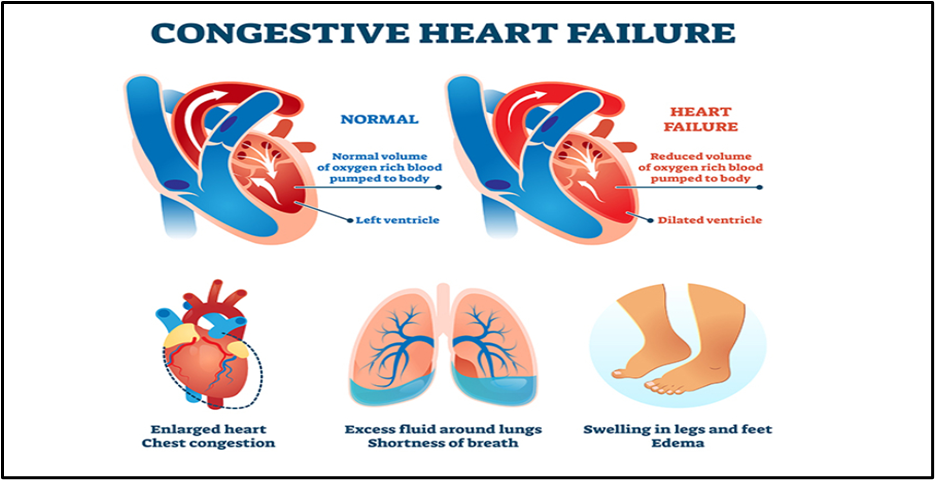
CHF happens when the heart's ability to pump blood is impaired, which causes tissues to be underperfused. Numerous underlying disorders can cause it, such as congenital heart disease, ischemic heart disease, hypertension, valvular heart disease, and cardiomyopathies. Diabetes and kidney-related diseases frequently coexist with CHF. [14]
Fig No.1: Congestive heart failure [55]
Brief Of Congestive Heart Failure :
Heart output and stroke volume are reduced when a pump fails. Consequently, compensatory mechanisms are activated to raise CO. Epinephrine and norepinephrine are released when the sympathetic nervous system is stimulated, which raises heart rate (HR), contractility, and peripheral vasoconstriction (increased afterload). Myocardial hypertrophy occurs when the heart's walls grow to produce additional muscular mass for stronger contractions. [1]
FigNo.2: Mechanism of congestive heart failure[60]
Congestive heart failure affects 4.8 million people in the US, with between 400000 and 700000 new cases reported year. 17–19 Between 1.5% and 2% of people suffer from heart failure. 17–19 The prevalence among Americans over 65 is currently between 6% to 10%, and it is predicted to increase as the number of elderly people increases and the median life expectancy rises. [65]17–19 The most common reason for hospitalization is heart failure, and up to 20 million people have an asymptomatic cardiac function impairment, with symptoms anticipated to appear within the next one to five years. 20 Congestive heart failure is more common in men across all age groups, but it is almost equally prevalent in women. 17, 21 The majority of therapy recommendations for women are essentially hypothetical because, regrettably, women make up only 20% of patients in the majority of scientific trials. [2]
Etiology Of Congestive Heart Failure:
Table No.1.Etology of Congestive Heart Failure[15]
Both systolic and diastolic cardiac failure are possible. It is common to have CHF with normal diastolic and systolic function; 40% of people over 70 have this condition, compared to 6% of patients under 60. 9. Reduced early diastolic filling rates, elevated end diastolic volume and pressure, and heightened reliance on atrial contribution are the hallmarks of diastolic dysfunction, which is more prevalent in hypertension. Ischemic heart disease is more likely to cause systolic dysfunction. A modestly enlarged aging heart is more vulnerable to ischemic damage. The main cause of CHF in the elderly is impedance to LV ejection, and the most crucial treatment is vasodilation. [17]
Clinical Feature:
The characteristic heart failure symptoms that young people display may also be seen in older adults. However, due to limited labor and other diseases, they could show up late and often in an odd manner.
Atypical features of heart failure in elderly:
Lethargy
Falls
Weakness
mobility
Anorexia
Confusion
Dizziness
Heart failure symptoms should be carefully analyzed because most of them are vague and may be caused by other ailments. The Framingham criteria for CHF have been frequently cited, however neither their validity in an exclusively older population nor their suitability for clinical practice and research studies have been fully investigated. [10]
Investigation:
It could be challenging to find a chest X-ray of high quality. The patient can sit up straight in a wheelchair during the procedure. An enlarged heart, expanded hila with blurred borders, and the prominence of veins draining the upper lobes are the main findings. The 32 amino acid polypeptides known as B type natriuretic peptide (BNP) has a ring shape made up of 17 amino acids. Although an ECG can be normal, it is useful in determining the etiological diagnosis. Echocardiography is necessary to distinguish between predominant systolic and diastolic dysfunction in addition to diagnosing reversible causes, such as pericardial and valvular disorders. Invasive tests and exercise should only be performed on patients who are scheduled for heart surgery. [7]
Treatment:
The treatment of heart failure in the elderly follows the same principles as in the young, but careful consideration must be given to age-related pharmacokinetic changes and coexisting morbidities. Simultaneous implementation of both general and specialized measures is required. [17]
Clinical Evaluation:
Diagnostic Test:
Every patient should have a basic laboratory workup that includes a complete blood count, serum electrolytes, blood urea nitrogen, serum creatinine, glucose, fasting lipid profile, liver function tests, thyroid stimulating hormone, and urinalysis. Every patient with HF should have a 12-lead EKG performed. In addition to these fundamental tests, etiology-specific tests may be done in response to clinical suspicion; for example, more research may be conducted if hemochromatosis is suspected. Every patient who presents with heart failure should not undergo more than one test.[38]
Chest X-ray:
A chest X-ray should be performed on patients with suspected, acute, or recently diagnosed heart failure in order to evaluate the size of the heart and any pulmonary edema, as well as to identify any additional cardiopulmonary reasons that might be causing the patient's symptoms. [50]
2D-echo:
To evaluate all of the heart's anatomical and functioning components, a 2D echocardiography with Doppler tests should be acquired during the initial evaluation. Patients with HF who have experienced a significant change in their clinical status, received treatment that may have affected their heart function, or are considering device therapy can benefit from serial echocardiographic examinations for EF and the degree of myocardial remodeling. Otherwise, it is best to avoid performing routine repeat evaluations of left ventricular function. [40]
When ischemia may be a contributing factor to heart failure, it makes sense to do coronary angiography or left heart catheterization. [45]
Endo Myocardial Biopsy:
Routine endo myocardial biopsies are not recommended unless a particular diagnosis that may impact treatment is found. [5]
Electrocardiography:
The process of creating an ECG, which records the electrical activity of the heart during repeated cardiac cycles, is known as electrocardiography. It is an electrogram of the heart, which uses electrodes applied to the skin to create a graph of voltage against time of the electrical activity of the heart. The tiny electrical alterations brought on by the depolarization and repolarization of the heart muscle during each cardiac cycle are detected by these electrodes. Many cardiac disorders result in alterations to the typical ECG pattern. [18]
Congestive Heart Failure Durgs Use in Treatment:
Cardiac glycosides-eg Digitoxins
Angiotensin coverting enzyme inhibitor (ACEinhibitors) and AT1Receptor Antagonists –Eg: Captopril
In patients with heart failure and large hearts (low ejection fraction), ACE inhibitors have been demonstrated to lower mortality, hospitalization, symptoms, and boost exercise capacity. Enalapril decreased the one-year mortality by about one-third in patients with severe (NYHA grade IV) heart failure, according to the CONSENSUS study15 (mean age 70 years). By lowering preload and afterload, ACE inhibitors reduce pulmonary venous congestion and raise cardiac output and myocardial oxygen consumption. [30]
ACE inhibitors should be tried in all patients with left ventricular systolic dysfunction characterized by LVEF less than 40%, unless there are contraindications that call for lowering the dosage or even stopping it if the patient experiences orthostatic hypotension, a severe cough, dyspnea, or wheezing, or if the serum potassium rises to 6 meq/L or the creatinine rises by 0.75 mg to 1 mg/dl. Elderly people may not reach the recommended maintenance dose, but benefits can still be shown at lesser dosages. 14–16d. [35]
Digoxin:
Digoxin, the only approved oral active inotropic drug, is helpful in treating CHF with systolic dysfunction. Digoxin has been demonstrated to improve the ejection fraction in a group of 20 elderly patients with CHF (over 74 years of age). 23 Digoxin is also helpful for atrial fibrillation in CHF patients. Elderly people have different digoxin pharmacokinetics due to reduced renal clearance and volume of distribution. Digoxin loading doses should be avoided in non-emergency. Conditions; 0.125 mg should be administered daily for creatinine clearance between 10 and 30 ml/min and every two or three days for creatinine clearance less than 10 ml/min. [25]
Digoxin's therapeutic toxic window is limited, and while its arrhythmogenic potential does not change in the elderly, its inotropic effect does. Elderly people with digitalis poisoning may exhibit unusual symptoms such as disorientation, exhaustion, and agitation. [9]
Beta Blocker:
Since beta-blockers prevent the potentially negative effects of circulating catecholamines, there is compelling evidence that they have significant positive effects on individuals with chronic CHF. Research using beta-blockers with vasodilator properties, such as bisoprolol24, metoprolol25, and carvediol26, has demonstrated advantages during long-term treatment, including reduced hospitalization rates and increased survival. Stable outpatients with mild to moderate chronic CHF (NYHA classification IIII) on standard dosages of ACE inhibitors and diuretics have been studied for carvingiol. Twice daily, 3.125 mg of carvingilol was administered. [55] The dosage was raised every two weeks until it reached a tolerable level (maximum of 50 mg). Since 10% of patients may worsen after beginning and up titration, patients require careful monitoring. Increasing the dosage of diuretics can help manage this. Although few trials have involved senior people, there have been no independent trials on their usage in the elderly.[20]
Hydralazine And Isosorbide:
In patients with heart failure, the combination treatment of isosorbide with hydralazine hydrochloride reduces mortality. 104 On the other hand, enalapril exhibited a greater mortality benefit when compared directly. 60 If an ACE inhibitor is not tolerated, the majority of doctors initially prescribe an angiotensin receptor blocker. Thus, this treatment plan should only be taken into consideration if the patient has renal insufficiency and/or ACE inhibitors are not tolerated. [2]
Anticoagulation:
Anticoagulation is debatable in patients with reduced left ventricular function who do not have atrial fibrillation. No double-blind, placebo-controlled study with patients with heart failure has been conducted. Due to atrial fibrillation, poor contractility, asynergy caused by localized wall motion anomalies, and increased stasis in dilated chambers, patients with dilated cardiomyopathy are at risk for thromboembolism. 117 A retrospective study conducted in 1981 by Fuster et al.118 found that patients with nonischemic dilated cardiomyopathy had an 18% frequency of thromboembolism, with an incidence of 3.5 per 100 patient-years. Recent trials on heart failure have confirmed this low incidence fact. 59 In a recent SOLVD cohort research, warfarin sodium decreased the risk of death or hospitalization for heart failure as well as all-cause mortality.[10]119 Some of this uncertainty is anticipated to be resolved by the Warfarin Versus Aspirin in Reduced Cardiac Ejection Fraction (WARCEF) Trial121, the Warfarin and Antiplatelet Therapy in Chronic Heart Failure (WATCH) Trial,120, and the Warfarin Aspirin Study in Heart Failure (WASH Trial). In NYHA classes II and IV patients, the WASH Trial is a randomized, open, parallel research that compares warfarin, aspirin, and no antithrombotic treatment. 120 For NYHA classes II to IV patients with an ejection fraction of no more than 0.30, the WATCH Trial will compare aspirin, clopidogrel, and warfarin; for NYHA classes I to III patients with an ejection fraction of no more than 0.30, the WARCEF Trial will compare warfarin and aspirin. There will be enough power in the combined data from the WATCH and WARCEF trials to ascertain if warfarin lowers the risk of stroke in individuals whose ejection fraction is less than 0.30. [2]
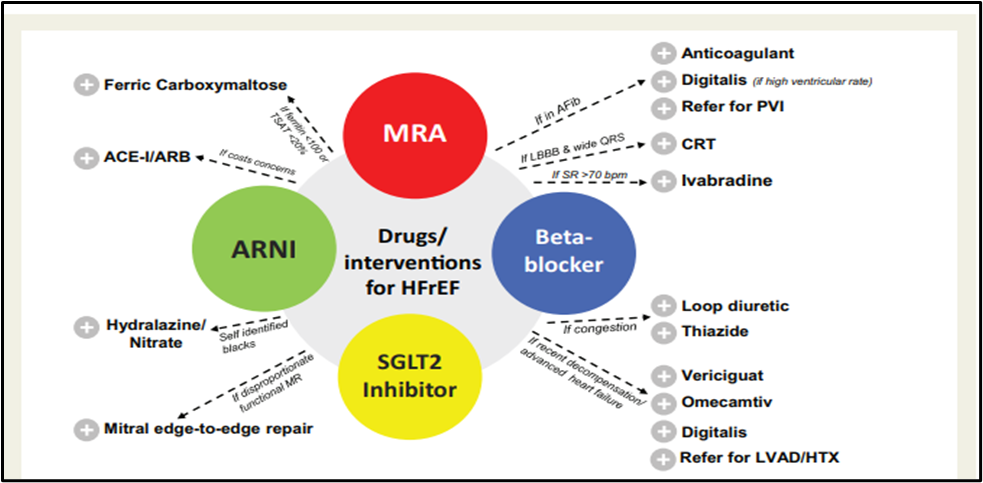
Fig No.3 : Drugs or Interventions for Heart Failure [70]
Methods of Congestive Heart Failure:
Some of the natural compounds which can aid in the treatment of congestive heart failure:
L-arginine amino acids:
By promoting endothelial cell releasing factor (ECRF), L-arginine increases cardiac blood flow and inhibits the development of plaque in the arteries. One of the precursors of nitric oxide (NO), a substance that has vasodilator properties, is L-arginine. Heart failure (HF) patients' ability to exercise is limited when the "L-arginine-nitric oxide" pathway malfunctions, resulting in decreased blood flow both during rest and activity. L-arginine significantly reduced the average heart rate during exercise and the recovery phase in patients with chronic stable heart failure in a 6-week study.[34] L-arginine seems to help address the aberrant blood vessel activity associated with chronic heart failure in another investigation. In CHF, L-arginine supplementation extends exercise duration. [11]
Hawthorn Extract:
In the United States and other European nations like Germany, where it is a prescription drug, hawthorn extract is a well-liked herbal remedy. Extract from Crataegus monogyna or Crataegus laevigata is typically used in preparations. Exercise tolerance, LVEF, and heart failure-related symptoms have all improved, according to clinical research. German Commission E has approved the use of hawthorn leaf and flower extracts for patients with class II symptoms of the New York Heart Association (NYHA). [1]
Nonpharmacological Treatment of Congestive Heart Failure:
Heart muscle damage can alter the electrical system of the heart, resulting in a decrease in heartbeats. In order to treat heart failure and rectify an irregular pulse, various kinds of devices are available. [13]
Pacemakers:
Lead cables and a pulse generator, which contains a battery and a small microprocessor, make up a conventional pacemaker. When the computer determines that the heart rhythm is abnormal, it sends electrical impulses to the heart muscle to adjust its rate. The lead wires serve as the heart's electrical activity sensor. Pacemakers are typically used to treat very sluggish heart rhythms. However, they are also useful for treating rapid heartbeats or raising the heart rate in reaction to variations in the patient's degree of activity. [8]
Internal Cardioverter Defibrillator (ICD):
Ventricular fibrillation is one of the potentially fatal arrhythmias that patients with heart failure are susceptible to. This is especially true for patients with a history of rapid ventricular arrhythmia, an ejection fraction below 35 percent, or those who have survived abrupt cardiac arrest. When the ICD detects electrical activity, it can identify a hazardous heart rhythm and shock the heart. Patients with heart failure who have implanted cardiac defibrillators had a lower chance of dying from sudden cardiac arrest. Think of your ICD as the "emergency room" in your heart. In order to reestablish a normal heart rhythm in the event of a fatal arrhythmia, the ICD will shock the patient, often multiple times. [68]
Advanced Treatment Strategies:
Cardiac transplantation: Patients with stage D HF who have a poor prognosis despite receiving the best care possible, including surgical and device management, should be sent to a cardiac transplantation clinic for assessment and possible heart transplantation. 49 Heart transplantation is most beneficial for those with advanced heart failure who have a bad prognosis. [5]
CONCLUSION:
A serious health concern is heart failure, which has a high rate of morbidity and mortality. Therefore, there is a significant need for innovative strategies to stop heart failure from getting worse. Heart failure was thought to be a serious and incurable condition up to this point. However, advancement in the treatment era such as gene therapy and stem cell therapy approach have offered the promise of a valuable therapy. [80] It will take time to determine whether a single target strategy is adequate to repair heart function and stop deterioration or if stem cell therapy and several gene targets are required to eventually replace the damaged myocardium. Considerable progress has been made in that direction over the last few years. It is possible to make significant progress in our understanding of the pathophysiology of HF and apply it help improve patient care even more. The entire therapeutic potential of cutting-edge therapeutics for the treatment of CHF will be made possible by extensive, well designed, randomized clinical studies with clear objectives. [1]
REFERENCES
Altamash J.Momin, Amogh R.Lotankar , Advance in pharmacy 6(2): 57-64 2018. Department of Medical Affairs, Indoco Remedies. Congestive heart failure:urrent treatment and therapeuties under realm of research.
Mardi Gomberg-Maitland MD; David A.Baran,MD: Valentin Fuster, MD, PhD: Guidelines for the primary care physician and the heart failure specialist ; Treatment Of Congestive Heart Failure.
Wiwik Mayanti (Resident Of Oral Medicine Residency Program); Anandina Irmagita Soegyanto(Department of oral medicine): International Dental Conference of Sumetera Utara 2017 (IDCSU 2017)
Alok Kumar Singh, Rameshwar Nath Chaurasia, I.S. Gambhir; Journal of the Indian Academy Of Geriatics, 2005;1:31-39. Congestive Heart Failure (CHF) in elderly.
Lipy Lucy Costa ,Md. Shariful Islam, Mohammad Nurul Anowar, Md. Abdul Lati.; Open Journal of Nurshg 2020, 10, 831-857 ; Quality of life of chronic Heart failure patients.
Yunn-Hee Jeon, Stefan G.Kraus, Tanisha Jpwsey, Niccholas J.Glasgow ; Jeon et of BMC health Services Research 201 D, 10:77 ; The experience of living with chronic heart failure.
Murphy, S. P., Ibrahim, N. E., & Januzzi, J. L., Jr (2020). Heart Failure With Reduced Ejection Fraction: A Review. JAMA, 324(5), 488–504.
DeFilippis, E. M., Bhagra, C., Casale, J., Ging, P., Macera, F., Punnoose, L., Rasmusson, K., Sharma, G., Sliwa, K., Thorne, S., Walsh, M. N., & Kittleson, M. M. (2023). Cardio-Obstetrics and Heart Failure: JACC: Heart Failure State-of-the-Art Review. JACC. Heart failure, 11(9), 1165–1180.
Yehya, A., Lopez, J., Sauer, A. J., Davis, J. D., Ibrahim, N. E., Tung, R., Bozkurt, B., Fonarow, G. C., & Al-Khatib, S. M. (2025). Revisiting ICD Therapy for Primary Prevention in Patients With Heart Failure and Reduced Ejection Fraction. JACC. Heart failure, 13(1), 1–13.
Balthazar, T., Vandenbriele, C., Verbrugge, F. H., Den Uil, C., Engström, A., Janssens, S., Rex, S., Meyns, B., Van Mieghem, N., Price, S., & Adriaenssens, T. (2021). Managing Patients With Short-Term Mechanical Circulatory Support: JACC Review Topic of the Week. Journal of the American College of Cardiology, 77(9), 1243–1256.
Gustafsson, F., Damman, K., Nalbantgil, S., Van Laake, L. W., Tops, L. F., Thum, T., Adamopoulos, S., Bonios, M., Coats, A. J., Crespo-Leiro, M. G., Mehra, M. R., Filippatos, G., Hill, L., Metra, M., Jankowska, E., de Jonge, N., Kaye, D., Masetti, M., Parissis, J., Milicic, D., … Ben Gal, T. (2023). Inotropic therapy in patients with advanced heart failure. A clinical consensus statement from the Heart Failure Association of the European Society of Cardiology. European journal of heart failure, 25(4), 457–468.
Ilonze, O. J., Ebong, I. A., Guglin, M., Nair, A., Rich, J., McLaughlin, V., Tedford, R. J., & Mazimba, S. (2024). Considerations in the Diagnosis and Management of Pulmonary Hypertension Associated With Left Heart Disease. JACC. Heart failure, 12(8), 1328–1342.
Ponikowski, P., Friede, T., von Bardeleben, R. S., Butler, J., Shahzeb Khan, M., Diek, M., Heinrich, J., Geyer, M., Placzek, M., Ferrari, R., Abraham, W. T., Alfieri, O., Auricchio, A., Bayes-Genis, A., Cleland, J. G. F., Filippatos, G., Gustafsson, F., Haverkamp, W., Kelm, M., Kuck, K. H., … Anker, S. D. (2024). Hospitalization of Symptomatic Patients With Heart Failure and Moderate to Severe Functional Mitral Regurgitation Treated With MitraClip: Insights From RESHAPE-HF2. Journal of the American College of Cardiology, 84(24), 2347–2363
Thiele, H., Freund, A., Zeymer, U., & Desch, S. (2023). Treatment of Heart Failure Related Cardiogenic Shock: When Treatment Is Dominated by Missing Clinical Evidence. JACC. Heart failure, 11(2), 188–190. 15. Badran, S., & Lee, S. (2022). Even in Heart Failure, Integrating Palliative Care and Aggressive Medical Therapy Is a Thing. Journal of the American College of Cardiology, 80(4), 345–347.
Braunwald, E., & Bristow, M. R. (2000). Congestive heart failure: fifty years of progress. Circulation, 102(suppl_4), Iv-14.
Kadosh, B. S., Berg, D. D., Bohula, E. A., Park, J. G., Baird-Zars, V. M., Alviar, C., Alzate, J., Barnett, C. F., Barsness, G. W., Burke, J., Chaudhry, S. P., Daniels, L. B., DeFilippis, A., Delicce, A., Fordyce, C. B., Ghafghazi, S., Gidwani, U., Goldfarb, M., Katz, J. N., Keeley, E. C., … Roswell, R. O. (2023). Pulmonary Artery Catheter Use and Mortality in the Cardiac Intensive Care Unit. JACC. Heart failure, 11(8 Pt 1), 903–914.
Choi, H. M., Park, M. S., & Youn, J. C. (2019). Update on heart failure management and future directions. The Korean journal of internal medicine, 34(1), 11–43.
Marine, J. E., & Yang, E. (2022). Assessing Interplay Between Atrial Fibrillation and Heart Failure in Patients With Cardiac Implantable Electronic Devices. JACC. Clinical electrophysiology, 8(2), 194–196.
Ehrlich, J. R., Nattel, S., & Hohnloser, S. H. (2002). Atrial fibrillation and congestive heart failure: specific considerations at the intersection of two common and important cardiac disease sets. Journal of cardiovascular electrophysiology, 13(4), 399–405.
Golbus, J. R., Gosch, K., Birmingham, M. C., Butler, J., Lingvay, I., Lanfear, D. E., Abbate, A., Kosiborod, M. L., Damaraju, C. V., Januzzi, J. L., Jr, Spertus, J., & Nallamothu, B. K. (2023). Association Between Wearable Device Measured Activity and Patient-Reported Outcomes for Heart Failure. JACC. Heart failure, 11(11), 1521–1530.
Pagani F. D. (2020). Right Heart Failure After Left Ventricular Assist Device Placement: Medical and Surgical Management Considerations. Cardiology clinics, 38(2), 227–238.
Mehra, M. R., Nayak, A., & Desai, A. S. (2023). Life-Prolonging Benefits of LVAD Therapy in Advanced Heart Failure: A Clinician's Action and Communication Aid. JACC. Heart failure, 11(8 Pt 1), 1011–1017.
Lindenfeld, J., Costanzo, M. R., Zile, M. R., Ducharme, A., Troughton, R., Maisel, A., Mehra, M. R., Paul, S., Sears, S. F., Smart, F., Johnson, N., Henderson, J., Adamson, P. B., Desai, A. S., Abraham, W. T., & GUIDE-HF, CHAMPION, and LAPTOP-HF Investigators (2024). Implantable Hemodynamic Monitors Improve Survival in Patients With Heart Failure and Reduced Ejection Fraction. Journal of the American College of Cardiology, 83(6), 682–694.
Bounader, K., & Flécher, E. (2024). End-stage heart failure: The future of heart transplant and artificial heart. Presse medicale (Paris, France : 1983), 53(1), 104191.
Pieri, M., & Pappalardo, F. (2018). Impella RP in the Treatment of Right Ventricular Failure: What We Know and Where We Go. Journal of cardiothoracic and vascular anesthesia, 32(5), 2339–2343.
Pio, S. M., Medvedofsky, D., Delgado, V., Stassen, J., Weissman, N. J., Grayburn, P. A., Kar, S., Lim, D. S., Redfors, B., Snyder, C., Zhou, Z., Alu, M. C., Kapadia, S. R., Lindenfeld, J., Abraham, W. T., Mack, M. J., Asch, F. M., Stone, G. W., Bax, J. J., & COAPT Trial Investigators (2024). Left Atrial Improvement in Patients With Secondary Mitral Regurgitation and Heart Failure: The COAPT Trial. JACC. Cardiovascular imaging, 17(9), 1015–1027.
Netuka, I., Tucanova, Z., Ivak, P., Gregor, S., Kolesar, D. M., Marek, T., Melenovsky, V., Binova, J., Dorazilova, Z., Hegarova, M., Podolec, M., Riha, H., Connors, J. M., & Mehra, M. R. (2024). A Prospective Randomized Trial of Direct Oral Anticoagulant Therapy With a Fully Magnetically Levitated LVAD: The DOT-HM3 Study. Circulation, 150(6), 509–511.
Sengupta, J., Storey, K., Casey, S., Trager, L., Buescher, M., Horning, M., Gornick, C., Abdelhadi, R., Tang, C., Brill, S., Ashbach, L., & Hauser, R. G. (2020). Outcomes Before and After the Recall of a Heart Failure Pacemaker. JAMA internal medicine, 180(2), 198–205.
Mene-Afejuku, T. O., Bamgboje, A. O., Ogunniyi, M. O., Akinboboye, O., & Ibebuogu, U. N. (2022). Ventricular Arrhythmias in Seniors with Heart Failure: Present Dilemmas and Therapeutic Considerations: A Systematic Review. Current cardiology reviews, 18(2), e181021197279.
Loisance D. Y. (2016). Quality of life in advanced chronic heart failure: a relevant or a misleading parameter?. European journal of cardio-thoracic surgery : official journal of the European Association for Cardio-thoracic Surgery, 50(2), 273–274. https://doi.org/10.1093/ejcts/ezw082.
Fluschnik, N., Strangl, F., Kondziella, C., Goßling, A., Becher, P. M., Schrage, B., Schnabel, R. B., Bernadyn, J., Bremer, W., Grahn, H., Bernhardt, A. M., Reichenspurner, H., Rybczynski, M., Blankenberg, S., Kirchhof, P., Magnussen, C., & Knappe, D. (2021). Gender differences in characteristics and outcomes in heart failure patients referred for end-stage treatment. ESC heart failure, 8(6), 5031–5039.
Vu, V., Rossini, L., Del Alamo, J. C., Dembitsky, W., Gray, R. A., & May-Newman, K. (2023). Benchtop Models of Patient-Specific Intraventricular Flow During Heart Failure and LVAD Support. Journal of biomechanical engineering, 145(11), 111010.
Loisance D. Y. (2016). Quality of life in advanced chronic heart failure: a relevant or a misleading parameter?. European journal of cardio-thoracic surgery : official journal of the European Association for Cardio-thoracic Surgery, 50(2), 273–274.
Aissaoui, N., Jouan, J., Gourjault, M., Diebold, B., Ortuno, S., Hamdan, A., Latremouille, C., Pirracchio, R., & Morshuis, M. (2018). Understanding Left Ventricular Assist Devices. Blood purification, 46(4), 292–300.
Beese, S., Av?ar, T. S., Price, M., Quinn, D., Lim, H. S., Dretzke, J., Ogwulu, C. O., Barton, P., Jackson, L., & Moore, D. (2024). Clinical and cost-effectiveness of left ventricular assist devices as destination therapy for advanced heart failure: systematic review and economic evaluation. Health technology assessment (Winchester, England), 28(38), 1–237.
Yan, L., Lu, Y., Deng, M., Zhang, Q., Bian, Y., Zhou, X., & Hou, G. (2023). Efficacy of high-flow nasal cannula in patients with acute heart failure: a systematic review and meta-analysis. BMC pulmonary medicine, 23(1), 476
NgLian, Z., Yu, S. R., Song, J. X., Lee, C. Y., Li, S. F., Cui, Y. X., Su, L. N., & Chen, H. (2020). Efficacy and safety of catheter-based renal denervation for heart failure with reduced ejection fraction: a systematic review and meta-analysis. Clinical autonomic research : official journal of the Clinical Autonomic Research Society, 30(6), 521–530. https://doi.org/10.1007/s10286-020-00716-yuyen, N., & Sussman, M. A. (2015). Rejuvenating the senescent heart. Current opinion in cardiology, 30(3), 235–239.
Hansen, C., Loges, C., Seidl, K., Eberhardt, F., Tröster, H., Petrov, K., Grönefeld, G., Bramlage, P., Birkenhauer, F., & Weiss, C. (2018). INvestigation on Routine Follow-up in CONgestive HearT FAilure Patients with Remotely Monitored Implanted Cardioverter Defibrillators SysTems (InContact). BMC cardiovascular disorders, 18(1), 131. https://doi.org/10.1186/s12872-018-0864-7.
Doumas, M., Faselis, C., Kokkinos, P., Anyfanti, P., Tsioufis, C., & Papademetriou, V. (2014). Carotid baroreceptor stimulation:a promising approach for the management of resistant hypertension and heart failure. Current vascular pharmacology, 12(1), 30–37.
Mazza, A., Bendini, M. G., Bianchi, V., Esposito, C., Calò, L., Andreoli, C., Santobuono, V. E., Dello Russo, A., Viscusi, M., La Greca, C., Baiocchi, C., Talarico, A., Albanese, R., Arena, G., Giubilato, G., Ziacchi, M., Rapacciuolo, A., Campari, M., Valsecchi, S., & Boriani, G. (2022). Association Between Device-Detected Sleep-Disordered Breathing and Implantable Defibrillator Therapy in Patients With Heart Failure. JACC. Clinica lelectrophysiology, 8(10), 1249–1256. https://doi.org/10.1016/j.jacep.2022.07.017
Elsner, C., Bettin, S., Tilz, R., & Häckl, D. (2024). EconomicConsiderations of Cardiovascular Implantable Electronic Devices for The Treatment of Heart Failure. Current heart failure reports, 21(3), 186–193.
Hansen, B. L., Deis, T., Larsson, J. E., Ersbøll, M., Rossing, K., Schou, M., Lim, H. S., & Gustafsson, F. (2025). Influence of Obesity on Invasive Hemodynamics and Prognosis in Patients With Heart Failure. JACC. Heart failure, 13(5), 725–736.
Farooqi, K. M., Saeed, O., Zaidi, A., Sanz, J., Nielsen, J. C., Hsu, D. T., & Jorde, U. P. (2016). 3D Printing to Guide Ventricular Assist Device Placement in Adults With Congenital Heart Disease and Heart Failure. JACC. Heart failure, 4(4), 301–311.
Sundaram, V., & Mackall, J. A. (2022). Cardiac Resynchronization Therapy: The Long and Short of It. JACC. Clinical electrophysiology, 8(2), 222–224
Zile, M. R., Kahwash, R., Sarkar, S., Koehler, J., & Butler, J. (2023). Temporal Characteristics of Device-Based Individual and Integrated Risk Metrics in Patients With Chronic Heart Failure. JACC. Heart failure, 11(2), 143–156.
Tippett, A., Ess, G., Hussaini, L., Reese, O., Salazar, L., Kelly, M., Taylor, M., Ciric, C., Keane, A., Cheng, A., Gibson, T., Li, W., Hsiao, H. M., Bristow, L., Hellmeister, K., Al-Husein, Z., Hubler, R., Begier, E., Liu, Q., Gessner, B., … Anderson, E. J. (2024). Influenza Vaccine Effectiveness Pre-pandemic Among Adults Hospitalized With Congestive Heart Failure or Chronic Obstructive Pulmonary Disease and Older Adults. Clinical infectious diseases : an official publication of the Infectious Diseases Society of America, 78(4), 1065–1072
Zeitler, E. P., Austin, A. M., Leggett, C. G., Gilstrap, L. G., Friedman, D. J., Skinner, J. S., & Al-Khatib, S. M. (2022). Complications and Mortality Following CRT-D Versus ICD Implants in Older Medicare Beneficiaries With Heart Failure. JACC. Heart failure, 10(3), 147–157. https://doi.org/10.1016/j.jchf.2021.10.012
Khan, M. S., Sievert, H., Stone, G. W., Anker, S. D., & Butler, J. (2021). Device Therapy in Chronic Heart Failure: JACC State-of-the-Art Review. Journal of the American College of Cardiology, 78(9), 931–956
Cole, S. P., Martinez-Acero, N., Peterson, A., Von Homeyer, P., Gebhardt, B., & Nicoara, A. (2022). Imaging for Temporary Mechanical Circulatory Support Devices. Journal of cardiothoracic and vascular anesthesia, 36(7), 2114–2131.
Zeitler, E. P., Austin, A. M., Leggett, C. G., Gilstrap, L. G., Friedman, D. J., Skinner, J. S., & Al-Khatib, S. M. (2022). Complications and Mortality Following CRT-D Versus ICD Implants in Older Medicare Beneficiaries With Heart Failure. JACC. Heart failure, 10(3), 147–157.
Law, S. P., Morales, D. L. S., Si, M. S., Friedland-Little, J. M., Joong, A., Bearl, D. W., Bansal, N., Sutcliffe, D. L., Philip, J., Mehegan, M., Simpson, K. E., Conway, J., Peng, D. M., & ACTION Learning Network (2021). Right heart failure considerations in pediatric ventricular assist devices. Pediatric transplantation, 25(3), e13990. https://doi.org/10.1111/petr.13990
Albus, C., Ladwig, K. H., & Hiraiwa, H., daSilva-deAbreu, A., Rodgers, J. E., Seltz, J., Mandras, S. A., Lavie, C. J., Loro-Ferrer, J. F., Ventura, H. O., Schauer, P. R., & Vest, A. R. (2024). Obesity, Challenges, and Weight-Loss Strategies for Patients With Ventricular Assist Devices. JACC. Heart failure, 12(10), 1661–1676.
Bazoukis, G., Papadatos, S. S., Letsas, K. P., Pagkalidou, E., & Korantzopoulos, P. (2017). Impact of statin therapy on all-cause mortality and ICD interventions in heart failure patients - a systematic review. Acta cardiologica, 72(5), 547–552
Hiraiwa, H., Okumura, T., Sawamura, A., Araki, T., Mizutani, T., Kazama, S., Kimura, Y., Shibata, N., Oishi, H., Kuwayama, T., Kondo, T., Furusawa, K., Morimoto, R., Adachi, T., Yamada, S., Mutsuga, M., Usui, A., & Murohara, T. (2022). Relationship between spleen size and exercise tolerance in advanced heart failure patients with a left ventricular assist device. BMC research notes, 15(1), 40.
Blumer, V., Greene, S. J., Wu, A., Butler, J., Ezekowitz, J. A., Lindenfeld, J., Alhanti, B., Hernandez, A. F., O'Connor, C. M., & Mentz, R. J. (2021). Sex Differences in Clinical Course and Patient-Reported Outcomes Among Patients Hospitalized for Heart Failure. JACC. Heart failure, 9(5), 336–345.
Powers, J. C., & Recchia, F. (2018). Canine Model of Pacing-Induced Heart Failure. Methods in molecular biology (Clifton, N.J.), 1816, 309–325
Tang, B., & Yang, H. (2020). Two year adverse outcomes of the magnetic levitated centrifugal continuous flow circulatory pump versus the axial continuous-flow pump for advanced heart failure: A systematic review and meta-analysis of randomized controlled trials. Medicine, 99(9), e19393.
Parati, G., & Esler, M. (2012). The human sympathetic nervous system: its relevance in hyChen, S., Wang, Z., Kiuchi, M. G., Andrea, B. R., Krucoff, M. W., Liu, S., & Pürerfellner, H. (2016). Cardiac pacing strategies and post-implantation risk of atrial fibrillation and heart failure events in sinus node dysfunction patients: a collaborative analysis of over 6000 patients. Clinical research in cardiology : official journal of the German Cardiac Society, 105(8), 687–698. https://doi.org/10.1007/s00392-016-0973
Hypertension and heart failure. European heart journal, 33(9), 1058–1066
Gelfman, L. P., Mather, H., McKendrick, K., Wong, A. Y., Hutchinson, M. D., Lampert, R. J., Lipman, H. I., Matlock, D. D., Swetz, K. M., Pinney, S. P., Morrison, R. S., & Goldstein, N. E. (2021). Non-Concordance between Patient and Clinician Estimates of Prognosis in Advanced Heart Failure. Journal of cardiac failure, 27(6), 700–705.
Chen, S., Wang, Z., Kiuchi, M. G., Andrea, B. R., Krucoff, M. W., Liu, S., & Pürerfellner, H. (2016). Cardiac pacing strategies and post-implantation risk of atrial fibrillation and heart failure events in sinManolis A. S. (2004). Cardiac resynchronization therapy in congestive heart failure: Ready for prime time?. Heart rhythm, 1(3), 355–363. https://doi.org/10.1016/j.hrthm.2004.03.065
US node dysfunction patients: a collaborative analysis of over 6000 patients. Clinical research in cardiology : official journal of the German Cardiac Society, 105(8), 687–698.
Manolis A. S. (2004). Cardiac resynchronization therapy in congestive heart failure: Ready for prime time?. Heart rhythm, 1(3), 355–363.
Liu, L. C., Damman, K., Lipsic, E., Maass, A. H., Rienstra, M., & Westenbrink, B. D. (2014). Heart failure highlights in 2012-2013. European journal of heart failure, 16(2), 122–132.
McMahon, J., Brown Wilson, C., Hill, L., Tierney, P., Thompson, D. R., Cameron, J., Yu, D., Moser, D. K., Spilsbury, K., Srisuk, N., Schols, J. M. G. A., van der Velden, M., & Mitchell, G. (2023). Optimising quality of life for people living with heart failure in care homes: Protocol for the co-design and feasibility testing of a digital intervention. PloS one, 18(7), e0288433
Clephas, P. R. D., Zwartkruis, V. W., Malgie, J., van Gent, M. W. F., Brunner-La Rocca, H. P., Szymanski, M. K., van Halm, V. P., Handoko, M. L., Kok, W. E. M., Asselbergs, F. W., van Kimmenade, R. R. J., Manintveld, O. C., van Mieghem, N. M. D. A., Beeres, S. L. M. A., Post, M. C., Borleffs, C. J. W., Tukkie, R., Mosterd, A., Linssen, G. C. M., Spee, R. F., … Brugts, J. J. (2024). Pulmonary artery pressure monitoring in chronic heart failure: effects across clinically relevant subgroups in the MONITOR-HF trial. European heart journal, 45(32), 2954–2964.
Molon, G., Zanotto, G., Rahue, W., Facchin, D., Leoni, L., Morani, G., Calvi, V., Catanzariti, D., Costa, A., Zago, L., Comisso, J., Varbaro, A., & Santini, M. (2014). Pulmonary fluid overload monitoring in heart failure patients with single and dual chamber defibrillators. Journal of cardiovascular medicine (Hagerstown, Md.), 15(4), 307–314.
Preda, A., Falco, R., Tognola, C., Carbonaro, M., Vargiu, S., Gallazzi, M., Baroni, M., Gigli, L., Varrenti, M., Colombo, G., Zanotto, G., Giannattasio, C., Mazzone, P., & Guarracini, F. (2024). Contemporary Advances in Cardiac Remote Monitoring: A Comprehensive, Updated Mini-Review. Medicina (Kaunas, Lithuania), 60(5), 819.
Mondésert, B., Dubin, A. M., & Khairy, P. (2014). Diagnostic tools for arrhythmia detection in adults with congenital heart disease and heart failure. Heart failure clinics, 10(1), 57–67. 64.
Leclercq, C., Burri, H., Delnoy, P. P., Rinaldi, C. A., Sperzel, J., Calò, L., Concha, J. F., Fusco, A., Al Samadi, F., Lee, K., & Thibault, B. (2023). Cardiac resynchronization therapy non-responder to responder conversion rate in the MORE-CRT MPP trial. Europace : European pacing, arrhythmias, and cardiac electrophysiology : journal of the working groups on cardiac pacing, arrhythmias, and cardiac cellular electrophysiology of the European Society of Cardiology, 25(10), euad294
Okumura, T., Sawamura, A., Araki, T., Mizutani, T., Kazama, S., Kimura, Y., Shibata, N., Oishi, H., Kuwayama, T., Kondo, T., Furusawa, K., Morimoto, R., Adachi, T., Yamada, S., Mutsuga, M., Usui, A., & Murohara, T. (2022). Relationship between spleen size and exercise tolerance in advanced heart failure patients with a left ventricular assist device. BMC research notes, 15(1), 40. https://doi.org/10.1186/s13104-022-05939-y
Herrmann-Lingen, C. (2014). Psychokardiologie: praxisrelevante Erkenntnisse und Handlungsempfehlungen [Psychocardiology: clinically relevant recommendations regarding selected cardiovascular diseases]. Deutsche medizinische Wochenschrift (1946), 139(12), 596–601
Kanwar, M. K., Kilic, A., & Mehra, M. R. (2021). Machine learning, artificial intelligence and mechanical circulatory support: A primer for clinicians. The Journal of heart and lung transplantation : the official publication of the International Society for Heart Transplantation, 40(6), 414–
Anker, M. S., Sanz, A. P., Zamorano, J. L., Mehra, M. R., Butler, J., Riess, H., Coats, A. J. S., & Anker, S. D. (2021). Advancedcancer is also a heart failure syndrome: a hypothesis. Journal of cachexia, sarcopenia and muscle, 12(3), 533–537.
Bradley, D. J., Bradley, E. A., Baughman, K. L., Berger, R. D., Calkins, H., Goodman, S. N., Kass, D. A., & Powe, N. R. (2003). Cardiac resynchronization and death from progressive heart failure: a meta-analysis of randomized controlled trials. JAMA, 289(6), 730–740
Shah, S. J., Feldman, T., Ricciardi, M. J., Kahwash, R., Lilly, S., Litwin, S., Nielsen, C. D., van der Harst, P., Hoendermis, E., Penicka, M., Bartunek, J., Fail, P. S., Kaye, D. M., Walton, A., Petrie, M. C., Walker, N., Basuray, A., Yakubov, S., Hummel, S. L., Chetcuti, S., … Mauri, L. (2018). One-Year Safety and Clinical Outcomes of a Transcatheter Interatrial Shunt Device for the Treatment of Heart Failure With Preserved Ejection Fraction in the Reduce Elevated Left Atrial Pressure in Patients With Heart Failure (REDUCE LAP-HF I) Trial: A Randomized Clinical Trial. JAMA cardiology, 3(10), 968–977.
McCullough, M., Caraballo, C., Ravindra, N. G., Miller, P. E., Mezzacappa, C., Levin, A., Gruen, J., Rodwin, B., Reinhardt, S., van Dijk, D., Ali, A., Ahmad, T., & Desai, N. R. (2020). Neurohormonal Blockade and Clinical Outcomes in Patients With Heart Failure Supported by Left Ventricular Assist Devices. JAMA cardiology, 5(2), 175–182
Halbfass, P., Sonne, K., Nentwich, K., Ene, E., & Deneke, T. (2018). Current developments in cardiac rhythm management devices. Clinical research in cardiology : official journal of the German Cardiac Society, 107(Suppl 2), 100–104.
Siddiqi, H. K., Rali, A. S., & Stevenson, L. W. (2023). Accepting the Pulmonary Artery Catheter for Cardiogenic Shock: Escape Past Equipoise?. JACC. Heart failure, 11(8 Pt 1), 915–917.
Anker, M. S., Sanz, A. P., Zamorano, J. L., Mehra, M. R., Butler, J., Riess, H., Coats, A. J. S., & Anker, S. D. (2021). Advanced cancer is also a heart failure syndrome: a hypothesis. Journal of cachexia, sarcopenia and muscle, 12(3), 533–537.
Anker, M. S., Sanz, A. P., Zamorano, J. L., Mehra, M. R., Butler, J., Riess, H., Coats, A. J. S., & Anker, S. D. (2021). Advanced cancer is also a heart failure syndrome: a hypothesis. European journal of heart failure, 23(1), 140–144.
Bradley, D. J., Bradley, E. A., Baughman, K. L., Berger, R. D., Calkins, H., Goodman, S. N., Kass, D. A., & Powe, N. R. (2003). Cardiac resynchronization and death from progressive heart failure: a meta-analysis of randomized controlled trials. JAMA, 289(6), 730–740.
Zhang, J., Bolli, R., Garry, D. J., Marbán, E., Menasché, P., Zimmermann, W. H., Kamp, T. J., Wu, J. C., & Dzau, V. J. (2021). Basic and Translational Research in Cardiac Repair and Regeneration: JACC State-of-the-Art Review. Journal of the American College of Cardiology, 78(21), 2092–2105.
Shah, S. J., Feldman, T., Ricciardi, M. J., Kahwash, R., Lilly, S., Litwin, S., Nielsen, C. D., van der Harst, P., Hoendermis, E., Penicka, M., Bartunek, J., Fail, P. S., Kaye, D. M., Walton, A., Petrie, M. C., Walker, N., Basuray, A., Yakubov, S., Hummel, S. L., Chetcuti, S., … Mauri, L. (2018). One-Year Safety and Clinical Outcomes of a Transcatheter Interatrial Shunt Device for the Treatment of Heart Failure With Preserved Ejection Fraction in the Reduce Elevated Left Atrial Pressure in Patients With Heart Failure (REDUCE LAP-HF I) Trial: A Randomized Clinical Trial. JAMA cardiology, 3(10), 968–977.
McCullough, M., Caraballo, C., Ravindra, N. G., Miller, P. E., Mezzacappa, C., Levin, A., Gruen, J., Rodwin, B., Reinhardt, S., van Dijk, D., Ali, A., Ahmad, T., & Desai, N. R. (2020). Neurohormonal Blockade and Clinical Outcomes in Patients With Heart Failure Supported by Left Ventricular Assist Devices. JAMA cardiology, 5(2), 175–182
Halbfass, P., Sonne, K., Nentwich, K., Ene, E., & Deneke, T. (2018). Current developments in cardiac rhythm management devices. Clinical research in cardiology : official journal of the German Cardiac Society, 107(Suppl 2), 100–104. 78. Siddiqi, H. K., Rali, A. S., & Stevenson,
L. W. (2023). Accepting the Pulmonary Artery Catheter for Cardiogenic Shock: Escape Past Equipoise?. JACC. Heart failure, 11(8 Pt 1), 915–917
Cooper, R. M., Raphael, C. E., Liebregts, M., Anavekar, N. S., & Veselka, J. (2017). New Developments in Hypertrophic Cardiomyopathy. The Canadian journal of cardiology, 33(10), 1254–1265.
Varga, C. R., Cleland, J. G. F., Abraham, W. T., Lip, G. Y. H., Leyva, F., & Hatamizadeh, P. (2024). Implantable Cardioverter Defibrillator and Resynchronization Therapy in Patients With Overt Chronic Kidney Disease: JACC State-of-the-Art Review. Journal of the American College of Cardiology, 84(14), 1342–1362.
Reference
Altamash J.Momin, Amogh R.Lotankar , Advance in pharmacy 6(2): 57-64 2018. Department of Medical Affairs, Indoco Remedies. Congestive heart failure:urrent treatment and therapeuties under realm of research.
Mardi Gomberg-Maitland MD; David A.Baran,MD: Valentin Fuster, MD, PhD: Guidelines for the primary care physician and the heart failure specialist ; Treatment Of Congestive Heart Failure.
Wiwik Mayanti (Resident Of Oral Medicine Residency Program); Anandina Irmagita Soegyanto(Department of oral medicine): International Dental Conference of Sumetera Utara 2017 (IDCSU 2017)
Alok Kumar Singh, Rameshwar Nath Chaurasia, I.S. Gambhir; Journal of the Indian Academy Of Geriatics, 2005;1:31-39. Congestive Heart Failure (CHF) in elderly.
Lipy Lucy Costa ,Md. Shariful Islam, Mohammad Nurul Anowar, Md. Abdul Lati.; Open Journal of Nurshg 2020, 10, 831-857 ; Quality of life of chronic Heart failure patients.
Yunn-Hee Jeon, Stefan G.Kraus, Tanisha Jpwsey, Niccholas J.Glasgow ; Jeon et of BMC health Services Research 201 D, 10:77 ; The experience of living with chronic heart failure.
Murphy, S. P., Ibrahim, N. E., & Januzzi, J. L., Jr (2020). Heart Failure With Reduced Ejection Fraction: A Review. JAMA, 324(5), 488–504.
DeFilippis, E. M., Bhagra, C., Casale, J., Ging, P., Macera, F., Punnoose, L., Rasmusson, K., Sharma, G., Sliwa, K., Thorne, S., Walsh, M. N., & Kittleson, M. M. (2023). Cardio-Obstetrics and Heart Failure: JACC: Heart Failure State-of-the-Art Review. JACC. Heart failure, 11(9), 1165–1180.
Yehya, A., Lopez, J., Sauer, A. J., Davis, J. D., Ibrahim, N. E., Tung, R., Bozkurt, B., Fonarow, G. C., & Al-Khatib, S. M. (2025). Revisiting ICD Therapy for Primary Prevention in Patients With Heart Failure and Reduced Ejection Fraction. JACC. Heart failure, 13(1), 1–13.
Balthazar, T., Vandenbriele, C., Verbrugge, F. H., Den Uil, C., Engström, A., Janssens, S., Rex, S., Meyns, B., Van Mieghem, N., Price, S., & Adriaenssens, T. (2021). Managing Patients With Short-Term Mechanical Circulatory Support: JACC Review Topic of the Week. Journal of the American College of Cardiology, 77(9), 1243–1256.
Gustafsson, F., Damman, K., Nalbantgil, S., Van Laake, L. W., Tops, L. F., Thum, T., Adamopoulos, S., Bonios, M., Coats, A. J., Crespo-Leiro, M. G., Mehra, M. R., Filippatos, G., Hill, L., Metra, M., Jankowska, E., de Jonge, N., Kaye, D., Masetti, M., Parissis, J., Milicic, D., … Ben Gal, T. (2023). Inotropic therapy in patients with advanced heart failure. A clinical consensus statement from the Heart Failure Association of the European Society of Cardiology. European journal of heart failure, 25(4), 457–468.
Ilonze, O. J., Ebong, I. A., Guglin, M., Nair, A., Rich, J., McLaughlin, V., Tedford, R. J., & Mazimba, S. (2024). Considerations in the Diagnosis and Management of Pulmonary Hypertension Associated With Left Heart Disease. JACC. Heart failure, 12(8), 1328–1342.
Ponikowski, P., Friede, T., von Bardeleben, R. S., Butler, J., Shahzeb Khan, M., Diek, M., Heinrich, J., Geyer, M., Placzek, M., Ferrari, R., Abraham, W. T., Alfieri, O., Auricchio, A., Bayes-Genis, A., Cleland, J. G. F., Filippatos, G., Gustafsson, F., Haverkamp, W., Kelm, M., Kuck, K. H., … Anker, S. D. (2024). Hospitalization of Symptomatic Patients With Heart Failure and Moderate to Severe Functional Mitral Regurgitation Treated With MitraClip: Insights From RESHAPE-HF2. Journal of the American College of Cardiology, 84(24), 2347–2363
Thiele, H., Freund, A., Zeymer, U., & Desch, S. (2023). Treatment of Heart Failure Related Cardiogenic Shock: When Treatment Is Dominated by Missing Clinical Evidence. JACC. Heart failure, 11(2), 188–190. 15. Badran, S., & Lee, S. (2022). Even in Heart Failure, Integrating Palliative Care and Aggressive Medical Therapy Is a Thing. Journal of the American College of Cardiology, 80(4), 345–347.
Braunwald, E., & Bristow, M. R. (2000). Congestive heart failure: fifty years of progress. Circulation, 102(suppl_4), Iv-14.
Kadosh, B. S., Berg, D. D., Bohula, E. A., Park, J. G., Baird-Zars, V. M., Alviar, C., Alzate, J., Barnett, C. F., Barsness, G. W., Burke, J., Chaudhry, S. P., Daniels, L. B., DeFilippis, A., Delicce, A., Fordyce, C. B., Ghafghazi, S., Gidwani, U., Goldfarb, M., Katz, J. N., Keeley, E. C., … Roswell, R. O. (2023). Pulmonary Artery Catheter Use and Mortality in the Cardiac Intensive Care Unit. JACC. Heart failure, 11(8 Pt 1), 903–914.
Choi, H. M., Park, M. S., & Youn, J. C. (2019). Update on heart failure management and future directions. The Korean journal of internal medicine, 34(1), 11–43.
Marine, J. E., & Yang, E. (2022). Assessing Interplay Between Atrial Fibrillation and Heart Failure in Patients With Cardiac Implantable Electronic Devices. JACC. Clinical electrophysiology, 8(2), 194–196.
Ehrlich, J. R., Nattel, S., & Hohnloser, S. H. (2002). Atrial fibrillation and congestive heart failure: specific considerations at the intersection of two common and important cardiac disease sets. Journal of cardiovascular electrophysiology, 13(4), 399–405.
Golbus, J. R., Gosch, K., Birmingham, M. C., Butler, J., Lingvay, I., Lanfear, D. E., Abbate, A., Kosiborod, M. L., Damaraju, C. V., Januzzi, J. L., Jr, Spertus, J., & Nallamothu, B. K. (2023). Association Between Wearable Device Measured Activity and Patient-Reported Outcomes for Heart Failure. JACC. Heart failure, 11(11), 1521–1530.
Pagani F. D. (2020). Right Heart Failure After Left Ventricular Assist Device Placement: Medical and Surgical Management Considerations. Cardiology clinics, 38(2), 227–238.
Mehra, M. R., Nayak, A., & Desai, A. S. (2023). Life-Prolonging Benefits of LVAD Therapy in Advanced Heart Failure: A Clinician's Action and Communication Aid. JACC. Heart failure, 11(8 Pt 1), 1011–1017.
Lindenfeld, J., Costanzo, M. R., Zile, M. R., Ducharme, A., Troughton, R., Maisel, A., Mehra, M. R., Paul, S., Sears, S. F., Smart, F., Johnson, N., Henderson, J., Adamson, P. B., Desai, A. S., Abraham, W. T., & GUIDE-HF, CHAMPION, and LAPTOP-HF Investigators (2024). Implantable Hemodynamic Monitors Improve Survival in Patients With Heart Failure and Reduced Ejection Fraction. Journal of the American College of Cardiology, 83(6), 682–694.
Bounader, K., & Flécher, E. (2024). End-stage heart failure: The future of heart transplant and artificial heart. Presse medicale (Paris, France : 1983), 53(1), 104191.
Pieri, M., & Pappalardo, F. (2018). Impella RP in the Treatment of Right Ventricular Failure: What We Know and Where We Go. Journal of cardiothoracic and vascular anesthesia, 32(5), 2339–2343.
Pio, S. M., Medvedofsky, D., Delgado, V., Stassen, J., Weissman, N. J., Grayburn, P. A., Kar, S., Lim, D. S., Redfors, B., Snyder, C., Zhou, Z., Alu, M. C., Kapadia, S. R., Lindenfeld, J., Abraham, W. T., Mack, M. J., Asch, F. M., Stone, G. W., Bax, J. J., & COAPT Trial Investigators (2024). Left Atrial Improvement in Patients With Secondary Mitral Regurgitation and Heart Failure: The COAPT Trial. JACC. Cardiovascular imaging, 17(9), 1015–1027.
Netuka, I., Tucanova, Z., Ivak, P., Gregor, S., Kolesar, D. M., Marek, T., Melenovsky, V., Binova, J., Dorazilova, Z., Hegarova, M., Podolec, M., Riha, H., Connors, J. M., & Mehra, M. R. (2024). A Prospective Randomized Trial of Direct Oral Anticoagulant Therapy With a Fully Magnetically Levitated LVAD: The DOT-HM3 Study. Circulation, 150(6), 509–511.
Sengupta, J., Storey, K., Casey, S., Trager, L., Buescher, M., Horning, M., Gornick, C., Abdelhadi, R., Tang, C., Brill, S., Ashbach, L., & Hauser, R. G. (2020). Outcomes Before and After the Recall of a Heart Failure Pacemaker. JAMA internal medicine, 180(2), 198–205.
Mene-Afejuku, T. O., Bamgboje, A. O., Ogunniyi, M. O., Akinboboye, O., & Ibebuogu, U. N. (2022). Ventricular Arrhythmias in Seniors with Heart Failure: Present Dilemmas and Therapeutic Considerations: A Systematic Review. Current cardiology reviews, 18(2), e181021197279.
Loisance D. Y. (2016). Quality of life in advanced chronic heart failure: a relevant or a misleading parameter?. European journal of cardio-thoracic surgery : official journal of the European Association for Cardio-thoracic Surgery, 50(2), 273–274. https://doi.org/10.1093/ejcts/ezw082.
Fluschnik, N., Strangl, F., Kondziella, C., Goßling, A., Becher, P. M., Schrage, B., Schnabel, R. B., Bernadyn, J., Bremer, W., Grahn, H., Bernhardt, A. M., Reichenspurner, H., Rybczynski, M., Blankenberg, S., Kirchhof, P., Magnussen, C., & Knappe, D. (2021). Gender differences in characteristics and outcomes in heart failure patients referred for end-stage treatment. ESC heart failure, 8(6), 5031–5039.
Vu, V., Rossini, L., Del Alamo, J. C., Dembitsky, W., Gray, R. A., & May-Newman, K. (2023). Benchtop Models of Patient-Specific Intraventricular Flow During Heart Failure and LVAD Support. Journal of biomechanical engineering, 145(11), 111010.
Loisance D. Y. (2016). Quality of life in advanced chronic heart failure: a relevant or a misleading parameter?. European journal of cardio-thoracic surgery : official journal of the European Association for Cardio-thoracic Surgery, 50(2), 273–274.
Aissaoui, N., Jouan, J., Gourjault, M., Diebold, B., Ortuno, S., Hamdan, A., Latremouille, C., Pirracchio, R., & Morshuis, M. (2018). Understanding Left Ventricular Assist Devices. Blood purification, 46(4), 292–300.
Beese, S., Av?ar, T. S., Price, M., Quinn, D., Lim, H. S., Dretzke, J., Ogwulu, C. O., Barton, P., Jackson, L., & Moore, D. (2024). Clinical and cost-effectiveness of left ventricular assist devices as destination therapy for advanced heart failure: systematic review and economic evaluation. Health technology assessment (Winchester, England), 28(38), 1–237.
Yan, L., Lu, Y., Deng, M., Zhang, Q., Bian, Y., Zhou, X., & Hou, G. (2023). Efficacy of high-flow nasal cannula in patients with acute heart failure: a systematic review and meta-analysis. BMC pulmonary medicine, 23(1), 476
NgLian, Z., Yu, S. R., Song, J. X., Lee, C. Y., Li, S. F., Cui, Y. X., Su, L. N., & Chen, H. (2020). Efficacy and safety of catheter-based renal denervation for heart failure with reduced ejection fraction: a systematic review and meta-analysis. Clinical autonomic research : official journal of the Clinical Autonomic Research Society, 30(6), 521–530. https://doi.org/10.1007/s10286-020-00716-yuyen, N., & Sussman, M. A. (2015). Rejuvenating the senescent heart. Current opinion in cardiology, 30(3), 235–239.
Hansen, C., Loges, C., Seidl, K., Eberhardt, F., Tröster, H., Petrov, K., Grönefeld, G., Bramlage, P., Birkenhauer, F., & Weiss, C. (2018). INvestigation on Routine Follow-up in CONgestive HearT FAilure Patients with Remotely Monitored Implanted Cardioverter Defibrillators SysTems (InContact). BMC cardiovascular disorders, 18(1), 131. https://doi.org/10.1186/s12872-018-0864-7.
Doumas, M., Faselis, C., Kokkinos, P., Anyfanti, P., Tsioufis, C., & Papademetriou, V. (2014). Carotid baroreceptor stimulation:a promising approach for the management of resistant hypertension and heart failure. Current vascular pharmacology, 12(1), 30–37.
Mazza, A., Bendini, M. G., Bianchi, V., Esposito, C., Calò, L., Andreoli, C., Santobuono, V. E., Dello Russo, A., Viscusi, M., La Greca, C., Baiocchi, C., Talarico, A., Albanese, R., Arena, G., Giubilato, G., Ziacchi, M., Rapacciuolo, A., Campari, M., Valsecchi, S., & Boriani, G. (2022). Association Between Device-Detected Sleep-Disordered Breathing and Implantable Defibrillator Therapy in Patients With Heart Failure. JACC. Clinica lelectrophysiology, 8(10), 1249–1256. https://doi.org/10.1016/j.jacep.2022.07.017
Elsner, C., Bettin, S., Tilz, R., & Häckl, D. (2024). EconomicConsiderations of Cardiovascular Implantable Electronic Devices for The Treatment of Heart Failure. Current heart failure reports, 21(3), 186–193.
Hansen, B. L., Deis, T., Larsson, J. E., Ersbøll, M., Rossing, K., Schou, M., Lim, H. S., & Gustafsson, F. (2025). Influence of Obesity on Invasive Hemodynamics and Prognosis in Patients With Heart Failure. JACC. Heart failure, 13(5), 725–736.
Farooqi, K. M., Saeed, O., Zaidi, A., Sanz, J., Nielsen, J. C., Hsu, D. T., & Jorde, U. P. (2016). 3D Printing to Guide Ventricular Assist Device Placement in Adults With Congenital Heart Disease and Heart Failure. JACC. Heart failure, 4(4), 301–311.
Sundaram, V., & Mackall, J. A. (2022). Cardiac Resynchronization Therapy: The Long and Short of It. JACC. Clinical electrophysiology, 8(2), 222–224
Zile, M. R., Kahwash, R., Sarkar, S., Koehler, J., & Butler, J. (2023). Temporal Characteristics of Device-Based Individual and Integrated Risk Metrics in Patients With Chronic Heart Failure. JACC. Heart failure, 11(2), 143–156.
Tippett, A., Ess, G., Hussaini, L., Reese, O., Salazar, L., Kelly, M., Taylor, M., Ciric, C., Keane, A., Cheng, A., Gibson, T., Li, W., Hsiao, H. M., Bristow, L., Hellmeister, K., Al-Husein, Z., Hubler, R., Begier, E., Liu, Q., Gessner, B., … Anderson, E. J. (2024). Influenza Vaccine Effectiveness Pre-pandemic Among Adults Hospitalized With Congestive Heart Failure or Chronic Obstructive Pulmonary Disease and Older Adults. Clinical infectious diseases : an official publication of the Infectious Diseases Society of America, 78(4), 1065–1072
Zeitler, E. P., Austin, A. M., Leggett, C. G., Gilstrap, L. G., Friedman, D. J., Skinner, J. S., & Al-Khatib, S. M. (2022). Complications and Mortality Following CRT-D Versus ICD Implants in Older Medicare Beneficiaries With Heart Failure. JACC. Heart failure, 10(3), 147–157. https://doi.org/10.1016/j.jchf.2021.10.012
Khan, M. S., Sievert, H., Stone, G. W., Anker, S. D., & Butler, J. (2021). Device Therapy in Chronic Heart Failure: JACC State-of-the-Art Review. Journal of the American College of Cardiology, 78(9), 931–956
Cole, S. P., Martinez-Acero, N., Peterson, A., Von Homeyer, P., Gebhardt, B., & Nicoara, A. (2022). Imaging for Temporary Mechanical Circulatory Support Devices. Journal of cardiothoracic and vascular anesthesia, 36(7), 2114–2131.
Zeitler, E. P., Austin, A. M., Leggett, C. G., Gilstrap, L. G., Friedman, D. J., Skinner, J. S., & Al-Khatib, S. M. (2022). Complications and Mortality Following CRT-D Versus ICD Implants in Older Medicare Beneficiaries With Heart Failure. JACC. Heart failure, 10(3), 147–157.
Law, S. P., Morales, D. L. S., Si, M. S., Friedland-Little, J. M., Joong, A., Bearl, D. W., Bansal, N., Sutcliffe, D. L., Philip, J., Mehegan, M., Simpson, K. E., Conway, J., Peng, D. M., & ACTION Learning Network (2021). Right heart failure considerations in pediatric ventricular assist devices. Pediatric transplantation, 25(3), e13990. https://doi.org/10.1111/petr.13990
Albus, C., Ladwig, K. H., & Hiraiwa, H., daSilva-deAbreu, A., Rodgers, J. E., Seltz, J., Mandras, S. A., Lavie, C. J., Loro-Ferrer, J. F., Ventura, H. O., Schauer, P. R., & Vest, A. R. (2024). Obesity, Challenges, and Weight-Loss Strategies for Patients With Ventricular Assist Devices. JACC. Heart failure, 12(10), 1661–1676.
Bazoukis, G., Papadatos, S. S., Letsas, K. P., Pagkalidou, E., & Korantzopoulos, P. (2017). Impact of statin therapy on all-cause mortality and ICD interventions in heart failure patients - a systematic review. Acta cardiologica, 72(5), 547–552
Hiraiwa, H., Okumura, T., Sawamura, A., Araki, T., Mizutani, T., Kazama, S., Kimura, Y., Shibata, N., Oishi, H., Kuwayama, T., Kondo, T., Furusawa, K., Morimoto, R., Adachi, T., Yamada, S., Mutsuga, M., Usui, A., & Murohara, T. (2022). Relationship between spleen size and exercise tolerance in advanced heart failure patients with a left ventricular assist device. BMC research notes, 15(1), 40.
Blumer, V., Greene, S. J., Wu, A., Butler, J., Ezekowitz, J. A., Lindenfeld, J., Alhanti, B., Hernandez, A. F., O'Connor, C. M., & Mentz, R. J. (2021). Sex Differences in Clinical Course and Patient-Reported Outcomes Among Patients Hospitalized for Heart Failure. JACC. Heart failure, 9(5), 336–345.
Powers, J. C., & Recchia, F. (2018). Canine Model of Pacing-Induced Heart Failure. Methods in molecular biology (Clifton, N.J.), 1816, 309–325
Tang, B., & Yang, H. (2020). Two year adverse outcomes of the magnetic levitated centrifugal continuous flow circulatory pump versus the axial continuous-flow pump for advanced heart failure: A systematic review and meta-analysis of randomized controlled trials. Medicine, 99(9), e19393.
Parati, G., & Esler, M. (2012). The human sympathetic nervous system: its relevance in hyChen, S., Wang, Z., Kiuchi, M. G., Andrea, B. R., Krucoff, M. W., Liu, S., & Pürerfellner, H. (2016). Cardiac pacing strategies and post-implantation risk of atrial fibrillation and heart failure events in sinus node dysfunction patients: a collaborative analysis of over 6000 patients. Clinical research in cardiology : official journal of the German Cardiac Society, 105(8), 687–698. https://doi.org/10.1007/s00392-016-0973
Hypertension and heart failure. European heart journal, 33(9), 1058–1066
Gelfman, L. P., Mather, H., McKendrick, K., Wong, A. Y., Hutchinson, M. D., Lampert, R. J., Lipman, H. I., Matlock, D. D., Swetz, K. M., Pinney, S. P., Morrison, R. S., & Goldstein, N. E. (2021). Non-Concordance between Patient and Clinician Estimates of Prognosis in Advanced Heart Failure. Journal of cardiac failure, 27(6), 700–705.
Chen, S., Wang, Z., Kiuchi, M. G., Andrea, B. R., Krucoff, M. W., Liu, S., & Pürerfellner, H. (2016). Cardiac pacing strategies and post-implantation risk of atrial fibrillation and heart failure events in sinManolis A. S. (2004). Cardiac resynchronization therapy in congestive heart failure: Ready for prime time?. Heart rhythm, 1(3), 355–363. https://doi.org/10.1016/j.hrthm.2004.03.065
US node dysfunction patients: a collaborative analysis of over 6000 patients. Clinical research in cardiology : official journal of the German Cardiac Society, 105(8), 687–698.
Manolis A. S. (2004). Cardiac resynchronization therapy in congestive heart failure: Ready for prime time?. Heart rhythm, 1(3), 355–363.
Liu, L. C., Damman, K., Lipsic, E., Maass, A. H., Rienstra, M., & Westenbrink, B. D. (2014). Heart failure highlights in 2012-2013. European journal of heart failure, 16(2), 122–132.
McMahon, J., Brown Wilson, C., Hill, L., Tierney, P., Thompson, D. R., Cameron, J., Yu, D., Moser, D. K., Spilsbury, K., Srisuk, N., Schols, J. M. G. A., van der Velden, M., & Mitchell, G. (2023). Optimising quality of life for people living with heart failure in care homes: Protocol for the co-design and feasibility testing of a digital intervention. PloS one, 18(7), e0288433
Clephas, P. R. D., Zwartkruis, V. W., Malgie, J., van Gent, M. W. F., Brunner-La Rocca, H. P., Szymanski, M. K., van Halm, V. P., Handoko, M. L., Kok, W. E. M., Asselbergs, F. W., van Kimmenade, R. R. J., Manintveld, O. C., van Mieghem, N. M. D. A., Beeres, S. L. M. A., Post, M. C., Borleffs, C. J. W., Tukkie, R., Mosterd, A., Linssen, G. C. M., Spee, R. F., … Brugts, J. J. (2024). Pulmonary artery pressure monitoring in chronic heart failure: effects across clinically relevant subgroups in the MONITOR-HF trial. European heart journal, 45(32), 2954–2964.
Molon, G., Zanotto, G., Rahue, W., Facchin, D., Leoni, L., Morani, G., Calvi, V., Catanzariti, D., Costa, A., Zago, L., Comisso, J., Varbaro, A., & Santini, M. (2014). Pulmonary fluid overload monitoring in heart failure patients with single and dual chamber defibrillators. Journal of cardiovascular medicine (Hagerstown, Md.), 15(4), 307–314.
Preda, A., Falco, R., Tognola, C., Carbonaro, M., Vargiu, S., Gallazzi, M., Baroni, M., Gigli, L., Varrenti, M., Colombo, G., Zanotto, G., Giannattasio, C., Mazzone, P., & Guarracini, F. (2024). Contemporary Advances in Cardiac Remote Monitoring: A Comprehensive, Updated Mini-Review. Medicina (Kaunas, Lithuania), 60(5), 819.
Mondésert, B., Dubin, A. M., & Khairy, P. (2014). Diagnostic tools for arrhythmia detection in adults with congenital heart disease and heart failure. Heart failure clinics, 10(1), 57–67. 64.
Leclercq, C., Burri, H., Delnoy, P. P., Rinaldi, C. A., Sperzel, J., Calò, L., Concha, J. F., Fusco, A., Al Samadi, F., Lee, K., & Thibault, B. (2023). Cardiac resynchronization therapy non-responder to responder conversion rate in the MORE-CRT MPP trial. Europace : European pacing, arrhythmias, and cardiac electrophysiology : journal of the working groups on cardiac pacing, arrhythmias, and cardiac cellular electrophysiology of the European Society of Cardiology, 25(10), euad294
Okumura, T., Sawamura, A., Araki, T., Mizutani, T., Kazama, S., Kimura, Y., Shibata, N., Oishi, H., Kuwayama, T., Kondo, T., Furusawa, K., Morimoto, R., Adachi, T., Yamada, S., Mutsuga, M., Usui, A., & Murohara, T. (2022). Relationship between spleen size and exercise tolerance in advanced heart failure patients with a left ventricular assist device. BMC research notes, 15(1), 40. https://doi.org/10.1186/s13104-022-05939-y
Herrmann-Lingen, C. (2014). Psychokardiologie: praxisrelevante Erkenntnisse und Handlungsempfehlungen [Psychocardiology: clinically relevant recommendations regarding selected cardiovascular diseases]. Deutsche medizinische Wochenschrift (1946), 139(12), 596–601
Kanwar, M. K., Kilic, A., & Mehra, M. R. (2021). Machine learning, artificial intelligence and mechanical circulatory support: A primer for clinicians. The Journal of heart and lung transplantation : the official publication of the International Society for Heart Transplantation, 40(6), 414–
Anker, M. S., Sanz, A. P., Zamorano, J. L., Mehra, M. R., Butler, J., Riess, H., Coats, A. J. S., & Anker, S. D. (2021). Advancedcancer is also a heart failure syndrome: a hypothesis. Journal of cachexia, sarcopenia and muscle, 12(3), 533–537.
Bradley, D. J., Bradley, E. A., Baughman, K. L., Berger, R. D., Calkins, H., Goodman, S. N., Kass, D. A., & Powe, N. R. (2003). Cardiac resynchronization and death from progressive heart failure: a meta-analysis of randomized controlled trials. JAMA, 289(6), 730–740
Shah, S. J., Feldman, T., Ricciardi, M. J., Kahwash, R., Lilly, S., Litwin, S., Nielsen, C. D., van der Harst, P., Hoendermis, E., Penicka, M., Bartunek, J., Fail, P. S., Kaye, D. M., Walton, A., Petrie, M. C., Walker, N., Basuray, A., Yakubov, S., Hummel, S. L., Chetcuti, S., … Mauri, L. (2018). One-Year Safety and Clinical Outcomes of a Transcatheter Interatrial Shunt Device for the Treatment of Heart Failure With Preserved Ejection Fraction in the Reduce Elevated Left Atrial Pressure in Patients With Heart Failure (REDUCE LAP-HF I) Trial: A Randomized Clinical Trial. JAMA cardiology, 3(10), 968–977.
McCullough, M., Caraballo, C., Ravindra, N. G., Miller, P. E., Mezzacappa, C., Levin, A., Gruen, J., Rodwin, B., Reinhardt, S., van Dijk, D., Ali, A., Ahmad, T., & Desai, N. R. (2020). Neurohormonal Blockade and Clinical Outcomes in Patients With Heart Failure Supported by Left Ventricular Assist Devices. JAMA cardiology, 5(2), 175–182
Halbfass, P., Sonne, K., Nentwich, K., Ene, E., & Deneke, T. (2018). Current developments in cardiac rhythm management devices. Clinical research in cardiology : official journal of the German Cardiac Society, 107(Suppl 2), 100–104.
Siddiqi, H. K., Rali, A. S., & Stevenson, L. W. (2023). Accepting the Pulmonary Artery Catheter for Cardiogenic Shock: Escape Past Equipoise?. JACC. Heart failure, 11(8 Pt 1), 915–917.
Anker, M. S., Sanz, A. P., Zamorano, J. L., Mehra, M. R., Butler, J., Riess, H., Coats, A. J. S., & Anker, S. D. (2021). Advanced cancer is also a heart failure syndrome: a hypothesis. Journal of cachexia, sarcopenia and muscle, 12(3), 533–537.
Anker, M. S., Sanz, A. P., Zamorano, J. L., Mehra, M. R., Butler, J., Riess, H., Coats, A. J. S., & Anker, S. D. (2021). Advanced cancer is also a heart failure syndrome: a hypothesis. European journal of heart failure, 23(1), 140–144.
Bradley, D. J., Bradley, E. A., Baughman, K. L., Berger, R. D., Calkins, H., Goodman, S. N., Kass, D. A., & Powe, N. R. (2003). Cardiac resynchronization and death from progressive heart failure: a meta-analysis of randomized controlled trials. JAMA, 289(6), 730–740.
Zhang, J., Bolli, R., Garry, D. J., Marbán, E., Menasché, P., Zimmermann, W. H., Kamp, T. J., Wu, J. C., & Dzau, V. J. (2021). Basic and Translational Research in Cardiac Repair and Regeneration: JACC State-of-the-Art Review. Journal of the American College of Cardiology, 78(21), 2092–2105.
Shah, S. J., Feldman, T., Ricciardi, M. J., Kahwash, R., Lilly, S., Litwin, S., Nielsen, C. D., van der Harst, P., Hoendermis, E., Penicka, M., Bartunek, J., Fail, P. S., Kaye, D. M., Walton, A., Petrie, M. C., Walker, N., Basuray, A., Yakubov, S., Hummel, S. L., Chetcuti, S., … Mauri, L. (2018). One-Year Safety and Clinical Outcomes of a Transcatheter Interatrial Shunt Device for the Treatment of Heart Failure With Preserved Ejection Fraction in the Reduce Elevated Left Atrial Pressure in Patients With Heart Failure (REDUCE LAP-HF I) Trial: A Randomized Clinical Trial. JAMA cardiology, 3(10), 968–977.
McCullough, M., Caraballo, C., Ravindra, N. G., Miller, P. E., Mezzacappa, C., Levin, A., Gruen, J., Rodwin, B., Reinhardt, S., van Dijk, D., Ali, A., Ahmad, T., & Desai, N. R. (2020). Neurohormonal Blockade and Clinical Outcomes in Patients With Heart Failure Supported by Left Ventricular Assist Devices. JAMA cardiology, 5(2), 175–182
Halbfass, P., Sonne, K., Nentwich, K., Ene, E., & Deneke, T. (2018). Current developments in cardiac rhythm management devices. Clinical research in cardiology : official journal of the German Cardiac Society, 107(Suppl 2), 100–104. 78. Siddiqi, H. K., Rali, A. S., & Stevenson,
L. W. (2023). Accepting the Pulmonary Artery Catheter for Cardiogenic Shock: Escape Past Equipoise?. JACC. Heart failure, 11(8 Pt 1), 915–917
Cooper, R. M., Raphael, C. E., Liebregts, M., Anavekar, N. S., & Veselka, J. (2017). New Developments in Hypertrophic Cardiomyopathy. The Canadian journal of cardiology, 33(10), 1254–1265.
Varga, C. R., Cleland, J. G. F., Abraham, W. T., Lip, G. Y. H., Leyva, F., & Hatamizadeh, P. (2024). Implantable Cardioverter Defibrillator and Resynchronization Therapy in Patients With Overt Chronic Kidney Disease: JACC State-of-the-Art Review. Journal of the American College of Cardiology, 84(14), 1342–1362.
Siddhant Sankhe
Corresponding author
Ideal Institute Of Pharmacy, Mumbai University, Mahatma Gandhi Road Mantralaya Fort, Mumbai, Maharashtra 400032



 10.5281/zenodo.17213044
