We use cookies to make sure that our website works properly, as well as some ‘optional’ cookies to personalise content and advertising, provide social media features and analyse how people use our site. Further information can be found in our Cookies policy
Bauhinia variegata Linn., commonly known as Kanchnar, Mountain Ebony, or Orchid Tree, is an important medicinal plant belonging to the family Fabaceae (Caesalpiniaceae). It has been extensively used in traditional systems of medicine such as Ayurveda, Unani, and folk medicine for the treatment of various diseases including thyroid disorders, diabetes mellitus, inflammatory conditions, skin diseases, gastrointestinal disorders, and cancer. Different parts of the plant such as bark, leaves, flowers, seeds, and roots possess significant therapeutic value.
Medicinal plants have served as the foundation of healthcare systems worldwide for millennia [1]. The medicinally valuable plant Bauhinia variegata Linn., often called Kanchnar or Mountain Ebony, is a member of the Fabaceae (Caesalpiniaceae) family.[2,3]. This medium-sized deciduous tree, which is found throughout Southeast Asia and the Indian subcontinent, is prized for both its numerous medicinal uses and aesthetic appeal. [4,40]. The genus Bauhinia contains over 100 species, eight of which are native to India and reach elevations of 1300 meters in the Himalayas. 5,40]. The genus Bauhinia has attracted significant attention from modern researchers and traditional practitioners due to its immense medicinal potential[6,40]. Various species of Bauhinia have been employed for centuries in Ayurveda and Unani systems to treat numerous ailments[7,8]. These herbs have been widely used by tribal people in India, and traditional medical systems like homeopathy, Ayurveda, and Unani recognize them. [9,40]. Reducing sugars, steroids, flavonoids, tannins, saponins, terpenoids, and cardiac glycosides have all been found in Bauhinia species by phytochemical screening, contributing to their varied pharmacological characteristics. [10,11]. In numerous in vitro and in vivo research, pharmacological analyses have shown that Bauhinia species have anti-inflammatory, antibacterial, hypolipidemic, anticancer, nephroprotective, hepatoprotective, immunomodulating, molluscicidal, and wound-healing properties. [12,13].
1.1 Historical Significance
The use of B. variegata in traditional medicine spans centuries. Ancient Ayurvedic texts mention the plant as Kovidara and Karbudara 6,40].Sushruta categorized it as a bitter herb (Kashaya Varga), while Acharya Charaka discussed its usage in emetic therapy (Vamana Panchakarma).[7,8,40]. The Sanskrit name Kanchana means “a glowing beautiful lady,” which reflects the plant’s eye-catching pink, white, or purple blooms. [9,40]. Its grey, longitudinally cracked bark is pale pink inside, and its few-flowered, lateral, sessile, or short-peduncled corymbs bear blooms of a variety of colors. The tall, rigid, flat, glabrous, dehiscent pods hold ten to fifteen seeds. [10,40].
1.2 Vernacular Names
Language
Name
Reference
Hindi
Kachanar
[3,9]
Bengali
Kanchana
[2,40]
Marathi
Raktakanchan, Koral
[9,40]
Tamil
Mandare
[2,40]
Telugu
Devakanchanamu
[2,40]
Gujarati
Chapmakati
[2,40]
Malayalam
Koral, Kanchan
[2,40]
English
Mountain Ebony, Orchid Tree
[2,9]
Sanskrit
Kanchana, Kovidara, Karbudara
[2,7]
1.3 Therapeutic Applications
Modern research has validated numerous traditional uses of B. variegata in treating[11,12]:
Diabetes mellitus[25,26]
Inflammatory disorders[31,32]
Microbial infections[18,34]
Cancer[15,30]
Gastrointestinal disorders[2,9]
Thyroid dysfunction[12,17]
Skin diseases[9,18]
Wound healing[18,44]
Key Bioactive Constituents: The plant's therapeutic potential is attributed to its rich phytochemical profile including flavonoids, tannins, terpenoids, saponins, cardiac glycosides, alkaloids, and phenolic compounds[13,14]. The flowers contain essential oils including myrcene, linalool, borneol, limonene and eugenol[15,40]. The bark is used as one of the ingredients of Kanchnar Guggulu for various glandular swellings and in Ayurvedic preparations used for goitre[16,17]. Crude extracts of the bark have been studied for antidiabetic, antioxidant, and anti-inflammatory activities[17,18].
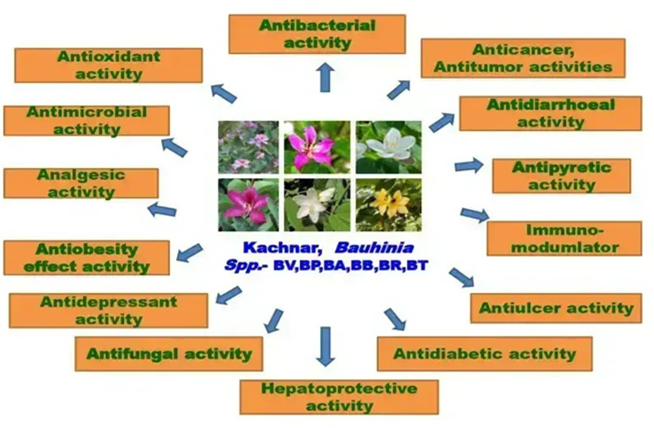
Figure 3: Graphical Illustration of pharmacological activities of Bauhinia Spp. - Kachnar (BV, BP, BA, BB, BR, BT)[40]
2. BOTANICAL DESCRIPTION AND TAXONOMY
2.1 Taxonomic Classification
Rank
Classification
Reference
Kingdom
Plantae
[18,19]
Clade
Tracheophytes, Angiosperms, Eudicots, Rosids
[18,40]
Order
Fabales
[19,40]
Family
Fabaceae (Caesalpiniaceae)
[18,19]
Tribe
Bauhinieae
[6,40]
Genus
Bauhinia
[6,40]
Species
B. variegata Linn.
[1,2]
Synonym
Phanera variegata Benth.
[1,40]
Morphological Characteristics
2.2.1 Tree Habit
Height: 10–15 meters[1,40]
Trunk diameter: ~0.5 meters[1,40]
Crown: Thin, elongated, spreading[20,40]
Bole: Straight, erect, single-stemmed[1,20]
2.2.2 Bark
Young bark: Thin, smooth, pale pink internally[5,40]
Old bark: Brown to dark grey with longitudinal fissures, fibrous texture[1,5]
Taste: Astringent[2,5]
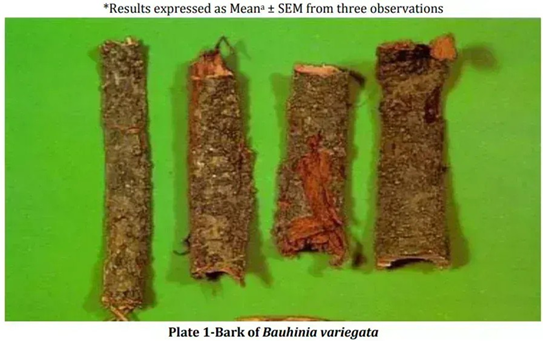
Plate 1: Bark of Bauhinia variegata showing external and internal characteristics[5]
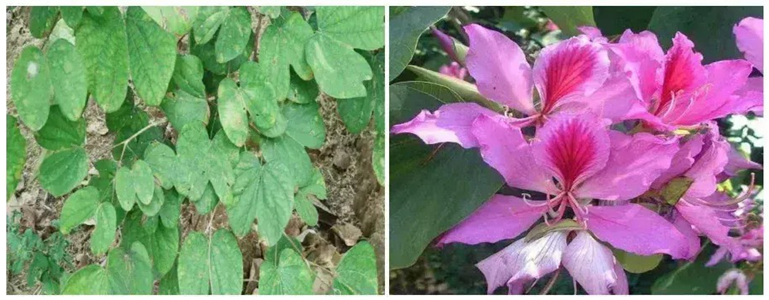
2.2.3 Leaves
The leaves exhibit a distinctive bilobed shape resembling a camel's foot[2,20]:
Introduced: United States (Texas, Louisiana)[14,40]
3.2 Distribution in India
Widely distributed across Indian states including Bihar, Delhi, Jammu & Kashmir, Madhya Pradesh, Karnataka, Manipur, Nagaland, Meghalaya, Odisha, Mizoram, Punjab, Rajasthan, Uttar Pradesh, Tamil Nadu, Tripura, West Bengal, and Sikkim[17,40].
The plant grows naturally in deciduous forests and mixed dry forests, and is cultivated as an ornamental plant in parks and gardens[1,40].
3.3 Ecological Importance
Ornamental value: Beautiful flowers[1,40]
Soil conservation: Root system prevents erosion[1,40]
Wildlife habitat: Food for pollinators[1,40]
Agroforestry: Nitrogen-fixing ability[1,40]
3.4 Cultivation and Propagation
Propagation methods[21,22]:
Seeds: Natural dispersal and germination[20,22,]
Direct seeding: Lines 3m apart after monsoon[21,40]
Stump planting: Effective for whole plants[22,40]
Branch cuttings: With auxin treatment[21,22]
Planting season: Seeds sown in March/April for July/August planting[22,40]
4. TRADITIONAL AND ETHNOBOTANICAL USES
B. variegata has been extensively used across traditional medicine systems, particularly Ayurveda, Unani, and folk medicine[2,9].
4.1 Ayurvedic Properties
Property
Description
Reference
Rasa (Taste)
Kashaya (Astringent)
[9,40]
Guna (Quality)
Laghu (Light), Ruksha (Dry)
[2,9]
Virya (Potency)
Sheeta (Cold)
[2,40]
Vipaka (Post-digestive)
Katu (Pungent)
[9,40]
Prabhava (Special effect)
Gandamala Nashana (thyroid/ lymph disorders)
[2,12]
Dosha effect
Relieves Kapha & Pitta; may aggravate Vata
[2,9]
4.2 Classical Ayurvedic References
Charaka Samhita
Mentioned as Kovidara and Karbudara[2,7]
Included in Vamana Upaga group (emetic therapy)[7,40]
Flowers described as Grahi (absorbent) and Raktapitta Shamaka (bleeding disorders)[2,31]
Sushruta Samhita
Placed under Urdhva Bhagahara Dravya (emetic herbs)[2,8]
Classified in Kashaya Varga (bitter herbs)[2,8,40]
Active compounds: Quercetin, kaempferol, glucokinin, terpenoids[25,26]
Evidence:
STZ-induced diabetes: Ethanolic, aqueous, and hydro-alcoholic extracts (200–400 mg/kg) significantly reduced blood glucose in type I and II diabetes models[1,25]
Alloxan-induced diabetes: Similar hypoglycemic effects[59,99]
Stability studies and shelf-life determination [1,40]
10.7 Other Research Needs
Agricultural and conservation:
Sustainable harvesting practices[1,40]
Cultivation optimization[21,22,40]
GACP implementation[1,40]
Conservation strategies[1,40]
Regulatory aspects:
Comprehensive monographs[1,40]
International standard harmonization[1,40]
Evidence for regulatory approvals[1,40]
Intellectual property protection[1,40]
Integration with modern medicine:
Evidence-based integrative guidelines[1,40]
Healthcare provider education[1,40]
Drug interaction studies[1,40]
Adjuvant use protocols[1,40]
REFERENCES
Abdel-Halim AH, Fyiad AAA, Aboulthana WM, El-Sammad NM, Youssef AM, Ali MM. Assessment of the anti-diabetic effect of Bauhinia variegata gold nano-extract against streptozotocin induced diabetes mellitus in rats. J. Applied Pharm. Sci. 2020;10(05):077–091.
Agnivesha. Charaka Samhita. Commentary by Pt. Kashinatha Shastri and Dr. Gangasahaya Pandeya, Part 1. Varanasi: Chaukhamba Sanskrit Sansthan; Reprint 2006.
Anonymous. The Wealth of India: A Dictionary of Indian Raw Materials and Industrial Products- Raw Materials. Publication and Information Directorate, CSIR, New Delhi, India. 1988;Vol.2:B:56.
Anonymous. Useful Tropical plants - Bauhinia variegata L. 2024. Available from: https://tropical.theferns.info/viewtropical.php?id=Bauhinia+variegata
Arora SK, Hussain M, Subhash RY, Moharir K, Pande V, Ittadwar A. Bauhinia purpurea: An Updated Pharmacological Profile. Journal of Ayurvedic and Herbal Medicine. 2020;6(2):81-85.
Babu S, Jayaraman S. An update on β-sitosterol: A potential herbal nutraceutical for diabetic management. Biomed Pharmacother. 2020;131:110702.
Bodakhe SH, Ram A. Hepatoprotective properties of Bauhinia variegata bark extract. Yakugaku zasshi. 2007 Sep 1;127(9):1503-7.
Brain KR, Turner T. The Practical Evaluation of Phytopharmaceuticals. Wright-Scientechnica, Bristol. 1975:10-12.
Burrows JE, Burrows SM, Lötter MC, Schmidt E. Trees and Shrubs Mozambique. Publishing Print Matters (Pty), Cape Town. 2018:240.
Cechinel FV. Chemical composition and biological potential of plants from the genus Bauhinia. Phytother Res. 2009 Oct;23(10):1347-54.
Chandra TR, Suresh C, Sanghamitra D, Kumar GR. Kanchnara (Bauhinia variegata linn): a critical review. Int J Ayurveda Pharm Res. 2015;3(7):39-46.
Chauhan NS. Medicinal and aromatic plants of Himachal Pradesh. Indus publishing; 1999.
Chen VT, Tham M Vo, Phong T Bui, Duc NP Duong, Lam XN Duong, Diep Q Dinh, Hien TT Nguyen. Phytochemical Screening, Antioxidant Activity and α?Glucosidase Inhibitability of Bauhinia blakeana Dunn Leaf and Flower Extracts from Vietnam. Tropical Journal of Natural Product Research. 2023;7(4):2737-2743.
Dhale DA. Phytochemical screening and antimicrobial activity of Bauhinia variegata Linn. Journal of Ecobiotechnology. 2011 Oct 8;3(9).
Dhonde SM, Siraskar BD, Kulkarni AV, Kulkarni AS, Bingi SS. Haematinic activity of ethanolic extract of stem bark of Bauhinia variegata Linn. Int J Green Pharm. 2007;1(3-4):28-33.
dos Santos KM, Gomes IN, Oliveira RJ, Pinto FE, Oliveira B, Batista FP, et al. ID7 Isolated from Bauhinia variegata Stem Inhibits Tumor Progression and Metastatic Mechanisms of Triple Negative Breast Cancer in Vivo. Journal of Pharmacy and Pharmacology. 2019;7:368-84.
Dugasani S, Balijepalli MK, Tandra S, Pichika MR. Antimicrobial activity of Bauhinia tomentosa and Bauhinia vahlii roots. Pharmacognosy magazine. 2010 Jul;6(23):204.
Ghaisas MM, Shaikh SA, Deshpande AD. Evaluation of the immunomodulatory activity of ethanolic extract of the stem bark of Bauhinia variegata Linn. International Journal of Green Pharmacy (IJGP). 2009;3(1).
Golwala DK, Vaidya SK, Dholwani KK, Patel DS, Sahoo S. Antioxidant and antimutagenic (anticlastogenic) activity of alcoholic extract of Bauhinia variegata (Linn.) root. Eur. J. Med. Plants. 2020:32-39.
Gudavalli D, Pandey K, Gopal EDEV, Sable D, Ashwini S, Ghagare, Kate AS. Phytochemistry and pharmacological activities of five species of Bauhinia genus: A review. Journal of Fitoterapia. 2024;105830.
Gupta M, Mazumder UK, Siva Kumar T, Gomathi P, Sambath Kumar R. Antioxidant and hepatoprotective effects of Bauhinia racemosa against paracetamol and carbon tetrachloride induced liver damage in rats. Iran Journal of Pharmacol Ther. 2004;3(1):12-20.
Gupta N, Kondalkar SA, Arya M, Bharthi V, Paul B, Kondalkar A, Meena AK. Pharmacognostical, phytochemical, HPTLC and ethano-botanical study of Bauhinia purpurea L. pod. International Journal Pharmaceutical Science and Research. 2024;15(3):889-899.
Habib MR, Nikkon F, Rahman M, Haque ME, Karim MR. Isolation of stigmasterol and beta-sitosterol from methanolic extract of root bark of Calotropis gigantea (Linn). Pakistan journal of biological sciences: PJBS. 2007 Nov 1;10(22):4174-6.
Harborne JB. Phytochemical methods. 3rd eds. Chapman and Hall. New York. 1998:90,203.
Indian Pharmacopoeia. Government of India, Ministry of Health and Family Welfare. Delhi: Controller of Publications. 1996;2(35):448.
Kannan N, Renitta RE, Guruvayoorappan C. Bauhinia tomentosa stimulates the immune system and scavenges free radical generation in vitro. Journal of Basic Clin Physiol Pharmacol. 2010;21(2):157–68.
Kansal M, Shukla P, Shukla P. A Boon to Human Health-Bauhinia Variegata. Int J Pharmacogn. 2020;7:155-61.
Khanduri VP, Sharma CM. Pollen production in relation to pollination behaviour in some multipurpose Himalayan trees. Journal of Tropical Forest Science. 2001 Apr 1;13(2):394-6.
Kokoski J, Kokoski R, Salma FJ. Fluorescence of powdered vegetable drugs under ultraviolet radiation. J Am Pharm Ass. 1958;47:715-717.
Kumar A, Anand V, Dubey RC, Goel KK. Evaluation of antioxidant potential of alcoholic stem bark extracts of Bauhinia variegata Linn. J. Applied. Nat. Sci. 2019;11(1):235-239.
Kumar R, Gupta YK, Singh S, Arunraja S. Cissus quadrangularis attenuates the adjuvant induced arthritis by down regulating pro-inflammatory cytokine and inhibiting angiogenesis. Journal of ethnopharmacology. 2015 Dec 4;175:346-55.
Kumar S, Kumar R, Gupta YK, Singh S. In vivo anti-arthritic activity of Bauhinia purpurea Linn. Bark Extract. Indian journal of pharmacology. 2019 Jan 1;51(1):25-30.
Kumar V, Rathore K, Jain P, Ahmed Z. Biological activity of Bauhinia racemosa against diabetes and interlinked disorders like obesity and hyperlipidemia. Clin. Phytosci. 2017;3(1):7.
Lau CPY, Ramsden L, Saunders RMK. Hybrid origin of "Bauhinia blakeana" (Leguminosae: Caesalpinioideae), inferred using morphological, reproductive, and molecular data. American Journal of Botany. 2005;92(3):525–33.
Liu M, Dong J, Lin Z, Niu Y, Zhang X, Jiang H, Guo N, Li W, Wang H, Chen S. Rapid Screening Of Transferrin-Binders In The Flowers Of Bauhinia Blakeana Dunn By On-Line High-Performance Liquid Chromatography. Journal Of Chromatography A. 2016;1450:17-28.
Llamas KA. A Guide to Identification and Cultivation. Tropical flowering plants. 2003.
Reference
Abdel-Halim AH, Fyiad AAA, Aboulthana WM, El-Sammad NM, Youssef AM, Ali MM. Assessment of the anti-diabetic effect of Bauhinia variegata gold nano-extract against streptozotocin induced diabetes mellitus in rats. J. Applied Pharm. Sci. 2020;10(05):077–091.
Agnivesha. Charaka Samhita. Commentary by Pt. Kashinatha Shastri and Dr. Gangasahaya Pandeya, Part 1. Varanasi: Chaukhamba Sanskrit Sansthan; Reprint 2006.
Anonymous. The Wealth of India: A Dictionary of Indian Raw Materials and Industrial Products- Raw Materials. Publication and Information Directorate, CSIR, New Delhi, India. 1988;Vol.2:B:56.
Anonymous. Useful Tropical plants - Bauhinia variegata L. 2024. Available from: https://tropical.theferns.info/viewtropical.php?id=Bauhinia+variegata
Arora SK, Hussain M, Subhash RY, Moharir K, Pande V, Ittadwar A. Bauhinia purpurea: An Updated Pharmacological Profile. Journal of Ayurvedic and Herbal Medicine. 2020;6(2):81-85.
Babu S, Jayaraman S. An update on β-sitosterol: A potential herbal nutraceutical for diabetic management. Biomed Pharmacother. 2020;131:110702.
Bodakhe SH, Ram A. Hepatoprotective properties of Bauhinia variegata bark extract. Yakugaku zasshi. 2007 Sep 1;127(9):1503-7.
Brain KR, Turner T. The Practical Evaluation of Phytopharmaceuticals. Wright-Scientechnica, Bristol. 1975:10-12.
Burrows JE, Burrows SM, Lötter MC, Schmidt E. Trees and Shrubs Mozambique. Publishing Print Matters (Pty), Cape Town. 2018:240.
Cechinel FV. Chemical composition and biological potential of plants from the genus Bauhinia. Phytother Res. 2009 Oct;23(10):1347-54.
Chandra TR, Suresh C, Sanghamitra D, Kumar GR. Kanchnara (Bauhinia variegata linn): a critical review. Int J Ayurveda Pharm Res. 2015;3(7):39-46.
Chauhan NS. Medicinal and aromatic plants of Himachal Pradesh. Indus publishing; 1999.
Chen VT, Tham M Vo, Phong T Bui, Duc NP Duong, Lam XN Duong, Diep Q Dinh, Hien TT Nguyen. Phytochemical Screening, Antioxidant Activity and α?Glucosidase Inhibitability of Bauhinia blakeana Dunn Leaf and Flower Extracts from Vietnam. Tropical Journal of Natural Product Research. 2023;7(4):2737-2743.
Dhale DA. Phytochemical screening and antimicrobial activity of Bauhinia variegata Linn. Journal of Ecobiotechnology. 2011 Oct 8;3(9).
Dhonde SM, Siraskar BD, Kulkarni AV, Kulkarni AS, Bingi SS. Haematinic activity of ethanolic extract of stem bark of Bauhinia variegata Linn. Int J Green Pharm. 2007;1(3-4):28-33.
dos Santos KM, Gomes IN, Oliveira RJ, Pinto FE, Oliveira B, Batista FP, et al. ID7 Isolated from Bauhinia variegata Stem Inhibits Tumor Progression and Metastatic Mechanisms of Triple Negative Breast Cancer in Vivo. Journal of Pharmacy and Pharmacology. 2019;7:368-84.
Dugasani S, Balijepalli MK, Tandra S, Pichika MR. Antimicrobial activity of Bauhinia tomentosa and Bauhinia vahlii roots. Pharmacognosy magazine. 2010 Jul;6(23):204.
Ghaisas MM, Shaikh SA, Deshpande AD. Evaluation of the immunomodulatory activity of ethanolic extract of the stem bark of Bauhinia variegata Linn. International Journal of Green Pharmacy (IJGP). 2009;3(1).
Golwala DK, Vaidya SK, Dholwani KK, Patel DS, Sahoo S. Antioxidant and antimutagenic (anticlastogenic) activity of alcoholic extract of Bauhinia variegata (Linn.) root. Eur. J. Med. Plants. 2020:32-39.
Gudavalli D, Pandey K, Gopal EDEV, Sable D, Ashwini S, Ghagare, Kate AS. Phytochemistry and pharmacological activities of five species of Bauhinia genus: A review. Journal of Fitoterapia. 2024;105830.
Gupta M, Mazumder UK, Siva Kumar T, Gomathi P, Sambath Kumar R. Antioxidant and hepatoprotective effects of Bauhinia racemosa against paracetamol and carbon tetrachloride induced liver damage in rats. Iran Journal of Pharmacol Ther. 2004;3(1):12-20.
Gupta N, Kondalkar SA, Arya M, Bharthi V, Paul B, Kondalkar A, Meena AK. Pharmacognostical, phytochemical, HPTLC and ethano-botanical study of Bauhinia purpurea L. pod. International Journal Pharmaceutical Science and Research. 2024;15(3):889-899.
Habib MR, Nikkon F, Rahman M, Haque ME, Karim MR. Isolation of stigmasterol and beta-sitosterol from methanolic extract of root bark of Calotropis gigantea (Linn). Pakistan journal of biological sciences: PJBS. 2007 Nov 1;10(22):4174-6.
Harborne JB. Phytochemical methods. 3rd eds. Chapman and Hall. New York. 1998:90,203.
Indian Pharmacopoeia. Government of India, Ministry of Health and Family Welfare. Delhi: Controller of Publications. 1996;2(35):448.
Kannan N, Renitta RE, Guruvayoorappan C. Bauhinia tomentosa stimulates the immune system and scavenges free radical generation in vitro. Journal of Basic Clin Physiol Pharmacol. 2010;21(2):157–68.
Kansal M, Shukla P, Shukla P. A Boon to Human Health-Bauhinia Variegata. Int J Pharmacogn. 2020;7:155-61.
Khanduri VP, Sharma CM. Pollen production in relation to pollination behaviour in some multipurpose Himalayan trees. Journal of Tropical Forest Science. 2001 Apr 1;13(2):394-6.
Kokoski J, Kokoski R, Salma FJ. Fluorescence of powdered vegetable drugs under ultraviolet radiation. J Am Pharm Ass. 1958;47:715-717.
Kumar A, Anand V, Dubey RC, Goel KK. Evaluation of antioxidant potential of alcoholic stem bark extracts of Bauhinia variegata Linn. J. Applied. Nat. Sci. 2019;11(1):235-239.
Kumar R, Gupta YK, Singh S, Arunraja S. Cissus quadrangularis attenuates the adjuvant induced arthritis by down regulating pro-inflammatory cytokine and inhibiting angiogenesis. Journal of ethnopharmacology. 2015 Dec 4;175:346-55.
Kumar S, Kumar R, Gupta YK, Singh S. In vivo anti-arthritic activity of Bauhinia purpurea Linn. Bark Extract. Indian journal of pharmacology. 2019 Jan 1;51(1):25-30.
Kumar V, Rathore K, Jain P, Ahmed Z. Biological activity of Bauhinia racemosa against diabetes and interlinked disorders like obesity and hyperlipidemia. Clin. Phytosci. 2017;3(1):7.
Lau CPY, Ramsden L, Saunders RMK. Hybrid origin of "Bauhinia blakeana" (Leguminosae: Caesalpinioideae), inferred using morphological, reproductive, and molecular data. American Journal of Botany. 2005;92(3):525–33.
Liu M, Dong J, Lin Z, Niu Y, Zhang X, Jiang H, Guo N, Li W, Wang H, Chen S. Rapid Screening Of Transferrin-Binders In The Flowers Of Bauhinia Blakeana Dunn By On-Line High-Performance Liquid Chromatography. Journal Of Chromatography A. 2016;1450:17-28.
Llamas KA. A Guide to Identification and Cultivation. Tropical flowering plants. 2003.
Khemnar Sanskar
Corresponding author
Ashvin College of Pharmacy, Manchi Hill, Sangamner, Ahilyanagar, Maharashtra 413714






 10.5281/zenodo.19381094
