
Department of Pharmacy, Institute of Technology & Management, GIDA, Gorakhpur
Stomach or duodenal ulcers are signs of peptic ulcer disease (PUD), a common gastrointestinal condition. The primary causes of PUD are Helicobacter pylori infection and the use of nonsteroidal anti-inflammatory medications (NSAIDs). If therapy is not performed, it may result in intestinal issues such as bleeding, perforation, and obstruction. The symptoms of PUD include nausea, vomiting, heartburn, regurgitation, and stomach pain. There are various synthetic medications available to treat ulcers. However, these medications are more expensive than herbal remedies and are more likely to cause adverse side effects. The use of herbal medicine is crucial, and limits are necessary to ensure the quality of the product. Specifically, randomised studies were conducted to determine their efficacy and safety in treating ulcers. However, these medications are more expensive than herbal remedies and are more likely to cause adverse side effects. The use of herbal medicine is crucial, and limits are necessary to ensure the quality of the product. Specifically, randomised studies to determine their efficacy and safety in treating ulcers. This review examines the current scientific understanding of P. Alba's botanical description, phytochemistry, pharmacological qualities, and potential applications. According to one study, the plant has different bioactive chemicals with potential medical applications, including antibacterial, anti-arthritic, and antioxidant characteristics.
A rupture in the normal integrity of the gastric mucosa that extends through the muscularis mucosa into the sub mucosa or deeper is known as a gastric ulcer, also known as a stomach ulcer. An imbalance between the mucosal defensive forces (mucus bicarbonate, blood flow, and prostaglandins) and the stomach aggressive factors (acid, pepsin, H. pylori, and non- steroidal anti-inflammatory drugs) leads to peptic ulcers. [1] Although there are several causes of peptic ulcer disease (PUD), Helicobacter pylori-associated PUD and NSAID associated PUD make up the majority of the illness's pathogenesis [2].
Types of Ulcer
Duodenal ulcer
Peptic ulcer disease is a broad spectrum of illnesses that includes duodenal ulcers. The state of illness and clinical "Peptic ulcer disease" refers to symptoms that arise from a disturbance in the mucosal membrane of the stomach or duodenum, the first segment of the small intestine. Pre-epithelial, epithelium, and subepithelial components make up the anatomical protection system on the surfaces of the stomach and duodenum. Damage to the mucosal surface underneath the superficial layer results in ulceration. [3]
Gastric Ulcer
Gastric ulcer disease is more commonly known as peptic ulcer disease (PUD), which refers to ulcers that can occur in the stomach and the proximal duodenum (the two organs most frequently impacted by the secretion of pepsin and gastric acid), though the lower esophagus, distal duodenum, and jejunum can also be affected, albeit to a lesser extent [4].
Esophageal ulcer
An esophageal ulcer is an obvious break in the mucosal membrane of the esophagus. injuries brought on by esophageal reflux. According to endoscopic examination, the majority of patients have some degree of hiatal hernia, and gastroesophageal reflux syndrome is the most common cause of esophageal ulcers. [5]
However, there was individual variation in the pathogenicity of HP, which was impacted by both environmental and genetic variables. Ironically, HP-induced chronic gastritis seems to protect against gastroesophageal reflux disease (GERD), making its role in stomach health and disease more difficult to grasp [6] Individual susceptibility is demonstrated by the fact that peptic ulcers only occur in a small percentage of infected or NSAID-using people. Interleukin 1β (IL1B) and other cytokine genes have genetic variations. According to observations, these issues are NSAID users were four times more likely, while aspirin users were twice as probable. The risk of upper gastrointestinal bleeding increases when anticoagulants, corticosteroids, and selective serotonin reuptake inhibitors (SSRIs) are used concurrently. NSAIDs, aspirin, and H. pylori infection appear to have separate hazards, according to a meta-analysis. About one-fifth of cases are idiopathic peptic ulcers, which are H. pylori-negative, NSAID-negative, and aspirin-negative [7-10]. Peptic ulcer disease's age- standardised prevalence rate dropped from 143·4 per 100,000 population in 1990 to 99·4 per 100,000 people in 2019, which coincided with declines in disability-adjusted life years and mortality.[11] Peptic ulcers are treated with a variety of drug classes, such as antimicrobials (metronidazole and clarithromycin), inhibitors of proton pumps that block the H+, K+ ATPase pump (omeprazole and lansoprazole), blocking agents of the H2-receptor (cimetidine and ranitidine), and drugs that disrupt the bacterial cell wall (bismuth salt). The majority of these medications have serious drug-drug interactions that limit their potential usage, as well as unfavourable side effects include gynecomastia, hypersensitivity, impotence, arrhythmia hematopoietic alterations, and renal illness [12]. In many regions of the world, plants have offered beneficial sources of nutrients and medicinal preparations for the treatment of various medical ailments. When compared to manufactured pharmaceuticals, the great majority of people who use plant extracts as medicine believe they are safer. [13] Numerous preclinical investigations have revealed the anti-ulcerative activities of a number of chemical compounds obtained from plants. These components are classified as alkaloids, tannins, terpenoids, flavonoids, glycosides, carotenoids Numerous Alkaloids, tannins, flavonoids, terpenoids, glycosides, carotenoids, and saponins are among the ingredients.[14-16]
Plumeria alba
Traditional medicine has been based on plants for generations, using their bioactive compounds to cure a variety of illnesses. Plumeria alba, often known as white frangipani, is widely used for its therapeutic properties in a number of regions. It is often found in gardens and temples and serves both decorative and medicinal purposes. Contemporary phytochemical and pharmacological studies have begun to support conventional claims and investigate their application in contemporary medicine [17]. It is a member of the Apocynaceae family. The bark, leaves, and flowers of P. alba have been found to contain a variety of bioactive components with strong antibacterial, anti-inflammatory, anthelmintic, antipyretic, and antirheumatic qualities. Skin conditions like herpes, scabies, and ulcers are treated using the stem and leaf of P. alba. [18-20] White Champa, also known as Plumeria alba Linn (Apocynaceae), is a tiny lactiferous tree or shrub that is indigenous to tropical America. Occasionally grown in the gardens, it stands 4.5 meters tall. The plant is mostly cultivated for its fragrant and decorative blossoms. Lanceolate leaves are present. The plant produces white flowers with golden centers. In corymbose fascicles, fragrant Frangipani is renowned for its spiral-shaped blossoms and strong scent [21] A combination of amyrins, ß- sitosterol, scopotetin, the iriddoids isoplumericin, plumieride, plumieride coumerate, and plumieride coumerate glucoside are believed to be present in the plant. [22-23]
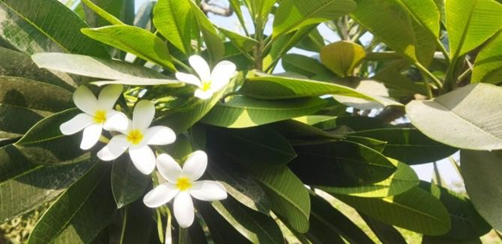
Fig:1 Plumeria alba
The floral oil is mostly composed of primary alcohols such as geraniol, citronellol, farnesol, and phenyl ethyl alcohol, with a trace quantity of linalool. The flowers include kaempferol and quercetin. [24]
Taxonomical classification [25]
|
Plantae |
|
|
Super division |
Spermatophyta |
|
Division |
Magnolliophyta |
|
Class |
Magnoliopsida |
|
Sub class |
Aateridae |
|
Order |
Gentianales |
|
Family |
Apocynaceae |
|
Genus |
Plumeria |
Phytochemical constituents
Chemicals like amyrin, scopotein, iridoid isoplumericin, plumerein, plumeride cumarate, and plumeride cumarate glycoside are found in white frangipani. Plumierin, resinic acid, fulvoplumierin, terpeneoid combination, sterol, and plumeride are found in the leaves and bark. Additionally, cytotoxic iridoid, allamcin, allamandin, 2, 5-dimethoxy-p-benzoquinone, plumericin, and liriodindrin are found in the bark. Alkaloid, tannin, and iridoid are also present in white frangipani roots [26]
Steroids, flavonoids, and alkaloids were found in the P. alba flower extract during preliminary phytochemical screening. Eicosanoid production can be disrupted by flavonoids. By preventing neutrophils from degranulating, flavonoids can also lower the synthesis of arachidonic acid. Alkaloids have also been linked to the capacity to reduce pain perception in addition to flavonoids. The plant may include phytoconstituents that act on central opioid receptors or inhibit the cyclooxygenase enzyme. [27] The biological actions of P. alba essential oils have been the subject of further research. Liu et al. investigated the antibacterial, antioxidant, and antipyretic-analgesic properties of P. alba flower essential oil and suggested that the bioactivity may be attributed to the essential oil's primary constituents, including benzyl salicylate, benzyl benzoate, germacrene B, and linalool. [28]
Terpenoids, tannins, diterpenes, triterpenes, flavonoids, flavonols, coumarins, steroids, saponins, alkaloids, quinones, and phenols are examples of phytoconstituents. and glycosides typically have important roles in antifungal, antibacterial, antibiotic, and antinutritional activities [29]
Pharmacological Effects
Anti-microbial
The leaf and flower extracts exhibit a variety of antibacterial qualities against fungus like Candida albicans and bacteria like E. coli and Staphylococcus aureus. [30]
When it comes to the uro-gastro pathogenic Escherichia coli, one of the prevalent bacteria with pathogenic strains that are comparatively resistant to synthetic medications, P. alba seems to have a considerable antibacterial ability that resembles a broad range antibiotic. This fragrant plant may be a source of newly developed antibacterial compounds as well as a non-toxic agent that produces antibiotics. Particularly against E. coli, frangipani extracts have the potential to be a natural source of anti-toxic antibiotics. [31]
Antipyretic and Analgesic Properties
Plumeria extracts have been demonstrated to have antipyretic (fever-reducing) and analgesic (pain-relieving) qualities, suggesting that they may be utilized as natural remedies for fever and pain. [32]
Anti-oxidant
Numerous pathologic conditions, including cancer, inflammation, and oxidized states caused by reactive oxygen stress (ROS), have been thoroughly researched. Cardiovascular conditions, etc. By employing ethanol and acetic acid to extract its blossom, white frangipani has been shown to have antioxidant activity [33] Extracts from the plant's leaves and flowers show moderate to strong antioxidant activity. The flower and leaf oils had respective total antioxidant capacities (TACs) of 57 µg/g and 83 µg/g. Because leaf extracts include more polyphenols than flower extracts, they often exhibit more DPPH radical scavenging [34].
Gastro protective activity
The methanolic extract produced from the stem bark of Plumeria obtusa was assessed for its gastro protective properties. By suppressing the proton pump mechanism, enhancing gastric mucosal protection, and lowering stomach acid formation, the extract shown effectiveness. [35]
Anti-fungal
Using the conventional dilution test on Mueller-Hinton (MH) agar medium, the antifungal properties of the methanolic extract and the isolated fraction of *P. alba* were assessed. Using the disc diffusion method, the inhibitory zones were compared to those generated by the common antibiotic ciprofloxacin (5 mg/disc). Using Sabouraud dextrose agar medium and the conventional dilution technique, the antifungal impact was also evaluated. The results were compared to the standard antifungal Clotrimazole (125 mcg/ml). [36]
Anti-arthritis
In Sprague-Dawley rats, P. alba's ethyl acetate and n-butanol fractions have antiarthritic effects. P.Alba provides a scientific justification for the plant's traditional use in the treatment of inflammatory diseases such rheumatoid arthritis [37]
Anti- cancer
The fruit of P. alba is regarded as a natural source of antioxidants that help reduce free radical- mediated disorders like diabetes, cancer, and coronary heart disease, and the bark is utilized as a plaster for difficult tumors. [38]
Hepatoprotective
Rats with liver damage caused by paracetamol were used to test the hepatoprotective properties of P. alba extract. Methanol extracts of the plant *P. alba Lam.*, also called *Plumeria acutifolia*, were employed in the study at different concentrations (100, 200, and 400 mg/kg). Poir's efficacy in treating Wistar rats with acute liver injury caused by paracetamol was assessed. At doses up to 2000 mg/kg body weight in mice, the methanolic extract of *P. alba* did not result in any toxic effects or fatalities, suggesting that the extract is safe and non-toxic for additional pharmacological testing. Hepatocytes were arranged neatly and the central vein remained unaltered in the normal control group, which had a typical liver anatomy. [39]
Mechanism of anti-ulcer activity of Plumeria alba
Tannins' ability to chelate metals, antioxidant activity, antibacterial action, and complexation power with other molecules provide the mechanism of action that explains why they enhance the treatment and prevention of diarrhea and gastritis symptoms.[40-43] Excellent antioxidant and anti-inflammatory characteristics of flavonoids contribute in mucosal protection and ulcer healing [44, 45]. Anti-secretory and anti-ulcer effects[46] This class of compounds has become increasingly popular in terms of health protection because it has a remarkable spectrum of biochemical and pharmacological activities. Perhaps the most active area of research with flavonoids today is the possible medicinal contribution that flavonoids make to human health [47]. The main elements of mucosal protection include the generation of cytoprotective prostaglandins (PGs), mucus, bicarbonate (HCO3−), nitric oxide (NO), the endogenous antioxidant system, and adequate blood flow [48,49]. Pepsin activity, bile reflux, hydrochloric acid (HCl) secretion [50], and abnormal motility [51] Kaempferol (40, 80, and 160 mg/kg, p.o.) and the control medication omeprazole (20 mg/kg) avoid gastric ulcers due to ethanol in mice via decreasing neutrophil accumulation, myeloperoxidase (MPO) activity, and pro- inflammatory cytokines consisting of TNF-α, IL-1β, and interleukin-6 (IL-6), and additionally improving NO and gastric mucus [52]. Increased gastric blood flow, improved synthesis of mucosubstances of the gastric mucosa [53], and increased effects on the contents of PGs in gastric tissue [54] are the mechanisms of action involved in gastric protection. In addition to its cytoprotective properties, sofalcone directly inhibits H. pylori with a minimum inhibitory concentration of 55-222 µmol/L, possesses anti-urease action, and decreases the organism's adherence to gastric epithelial cells [55, 56]
CONCLUSION
Plumeria alba L. possesses a wide range of therapeutic characteristics that are supported by both modern pharmacological research and traditional wisdom. It contains a number of bioactive compounds with notable antibacterial, antioxidant, antiarthritic, and analgesic effects. These active metabolites, derived from a variety of plant sources, including alkaloids, flavonoids, tannins, saponins, and polyphenols, serve various functions in ulcer treatment and work in tandem with plant extracts' anti-ulcerative properties. Plumeria alba L. possesses a wide range of therapeutic characteristics that are supported by both modern pharmacological research and traditional wisdom. It contains a number of bioactive compounds with notable antibacterial, antioxidant, antiarthritic, and analgesic effects. The Study’s findings indicate that a certain hydro alcoholic extract of Plumeria alba L. exhibits antiulcer action, as evidenced by the notable reduction of ulcer formation generated by various models, which is in line with the folk medicine literature report.
REFERENCES


Shipra Mishra, Dr. Suprabha Devi, A Review: Plumeria alba as an anti-ulcer agent, Int. J. of Pharm. Sci., 2026, Vol 4, Issue 3, 1009-1017. https://doi.org/10.5281/zenodo.18938617
 10.5281/zenodo.18938617
