
School of Pharmacy, G H Raisoni University, Saikheda, Dist- Pandhurna, Madhya Pradesh, India – 480337
Oral diseases such as gingivitis, periodontitis, and candidiasis remain prevalent worldwide, often exacerbated by poor hygiene and microbial symbiosis. Conventional treatment, while effective, is frequently associated with adverse effects including mucosal irritation, tooth staining, and antimicrobial resistance. Polyherbal formulation derived from Synergistics blends of medical plants, offers a promising alternative rooted in traditional systems like Ayurveda and Nazi. The review explores the therapeutic potential of polyherbal formulations in managing oral pathologies, emphasizing their antimicrobial, anti-inflammatory, and tissue-regenerative properties. Key botanicals such as Azadirachta indica (Neem), Syncytium aromaticum (Clove), Curcuma longa (Turmeric) demonstrates broad-spectrum efficacy against oral pathogen while promoting mucosal healing. This paper consolidates current evidence on phytochemical profiles, formulation types, and clinical relevance, underscoring the role of polyherbal formulations in advancing oral health through biocompatible and sustainable therapeutics
Oral infection is one of the most common diseases worldwide, leading to dental caries and periodontal disease. Dental caries is a dynamic process causing progressive destruction of hard tooth substance involving demineralization of the inorganic part and dissolution of the organic portion. [1] Periodontitis a destructive gum, disease, may progress irreversibly in breaking down supporting periodontal structure which result in loss of drawback of this product is that they possess significant toxicity and are responsible for the staining of teeth and burning sensation on tongue. [2]
The mouth and oral cavity are the important outlets through which the body communicates with the external environment. Speech, chewing, swallowing, and the early stage of digestion are all vital physiological functions that have their orifices in the oral cavity, and mouth plays a role in psychological identity. [3]
There are multiple surface types in the oral cavity, and each surface is colonized by a unique population of 500 or fewer 700 species of bacteria, viruses, fungi, and protozoa, some of which, mainly protozoa, are very virulent and many have never been cultivated. Since oral hygiene has a major influence on the composition of the oral microbiome. Individual with good hygiene to have a simple flora dominated by gram-negative cocci, while those with a shift to a more diverse and complex flora terminated by anaerobic gram-negative organism. [4,5]

Figure no 01 : Gingival and Periodontal Inflammation [5]
Gingival and Periodontal Inflammation: Implication for Oral Health
Gingivitis
An early gum disease caused by plaque buildup.
Symptoms: red, swollen, bleeding gums, bad breath.
Risk factors: poor hygiene, smoking, tablets. Reversible with brushing, flossing, dermal cleaning, and mouthwash.[6]
Periodontitis
Severe gum infection from untreated gingivitis.
Symptoms: gum recession, loose teeth bad breath, pus.
Causes: plaque buildup, smoking, diabetes. Needs deep cleaning, antibiotics, surgery.
Can lead to tooth loss and systemic diseases.[7]
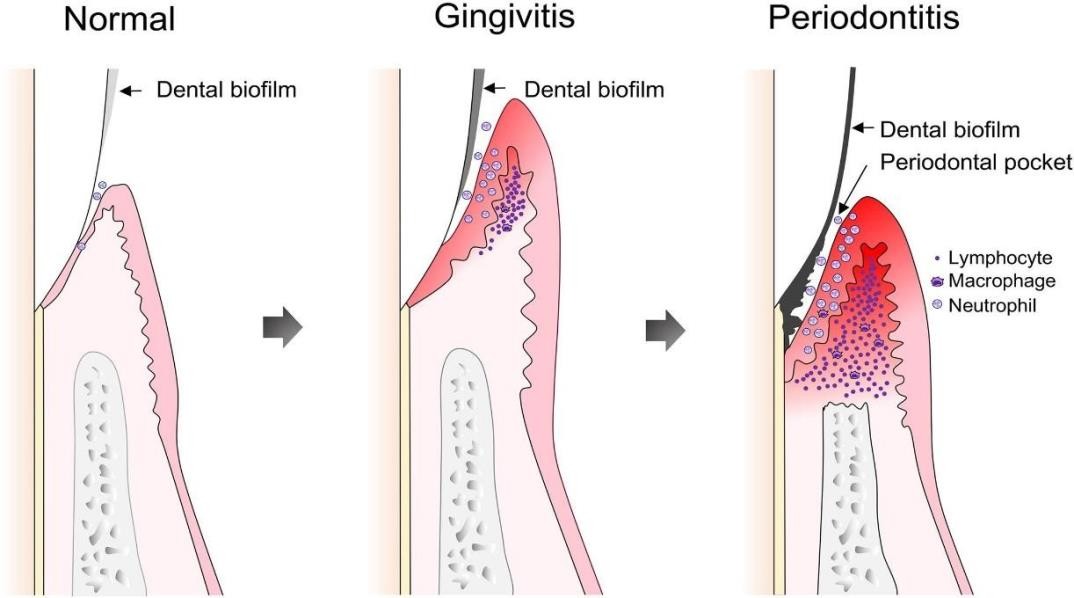
Figure no : 02 Normal →Gingivitis →periodontitis (stages of gum disease)[7]
Acute Necrotizing Ulcerative Gingivitis (ANUG)
Severe bacterial gum infection with tissue death.
Symptoms: painful ulcers, bleeding, foul breath, fever
Risk factors: poor hygiene, stress, smoking. Treated with cleaning, antibiotics,
antiseptic rinses.[8]
Pericoronitis
Infection around a partially erupted tooth (usually wisdom teeth).
Symptoms: swollen gums, pain, trismus, pus.
Treatment: saltwater rinses, antibiotics, possible surgery.[9,10]
Dental Abscess
Pus-filled infection in gums, teeth, or bone,
Symptoms: severe pain, swelling, fever, pus drainage
Treatment: Needs drainage, antibiotics, root canal, or extraction.[11]
Gingival Candidiasis
Fungal gum infection (Candida albicans)
Symptoms: white patches, redness, burning. Common in weakened immunity.[12]
Treated with antifungals and good oral hygiene.
Herpetic Gingivostomatitis
HSV-1 viral infection of mouth and gams,
Symptoms: painful blisters, ulcers, fever, swollen guns
Treated with antivirals, pain relief, and hydration. Severe cases may need
hospitalization.[11,12]
Polyherbal Formulations (PHF)
Polyherbal formulations are medicinal preparations containing a combination of two or more herbs, widely used in traditional systems such as Ayurveda, Siddha, and Unani.[13] They provide synergistic therapeutic effects, reduced toxicity, and broad-spectrum activity, making them superior to single-herb formulations. Increasing scientific research highlights their potential in managing chronic, infectious, and lifestyle-related diseases, bridging traditional knowledge with modern evidence-based medicine. [14] Recent research has shown that polyherbal formulations offer several advantages over single- herb preparations, including broad-spectrum therapeutic action, improved bioavailability of phytoconstituents, and multi-target mechanisms beneficial in the management of chronic and lifestyle-related diseases. Furthermore, polyherbal is considered a promising strategy to overcome limitations such as drug resistance in microbial infections and reduced efficacy in single-drug therapies. [15] Given the increasing global interest in herbal medicine, the scientific evaluation of polyherbal formulations has gained momentum, focusing on phytochemical standardization, pharmacological validation, and clinical efficacy. This review aims to provide comprehensive insights into the concept, advantages, therapeutic potential, and current research trends in polyherbal formulations, thereby bridging the gap between traditional knowledge and modern scientific evidence. [14,15]
Advantages
Synergistic Efficacy: Multiple herbs enhance the therapeutic action, boosting antimicrobial and anti – inflammatory effects in oral tissues.
Broad – spectrum Action: Targets inflammation, bacteria, and tissue repair, improving periodontal health comprehensively.
Resistance Reduction: Diverse compounds lower antimicrobial resistance, ensuring long – term efficacy against pathogens.
Fewer Side Effects: Natural ingredients reduce adverse reaction compared to synthetic drugs.
Cost-Effective: Affordable herbal source lower treatment costs, enhancing accessibility.
Tissue Restoration: Promotes gum healing and reduce infections, aiding oral homeostasis.
Better Compliance: Patients prefer natural remedies, improving adherence to oral
care.[16]
Table No. 1: Type of Formulation with Example and Properties
|
Sr. no. |
Formulation type |
Example product |
Key Botanical ingredients (Botanical Name) |
Relevant properties |
|
1 |
Herbal mouthwashes |
Dabur Red Herbal |
Mint (Mentha spicata.), Clove (Syzigium aromaticum) |
Anti-microbial, anti- inflammatory plaque & gingivitis reduction |
|
2 |
Herbal Toothpastes & Gels |
Vicco Vajradanti Toothpaste |
Turmeric (Curcuma longa), Neem (Azadirachta indico), Miswak (Salvadora persico) |
Anti-microbial, astringent, anti- inflammatory, gingival care |
|
3 |
Herbal Gums & Lozenges |
Himalaya Herbal Gum care |
Pomegranate (Punica granatum) |
gingivitis, freshens Reduces plaque, breath |
|
4 |
Subgingival Herbal |
Periocine Periodontal Chip |
Curcumin (Curcuma longa), Neem (Azadirachta indica) |
Localized inflammatory anti-bacterial anti-effect, pocket depth reduction |
|
5 |
Herbal Oils & Essential Oil Rinses |
Colgate Herbal White |
Clove (Syzygium aromaticum), Camphor (Cinnamomum camphora) |
Analgesic, anti- microbial, reduces gum inflammation |
|
6 |
Herbal Powders |
Baidyanath Dant Manjan |
Triphala (Emblica officinalis, Terminalia chebula, Terminalia bellirica), Neem, Clove |
Anti-bacterial, anti- inflammatory. strengthens gums, reduces bleeding |
|
7 |
Herbal Patches |
Curcumin based Periodontal Films (study) |
Turmeric (Curcuma longa), Aloevera (Aloe barbadensis) |
Localized anti- inflammatory, promotes healing [17] |
|
8 |
Mouthwash / gargle |
Himalaya Herbal Mouthwash; Triphala mouthwash (research formulations) |
Triphala (Amla, Haritaki, Bibhitaki), Neem, Tulsi, Clove |
Antimicrobial vs plaque bacteria; reduces gingival inflammation; chlorhexidine-comparabl e in some trials |
|
9 |
Neem mouthrinse |
Neem mouthrinse formulations (commercial/clinical) |
Neem (Azadirachta indica) extracts / oil |
Antiseptic, antiplaque; several RCTs report reductions in plaque & gingivitis vs controls |
|
10 |
Toothpaste / dentifrice |
Dabur Red / Babool-type herbal pastes; clinical formulations |
Neem, Babool (Acacia), Triphala, Clove, Mint |
Anti-cariogenic, antiplaque activity; some in-vitro and clinical evidence for reduced plaque / gingivitis |
Table No. 2: Ingredients used in Polyherbal Formulations for oral cavity
|
Sr. no. |
Herb Name |
Scientific Name |
Key Bioactive Compounds |
Primary Therapeutic Properties |
Common Applications |
|
1 |
Neem |
Azadirachta indica |
Azadirachtin, Nimbin, Nimbidin |
Anti-bacterial, Anti- fungal, Anti- inflammatory |
Toothpastes, Mouthwashes |
|
2 |
Clove |
Syzygium aromaticum |
Eugenol |
Analgesic, Anti- microbial, Anti- inflammatory |
Toothpastes, Gels, Mouthwashes |
|
3 |
Pomegranate |
Punica granatum |
Punicalagins, Ellagic Acid |
Antioxidant, Antimicrobial, Anti-inflammatory |
Toothpastes, Mouthwashes |
|
4 |
Guava Leaves |
Psidium guajava |
Flavonoids, Tannins, Essential Oils |
Antiseptic, Wound- Healing, Anti- inflammatory |
Gels, Oral Films, Mouthwashes |
|
5 |
Turmeric |
Curcuma longa |
Curcumin |
Anti-inflammatory, Antimicrobial, Antioxidant |
Gels, Mouthwashes, Toothpastes |
|
6 |
Betel Leaf |
Piper betle |
Eugenol, Chavicol |
Antimicrobial, Tissue- Regenerative |
Chewable Tablets, Oral Sprays |
|
7 |
Ginger |
Zingiber officinale |
Gingerol |
Antimicrobial, Anti-inflammatory, Tissue-Repair |
Toothpastes, Mouthwashes |
|
8 |
Liquorice |
Glycyrrhiza glabra |
Glycyrrhizin |
Anti-inflammatory, Antimicrobial |
Mouthwashes, Gels, Toothpastes |
|
9 |
Amla |
Phyllanthus emblica |
Vitamin C, Polyphenols |
Antioxidant, Tissue-Repair, Immune- Modulatory |
Toothpastes, Oral Films |
|
10 |
Strawberry |
Fragaria x ananassa |
Anthocyanins, Ellagic Acid, Flavonoids , Vitamin C, Phenolic Acid, Tannins |
Antioxidant, Antimicrobial, Anti-inflammatory, Astringent, Collagen support |
Flavouring Agent, Mild Anti-microbial [18] |
Table no. 3: Investigational study on different drug delivery system
|
SR. NO. |
TITLE |
JOURNAL |
POLYHERBAL DRUGS |
FINAL PRODUCUT |
|
1 |
Formulation Development and Evaluation of Polyherbal Mouthwash Containing Psidium guajava L. (2023) [19] |
J. Biomed. Pharm. Res. |
Psidium guajava, Curcuma longa, Syzygium aromaticum |
Mouthwash |
|
2 |
Curcumin-based Polyherbal Nanoemulsion Mouthwash (2024)[20] |
Curr. Trends Biotech. Pharm. |
Curcumin + herbal mix |
Nanoemulsion Mouthwash |
|
3 |
Antibacterial and Cytotoxicity Properties of a Polyherbal Mouthwash Containing Achyranthes aspera and Trachyspermum ammi (2024)[21] |
PubMed indexed |
Achyranthes aspera, Trachyspermum ammi |
Mouthwash |
|
4 |
Efficacy of an All- Natural Polyherbal Mouthwash in Patients with Periodontitis: A Single-Blind Ran Controlled Trial [22] |
PubMed Clinical Trial |
Propolis, Plantago lanceolata, Salvia officinalis, Essential oils |
Mouthwash |
|
5 |
Novel Poly Herbal Muco-Adhesive Formulation for Treatment of Oral Aphthous Ulcer (2021)[23] |
Int. J. Basic & Clin. Pharmacol. |
Glycyrrhiza glabra, Acacia catechu, Punica granatum, Curcuma longa, Mentha piperita |
Mucoadhesive Gel |
|
6 |
Formulation and Evaluation of Polyherbal Toothpaste: To Overcome Oral Problems(2023) [24] |
IJRASET |
Clove, Neem, Pomegranate peel |
Toothpaste |
|
7 |
Polyherbal Oral Spray for Instant Mouth Refreshing (2023) [25] |
Med. Sci. Forum |
Clove oil, Peppermint, Fennel, Cardamom, Betel leaf |
Oral Spray |
|
8 |
Polyherbal Chewing Gum: A Comprehensive Exploration of Design and Quality for Mouth Ulcers Relief (2024) [26] |
Asian J. Pharm. Res. Dev. |
Mentha, Clove, herbal actives |
Chewing Gum |
|
9 |
Oral Health Protection Through an Ayurveda Poly Herbal Formulation An In vitro Study (2023)[27] |
J. Ayurvedic Herbal Integr. Med. |
Jasminum officinale, Terminalia chebula, Tinospora cordifolia, Desmodium triflorum, Glycyrrhiza glabra |
Mouthwash (Gandusha) |
|
10 |
Cassia-Santos D. Effectiveness of Aloe vera in treatment of oral mucositis: systematic review & meta-analysis. |
Int. J. Oral Maxillofac Surg. / 2025. |
Aloe vera (often with other botanicals) |
Mouthwash / oral gel for mucositis |
CONCLUSION
Polyherbal formulations represent a scientifically validated, biocompatible approach to oral healthcare, offering multifaceted benefits including antimicrobial action, inflammation control, and mucosal regeneration[28]. Their incorporation into diverse delivery system such as polyherbal toothpaste, gels, and subgingival films enhance therapeutics reach and patient compliance. The synergistic interaction of bioactive compounds form herbs like neem, clove, turmeric, and guava contributes to broad -spectrum efficacy while minimizing side effects commonly associated with synthetic agents[6,8]. As global interest in herbal medicine intensifies, rigorous phytochemical standardization and clinical validation of polyherbal formulations are imperative to bridge traditional wisdom with modern pharmacotherapy. Future research should focus on optimizing formulations stability, bioavailability, and targeted delivery to establish polyherbal formulations as mainstream adjuncts in oral disease management.[29]
REFERENCES:
& Al-Ahmad, A. (2016). [13] Natural antimicrobials and oral microorganisms: A systematic review on herbal interventions for the eradication of multispecies oral biofilms. Frontiers in Microbiology, 6, 1529.
Sukumaran, V. G. (2010). Evaluation of antimicrobial efficacy of herbal alternatives
(Triphala and green tea polyphenols), MTAD, and 5% sodium hypochlorite against Enterococcus faecalis biofilm formed on tooth substrate: An in vitro study. Journal of Endodontics, 36(1), 83–86.
Adjunctive periodontal treatment with Centella asiatica and Punica granatum extracts:
A preliminary study. Journal of International Academy of Periodontology, 7(1), 70–79. [16]
Molecules, 14(12), 4987–5000.
Gastroprotective effect of ginger rhizome (Zingiber officinale): Role of soluble and insoluble dietary fiber. Journal of Medicinal Food, 14(7-8), 849–857.
2024.
& Al-Ahmad, A. (2016). [13] Natural antimicrobials and oral microorganisms: A systematic review on herbal interventions for the eradication of multispecies oral biofilms. Frontiers in Microbiology, 6, 1529.
Sukumaran, V. G. (2010). Evaluation of antimicrobial efficacy of herbal alternatives
(Triphala and green tea polyphenols), MTAD, and 5% sodium hypochlorite against Enterococcus faecalis biofilm formed on tooth substrate: An in vitro study. Journal of Endodontics, 36(1), 83–86.
Adjunctive periodontal treatment with Centella asiatica and Punica granatum extracts:
A preliminary study. Journal of International Academy of Periodontology, 7(1), 70–79. [16]
Molecules, 14(12), 4987–5000.
Gastroprotective effect of ginger rhizome (Zingiber officinale): Role of soluble and insoluble dietary fiber. Journal of Medicinal Food, 14(7-8), 849–857.
2024.


Suhani Pagare, Gaurav Akhare, Shikha Prasad*, A Review: Polyherbal Formulation in Oral Health Management, Int. J. of Pharm. Sci., 2026, Vol 4, Issue 2, 702-710. https://doi.org/10.5281/zenodo.18492011
 10.5281/zenodo.18492011
