
1Sahyadri college of Pharmacy,Methwade,Sangola,Maharashtra,India 413307
2Krishna foundation’s jaywant institute of pharmacy,Wathar,Karad,Maharashtra,India 415539
Artificial intelligence (AI) is transforming pharmaceutical formulation design by enabling data-driven, predictive, and fully automated development strategies. Traditional formulation development often relies on iterative experimentation, empirical knowledge, and time-consuming optimization processes. In contrast, AI-driven de novo approaches allow scientists to design formulations from first principles by leveraging machine learning, deep learning, and generative algorithms to predict optimal compositions, excipient compatibility, stability profiles, and performance characteristics before laboratory testing.By integrating large experimental datasets, physicochemical properties, and biological response data, AI models can rapidly explore vast formulation spaces that would be impractical to investigate using conventional methods. These systems identify hidden patterns, optimize multi-parameter constraints, and generate novel formulation candidates tailored to specific therapeutic goals such as enhanced bioavailability, controlled release, targeted delivery, and patient-centric dosage forms. Furthermore, AI-driven platforms support real-time decision-making, reduce development costs, minimize material waste, and accelerate time-to-market.The power of de novo AI approaches lies in their ability to shift formulation science from trial-and-error experimentation to predictive, rational design. As regulatory frameworks evolve and digital transformation advances, AI-enabled formulation development is poised to become a cornerstone of next-generation pharmaceutical innovation, fostering precision medicine and smarter manufacturing ecosystems.
Formulation design—the process of combining active ingredients with excipients to create stable, effective products—is a cornerstone of industries like pharmaceuticals, agrochemicals, and consumer goods. Traditional approaches rely on empirical experimentation, which is time-consuming, costly, and limited by human intuition. De novo design, or creating formulations entirely from first principles without prior templates, amplifies these challenges.
Enter AI: algorithms trained on vast datasets can predict molecular interactions, optimize compositions, and generate novel formulations. This shift, often termed "AI-driven de novo approaches," promises to revolutionize the field by reducing development timelines from years to months and enhancing efficacy. This review synthesizes recent advancements, drawing from peer-reviewed literature and case studies.
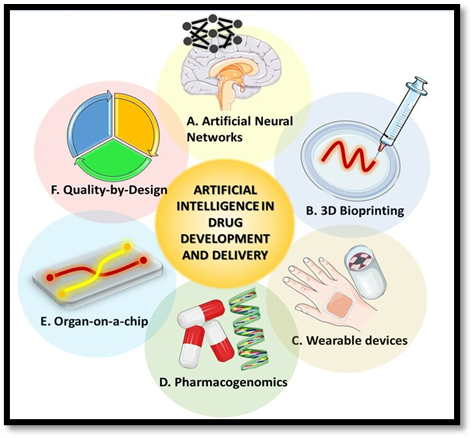
Fig.no.1.ai in drug development and delivery
AI Technologies in De Novo Formulation Design
AI's power lies in its ability to model complex systems. Key technologies include:
- Machine Learning (ML) and Deep Learning (DL):Supervised models like random forests or neural networks predict properties such as solubility, stability, and bioavailability. For instance, ML algorithms analyze physicochemical data to forecast drug-excipient compatibility (e.g., studies in Journal of Pharmaceutical Sciences, 2022).
-Generative Models:Techniques like generative adversarial networks (GANs) and variational autoencoders (VAEs) create new molecular structures or formulations. In de novo design, these models generate candidate formulations by learning from existing data, then refining them via reinforcement learning (RL) for optimal performance.
-Molecular Dynamics Simulations Integrated with AI:AI enhances simulations by predicting binding affinities or phase behaviors, enabling virtual screening of billions of combinations.
- Data Sources and Integration:AI systems ingest data from databases like PubChem, ChEMBL, or proprietary pharma datasets, combined with high-throughput experimentation (HTE) for validation.
These tools enable "inverse design," where desired properties (e.g., controlled release) dictate the formulation, rather than vice versa.
APPLICATIONS AND CASE STUDIES
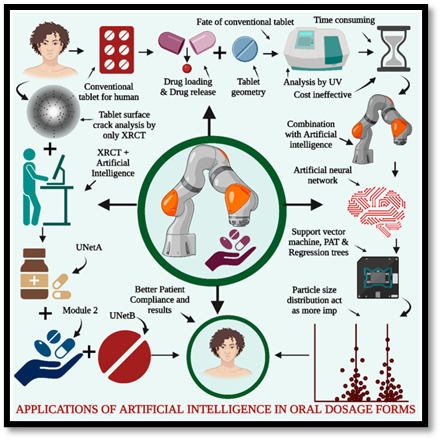
Fig.No.2.Applications of artificial intelligence in oral dosage forms
AI-driven de novo approaches have yielded breakthroughs across domains:
- Pharmaceuticals: In drug delivery, AI has designed nanoparticle formulations for targeted therapies. A 2023 study in Nature Biotechnology used GANs to generate lipid nanoparticles for mRNA vaccines, optimizing encapsulation efficiency and reducing toxicity. Similarly, de novo design of amorphous solid dispersions improved bioavailability for poorly soluble drugs, as demonstrated by ML models predicting glass transition temperatures.
- Cosmetics and Personal Care: AI optimizes emulsions and gels for skin penetration. For example, a 2021 paper in International Journal of Pharmaceutics employed DL to design sunscreen formulations with enhanced UV protection and reduced irritation, generating novel surfactant combinations.
- Agrochemicals and Materials:In pesticides, AI creates formulations with improved environmental stability. A case from ACS Applied Materials & Interfaces (2022) used RL to design biodegradable polymers for controlled-release fertilizers, minimizing runoff.
-Emerging Areas: In food science, AI designs nutraceutical formulations, such as vitamin-enriched gels, by predicting sensory properties and shelf life. These applications often integrate AI with robotics for automated synthesis and testing, accelerating the design-make-test cycle.
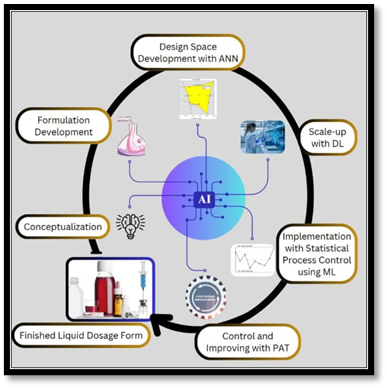
Fig.No.3.Applications of AI in drug development
ADVANTAGES
-Efficiency and Speed:AI reduces iterations by 70-90%, as seen in virtual screening workflows (e.g., AstraZeneca's AI platform cut formulation time for new drugs).
-Innovation:De novo methods uncover non-obvious solutions, like unconventional excipient pairings that enhance stability.
- Scalability: Handles multi-objective optimization (e.g., cost, efficacy, safety) across large parameter spaces.
-Sustainability:Predicts eco-friendly formulations, reducing waste in R&D.
CHALLENGES
*Data Quality and Bias:* AI models require high-quality, diverse datasets; biases in training data can lead to suboptimal designs.
- *Interpretability:* Black-box models like DL hinder regulatory approval, as seen in FDA guidelines emphasizing explainable AI.
- *Computational Demands:* Training generative models needs significant resources, limiting accessibility for smaller firms.
- *Validation Gaps:* Virtual predictions must align with real-world performance; discrepancies in complex systems (e.g., biological interactions) persist.
- *Ethical and Regulatory Hurdles:* Ensuring AI-generated formulations meet safety standards without extensive testing remains a concern.
FUTURE DIRECTIONS
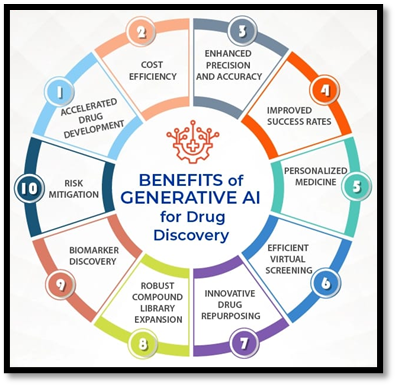
Fig.No.4.Benefits of generative AI for drug discovery
The field is poised for growth with advancements like:
- Hybrid AI-Human Systems:Collaborative tools where AI proposes designs and experts refine them.
- Quantum Computing Integration:For faster simulations of quantum-level interactions in formulations.
-Personalized Formulations:AI tailoring products to individual genomics or microbiomes, as in precision medicine.
-Open-Source Initiatives:Platforms like those from IBM or Google could democratize access, fostering interdisciplinary research.
Ongoing research, such as EU-funded projects on AI in pharma, will likely address current limitations, paving the way for fully autonomous formulation labs.
CONCLUSION
AI-driven de novo approaches are reshaping formulation design, offering unprecedented speed, innovation, and precision. While challenges in data, interpretability, and validation must be overcome, the potential to accelerate product development and sustainability is immense. As AI matures, it will empower industries to tackle global challenges, from drug shortages to environmental degradation, marking a new era in materials science. For deeper dives, refer to recent reviews in Advanced Drug Delivery Reviews (2023) and AI in Drug Discovery (2024).
REFERENCES


Rohan Raut, Sanika Mote, Revolutionizing Formulation Design: The Power of Ai-Driven De Novo ApproachesInt. J. of Pharm. Sci., 2026, Vol 4, Issue 3, 162--167. https://doi.org/10.5281/zenodo.18851648
 10.5281/zenodo.18851648
