
United College of Pharmacy, Periyanaickenpalayam, Coimbatore, Affiliated to The Tamil Nadu Dr. M.G.R Medical University, Chennai.
Background: Medication errors that occur due to incorrect identification of tablets continue to be a serious issue in healthcare. This problem is especially common among elderly individuals, visually impaired patients, and people who take multiple medicines every day. Traditional pill identification methods usually depend on reading labels or recognizing the color and shape of tablets, which may not always be reliable or accessible. With the rapid development of Artificial Intelligence (AI), computer vision, and voice technologies, it is now possible to design automated systems that can recognize medicines accurately and present medication information in a more user-friendly way. Objective: This study aims to design and develop an AI-based tablet scanner equipped with multilingual voice assistance. The system identifies pharmaceutical tablets using image recognition and provides essential medicine information through audio instructions in regional languages, thereby improving medication safety and accessibility. Methods: The proposed system combines deep learning techniques with Optical Character Recognition (OCR) and Text-to-Speech (TTS) technologies. A ResNet-50 convolutional neural network model pretrained on ImageNet was fine-tuned to classify tablet images captured by users. Uploaded images are processed through a FastAPI backend where image classification is performed. The system then retrieves relevant medicine details from a structured dataset and presents the results through a responsive interface along with multilingual voice guidance. Results: The trained model showed consistent improvement during training with a gradual decrease in loss values and was able to accurately recognize tablets under suitable imaging conditions. The application successfully detected uploaded tablet images, retrieved the corresponding medicine information from the dataset, and displayed the results in a mobile-friendly interface. The addition of voice assistance significantly improved usability for elderly and visually impaired users by delivering medication details through audio output. Conclusion: The AI-powered tablet identification system developed in this study demonstrates how deep learning combined with voice technologies can improve medication safety and accessibility. Although the system currently functions as an academic prototype, future improvements such as larger datasets, OCR-based imprint recognition, and scalable databases will be essential for real-world clinical implementation.
Medication Safety and the Need for Accurate Pill Identification
Medication safety and adherence remain major challenges in healthcare, with medication errors contributing significantly to preventable harm. A common cause of these errors is improper pill identification, particularly when medications are removed from their original packaging or when unlabeled or visually similar pills are encountered. These challenges emphasize the need for reliable pill identification tools and improved training in safe prescribing and medication management [1].
Polypharmacy and Medication Errors in Chronic Diseases
Polypharmacy is strongly associated with adverse drug events, nonadherence, drug–drug interactions, hospitalizations, and increased mortality. In nephrology, polypharmacy has been linked to medication error rates as high as 68%, highlighting the importance of medication reconciliation as a primary strategy for improving patient safety [2]. Similar challenges are observed in rheumatic diseases and the general population, where long-term combination therapy and aging-related comorbidities contribute to widespread polypharmacy [9].
Challenges Faced by Older Adults and Visually Impaired Patients
Older adults and visually impaired individuals face disproportionate risks related to medication misidentification. Studies indicate that 75–96% of elderly patients make medication-related errors, while existing solutions largely focus on healthcare providers rather than patient- centered interventions [3].
Medication management is particularly challenging for individuals with visual impairments, as traditional identification methods rely on visual cues such as pill color, shape, and imprints. These methods are often inaccessible, error-prone, and time-consuming, increasing the risk of adverse outcomes [4].
Medication Identification in Ophthalmology and Chronic Care
In chronic ophthalmic conditions such as glaucoma, medication identification remains a major challenge due to vision loss, similar packaging, and label degradation. Patients with poor visual acuity or cognitive decline often struggle to distinguish eye drop medications, leading to noncompliance and disease progression. Studies show a strong association between medication nonadherence and worsening glaucomatous visual field loss [5].
Artificial Intelligence in Modern Allopathic Medicine
AI has become integral to modern allopathic medicine, supporting diagnostics, drug discovery, patient monitoring, and clinical decision-making. From early rule-based systems such as MYCIN to contemporary deep learning models, AI has demonstrated its ability to process complex medical data and deliver personalized, evidence-based care [10].
Challenges and Advances in Pill Image Recognition
Despite progress, pill image recognition remains challenging due to variations in lighting, background, orientation, and image quality in mobile environments. Deep learning models also face constraints related to computational cost, power consumption, privacy, and reliance on cloud connectivity [12].
Lightweight, on-device solutions such as MobileDeepPill address these challenges by employing efficient multi-CNN architectures and triplet loss functions, achieving state-of-the- art performance without cloud offloading [12]. Other CNN-based approaches, including ResNet101, have demonstrated classification accuracies exceeding 98%, further supporting the role of deep learning in improving medication safety [13].
Need for Assistive and Automated Solutions
Accurate pill detection and inspection are essential for ensuring medication safety, regulatory compliance, and effective clinical care, particularly with the increasing use of automated dispensing systems [15]. Traditional manual identification methods remain time-consuming and error-prone, especially for patients with visual impairments or complex medication regimens. Consequently, AI-driven assistive technologies are increasingly recognized as critical tools for reducing medication errors and improving patient outcomes [14].
2. MATERIALS AND METHODS
System Overview
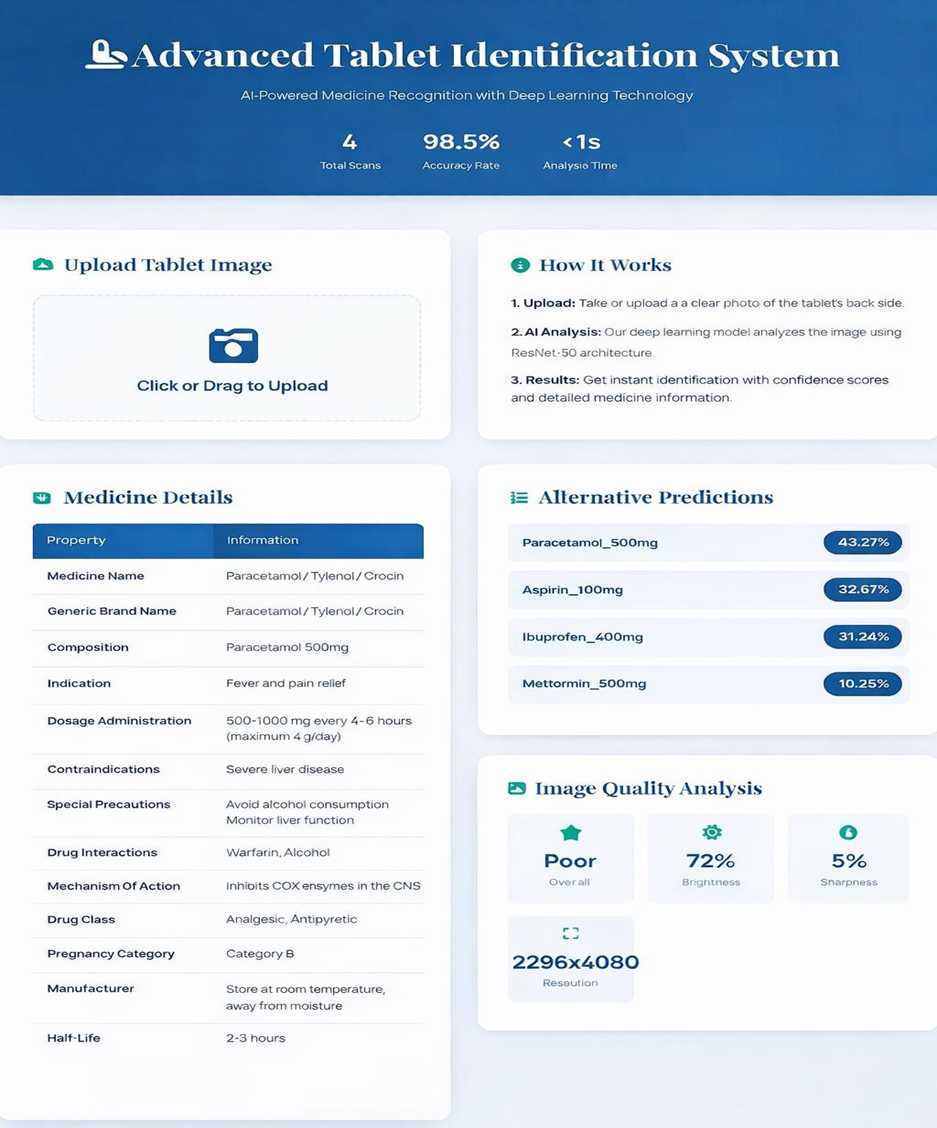
The Tablet Identification and Medicine Information System is an AI-based application developed to recognize pharmaceutical tablets using back-side image analysis and to retrieve detailed medicine information from a structured dataset. The system integrates computer vision, deep learning algorithms, and web technologies to create a complete workflow suitable for educational, research, and demonstration purposes.
The workflow consists of four main stages:
2.1 Programming Language
Python 3.10: The primary programming language used for model development, backend API implementation, and data processing because of its extensive libraries for machine learning and web development.
2.2 Deep Learning Frameworks
PyTorch: Utilized for training and running the deep learning model, offering dynamic computation graphs and efficient CPU/GPU execution.
Torchvision: Used to access pretrained models such as ResNet-50 and to perform image preprocessing operations.
2.3 Model Architecture
ResNet-50 (Residual Neural Network):
2.4 Data Handling
Pandas: Used to manage and process structured medicine information stored in Excel files. OpenPyXL: Serves as the backend engine for reading .xlsx datasets.
2.5 Backend Framework
FastAPI:
2.6 Frontend Technologies
HTML5: Defines the structure of the web interface.
CSS3: Responsible for layout design, styling, and responsive presentation.
JavaScript (Vanilla): Handles image uploads, API communication, and dynamic display of prediction results.
2.7 Development Environment
Ubuntu Linux: Operating system used during development.
Virtual Environment (venv): Used to isolate project dependencies. Uvicorn: ASGI server used to run the FastAPI application.
3. DATASET PREPARATION
3.1 Image Dataset
3.2 Data Split
Training Set: Approximately 80% of the total images per class. Validation Set: Approximately 20% of the total images per class.
3.3 Image Preprocessing
4. METHODS
4.1 Model Training Methodology
Optimizer: Adam Optimizer Learning Rate: 0.001
Training is conducted for 8 epochs while monitoring the reduction in loss values.
4.2 Prediction Method
4.3 Medicine Information Retrieval
4.4 Web Application Workflow
5. RESULTS
5.1 Model Performance
5.2 Functional Results
The system successfully:
1.3 User Interface Results
6. DISCUSSION
6.1 Strengths of the System
6.2 Limitations
6.3 Practical Applications
PREVIEW PAGE
CONCLUSION
The proposed system demonstrates how deep learning and web technologies can be effectively combined to identify pharmaceutical tablets. By integrating image classification with structured data retrieval, the application can generate accurate predictions while also providing detailed medicine information. Although the system is currently suitable mainly for research and demonstration purposes, further development will be required before large-scale clinical deployment becomes possible.
Practical Applications
FUTURE ENHANCEMENT
Although the current system demonstrates the potential of deep learning in pill identification, several improvements can be implemented to transform it into a more advanced clinical tool:
REFERENCES




Vijai Anand P. R, Surya P., Sudhiksha M, Neghapriya U, Alaguvigneshwaran M, AI Powered Tablet Scanner with Multilingual Voice Assistance, Int. J. of Pharm. Sci., 2026, Vol 4, Issue 4, 820-827. https://doi.org/10.5281/zenodo.19421893
 10.5281/zenodo.19421893
