
Ashvin College of Pharmacy, Manchi Hill, Sangamner, Ahilyanagar, Maharashtra 413714
The medicinal plants have been plays vital role from ancient times. Adhatoda vasica belongs to the Acanthaceae family. Adhatoda vasica, commonly known as “Adulsa, Vasaka, Malabar Nut” is an ayurvedic medicinal plant used to treat blood diseases, asthma, coughing, nasal congestion, allergies, and breathing issues. (Ravishankar, 2007), (Atish Gheware, Dhwani Dholakia, Sadasivam Kannan, Lipsa Panda, Ritu Rani, Bijay Ranjan Pattnaik, Vaibhav Jain, Yash Parekh, M. Ghalib Enayathullah, Kiran Kumar Bokar, Venkatesan Subramanian, Mitali Mukerji, Anurag Agrawal, and Bhavana Prasher, 2021) Adhatoda vasica is used as traditional as well as modern respiratory therapeutics. It has pharmacological qualities like expectorant, bronchodilator, mucolytic, sedative, antispasmodic, antitussive, antibacterial, and anti-diabetic activity. The alkaloids Vasicine and vasicinone exhibit an important role in bronchodilation, expectorant, anti-inflammatory, and antibacterial properties, and are among the active ingredients of Adhatoda vasica. Asthma, bronchitis, cough, and other respiratory physical disorders.
Medicinal plants have fascinated human interest, playing an important role in supporting human health through herbal medicine (Sarvechana Singh, 2024). Medicines derived from these medicinal plants have been used by various medicinal systems, such as Ayurveda, homeopathy, naturopathy, Siddha, and Unani, to treat various types of disease (Ms. Harshali N. Patil, Ms. Sakshi T. Thakare, Ms. Vrushali B. Bhosale, Mr. Jayvendra V. Rajput, Mr. Aniket G. Bhoite., 2024). Adhatoda vasica (Adulsa) is an evergreen herb belonging to the family Acanthaceae (Mr. Gaikwad Sushilkumar Dnyaneshwar, Mr. Vitthal B. Kaulage, Mr. Suryawanshi Sachin Santosh, Mr. Bhosale Prathmesh Sunil., 2024). The leaves of Vasica show stimulant effectiveness on the respiratory system. It shows antispasmodic and expectorant properties and is used to treat asthma, chronic bronchitis, and other respiratory diseases. Boiled leaves are used to treat rheumatic pain and to relieve the pain of UTI. (Atul Kumar Gangwar and Ashoke K. Ghosh, 2014). The plant grows in tropical climates and can be spotted by its spear-shaped leaves, small white or purple flowers, and bitter taste. The leaves are the essential part for medicinal purposes, though the roots, flowers, and bark also have therapeutic properties. Its important bioactive compound, vasicine, is known for its medicinal effects, especially in treating respiratory physical disorders. The plant is known to be a rich source of vitamin C, carotene & essential oil, phenols, flavonoids, and sterols. Historically important, the vasaka plant has held an important place in ancient healing practices, particularly in Ayurveda, where it is valued for its therapeutic benefits (Ms. Harshali N. Patil, Ms. Sakshi T. Thakare, Ms. Vrushali B. Bhosale, Mr. Jayvendra V. Rajput, Mr. Aniket G. Bhoite., 2024).
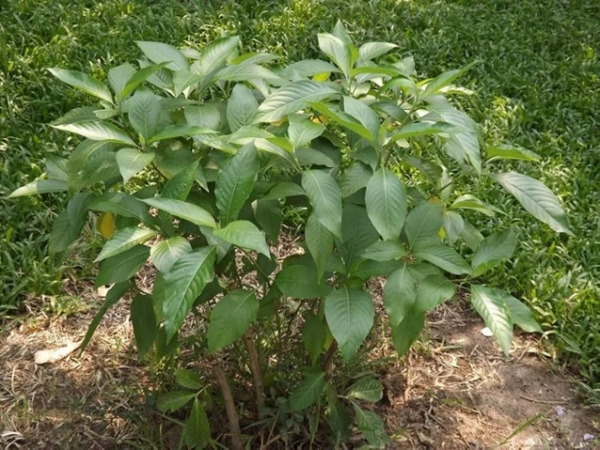
Fig 1: Adhatoda Vasica
Vernacular (popular) Name of A. vasica-
Plant Profile
A) Vasaka (Adhatoda vasica)
Adhatoda vasica is a plant used in Ayurveda to treat asthma and problems with the airways.
The plant contains chemicals called quinazoline alkaloids that help open up the airways and make it easier to breathe by clearing mucus from the windpipe.
Biological Source: Leaves of Adhatoda vasica (Family: Acanthaceae)
Common Names: Malabar Nut, Vasaka, Adulsa, Arusa
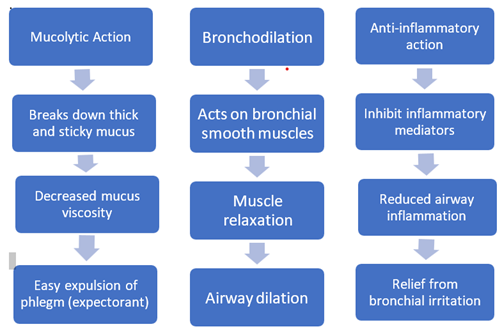
Diagram 1: Mechanism of Action of Adhatoda Vasica
Chemical Constituents:
Alkaloids: Vasicine, Vasicinone, Deoxyvasicine (quinazoline alkaloids) Others: Flavonoids, Saponins.
Active Ingredients: Vasicine, Vasicinone, Deoxyvasicine, Flavonoids (Udyanee Jayaweera, Naveen Kumar Hawala Shivashekaregowda, Sajeewa K. M. K. Herapathdeniya Priyani Ashoka Paranagama, 2024)
Mechanism of Action:
Bronchodilator: It helps relax the muscles in the airways, making it easier to breathe by reducing tightness
Mucolytic: It makes mucus thinner, so it’s easier to cough up.
Anti-inflammatory: It helps reduce swelling and inflammation in the airways Antimicrobial: It helps prevent infections in the respiratory tract.
Uses:
Part of Plant:
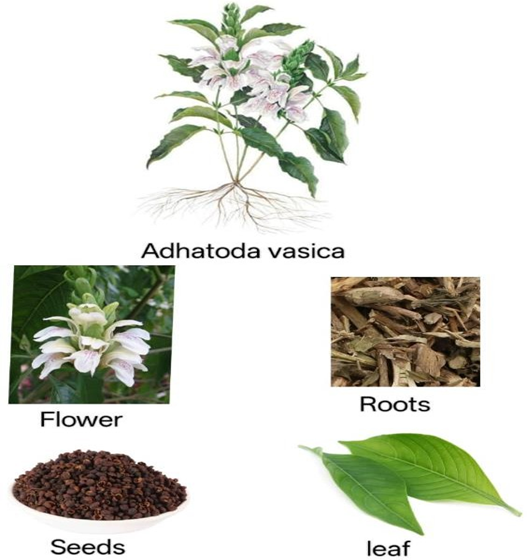
Fig 2: Adhatoda Vasica, Flower, Roots, Seeds, Leaf.
(Mukinur Hussain, Pranabesh Sikdar, Mrinmoy Nag, Bipul Nath, Manas Jyoti Kapil, Neelakshi Sharma, Biswajit Sarma., 2025)
Extraction and Isolation:
A vasica splint greasepaint (3.7 kg) was defatted with hexane at room temperature for overnight and also uprooted with methanol by hot percolation outfit for 6h at influx temperatures (65 °C). The hexane and methanol excerpts were filtered and concentrated at reduced pressure to get crude remainders of 94 gm and 443 gm independently. 50 grams of splint methanol excerpt was originally washed couple of times with n- hexane at RT and filtered. Now, this defatted residue was washed multiple times with 0.3 acetic acid result (pH 4.0, 100 mL X 3 times) and filtered. All the acid answerable portions were mixed and uprooted with chloroform (100 mL X 3 times) to remove non alkaloidal factors. The waterless part was basified with aq. Ammonia (pH 9) and uprooted with chloroform (100 mL X 3 times). The chloroform part was back washed with 50 mL of distilled water and dried over anhydrous sodium sulphate and concentrated. The attained semi-solid part was dissolved in methanol (in hot condition at 60 °C) and added same quantum of chloroform and kept it at refrigerator overnight. The unheroic-coloured solid rained was filtered and washed with cold chloroform to get a pale unheroic coloured Vasicine (650 mg.) in pure form (chastity 95). latterly, left over methanolic portion was purified by column chromatography using silica- gel 100- 200 mesh as stationary phase and hexane and fusions of ethyl acetate in hexane as mobile phase to get Vasicinone (30 mg, chastity 94) in pure form. These insulated marker composites were used as reference norms for the HPLC grounded quality system development
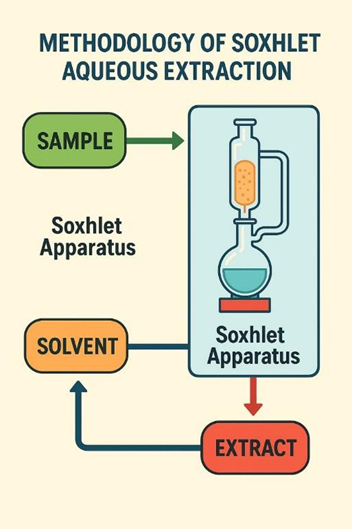
Diagram 2: Methodology of Soxhlet Aqueous Extraction.
(C. Rohini, T.N. Kavya, A. Niranjana Kumar, B. Venkatesh, J. Kotesh Kumar, KVNS. Srinivas, P. Ravi Kumar), (Dinkar Pratiksha S., Gowda Aishwarya K., Bhoir Pranali S., Miss. Padwal Prachi N., 2024)
Pharmacological Properties:
|
Sr. No. |
Pharmacological Properties |
Chemical Constituent |
Pharmacological Effect |
Clinical importance |
|
1 |
Bronchodilator and expectorant |
Vasicine |
Relaxes bronchial smooth muscles |
Asthma and chest congestion |
|
2 |
Antitussive |
Plant extracts |
Suppress cough reflex |
Dry cough |
|
3 |
Anti- inflammatory |
Flavonoids |
Reduces inflammation |
Beneficial in asthma and bronchitis |
(Mr. Gaikwad Sushilkumar Dnyaneshwar, 2024), (Sarala Patel, 2025), (Santosh Kumar Singh, Dr. Jay Ram Patel, Arvind Dangi, Deepak Bachle and Rahul Kumar Kataria, 2017), (Rachana , Basu Sujata, Pant Mamta, Kumar Manoj Priyanka and Saluja Sonam, 2011)
Phyto-Chemical Constituents:
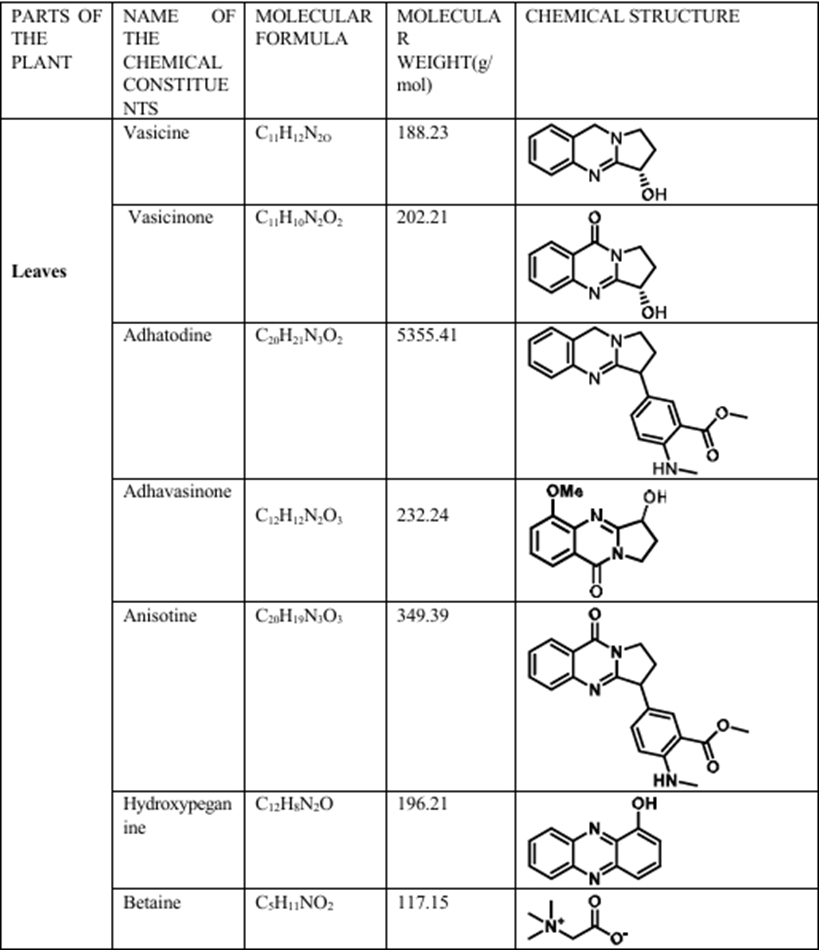
(Mukinur Hussain, Pranabesh Sikdar, Mrinmoy Nag, Bipul Nath, Manas Jyoti Kapil, Neelakshi Sharma, Biswajit Sarma., 2025), (Rachana, Basu Sujata, Pant Mamta, Kumar Manoj Priyanka and Saluja Sonam, 2011), (Drashti V Patel, Bandapalle Dattu Narayan, 2022), (Avani Gohel, Vijay Upadhye, Tarun K Upadhyay, Esha Rami, Rakeshkumar Panchal, Suraj Jadhav, Rajesh Dhakane, Vijay Kele, 2021)
CONCLUSION:
The plant Adhatoda has an important role in the herbal therapeutic system, according to various research. Adhatoda vasica is a plant with pharmacological properties and phytoconstituents. Parts of the vasaka plant are used to treat respiratory conditions and have a number of pharmacological applications, including antibacterial, antitussive, anti-inflammatory, anti-ulcer, anti-cancer, anti-diabetic, and lung, liver, and heart protection. additional organs. These plants' scientific formulation demonstrates positive effects, particularly in respiratory conditions.
REFERENCES

Prashant Palghadmal, Hindavi Adhav, Bhakti Khandagale, Asmita Dukre, Krishna Vishwasrao, Rajwardhan Patil, Indranil Thombare, A Critical Review on Analytical Methods for FDA Approved Drugs: Olaparib, Int. J. of Pharm. Sci., 2026, Vol 4, Issue 1, 878-884. https://doi.org/10.5281/zenodo.18200779
 10.5281/zenodo.18200779
