
Shraddha Institute of Pharmacy, Kondala Zambre, Washim-444505.
Control of mosquitoes is something of utmost importance in the present day with rising number of mosquitoes borne illnesses. Deforestation and industrialized farming are also two of the factors causing an alarming increase in the range of mosquitoes. Specialty products like mosquito repellent used to combat mosquitoes are required. Each of the products used for mosquito control have varying degrees of effectiveness. Carbon dioxide and lactic acid present in sweat in warm- blooded animals act as an attractive substance for mosquitoes. The perception of the odor is through chemo-receptors present in the antennae of mosquitoes. Insect repellents work by masking human scent; a number of natural and chemical mosquito repellents were studied in this review that work to repel mosquitoes. Chemical mosquito repellents has a remarkable safety profile , but they are toxicity against the skin & nervous system like rashes, swelling, eye irritation, and worse problems, though unusual --including brain swelling in children, anaphylactic shock, and low blood pressure. Hence it was concluded that natural mosquito repellents were preferred over chemical mosquito repellents. Mosquito-borne illnesses are still a concern to world health, particularly in tropical and subtropical areas. An efficient defense against mosquito bites and the spread of these diseases is the use of mosquito repellents. Chemical-based mosquito repellents can be harmful to human health, especially to children and pregnant women. The use of natural plant-based components is a potential approach in the development of sustainable and eco-friendly mosquito repellents, which has gained popularity in recent years.Mosquito are among the most common and widely distributes insects. It has earned a worldwide reputation as torturers of man and also diseases carries. Mosquito are classified as one of the deadliest pests known to man. The activity of mosquito is affected by climate, light and temperature. The current study is mainly carried out for the development of mosquito repellent cotton fabric using “orange peel” extracts.[1].
Most plants have compounds that help protect them from attacks by phytophagous (plant-eating) insects. These compounds fall into the following categories: poisons, growth regulators, repellents, and feeding deterrents. Repellants made from plants are easily biodegradable and provide no toxicity risk to humans or domestic animals. Natural items are safe for human consumption, unlike synthetic ones. Thus, now is the time to begin a thorough investigation into environmentally safe biological materials for insect pest control. Several researchers have noted that phytochemials formed from plant resources have deterrent properties and can function as larvicidal, insect development regulators, repellents, and ovipositional attractants. In many regions of the world, plant items have long been used to either kill or repel mosquitoes. Research on phytochemicals as insect repellents is desperately needed[1].Natural plant remedies have been used for ages to repel or eliminate mosquitoes in various parts of the world. Investigating phytochemicals as insect repellents is urgently needed. Citrus fruits like oranges are members of the Rutaceae family. They are a good source of vitamin C and dietary fiber, along with other essential elements. Oranges are usually round or oval in shape, with rough, leathery skin that might be orange or yellow-orange in color. The inside fruit might be segmented, juicy, sweet, or sour, depending on the variety. The outer, colorful coat of orange skin that shields the fruit within is called an orange peel. They are abundant in flavonoids, essential oils, and other nutrients. Depending on the orange variety and peel thickness, orange peels can be either sweet or bitter. While sweet orange peels are utilized for baking and other culinary applications, bitter orange peels are frequently used to make marmalades and other preserves[2].
Fig no.1 Orange Peels

Fig no.1 Orange Peels
Definition Of Mosquito Repellent:
Mosquito repellent are product that are used to keep mosquitoes away, which are insect that can spread diseases like malaria, dengue.
Mosquito Born Diseases:
Mosquitoes have been known to transmit a number of human diseases since ancient times. Mosquitoes, of which there are over 3,500 species, are found in areas outside of the world's tropical and subtropical zones. Anopheles (malaria, filariasis), Aedes (yellow fever, dengue, chikungunya), and Culex (West Nile, Japanese encephalitis, filariasis) are the main genera that spread human illnesses[3,4]. A female mosquito consumes blood several times during its life cycle in order to receive the proteins required for the development of its eggs[5]. It injects pathogen-containing saliva into the host during feeding, enabling the pathogens to finish a portion of their life cycle and proliferate inside the mosquito's salivary glands[6]. Because of this, the female mosquito is a powerful carrier of many human infections and blood-borne illnesses. Malaria continues to be one of the leading causes of death in India[7]. According to historical records, the 1950s had the highest frequency of malaria in the nation, with an estimated 75 million cases and 0.8 million fatalities per year[8].Most common diseases spread by mosquitoes are zika, dengue, chikungunya, West Nile virus, malaria and yellow fever[9].
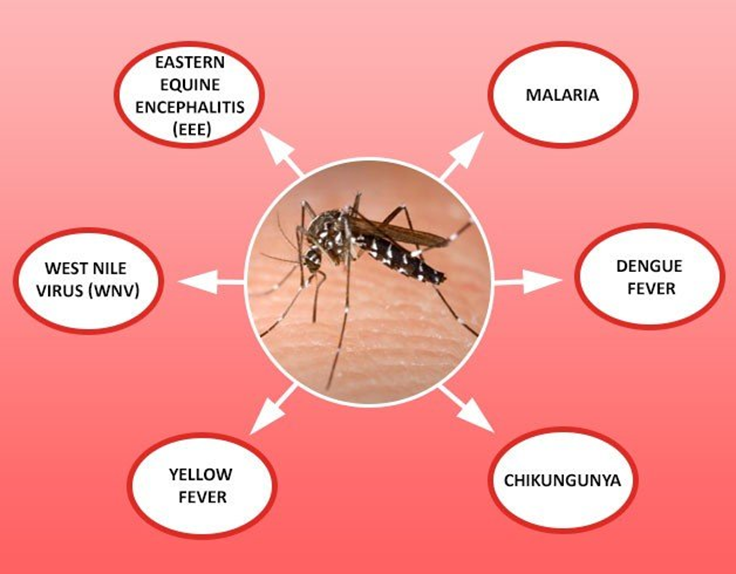
Fig no. 2 Mosquito Born Diseases
Malaria
It is a dangerous and common disease. The illness usually manifests 10 to 15 days after the Mosquito bite. Symptoms include fever, chills and sweating.
Dengue Fever
A mosquito carrying the virus can bite a person and spread the dengue illness. The symptoms start to show up three to fourteen days after infection. A common symptoms include high fever, headache, vomiting, joint pain.
Chikungunya
When an infected Aedes aegypti mosquito bites a human, it can transmit the virus that cause chikungunya. The symptoms of the sickness include a high fever, muscular and joint discomfort, joint swelling, exhaustion and headache.
Yellow Fever
It is spread by mosquitoes, yellow fever typically has a brief duration. The majority of people suffer from symptoms like fever, chills, nausea, back pain and appetite loss.
West Nile Virus
Even while the majority of west nile virus infection roughly 80% don’t cause any symptoms,the illness can still be harmful.If they do, they may have a fever, headache,stiff neck, tremors and weakness in their muscles.
Methods Of Mosquito Repellents
|
Chemical Methods |
Non-Chemical Methods |
Biological Methods |
|
Synthetic repellents: DEET, Permethrin Natural repellents: Neem oil, Citronella Oil
|
Physical methods: Medicated net, Non- Medicated net, Mosquito traps
Mechanical methods: Election mosquito zapper, Mosquito Magnet |
By growing some fish species that feeds on mosquito larvae in water bodies |
1)Chemical Methods
There are a number of natural and chemical mosquito repellents that works to repel mosquitoes. The synthetic chemical repellent, DEET is most effective. It is essentially a poison that masks the natural odor and carbon monoxide that is released from the human body[10].
Advantages of chemical methods:
Disadvantages of chemical methods:
2)Non-Chemical Methods
Non-Chemical Methods rely on physical or mechanical barriers and devices to prevent or control mosquito populations without using harmful chemicals. This method is safer for human health and environment as compared to chemical methods[11].
Advantages of Non chemical methods:
Disadvantages of Non chemical methods:
3)Biological Methods
By growing some fish species that feeds on mosquito larvae in water bodies.
“Village Pharmacy”
Orange used in repel the mosquitoes
Important micronutrients, such as vitamins C and E, as well as carotenoids and flavonoids, are found in the human diet and are necessary for maintaining human health. Almost all plant material contains many dietary sources for these chemicals[18]. The presence of these functional food elements and antioxidant nutraceuticals or phytochemicals contributes to the nutritional value of foods[19]. Phytochemicals are found in edible fruits and vegetables, and when consumed, they may help to regulate human metabolism and avoid chronic and degenerative diseases[20]. Citrus fruits are the primary source of key phytochemical components and have long been prized for their nutritional and antioxidant characteristics[21]. Oranges' high vitamin and mineral content has been scientifically demonstrated to provide numerous health benefits. Furthermore, other biologically active, non-nutrient compounds found in citrus fruits, such as phytochemical antioxidants and soluble and insoluble dietary fibres, are now recognised as beneficial in lowering the risk of cancer, as well as many chronic diseases such as arthritis, obesity, and coronary heart disease[22]. Orange itself is boon as its repellent activities against various insects such as cockroaches, beetle mosquitoes, etc. The seeds and powder of its peels is used in various ways in controlling pests in storage. Its seeds and peels contain certain compounds which varied the level of bitterness and these compounds have been tested against insects and proved to be effective[23]. The beneficial roles of orange are as follows:
Importance of Orange in the economy:
Orange (Citrus sinensis) is one of the world’s major fruit crops with global availability and popularity in human diets. Albert Lasker invented orange juice as the solution for the solution for orange overproduction, years later people start invented orange juice as a commercial product and start to sell it. The largest producer of orange juice in the world is Brazil, followed by the U.S.A., India, China and Spain.Citrus sinensis has a world production of 49.6 million metric tons for the year 2016-2017 (USDA, 2017).
CONCLUSION:
Mosquitoes continue to be a major hazard to global health since they are carriers of many infectious diseases, especially in tropical and subtropical areas where their survival and reproduction are encouraged. Mosquito populations and their range of activity have rapidly increased due to environmental factors including deforestation and mechanized farming, as well as the growing spread of diseases carried by mosquitoes.The best way to repel mosquitoes, when compared to synthetic methods, is to use natural repellents. However, because natural repellents can evaporate completely, they may need to be reapplied more frequently to maintain full protection. This can be addressed by creating different dosage forms of volatile oil, such as lotions, ointments, and creams, using different water-removable bases.In light of these drawbacks, research on safer, more environmentally friendly, and natural mosquito control methods is becoming more and more important.Because they are sustainable, non-toxic, and biodegradable, plant-based repellents present a promising alternative. An inventive and environmentally responsible method is the use of natural substances, such orange peel extract, to create cotton garments that repel mosquitoes. In addition to lowering health hazards, these natural formulations also lessen reliance on dangerous synthetic chemicals.Thus, the creation and use of plant-based insect repellents can be seen as a safe, sustainable, and successful approach to preventing mosquito-borne illnesses in the contemporary world.
REFERENCES

Shreya Rajbinde*, Swati Kanoje, Dr. Swati Deshmukh, Review on Efficacy of Orange Peels as a Mosquito Repellents, Int. J. of Pharm. Sci., 2025, Vol 3, Issue 11, 553-561 https://doi.org/10.5281/zenodo.17528392
 10.5281/zenodo.17528392
