View Article

Abstract

Mass spectrometry is a technique used to find and identify proteins and other molecules in biological samples. It can also help in studying how proteins interact with each other. In this method, a molecule is broken into charged pieces. These pieces(ions) are then moved, separated, and detected based on their mass-to-charge (m/z) ratio. The detector shows how many ions are present by measuring their signals. This chapter also explains the common problems that can occur while collecting raw data and how the data is processed to read the mass spectrum. First, peaks are selected from a survey scan. These peaks are then studied in MS/MS to find the mass of peptide fragments. The fragments are matched with a database to get a peptide score. Finally, proteins are identified from the correctly matched peptides

Keywords

Mass, Charge, Velocity, Ion, Fragment, Protein

Introduction

Mass spectrometry (MS) is a powerful method used to study different chemicals in areas likethe environment, medicine, pharmacy, forensics, and food testing(1). In this technique, thesample (solid or liquid) is changed into gas and then into charged particles called ions(2). These ions are separated based on how they move in electric and magnetic fields. The results appearas a mass spectrum, which is a graph showing different ions based on their mass(3). If a puresubstance is present, the graph shows a strong peak with a high m/z value. When MS isconnected with instruments like HPLC or GLC, it becomes more sensitive and can detect even very small amounts of a substance(4). MS is also used to find the structure and molecular weight of organic and biological compounds. It is an important tool in proteomics, the study of protein structures (5).

PRINCIPLE-

In a mass spectrometer, the sample is first heated to create a high vapor pressure, which helps the molecules break into fragments and become ionized. These charged ions are then accelerated by applying voltage, making them move through the mass analyzer based on their mass. Ions that have the same charge travel with the same speed. Next, the ions enter a magnetic field in the detector. This magnetic force pushes ions with the same speed into a curved or circular path. Charged ions bend because the magnetic field acts like a centripetal force, pulling them toward the center. Only the ions that have the right combination of electric and magnetic properties pass through without bending and reach the data system, where their signals are recorded. The mass spectrum created from this process is then used to study and identify substances in the sample(6)
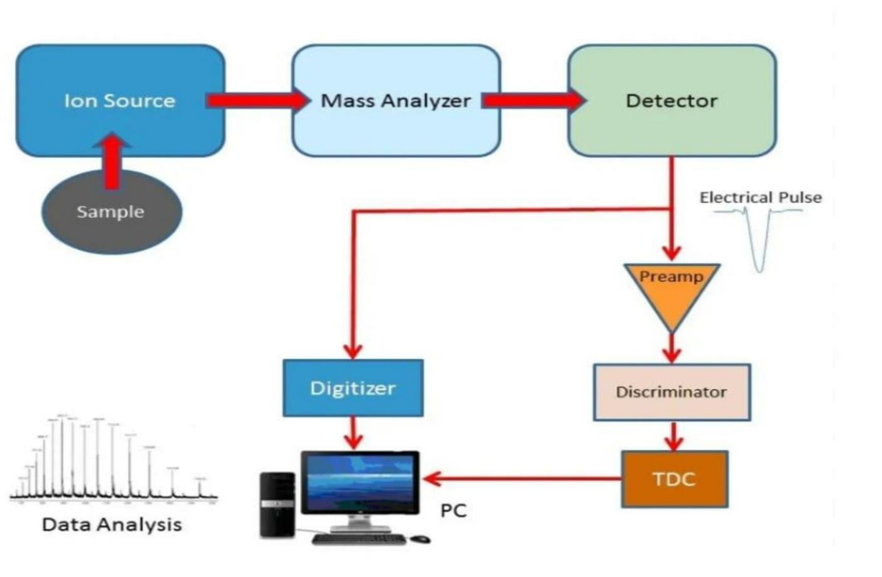


Fig no .1 working of mass spectroscopy


WORKING–

Before a sample can be analyzed in mass spectrometry, it must be properly prepared forionization, which is an essential step in the working of the instrument. Samples are commonly converted into liquid or gaseous form using chromatography techniques such as gas chromatography and liquid chromatography(7). In gas chromatography, thesample is diluted, vaporized, and separated based on properties like molecular size,shape, boiling point, and weight, after which the volatile components are directed intothe mass spectrometer for ionization and detection(8). Liquid chromatographyseparates components according to theirinteraction with the mobile and stationaryphases, mainly influenced by polarity, allowing each compound to enter the massspectrometer individually for further ionization, mass separation, and detection(9).Other ionization-based preparation methods, such as electrospray ionization and fastatom bombardment, help convert samples into ions directly from liquid or solidphases(10). These steps enable the mass spectrometer to accurately analyze a widerange of biomolecules, including proteins, nucleic acids, lipids, and fatty acids, as part of its overall working mechanism(11,12).


 RECENT ADVANCEMENT –
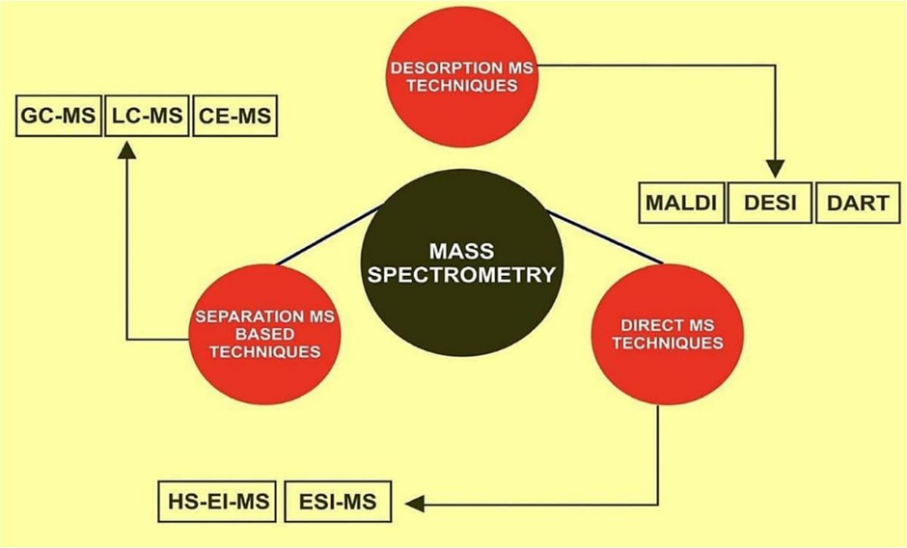


Fig no.2 Recent advancement of mass spectroscopy


APPLICATION-

[1] Analysis of Aerosol Particles-

•Helps monitor and control air pollution.

• Assists in predicting climate change effects.

• Evaluates health risks from airborne particles.

• Identifies sources of dust, smoke, and pollutants

•Supports environmental and atmospheric research (13,14,15).

[2] Emerging Medical and Biomedical -

•Detects age-related protein changes.

•Identifies disease biomarkers (Alzheimer’s, Parkinson’s).

•Detects antibiotic-resistant microbes.

Used in toxicology and drug testing.

•Checksherbal, nutrition, and supplement

Composition (15,16,17,18,19,20,21,22,23,24,25,26,27)

[3] Identification of Environmental Pollutants

Mass spectrometry (MS) can be used to identify environmental pollutants such as

nitrogen oxides, sulfur dioxide, plastics, lead, and particulate matter that are harmful to

both humans and animals. By combining the selectivity of liquid chromatography (LC)

with the high sensitivity of MS, LC-MS has become a powerful tool for environmental

analysis. It helps detect steroid estrogens and nitrosamines in wastewater, analyze

polar, ionic, and heat-sensitive substances, identify antibiotics in pesticides, and detect

perfluorinated organic (PFO) compounds found in cleaning products, textiles, and

photographic materials. Thus, LC-MS plays an important role in assessing and

controlling environmental pollution (28).

[4] Proteomics Mass spectrometry (MS) is widely used for protein analysis, helping in protein

characterization and sequencing through soft ionization methods like electrospray and

MALDI. It can identify proteins of different molecular weights, study changes in protein

expression, detect post-translational modifications, and analyze important interactions

such as protein–ligand, protein–protein, and protein–DNA interactions (29).

?

CONCLUSION

Advanced mass spectrometry techniques can now accurately detect andidentify over 2,000 proteins within a single proteome. In complex mixtures, the majorchallenges are not sensitivity, but rather the wide dynamic range—where highly abundantpeptides can overshadow those present in low amounts—and the limited sequencing speed ofthe instrument..

??REFERENCES

  1. ?H. H. Willard, L. L. Merritt, Jr., J. A. Dean, F. A. Settle, Jr. (1988) Instrumental Methods of Analysis, Wadsworth Publishing Co., Belmont, CA, pp. 465-507.
  2. Sparkman, O. David (2000). Mass spectrometry desk reference. Pittsburgh: Global View Pub. ISBN 978-0-9660813-2-9.
  3. J. Barker, Mass Spectrometry, Analytical Chemistry by Open Learning, Wiley, 2nd Edition (1999).
  4. J. T. Watson, O. D. Sparkman, Introduction to Mass Spectrometry– Instrumentation, Applications and Strategies for DataInterpretation, 4th Ed., John Wiley and Sons, Chichester, 2007.
  5. E. De Hoffmann, V. Stroobant, Mass Spectrometry – Principles and Applications, 3rd Ed., John Wiley and Sons, Chichester, 2007.
  6. Strathmann FG, Hoofnagle AN. Current and future applications of mass  spectrometry to the clinical laboratory. Am J Clin Pathol. 2011; 136: 609-616.
  7. Bourgogne E, Wagner M. [Sample preparation and bioanalysis in mass spectrometry]. Ann Biol Clin (Paris). 2015 Jan-Feb;73(1):11-23. [PubMed]
  8. Fothergill WT. Gas chromatography. Technique. Proc R Soc Med. 1968 May;61(5):525 -8. [PMC free article] [PubMed]
  9. Rappold BA. Review of the Use of Liquid Chromatography-Tandem Mass Spectrometry in Clinical Laboratories: Part I-Development. Ann Lab Med. 2022 Mar 01;42(2):121-140. [PMC free article] [PubMed]
  10. Meher AK, Chen YC. Electrospray Modifications for Advancing Mass Spectrometric Analysis. Mass Spectrom (Tokyo). 2017;6(Spec Iss):S0057. [PMC free article] [PubMed]
  11. Hemling ME. Fast atom bombardment mass spectrometry and its application to the analysis of some peptides and proteins. Pharm Res. 1987 Feb;4(1):5-15. [PubMed]
  12. Züllig T, Köfeler HC. HIGH RESOLUTION MASS SPECTROMETRY IN LIPIDOMICS. Mass Spectrom Rev. 2021 May;40(3):162-176. [PMC free article] [PubMed]
  13. Nash, David G.; Baer, Tomas; Johnston, Murray V. (2006).“Aerosol mass spectrometry: An introductory review”.International Journal of Mass Spectrometry. 258 (1-3): 2-12. Bibcode:2006IJMSp.258....2N.
  14. Pratt, Kerri A.; Prather, Kimberly A. (2012). “Mass spectrometry of atmospheric aerosols-Recent developments and applications. Part I: Off-line mass spectrometry techniques”. Mass Spectrometry Reviews. 31 (1): 16.doi:10.1002/mas.20322
  15. Pratt, Kerri A.; Prather, Kimberly A. (2012). “Mass spectrometry of atmospheric aerosols-Recent developments and applications. Part II: On-line mass spectrometrytechniques”. Mass Spectrometry Reviews. 31 (1): 17-48
  16. Shuken, S.R., Rutledge, J., Iram, T. et al. Limited proteolysis–mass spectrometry reveals aging-associated changes in cerebrospinal fluid protein abundances structures. Nat Aging (2022).
  17. Sebastián-Serrano Á, de Diego-García L, Díaz-Hernández M. The Neurotoxic Role of Extracellular Tau Protein. Int J Mol Sci. 2018;19(4): 998. Published 2018 Mar 27. Ozge Karayel, Sebastian Virreira Winter, Shalini Padmanabhan, Yuliya I. Kuras, Duc
  18. Tung Vu, Idil Tuncali, Kalpana Merchant, Anne-Marie Wills, Clemens R. Scherzer, Matthias Mann. Proteome Profiling of Cerebrospinal Fluid Reveals Novel BiomarkerCandidates for Parkinson’s Disease. bioRxiv 2021.07.22.453322.
  19. Michno W, Blennow K, Zetterberg H, Brinkmalm G. Refining the amyloid β peptide molecula characterization in brain, cerebrospinal fluid, blood, and plasma. J Neurochem. 2021 Oct; 159(2): 234-257.
  20. Hrabak J, Bitar I, Papagiannitsis CC. Combination of mass spectrometry and DNA sequencing for detection of antibiotic resistance in diagnostic laboratories. Folia Microbiol (Praha). 2020 Apr; 65(2): 233-243.
  21. Charretier Y, Schrenzel J. Mass spectrometry methods for predicting antibiotic resistance. Proteomics Clin Appl. 2016 Oct;10(9-10): 964-981.
  22. Liang T, Leung LM, Opene B, Fondrie WE, Lee YI, Chandler CE,Yoon SH, Doi Y, Ernst RK, Goodlett DR. Rapid Microbial Identification and Antibiotic Resistance Detection by Mass Spectrometric Analysis of Membrane Lipids. Anal Chem.2019 Jan 15; 91(2): 1286-1294.
  23. Abril AG, Carrera M, Böhme K, Barros-Velázquez J, Calo-Mata P,Sánchez-Pérez A, Villa TG. Proteomic Characterization ofAntibiotic Resistance in Listeria and Production of Antimicrobialand Virulence Factors. Int J Mol Sci. 2021 Jul 29; 22(15): 8141.
  24. Wu AHB. The Impact of Mass Spectrometry on Patients' Medicaland Nonmedical Lives.Lab Med. 2021 Jul 1; 52(4):e58-e65.
  25. Holzlechner M, Eugenin E, Prideaux B. Mass spectrometryimaging to detect lipidbiomarkers and disease signaturcancerCancer Rep (Hoboken). 2019 Dec; 2(6): e1229.
  26. Haartmans MJJ, Emanuel KS, Tuijthof GJM, Heeren RMA,Emans PJ, Cillero-Pastor B.Mass Spectrometry-based BiomarkersforKnee Osteoarthritis: A Systematic Review. Expert RevProteomics. 2021 Aug; 18(8): 693-706.
  27. L?daru A, B?l?nescu P, Stan M, Codreanu I, Anca IA. Candidateproteomic biomarkers fornon-alcoholic fatty liver disease(steatosis and non-alcoholic steatohepatitis) discovered withmass-spectrometry: a systematic review. Biomarkers. 2016; 21(2):102-14.
  28. Bene J, Szabo A, Komlósi K, Melegh B. Mass SpectrometricAnalysis ofcarnitineandits Esters: Potential Biomarkers of Disturbances in Carnitine Homeostasis Curr Mol Med. 2020;20(5): 336-354.
  29. Chromatography and mass spectrometry for environmental analysis. https://www.azom.com/article.aspx?ArticleID=12518.
  30. Dancik V. et al.De novo peptide sequencing via tandem mass spectrometry. J Comput Biol. 1999; 6: 327-342.
  31. M. Karas and F. Hillenkamp, Laser desorption ionization of proteins with molecularweight exceeding 10,000 daltons, Analyt. Chem. 60 (1988), 2299-3201

Reference

  1. H. H. Willard, L. L. Merritt, Jr., J. A. Dean, F. A. Settle, Jr. (1988) Instrumental Methods of Analysis, Wadsworth Publishing Co., Belmont, CA, pp. 465-507.
  2. Sparkman, O. David (2000). Mass spectrometry desk reference. Pittsburgh: Global View Pub. ISBN 978-0-9660813-2-9.
  3. J. Barker, Mass Spectrometry, Analytical Chemistry by Open Learning, Wiley, 2nd Edition (1999).
  4. J. T. Watson, O. D. Sparkman, Introduction to Mass Spectrometry– Instrumentation, Applications and Strategies for DataInterpretation, 4th Ed., John Wiley and Sons, Chichester, 2007.
  5. E. De Hoffmann, V. Stroobant, Mass Spectrometry – Principles and Applications, 3rd Ed., John Wiley and Sons, Chichester, 2007.
  6. Strathmann FG, Hoofnagle AN. Current and future applications of mass  spectrometry to the clinical laboratory. Am J Clin Pathol. 2011; 136: 609-616.
  7. Bourgogne E, Wagner M. [Sample preparation and bioanalysis in mass spectrometry]. Ann Biol Clin (Paris). 2015 Jan-Feb;73(1):11-23. [PubMed]
  8. Fothergill WT. Gas chromatography. Technique. Proc R Soc Med. 1968 May;61(5):525 -8. [PMC free article] [PubMed]
  9. Rappold BA. Review of the Use of Liquid Chromatography-Tandem Mass Spectrometry in Clinical Laboratories: Part I-Development. Ann Lab Med. 2022 Mar 01;42(2):121-140. [PMC free article] [PubMed]
  10. Meher AK, Chen YC. Electrospray Modifications for Advancing Mass Spectrometric Analysis. Mass Spectrom (Tokyo). 2017;6(Spec Iss):S0057. [PMC free article] [PubMed]
  11. Hemling ME. Fast atom bombardment mass spectrometry and its application to the analysis of some peptides and proteins. Pharm Res. 1987 Feb;4(1):5-15. [PubMed]
  12. Züllig T, Köfeler HC. HIGH RESOLUTION MASS SPECTROMETRY IN LIPIDOMICS. Mass Spectrom Rev. 2021 May;40(3):162-176. [PMC free article] [PubMed]
  13. Nash, David G.; Baer, Tomas; Johnston, Murray V. (2006).“Aerosol mass spectrometry: An introductory review”.International Journal of Mass Spectrometry. 258 (1-3): 2-12. Bibcode:2006IJMSp.258....2N.
  14. Pratt, Kerri A.; Prather, Kimberly A. (2012). “Mass spectrometry of atmospheric aerosols-Recent developments and applications. Part I: Off-line mass spectrometry techniques”. Mass Spectrometry Reviews. 31 (1): 16.doi:10.1002/mas.20322
  15. Pratt, Kerri A.; Prather, Kimberly A. (2012). “Mass spectrometry of atmospheric aerosols-Recent developments and applications. Part II: On-line mass spectrometrytechniques”. Mass Spectrometry Reviews. 31 (1): 17-48
  16. Shuken, S.R., Rutledge, J., Iram, T. et al. Limited proteolysis–mass spectrometry reveals aging-associated changes in cerebrospinal fluid protein abundances structures. Nat Aging (2022).
  17. Sebastián-Serrano Á, de Diego-García L, Díaz-Hernández M. The Neurotoxic Role of Extracellular Tau Protein. Int J Mol Sci. 2018;19(4): 998. Published 2018 Mar 27. Ozge Karayel, Sebastian Virreira Winter, Shalini Padmanabhan, Yuliya I. Kuras, Duc
  18. Tung Vu, Idil Tuncali, Kalpana Merchant, Anne-Marie Wills, Clemens R. Scherzer, Matthias Mann. Proteome Profiling of Cerebrospinal Fluid Reveals Novel BiomarkerCandidates for Parkinson’s Disease. bioRxiv 2021.07.22.453322.
  19. Michno W, Blennow K, Zetterberg H, Brinkmalm G. Refining the amyloid β peptide molecula characterization in brain, cerebrospinal fluid, blood, and plasma. J Neurochem. 2021 Oct; 159(2): 234-257.
  20. Hrabak J, Bitar I, Papagiannitsis CC. Combination of mass spectrometry and DNA sequencing for detection of antibiotic resistance in diagnostic laboratories. Folia Microbiol (Praha). 2020 Apr; 65(2): 233-243.
  21. Charretier Y, Schrenzel J. Mass spectrometry methods for predicting antibiotic resistance. Proteomics Clin Appl. 2016 Oct;10(9-10): 964-981.
  22. Liang T, Leung LM, Opene B, Fondrie WE, Lee YI, Chandler CE,Yoon SH, Doi Y, Ernst RK, Goodlett DR. Rapid Microbial Identification and Antibiotic Resistance Detection by Mass Spectrometric Analysis of Membrane Lipids. Anal Chem.2019 Jan 15; 91(2): 1286-1294.
  23. Abril AG, Carrera M, Böhme K, Barros-Velázquez J, Calo-Mata P,Sánchez-Pérez A, Villa TG. Proteomic Characterization ofAntibiotic Resistance in Listeria and Production of Antimicrobialand Virulence Factors. Int J Mol Sci. 2021 Jul 29; 22(15): 8141.
  24. Wu AHB. The Impact of Mass Spectrometry on Patients' Medicaland Nonmedical Lives.Lab Med. 2021 Jul 1; 52(4):e58-e65.
  25. Holzlechner M, Eugenin E, Prideaux B. Mass spectrometryimaging to detect lipidbiomarkers and disease signaturcancerCancer Rep (Hoboken). 2019 Dec; 2(6): e1229.
  26. Haartmans MJJ, Emanuel KS, Tuijthof GJM, Heeren RMA,Emans PJ, Cillero-Pastor B.Mass Spectrometry-based BiomarkersforKnee Osteoarthritis: A Systematic Review. Expert RevProteomics. 2021 Aug; 18(8): 693-706.
  27. L?daru A, B?l?nescu P, Stan M, Codreanu I, Anca IA. Candidateproteomic biomarkers fornon-alcoholic fatty liver disease(steatosis and non-alcoholic steatohepatitis) discovered withmass-spectrometry: a systematic review. Biomarkers. 2016; 21(2):102-14.
  28. Bene J, Szabo A, Komlósi K, Melegh B. Mass SpectrometricAnalysis ofcarnitineandits Esters: Potential Biomarkers of Disturbances in Carnitine Homeostasis Curr Mol Med. 2020;20(5): 336-354.
  29. Chromatography and mass spectrometry for environmental analysis. https://www.azom.com/article.aspx?ArticleID=12518.
  30. Dancik V. et al.De novo peptide sequencing via tandem mass spectrometry. J Comput Biol. 1999; 6: 327-342.
  31. M. Karas and F. Hillenkamp, Laser desorption ionization of proteins with molecularweight exceeding 10,000 daltons, Analyt. Chem. 60 (1988), 2299-3201.

Photo
Ashwini Shinde
Corresponding author

Eklavya College Of Pharmacy

Photo
Shruti Mali
Co-author

Eklavya College Of Pharmacy

Photo
Mrudula More
Co-author

Assistant Professor, Eklavya College Of Pharmacy

Ashwini Shinde*, Shruti Mali, Mrudula More, Mass Spectrometry -A Powerful Tool for Modern Analysis, Int. J. of Pharm. Sci., 2026, Vol 4, Issue 2, 2299-2303. https://doi.org/10.5281/zenodo.18640058

More related articles
Formulation And Evaluation of Fast Disintegrating ...
Nagendra R., Anusha B. H., Venkatesh, K. Hanumanthachar Joshi, ...
Formulation and Evaluation of Herbal Cough Syrup o...
K. S. Jamkar, S. D. Ashfaq , K. M. Dahe, K. O. Naikwadi, V. V. Sh...
Drug Utilization Evaluation of Antibiotics at A Te...
Rashmitha R., Sahana G., Beulah Milton, Janavi G., ...
Related Articles
The Use Of Azolla Pinnata In Veterinary Nutrition: A Case Study Of Nashik, India...
Siddharth Avinash Kale, Deepali K. Kadam, Dipali V. Jain, Shraddha Kamankar, Shruti Zaware, Swaraj P...
Formulation and Evaluation of Herbal Anti-Aging Face Serum...
Sharad Mali, Ashish Raut, Dr. Amol Joshi, ...
Formulation And Evaluation Of The Various Physicochemical, Rheological, And Stab...
Priyanka S. Sawarkar, Mohit A. Gede, Ankit S. Kediya, M. P. Katwe, M. P. Rathod, R. O. Ganjiwale, ...
Formulation And Evaluation of Floating Gastroretentive Drug and Delivery System...
Mayuri Raut , Payal Malekar , Dr. A. Chandewar, Dr. Madhuri Channawar, ...
Formulation And Evaluation of Fast Disintegrating Tablet of Betaxolol Hydrochlor...
Nagendra R., Anusha B. H., Venkatesh, K. Hanumanthachar Joshi, ...
More related articles
Formulation And Evaluation of Fast Disintegrating Tablet of Betaxolol Hydrochlor...
Nagendra R., Anusha B. H., Venkatesh, K. Hanumanthachar Joshi, ...
Formulation and Evaluation of Herbal Cough Syrup of Tulsi by Using Honey Base...
K. S. Jamkar, S. D. Ashfaq , K. M. Dahe, K. O. Naikwadi, V. V. Shinde, Dr. R. D. Ingole, ...
Drug Utilization Evaluation of Antibiotics at A Tertiary Care Hospital...
Rashmitha R., Sahana G., Beulah Milton, Janavi G., ...
Formulation And Evaluation of Fast Disintegrating Tablet of Betaxolol Hydrochlor...
Nagendra R., Anusha B. H., Venkatesh, K. Hanumanthachar Joshi, ...
Formulation and Evaluation of Herbal Cough Syrup of Tulsi by Using Honey Base...
K. S. Jamkar, S. D. Ashfaq , K. M. Dahe, K. O. Naikwadi, V. V. Shinde, Dr. R. D. Ingole, ...
Drug Utilization Evaluation of Antibiotics at A Tertiary Care Hospital...
Rashmitha R., Sahana G., Beulah Milton, Janavi G., ...