
Department of Pharmaceutics, College of Pharmacy, Anjarakandy, Kannur, Kerala, India
The present study aimed to formulate and evaluate a polyherbal antifungal cream using natural ingredients with established therapeutic potential. The formulation comprised Psidium guajava, Curcuma longa, and Aloe vera along with suitable excipients such as beeswax, liquid paraffin, borax, methyl paraben, and rose oil. The cream was prepared by the emulsification method and identified as a water-in-oil (W/O) type emulsion. Five formulations (F1–F5) were developed and evaluated for physicochemical properties, including appearance, pH, viscosity, spreadability, thermal stability, and phase separation. All formulations exhibited acceptable physical characteristics such as smooth texture, semisolid consistency, and pleasant odor with no phase separation observed during stability testing. The pH of the formulations ranged from 5.02 to 5.49, indicating compatibility with skin pH. Viscosity values were found to be in the range of 31,500 to 46,200 cps, suggesting suitable consistency for topical application. Spreadability studies revealed values between 5.5 and 7.0 cm, indicating good spreadability of the formulations. The antifungal activity was evaluated against Candida albicans using the agar diffusion method. Among all formulations, F4 showed the highest zone of inhibition (30 mm), followed by F2 (24 mm), indicating superior antifungal activity. The enhanced activity of F4 may be attributed to the synergistic effect of phytoconstituents present in the herbal ingredients. The study concludes that the formulated polyherbal antifungal cream is stable, effective, and suitable for topical application, with F4 identified as the optimized formulation. This formulation may serve as a promising, safe, and economical alternative to conventional antifungal agents.
All cosmetic preparation has their application for long or short periods to beautify the body as well as to keep the body healthy up to some extent and has psychological impact to other. The “active life” of any cosmetic preparation begins the moment it is brought in contact with the skin/hair/teeth/or nails and ends when it is removed or has evaporated. During its active life, it has an intimate reciprocal relationship, which results in cosmetic changes on the body. The cosmetic product prevents its outer layer from drying out, penetrates below the external layer and introduces active substances in to deep lying strata or adhere only superficially to change color or luster of areas. The cosmetic which are used for decorative purposes, i.e., eyeliner, rouge, mascara, face masking preparations, etc., also carry the inherent risk of undesirable side effects. It may inhibit important physiological processes, chemically modify certain skin constituents (e.g., in the case of bleaching and coloring preparations), and contribute towards their removal or even give rise to certain allergic reactions.[1]
Creams are semisolid emulsions of either oil in water(o/w) or water in oil(w/o) type, which are usually medicated, intended for an external application. The skin care creams can be classified as follows according to the type of emulsion. [2]
COLD CREAM
Cold cream is a w/o type emulsion.It is an emulsion of water and fats which can be used to clean,soften the skin and to remove the makeup.The name derives from cool feeling that cream leaves on the skin. Cold cream produces a cooling effect because of the slow evaporation of the water present in the skin.
USES OF COLD CREAM
USES OF VANISHING CREAM
FUNGAL INFECTION
Fungal infections are also known as mycosis and are more severe because they occur on the third layer of the skin. Fungae act on keratin tissue such as skin, nails, and hair. In the skin, fungi lead to subcutaneous infections, and over the past years, the cases of fungal skin infections have been increasing rapidly, especially in immunocompromised individuals. Several well-known skin infections, such as Tineacorporis (ringworm), Tineapedis, Tineafaciei, Tineamanuum, Tineacruris, are caused mainly by Trichophyton species.[5,6]
The occurrence of Tinea infection in various body parts.
Table.1 The occurrence of Tinea infection in various body parts
|
Tinea Infection |
Affected Locations |
|
Tineacapitis |
Scalp[7] |
|
Tineacorporis |
Trunk[8] |
|
Tineafaciei |
Face[9] |
|
Tineamanuum |
Hands[10] |
|
Tineapedis |
Feet[11] |
|
Tineaunguium |
Nails[12] |
Fungal exposure causes tissue necrosis of epidermal layers and can lead to superficial, systemic, and subcutaneous mycosis. Except for the production of protease enzymes by yeast and non-dermatophytes, dermatophytes, yeast, and non-dermatophytes share the same pathologic pathway. They always act upon the skin, nails, and hair keratin of human beings and animals, as they utilize keratin as a nutrient source, which ultimately leads to tissue necrosis.
Types Of Fungal Infection
Antifungal fungal cream
Antifungal cream are used to kill or inhibit the growth of fungi that cause infection in humans, animal, and plants
Mechanism of action
The main mechanism of action of antifungal agents by disrupting the fungal cell membrane by targeting ergosterol.
The following materials are used in the preparation of the herbal antifungal cream :
Table 2: Materials used for herbal anti-fungal cream
|
Sr. No. |
Constituents |
Uses |
|
1. |
Guava powder |
Anti-fungal, anti-inflammatory |
|
2. |
Turmeric |
Exfoliant, anti-acne |
|
3. |
Aloe vera |
Anti-acne, soothing and healing property |
|
4. |
Beeswax |
Skin elasticity, anti-bacterial |
|
5. |
Liquid paraffin |
Hydrating, cleansing, and softening Property |
|
6. |
Borax |
Emulsifier, buffering agent |
|
7. |
Methyl paraben |
Preservative |
|
8. |
Ethyl alcohol |
Anti-microbial activity, cleansing property |
|
9. |
Rose oil |
Fragrance, anti-oxidant |
|
10. |
Water |
Solvent |
Table 3. Equipment’s used for formulation and evaluation for polyherbal cream
|
Sr. No. |
Equipment |
Company |
|
1. |
Digital pH meter |
RoyalLab |
|
2. |
Brooksfield Viscometer |
Ametek |
|
3. |
Incubator |
Brinsea |
|
4. |
Soxhlet Apparatus |
Dolphin |
|
5. |
Heating Mantle |
EIE instruments PVT.LTD |
|
6. |
Hot Plate |
Asian Scientific |
|
7. |
Autoclave |
URAVI |
METHOD
Preparation of guava extract: The leaves of guava were dried for 2-3 days and then ground to make powder, which was further screened by a mesh to get a uniform particle size. About 50g of powdered sample was taken in a thimble and mixed with 250ml of acetone (solvent) in the Soxhlet apparatus. Extraction was carried out for 12 hours. The extract was then filtered by Whatman filter paper no.1.
The solvents were removed by drying at room temperature to get the crude extracts, stored at refrigerated condition for further analysis. [13]
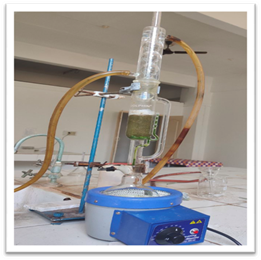
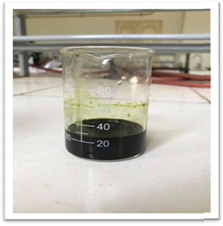
Figure 11.Soxhlet process of guava
The rhizomes of turmeric were dried for 4-6 days and then ground to make powder, which was further screened by a mesh to get a uniform particle size. About 40g of powdered sample was taken in a thimble and mixed with 200ml of acetone (solvent) in the Soxhlet apparatus. Extraction was carried out for 12 hours. The extract was then filtered by Whatman filter paper no.1. The solvents were removed by drying at room temperature to get the crude extracts, stored at refrigerated conditions for further analysis.[14]
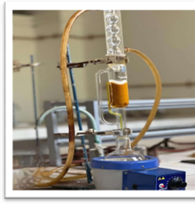
Figure 12. Soxhlet process of turmeric
4. Preparation of aloe vera extract:
Aloe vera gel was extracted by a simple draining procedure where 2-4 leaves of aloe vera were cut at half inch from the base so as to drain out all the yellow sap materials. The mucilage was stirred vigorously in a blender to make it uniform. This solution was strained through a muslin cloth and filtered, and the filtrate is stored.[15]
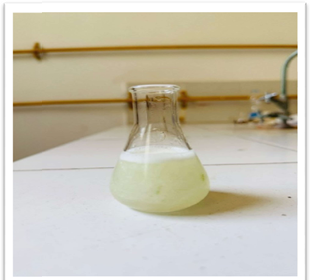
Figure 13. Aloe vera extract
The formulation of Polyherbal Antifungal cream :
Table 4: formula for polyherbal antifungal cream preparation
|
Sr. No. |
Constituents |
F1 |
F2 |
F3 |
F4 |
F5 |
|
1. |
Guava extract |
1g |
1g |
1g |
1g |
1g |
|
2. |
Turmeric extract |
1g |
1g |
1g |
1g |
1g |
|
3. |
Aloe vera extract |
1ml |
1ml |
1ml |
1ml |
1ml |
|
4. |
Beeswax |
3g |
3.5g |
4g |
4.5g |
5g |
|
5. |
Borax |
3g |
2.5g |
2g |
1.5g |
1.5g |
|
6. |
Liquid paraffin |
7ml |
7ml |
7ml |
7ml |
7ml |
|
7. |
Methylparaben |
0.1g |
0.1g |
0.1g |
0.1g |
0.1g |
|
8. |
Ethyl alcohol |
3ml |
3ml |
3ml |
3ml |
3ml |
|
9. |
Rose oil |
Q.S |
Q.S |
Q.S |
Q.S |
Q.S |
|
10. |
Water |
5ml |
5ml |
5ml |
5ml |
5ml |
PREPARATION OF POLYHERBAL ANTI-FUNGAL CREAM
Preparation:
The polyherbal anti-fungal cream formulation was prepared by using herbal extract. Melted the beeswax with mineral oil by heating in a water bath at a temperature of 70 °C. Here, curcumin and Psidium guajava is not soluble in water. So it was mixed with a minimum quantity of ethyl alcohol. This was added to borax water mixture and heated to the same temperature. Both temperatures were attained at a temperature of 70 °C. The aqueous phase was added to oil phase with rapid, constant stirring until cool. Filtered it into a container and labelled it.[16]
EVALUATION:
All five formulation polyherbal anti-fungal cream preparations were subjected to the following evaluation studies:
Spreadability is a term expressed to denote the extent of area to which the cream readily spreads on application on skin and expressed in terms of time in secs. Two sets of glass slides of standard dimensions were taken. The formulation whose spreadability had to be determined was placed over one of the slides; the other slide was placed on top of the formulation. Then a weight or certain load was placed on the upper slide so that the formulation between the two slides was pressed uniformly to form a thin layer. Then the weight was removed, and the excess of formulation adhering to the slides was scraped off. The upper slide was allowed to slip off freely by the force of the weight tied to it. The time taken by the upper slide to slip was noted. The spreadability was then calculated from the following formula [22,23]
The prepared cream was kept in a closed container at a temperature of 25-1000C away from light. Then, phase separation was checked for 24 hrs. Any change in phase separation was observed or checked. [24,25]
A dilution test was conducted to determine the type of emulsion formed. In this method, to find out the oil in water emulsion, it was diluted with an aqueous solvent, whereas to find out the water in oil emulsion, it was diluted with an oily liquid.[4]
ASSESSMENT OF ANTIFUNGAL ACTIVITY
The antifungal activity of all optimized formulations and blank formulation were carried out by Cup-plate method in comparison with the marketed antifungal formulation .The antifungal activity test was performed by using Candida albicans. Prepared nutrient (SDA) brought and poured in to sterile petri plates and kept aside for drying and cooling. After that candida albican culture were spread by micron wire loop. A sterile cork borer 6 mm diameter was used to drill holes 4 mm deep. Then place 0.5 gm of cream from each formulations in to this holes. Plates were then incubated at 27°C for 24 hr. Then the zone of inhibition (diameter in mm) was measured. [26,27]
RESULT
In this test color, odour,texture and state of 5 formulation was checked.
Table 5: Evaluation of physical appearance of poly-herbal antifungal cream
|
Sr. No. |
Parameters |
F1 |
F2 |
F3 |
F4 |
F5 |
|
1. |
Colour |
Orange |
Orange |
Orange |
Orange |
Orange |
|
2. |
Odour |
Pleasant |
Pleasant |
Pleasant |
Pleasant |
Pleasant |
|
3. |
Texture |
Smooth |
Smooth |
Smooth |
Smooth |
Smooth |
|
4. |
State |
Semisolid |
Semisolid |
Semisolid |
Semisolid |
Semisolid |
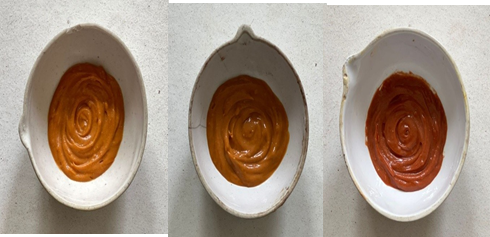
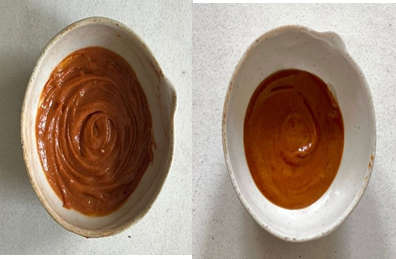
Figure 14. prepared polyherbal antifungal
Table 6: Evaluation of thermal stability of polyherbal antifungal cream
|
Formulations |
Thermal stability |
|
F1 |
Stable, no oil separation |
|
F2 |
Stable, no oil separation |
|
F3 |
Stable, no oil separation |
|
F4 |
Stable, no oil separation |
|
F5 |
Stable, no oil separation |
Table 7: Evaluation of pH of poly-herbal antifungal cream
|
Formulations |
Ph |
|
F1 |
5.02 |
|
F2 |
5.24 |
|
F3 |
5.02 |
|
F4 |
5.44 |
|
F5 |
5.49 |
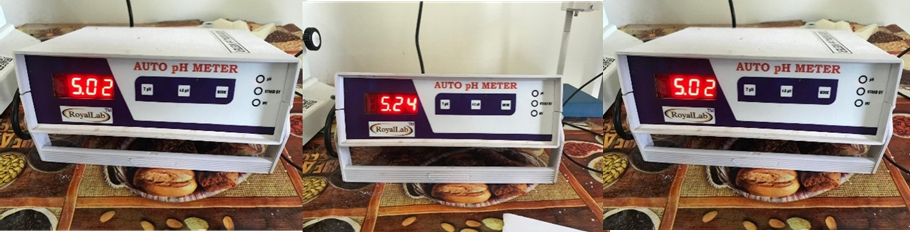
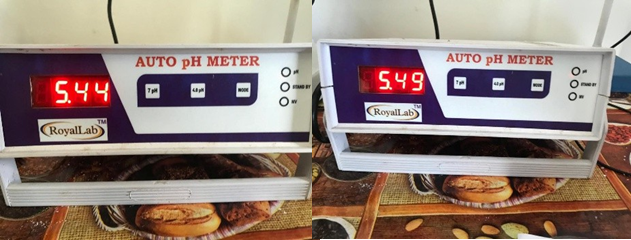
Figure 15. Determination of pH
Viscosity of cream were done using Brooke field viscometer at a temperature of 250C.According to the result, five formulation showed adequate viscosity.
Table 8. Determination of viscosity of polyherbal antifungal cream
|
SR. NO. |
FORMULATIONS |
VISCOSITY |
|
1 |
F1 |
46200 |
|
2 |
F2 |
43140 |
|
3 |
F3 |
34980 |
|
4 |
F4 |
31500 |
|
5 |
F5 |
32940 |
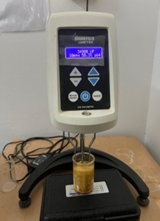
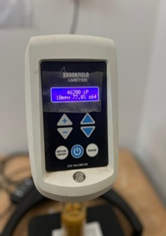
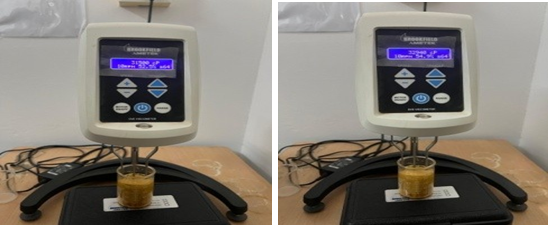
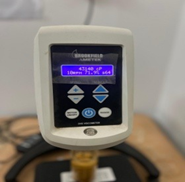
Figure 16. Determination of viscosity
Table 9: Evaluation of spreadability of poly-herbal antifungal cream
|
Formulations |
Initial diameter(cm) |
Final diameter(cm) |
|
F1 |
2 |
7 |
|
F2 |
2 |
6 |
|
F3 |
2 |
6.2 |
|
F4 |
2 |
5.5 |
|
F5 |
2 |
6.8 |
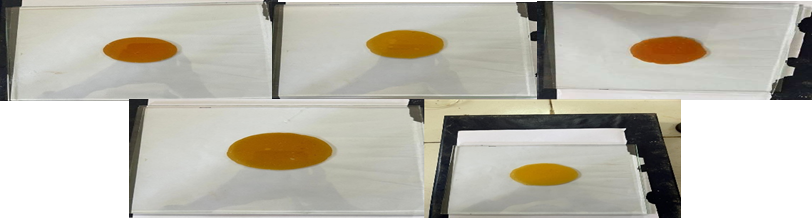
Figure 17. Spreadability
Prepared cream was kept in closed container at a temperature 25-1000C away from light. Then phase separation was checked for 24 hrs for 3 days. Any change in phase separation was observed. According to the result no phase separation was observed in all 5 formulations.
Table 10: Evaluation of type of emulsion test of poly-herbal antifungal cream
|
Sr. No. |
Formulation |
Type of emulsion |
|
1. |
F1 |
W/O |
|
2 |
F2 |
W/O |
|
3 |
F3 |
W/O |
|
4 |
F4 |
W/O |
|
5 |
F5 |
W/O |
DETERMINATION OF ANTIFUNGAL ACTIVITY
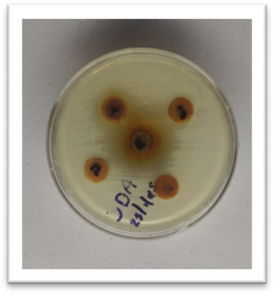
Figure 18. Zone of inhibition
The quantitative assessment for antifungal activity of the polyherbal cream containing extract of guava, turmeric, and aloe vera and their combination against Candida albicans was performed and determined by measuring the diameter of the zone given below:
Diameter of zone of inhibition
Table 11
|
FORMULATIONS |
DIAMETER OF ZONE |
|
F1 |
20mm |
|
F2 |
24mm |
|
F3 |
18mm |
|
F4 |
30mm |
|
F5 |
19mm |
CONCLUSION
Natural remedies are acceptable in the belief that they are safer with fewer side effects than synthetic ones. Herbal formulations have a growing demand in the world market. Polyherbal anti- fungal cream containing natural ingredients and herbal extracts of Psidium guajava and Curcuma longa, and aloe vera have potential effects in controlling fungal infections. Polyherbal anti- fungal cream helps to overcome various side effects caused by chemical agents in various marketed products. Our study has evaluated all five formulations for their physical and physicochemical properties. From the evaluation studies, it was determined that the F4 formulation has more antifungal activity and has optimum viscosity compared to the other four formulations. Considering the legacy of usage of the herbs for various healthcare practices, the above findings suggest that the study formulation on cream will be a safe, effective, and economical preparation for managing fungal infections
REFERENCES






Aswani V M, Adarsh C, Arathi V, Dhanha Fathima C M, Fathimathul Zahara P V, Muhammed Shajil C K, Formulation and Evaluation of Polyherbal Antifungal Cream, Int. J. of Pharm. Sci., 2026, Vol 4, Issue 4, 2380-2389. https://doi.org/10.5281/zenodo.19594572
 10.5281/zenodo.19594572
