View Article

Abstract

Lipstick and lip balm is an cosmetic product that are mainly used by women includes waxes, oils, pigments and dyes, antioxidants, fragrances, flavors and preservatives and other additives etc. which imparts the attractive color, texture and smoothness of lips. Now a day, herbal lipstick and lip balm has increased the demand because cosmetic industry uses many synthetic chemicals for skin care products to make formulation better and give quality standards, which become very harsh to lips because lips are very sensitive part of skin. It can damage due to prolonged use of synthetic lipstick. Herbal cosmetics contains all those natural ingredients require for formulation which has no side effect and chemically safe for use to keep lips healthy. In the present study, herbal lipstick and lip balm were prepared from the natural ingredients such as various extracts of beetroot, carrot and pomegranate fruits by using different extraction techniques, some other ingredients like oils, waxes, antioxidants, pigments etc. were used and prepared both formulation and evaluated by different evaluation tests which resembles the good results with standard values.

Keywords

Herbal lipstick, waxes, oils, formulation, lip balm, skin care etc

Introduction

According to D&C act 1940 & rules 1945, cosmetic means any article intended to be sprayed, poured, rubbed or sprinkled on or applied to the human body or its any part for glamorize, or reshape the appearance.1, 2 Cosmetics have become important aspects of everyone’s life to look beautiful and glamorous, to achieve healthy and smooth skin by using various cosmetic products. Cosmetics products are made to help nourish to skin and look beautiful but this contains synthetic chemicals that can be harsh to skin and it could be leave some undesirable conditions.6 Moreover, it is known that cosmetic industries uses dozens of synthetic chemicals in all skin care products from lipstick to creams and shampoos to hair oils to make formulation better and give quality standards.5 Now days, lipstick and lip balm is most popular beauty product used by women. Lipstick and lip balm contains noxious mixture of petroleum based chemicals, many of them not been tested for safety. Some chemicals in lipstick and lip balm are easily absorbed through the lips and even each time it is ingested a small dose of toxic chemicals. Lips are sensitive part of skin (lacks hairs and sweat glands, which means they do not have same natural defense that other types of skin have) and easily absorbed through the thin layer of skin that covers them. For that instance, consumers always look for natural based cosmetics to prevent themselves from any sort of adverse reaction on skin.3

Herbal cosmetics has increased its demand worldwide because it contains naturally occurring phyto ingredients without contains synthetic and harsh chemicals which may give harsh effect to human skin such as allergy, dermatitis, skin discoloration, drying of lips. Most important chemicals are dye, which is added into the lipstick formulation for imparting color. A lot of lipstick and lip balm are made with synthetic dyes that come from aluminium or petroleum products. These dyes are stored in our body in the organs and fatty tissues. Coal tar one of the petroleum products that used is known as carcinogen. Some of the colors may even contain heavy metals. Some of them are not approved as food colorants yet may be used in cosmetics. To avoid all this circumstances, herbal-based formulation contains natural coloring agent as a dye or pigments from leaves, fruits and flowering parts of plant sources, natural flavors, oils, wax and emollients, which provides color, texture, fragrance and protection to the lips. Therefore, there is tremendous boost in the use of herbal lipstick and lip balm so that consumers can take safe advantage of herbal lipstick.

It contain also wax, oil, pigments, essence, preservatives, & antioxidants. Wax gives smooth and glossy appearance, such as carnauba wax, white bees wax, honey bees wax. Oil that gives oily & translucent effect, such as castor oil, olive oil, coconut oil almond oil etc. pigment gives color or shade to the lipstick such as pomegranate, dragon fruit, carrot, beetroot, blue berries, purple cabbage, cocoa powder. Antioxidants increase its shelf life, such as vitamin C, vitamin E, and kiwi. Essence gives pleasant sent to the lipstick & mask the smell of other ingredients, such as vanilla, strawberry, rose etc.4

Components of herbal lipstick and lip balm:

TableNo.1 Components of herbal lipstick and lip balm

Sr. No.

Ingredients

% Used

Use

1

White bees wax

5-20%

Binds oil & it is higher melting point wax

2

Carnauba wax

1-3%

Impart rigidity and hardness

3

Castor oil

40-50%

Humectants

4

Almond oil

2-3%

Vitamin E

5

Lanolin

5-15%

Blender

6

Essence

q.s

Mask the smell of other ingredients

7

Extract

q.s

Gives color or shade to the lipstick

      Bases: mostly waxes are used as a base for lipstick and lip balm formulation. This wax gives a stable texture to the lipstick and lip balm. The content of bases should be much higher as compared to other components. All the ingredients required for making the lipstick and lip balm is dispersed between the wax phases. So that, the other ingredients must be wax soluble. As per herbal formulation point of view, the wax which is being used that should be natural  like white bees wax, yellow bees wax, carnauba wax, candeila wax, lanolin etc.

  1. Oils: oils are also used as a part of lipstick and lip balm formulation, as wax gives texture and oil gives glossy and smooth structure to the texture. The content of oils is adjusted near to that of wax phase because the other natural ingredients being used for formulation must be soluble in oil as well. Many more herbal oils are used for lipstick and lip balm formulation like, castor oil, olive oil, almond oil, jasmine oil, rose oil, orange oil, lemon oil, coconut oil, cotton seed oil, palm oil, avocado oil etc. basically, almost all the oils having different property like every oil has different fragrance so that we have a many choices in terms of fragrance for herbal formulation.
  2. Natural Coloring agent: the basic need of lipstick and lip balm formulation is to impart the color to the lips so that it covers any roughness or stain of lips as well as gives a beauty texture to the lips to look more beautiful than normal lips and to keep lips hydrated upto longer time. Different coloring agents give variety of shades. Solubility of color becomes challenging task in herbal formulation because the colors are obtained from natural sources especially from flowers and fruits. The naturally occurring colors are free from other chemical impurities, wax and oil soluble, non-toxic with no physiological activity.8

An ideal colorant should have following characteristics:

  1. The colorant should be non-toxic and having no physiological activity.
  2. The coloring power should be high enough so that only small quantities would be sufficient for use.
  3. Colorant should be unaffected by light, temperatures, pH changes, hydrolysis, and microorganisms therefore they must be stable on storage.
  4. It should compatible with other ingredients.
  5. Colorants should not be affected by oxidizing or reducing agents.

Advantages of natural coloring agents to our lips:

  1. Pomegranate is our favorite healthy breakfast fruit; pomegranate is another ideal solution for treating dark lips. It can nourish and moisturize lips as well as help restore give a natural looking pink color.
  2. Beetroot has bleaching properties and is often added in lip balms to give you perfectly tinted lips. Apart from making your lips rosy pink, it will also moisturize and nourish your lips.
  3. Carrot contains many essential vitamins and minerals and help increase blood circulation. You can also use beetroot paste or carrot pulp (which is the leftover part when you juice carrots) on your lips. It will help improve any dark spots or discoloration and make them look healthy and red rose petals nourish, soften and lighten your lips naturally. Together with milk, they work as a wonderful remedy for discoloration and repair dark, patchy lips.11

Table No. 2 Naturally occurring colors from different plant and fruits

Sr. No.

Sources

Chromophore

Color

1

Grapes, Blueberry, Purple Cabbage, Blackberry

Anthocyanin

Purple Blue

2

Avocado, kiwi, Cucumber, Spinach, Broccoli

Chlorophyll

Green

3

Papaya, Pineapple, Pumpkin, Carrot, Orange

Carotenoids

Yellow Orange

4

Beetroot, Tomato, Strawberry, Watermelon, Pomegranate

Lycopene

Red

5

Cauliflower, Potato, Ginger, Onion, Banana

Anthoxanthines

White tan

4. Flavoring agent:

Flavors are selected based on the taste of the drug or other ingredients that need to be
incorporated. Flavors used in a lipstick should not contain any ingredient, which may be irritating or toxic. These should have good taste and should be able to mask the fatty door of the base.

Flavoring agents are an essential component to mask the door of the fatty or wax base as well as to impart an attractive flavor.

Table No. 3 Examples of masking flavors

Sr. No.

Taste

Masking Flavors

1

Salt

Butterscotch, Mapple

2

Bitter

Wild cherry, walnut, liquorice,

3

Sweet

Fruit, berry, vanilla

4

Acid

Citrus

Some of the advantages of using natural cosmetics that make them a better choice over the synthetic ones are as follows.

  1. Safe to use
  2. Compatible with body
  3. Natural in nature
  4. Affordable and non-expensive
  5. Variety of products
  6. No side effect
  7. Not tested on animals

Ideal characteristic of Lipstick:

  1. Smooth and easy to apply.
  2. Non-irritant and non-toxic
  3. Should have attractive color and shine
  4. Free from grittiness and should be non-drying
  5. It should have required plasticity
  6. It should pleasant taste, odor, and flavor
  7. Do not lose its smooth and shiny appearance during storage.
  8. Stable during its shelf life-means free from bloom or sweating during storage.
  9. It should not melt or harden within reasonable variation of climate temperature.

MATERIALS AND METHODS:

Three different fruit extracts viz. Pomegranate, beetroot and carrots were used for formulation of herbal lipstick and lip balm. All the fruits were collected from nearby areas. Other ingredients such as natural oils and waxes were purchased from Analab fine chemicals, Mumbai.

EXTRACTION, PREPARATION AND EVALUATION OF HERBAL LIPSTICKS:
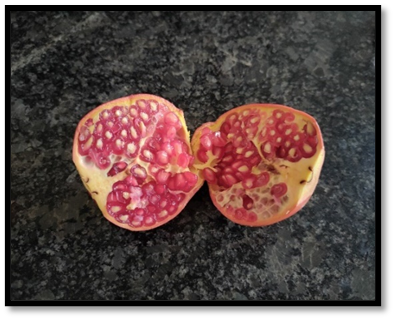
  1. Extraction process of pomegranate : firstly, washed pomegranate and peeled it. Then pomegranate blended and Collected Juice of Pomegranate. then, it  was shaken and macerated with 100 mL solvents (aqueous ethanol 50:50) for 15 minutes under ice cooling condition. The aqueous mixture was centrifuged at 18,000 rpm and 4C? for 20 min followed by fast filtration on nylon mesh. The ethanol was completely removed after concentration process and extract were kept in a dark.17

Figure 1: Pomegranate Fruit (Punica granatum) before extraction process
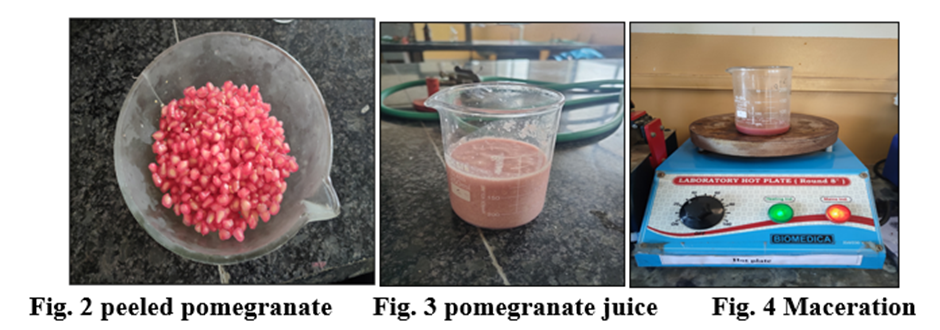
Figure 2, 3 and 4: Preparation of Peeled Pomegranate extract and Maceration process
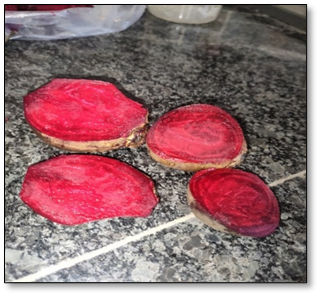
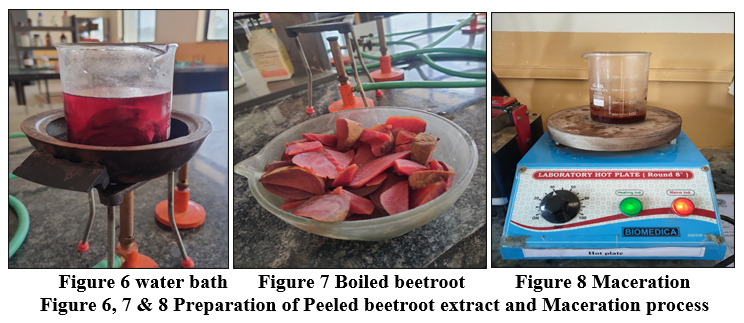
  1. Extraction process of beetroot: Extraction of pigment was achieved by homogenization of equal ratio of fruit pulp and solvents. 100 g of the peeled fruit was shaken and macerated with 100 mL solvents (aqueous ethanol 50:50) for 15 minutes under ice cooling condition. The aqueous mixture was centrifuged at 18,000 rpm and 4C? for 20 min followed by fast filtration on nylon mesh. The ethanol was completely removed after concentration process and sample kept in a dark vessel.6, 13,14

Figure 5 Beet Root (Beta vulgaris) before extraction process
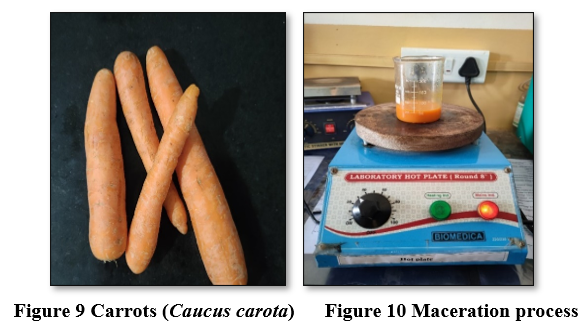
Extraction process of carrot: Carotenoids were obtained from carrot by milling followed by pressing; filtration and evaporation resulted into juice. Then, a juice was shaken and macerated with 100 ml solvent (aqueous ethanol 50:50) and add rose petals for 15 minutes under ice cooling condition. The aqueous mixture was centrifuged at 18,000 RPM and 4C? for 20 min followed by fast filtration on nylon mesh. The ethanol was completely removed after concentration process and samples were kept in dark vessels.19
Preparation of herbal lipstick of pomegranate, beetroot and carrot extract:
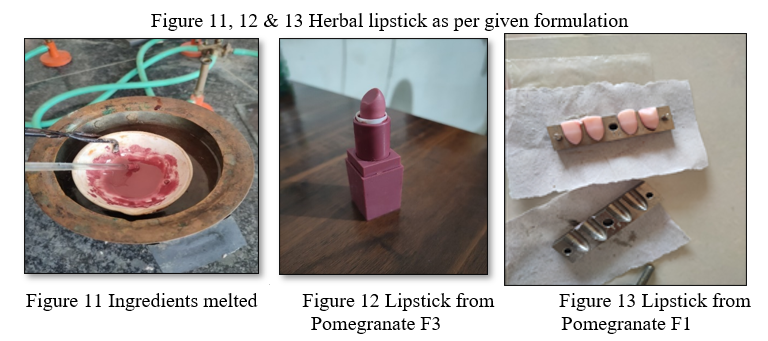
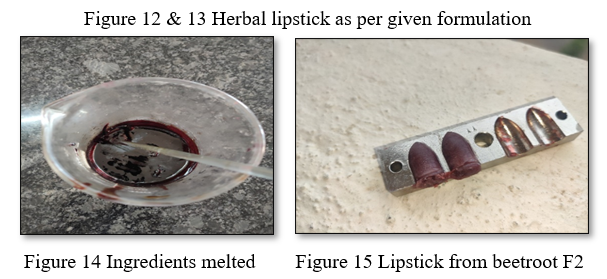
  1. Lipstick mould was cleaned and washed using detergent and water. Mould had lubricated with liquid paraffin and kept in inverted position on ice to drain excess lubricant and to cool lipstick mould.
  2. White bees wax, Lanolin, carnauba wax, with coconut oil or Almond oil were weighed and transferred it to porcelain dish, then kept on water bath until it melts properly.
  3. Acacia was added to above melted mixture and stirred well.
  4. Pomegranate extract and lemon juice were also added.
  5. Orange oil and essence was added and then final mixture was poured in the lipstick mould in excess quantity until overfills and brought mould on ice for half an hour.
  6. After solidification, mould was opened to remove lipstick using knife or blade and placed individual lipsticks in lipstick container.
  7. Same procedure followed for other extracts as per formulation.9,15

Figure 16 Herbal lipstick as per given formulation
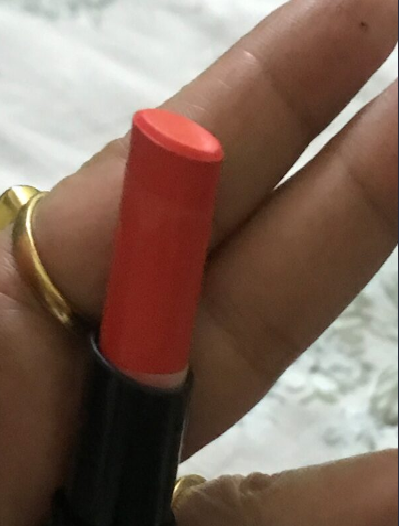
Figure 16 Lipstick from Carrot F3

Evaluation parameter:

  1. Melting point:

Determination of melting point is important part of stability testing. The melting point of formulated lipstick was determined by capillary tube method. The capillary was filled with lipstick and kept the capillary in melting point apparatus. Once liquid paraffin contained in apparatus starts boiling, that point has observed where lipstick starts to melt. After sometimes, product was completely melted. Procedure was repeated three times and the melting point ratio was observed in all formulation. The rising point of lipstick should be between 60 to 65 ?C. 10

  1. Solubility test:

The formulation herbal lipstick was dissolved in various solvents to observe the solubility.

  1. pH: The pH of formulated herbal lipstick was determined using pH meter.
  2. Color:

The colors and texture of all lipsticks were tested by applied on lips using a brush or other applicator.

  1. Breaking point:

Breaking point was done to determine the strength of lipstick. The lipstick was held horizontally in a socket inch away from the edge of support. The weight was gradually increased by a specific value (10 gm.) at specific interval of 30 second and weight at which breaks was considered as the breaking point.

  1. Force of application:

It is test for comparative measurement of the force to be applied for application. A piece of coarse brown paper kept on a shadow graph balance and lipstick was applied at 45º angle to cover a 1 sq. Inch area until fully covered. The pressure reading is an indication of force of application.4, 5, 12

PREPARATION AND FORMULATION OF HERBAL LIP BALM FROM POMEGRANATE, BEETROOT, CARROT EXTRACTS:

The appropriate ingredients have selected for the formulation of lip balm. As per the formula, initially, accurately weighed the given quantity of waxes in hot  water bath  in descending  order  of  their  melting  point  with  continuous stirring/heated  till  it  melts  completely .  Then all three coloring agents dissolved in to the mixture of melted waxes as per the oil and water solubility. Finally flavoring agent such as rose water, vanilla were added and continuously stirred to get a homogenized mixture. The mixture should be stirred vigorously until a smooth emulsion form.  Then,  this  mixture was poured  into  clean  and lubricated  mould or containers  and  allow  them  to  cool  to  achieve contraction  of  the  waxes  to  facilitate  easy  removal  of  the balm.10
Evaluation parameters for lip balm:         

The spread ability of  lip balm was tested by applying the formulated  lip balm  on  glass slide  at  room temperature  to observe uniformity in the formulation of protective layer and whether  the  stick  fragmental  deformed  or  broke  during application for appropriate results of different formulation.

The  melting  point  and  pH  of  lip  balm  are  also commonly  evaluated  by  capillary  method  and  pH  meter respectively.

Skin irritation test was performed by applying the product on skin for 30 min.

The product needs to study for the surface anomalies such as formation crystals on surfaces or contamination by mould fungi etc. There should not be sign of any surface defects.

The lip balm product was evaluated for perfume and aging stability over 30 day period in room temp. 25?C in refrigerator at 5?C and oven temperature 40? C 10, 12

RESULT AND DISCUSSION

The present work displayed the results of herbal formulation of lipstick and lip balm carried out on various extract of pomegranate, beetroot and carrot. The fruits were selected on the basis of literature survey.

Preparation of extract: The extracts were prepared by using maceration and extraction technique from the juice of Pomegranate seeds, beetroot, and carrots. The extracts were evaporated to dryness to get the powder of that extract.

Formulation of Herbal lipstick of Pomegranate seeds: As per the table no. 4, the formulas were prepared for the herbal lipstick of pomegranate. The herbal lipsticks of pomegranate were prepared by using F1, F2 and F3. However, out of three formulations F3 has shown best results. The entire formulated lipstick shown color but two were not imparting color on skin except F3.

Table 4 Formulation of Pomegranate Extract

Ingredients

Quantity (gm.)

F1

F2

F3

White bees wax

2 gm.

2 gm.

2 gm.

Carnauba wax

0.3 gm.

0.3 gm.

0.5 gm.

Castor oil

4.5 ml

2 ml

-

Coconut oil

1 ml

-

-

Vitamin C

4 -5 drops

-

-

Vanilla essence

2 – 3 drops

-

-

Pomegranate extract

1 gm.

2 gm.

3 gm.

Glycerine

-

0.5 ml

0.5 gm.

Lanolin

-

1 gm.

-

Gum acacia

-

0.2 gm.

1.5 gm.

Orange oil

-

1 ml

1 ml

Almond oil

-

1 ml

1 ml

Rose essence

-

-

2 -3 drops

Formulation of Herbal lipstick of Beetroot: As per the table no. 5, the formulas were prepared for the herbal lipstick of pomegranate. The herbal lipsticks of pomegranate were prepared by using F1, F2 and F3. However, out of three formulations F3 has shown best results. The entire formulated lipstick shown color but two were not imparting color on lipstick except F3.

Table 5 Formulation of Beet Root Extract

Ingredients

Quantity (gm)

F1

F2

F3

White bees wax

2 gm

2 gm

2 gm

Carnauba wax

0.3 gm

0.3 gm

0.5 gm

Castor oil

4.5 ml

2 ml

-

Coconut oil

1 ml

-

-

Vitamin C

4 -5 drops

-

-

Vanilla essence

2 – 3 drops

-

-

beetroot extract

1 gm

2 gm

3 gm

Glycerine

-

0.5 ml

0.5 gm

lanolin

-

1 gm

-

Gum acacia

-

0.2 gm

1.5 gm

Orange oil

-

1 ml

1 ml

Almond oil

-

1 ml

1 ml

Rose essence

-

-

2 -3 drops

Formulation of Herbal lipstick of Carrot: As per the table no. 6, the formulas were prepared for the herbal lipstick of pomegranate. The herbal lipsticks of pomegranate were prepared by using F1, F2 and F3. However, out of three formulations F3 has shown best results. The entire formulated lipstick shown color but two were not imparting color on lipstick except F3.

Table 6 Formulation of Carrot Extract

Ingredients

Quantity (gm)

F1

F2

F3

White bees wax

2 gm

2 gm

2 gm

Carnauba wax

0.3 gm

0.3 gm

0.5 gm

Castor oil

4.5 ml

2 ml

-

Coconut oil

1 ml

-

-

Vitamin C

4 -5 drops

-

-

Vanilla essence

2 – 3 drops

-

-

carrot extract

1 gm

2 gm

3 gm

Glycerine

-

0.5 ml

0.5 gm

Lanolin

-

1 gm

-

Gum acacia

-

0.2 gm

1.5 gm

Orange oil

-

1 ml

1 ml

Almond oil

-

1 ml

1 ml

Rose essence

-

-

2 -3 drops

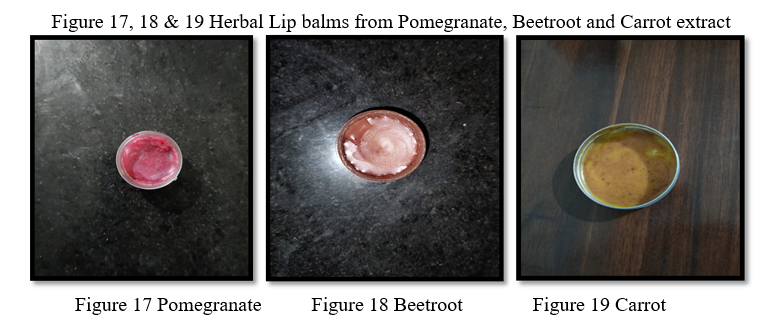
Formulation of Herbal lip balm of Pomegranate, Beetroot and carrot: As per the table no. 7, the formula was prepared for the herbal lip balm of pomegranate, beetroot and carrot. The herbal lip balm of pomegranate, beetroot and carrot were shown attractive color giving smooth and glossy texture to the lips.

Table 7 Formulation of Herbal Lip Balm of Pomegranate, Beetroot and Carrot Extract

Ingredients

Quantity

White bees wax

0.5 gm.

Ghee

1 gm.

Almond oil

1 ml

Pomegranate, Beetroot, Carrot Extract.

1.5 ml

Rose, vanilla, pineapple Essence

Q.S.

Evaluation of Herbal lipstick: the formulated herbal lipsticks were evaluated as per given parameter. All three formulations shown different colors and textures as per small change in formulation. The melting point of all formulation has evaluated which was in between 60 to 65°C.  pH has measured for each formulation which is in mention table no.8. Breaking point of formulations was obtained between 28-32.

Table 8 Evaluation of Herbal Lipstick

Sr. No

Extract used

Color

Spreadability

Avg. M.P.(°C)

pH

Breaking Point

1

Pomegranate Seed

Pink

Good

60-65

6.7±0.2

32

2

Beetroot extract

Light Wine

Good

61-63

6.5±0.2

31

3

Carrot

Orange red

Good

60-62

6.5±0.2

28

Evaluation of Herbal lip balm: The formulated herbal lip balms were evaluated as per given parameters. All the formulation of lip balm showed good stability and vibrant color and good Spreadability.

Table 9 Evaluation of Herbal Lip Balm

Sr. No

Extract used

Color

Odour

Spreadability

Skin irritation Test

Stability

1

Pomegranate Seed

Pink

Pleasent

Good

No

No deformation

Stable

2

Beetroot extract

Reddish brown

Pleasent

Good

No

Stable

3

Carrot

Yellowish orange

Pleasent

Good

No

Stable

CONCLUSION:

Different natural or herbal ingredients were used for the formulations of the herbal lipstick and lip balm like Beeswax, lanolin, castor oil, Beet root extract obtained from Beta vulgaris, carrot extract Daucus carota subs, pomegranate extract from Punica granatum used as coloring pigment. The lipsticks were evaluated for various criterions. From the above evaluation criterions, it was concluded that F3 formulation was found to pass all those criterions and it shows no side effects, showing maximum local effects and good properties like shining, spreading and smoothness of lip, hence F3 formulation was considered as the optimized formulation. The research finding also provides guidelines on effect of herbal ingredients towards the properties of lipsticks and lip balm and consumer acceptance of the herbal lipstick formulations.

ACKNOWLEDGEMENTS: We are very grateful to whom supported this work to accomplish this project with the encouragement and guidance.

REFERENCES

  1. Chavan RN, Dalvi KV, Karpe MS, Kadam VJ, Formulation and Evaluation of Lipstick Using Natural Colorants, Indo Am J Pharm Sci, 2017, 7:7798-7803.
  2. Sangar OS, Sutar KD, Sawant SB, Harshad RD, Patil AC, Payghan SA, Research Paper on Herbal Lipstick, World J Pharm Res, 2021, 10:1180-91.
  3. Kothari R, Shukla B, Gautam D, Bagaria M, Sharma A, Formulation and Evaluation of Herbal Lipstick from Natural Edible Coloring Matter, Int J Theor App Sci, 2018, 10(1):17-20.
  4. Patel P, Modi D, Formulation and Evaluation of Herbal Lipstick from Beetroot and Carrot Juice, Int J Pharm Pharm Res, 2022, 25:164-176.
  5. Rani GS, Pooja G, Harshavardhan V, Madhav BV, Pallavi B, Formulation and Evaluation of Herbal Lipstick from Beetroot (Beta vulgaris) Extract, Res J Pharmacognosy and Phytochem, 2019, 11:197-201
  6. Bornare A, Tribhuwan T, Magare S, Shinde A, Tarkase S, Formulation and Evaluation of Herbal Lipstick, Int J Creat Res Thoughts, 2020, 8:2390-2400.
  7. Pavani C, Rajeswaree B, Goud A, Ravali K, Reddy TP, Formulation and Evaluation of Herbal Lipsticks from Rosa kordesii, Int J Sci Res Rev, 2019, 8:29-36.
  8. Aher AA, Bairagi SM, Kadaskar PT, Desai SS, Nimase PK, Formulation and Evaluation of Herbal Lipstick from Colour Pigments of Bixa orellana (Bixaceae) Seeds, Int J Pharm Pharm Sci, 2012, 4:357-59.
  9. Sainath M, Sudheer KK, Ashok BK, Formulation and Evaluation of Herbal Lipstick, Int J Adv Res Med Pharm Sci, 2011, 16(1):14-19.
  10. Bhoite PA, Jadhav SC, Tiwari N, Review on Herbal Lip Balm, Int J Pharm Res App, 2022, 7:1827-32.
  11. Patil R, Deshmukh A, Patil S, Patil P, Patil P, Patil S et al., Formulation and Evaluation of Lip Balm Prepared Using Various Herbal Entities, Int J Inn Res Tech, 2023, 9:775-79.
  12. Yadav S, Redasani VK, Baid KJ, Formulation and Evaluations of Herbal Lipstick, World J Pharm Res, 2020, 9:1436-44.
  13. Swetha S, Vismaya A, Chithira CS, Sreekutti S, Vishnu M, Bhagyalakshmi AS et al., Formulation and Evaluation of Herbal Lipsticks by Using Beta vulgaris, Int J Pharm Sci Rev Res, 2022, 75:98-102.
  14. Mishra P, Dwivedi S, Formulation and Evaluation of Lipstick Containing Herbal Ingredients, Asian J Med Pharm Res, 2012, 2:58-60.
  15. Patel M, Patel M, Formulation and Evaluation of Herbal Lipstick Using Beta vulgaris Extract, Int Ayurvedic Med J, 2021, 1:1175-80.
  16. Elumalai A, Chinna ME, Nikhitha M, Formulation and Evaluation of a Herbal Lipstick from Punica granatum Fruit Peel, Res J Topical and Cosmetic Sci, 2012, 3:20-22.
  17. Suthar MH, Singh V, Jain P, Formulation and Evaluation of Herbal Lipstick from Pomegranate Pigments, J Pharmacog Phyto, 2022, 11:129-131.
  18. Kolekar AS, Hinghane LD, Formulation and Evaluation of Herbal Lipstick, Int J Creat Res Thoughts, 2022, 10:713-33.
  19. Kapoor VP, Herbal Cosmetics for Skin and Hair Care, Natural Product Radiance, 2005, 306-314.
  20. Kukreja BJ, Dodwad V, Herbal Mouthwashes – A Gift of Nature, Int J Pharm Bio Sci, 2012, 3:46-52.
  21. Kole PL, Jadhav HR, Thakurdesai P, Nagappa AN, Cosmetic Products of Herbal Extracts, Natural Product Radiance, 2005, 4.
  22. Gediya SK, Mistry RB, Patel UK, Blessy M, Jain HN, Herbal Plants: Used as Cosmetics, J Nat Prod Plant Resour, 2011, 1:24-32.
  23. Pandey S, Meshya N, Viral D, Herbs Play an Important Role in the Field of Cosmetics, Int J Pharm Tech Res, 2010, 2:632-39.
  24. Kaul S, Dwivedi S, Indigenous Ayurvedic Knowledge of Some Species in the Treatment of Human Disease, Int J Pharma Life Sci, 2010, 1:44-49.
  25. Chattopadhyay PK, Herbal Cosmetics and Ayurvedic Medicines, National Institute of Industrial Research, 2005, 45-50.
  26. Medscape, http://emedicine.medscape.com/article/835209-overview, assessed on 8 January 2015.
  27. NIH, http://elementsofmorphology.nih.gov/anatomy-oral.shtml, assessed on 8 January 2015.
  28. Ali BH, Wabel NA, Blunden G, Phytochemical, Pharmacological and Toxicological Aspects of Hibiscus sabdariffa – A Review, Phytother Res, 2005, 19:369-75.
  29. Balsam MS, Sagarin E, Cosmetics Science and Technology, Second ed., Wiley Interscience Publication, NY, USA, 2008, 209-512.
  30. Denavarre MG, The Chemistry and Manufacture of Cosmetics, Second ed., Continental Press, Orlando, USA, 1975, 699.
  31. Fernandes AR, Dario MF, Pinto CA, Kaneko TM, Baby AR, Velasco MV, Stability Evaluation of Organic Lip Balm, Braz J Pharm Sci, 2013, 2:49.
  32. Deshmukh S, Chavan M, Sutar M, Singh S, Preparation and Evaluation of Natural Lipsticks from Bixa orellana Seeds, Int J Pharm Bio Sci, 2013, 4:139-144.
  33. Harry RG, Wilkinson JB, Harry’s Cosmeticology, Sixth ed., Leonard Hill Books and Intertext Publisher, London, 1973.
  34. Sharma PP, Cosmetics – Formulation, Manufacturing and Quality Control, Fourth ed., Vandana Publications Pvt. Ltd., India, 2008.
  35. Mittal BM, Saha RN, A Handbook of Cosmetics, First ed., Vallabh Prakashan, New Delhi, India, 2000.
  36. Mundo MA, Padilla-Zakour OI, Worobo RW, Growth Inhibition of Foodborne Pathogens and Food Spoilage Organisms by Select Raw Honeys, Int J Food Microbio, 2004, 97:1-8.
  37. Sahar SA, Soltan M, Shehata MEM, The Effects of Using Color Foods of Children on Immunity Properties and Liver, Kidney on Rats, Food Nutri Sci, 2012, 3:897-904.
  38. Basha BN, Prakasam K, Goli D, Formulation and Evaluation of Gel Containing Fluconazole – Antifungal Agent, Int J Drug Development Res, 2011, 3:4.
  39. Balsam MS, Sagarin E, Cosmetics Science and Technology, Second ed., Wiley Interscience Publication, NY, USA, 2008, 365.

Reference

  1. Chavan RN, Dalvi KV, Karpe MS, Kadam VJ, Formulation and Evaluation of Lipstick Using Natural Colorants, Indo Am J Pharm Sci, 2017, 7:7798-7803.
  2. Sangar OS, Sutar KD, Sawant SB, Harshad RD, Patil AC, Payghan SA, Research Paper on Herbal Lipstick, World J Pharm Res, 2021, 10:1180-91.
  3. Kothari R, Shukla B, Gautam D, Bagaria M, Sharma A, Formulation and Evaluation of Herbal Lipstick from Natural Edible Coloring Matter, Int J Theor App Sci, 2018, 10(1):17-20.
  4. Patel P, Modi D, Formulation and Evaluation of Herbal Lipstick from Beetroot and Carrot Juice, Int J Pharm Pharm Res, 2022, 25:164-176.
  5. Rani GS, Pooja G, Harshavardhan V, Madhav BV, Pallavi B, Formulation and Evaluation of Herbal Lipstick from Beetroot (Beta vulgaris) Extract, Res J Pharmacognosy and Phytochem, 2019, 11:197-201
  6. Bornare A, Tribhuwan T, Magare S, Shinde A, Tarkase S, Formulation and Evaluation of Herbal Lipstick, Int J Creat Res Thoughts, 2020, 8:2390-2400.
  7. Pavani C, Rajeswaree B, Goud A, Ravali K, Reddy TP, Formulation and Evaluation of Herbal Lipsticks from Rosa kordesii, Int J Sci Res Rev, 2019, 8:29-36.
  8. Aher AA, Bairagi SM, Kadaskar PT, Desai SS, Nimase PK, Formulation and Evaluation of Herbal Lipstick from Colour Pigments of Bixa orellana (Bixaceae) Seeds, Int J Pharm Pharm Sci, 2012, 4:357-59.
  9. Sainath M, Sudheer KK, Ashok BK, Formulation and Evaluation of Herbal Lipstick, Int J Adv Res Med Pharm Sci, 2011, 16(1):14-19.
  10. Bhoite PA, Jadhav SC, Tiwari N, Review on Herbal Lip Balm, Int J Pharm Res App, 2022, 7:1827-32.
  11. Patil R, Deshmukh A, Patil S, Patil P, Patil P, Patil S et al., Formulation and Evaluation of Lip Balm Prepared Using Various Herbal Entities, Int J Inn Res Tech, 2023, 9:775-79.
  12. Yadav S, Redasani VK, Baid KJ, Formulation and Evaluations of Herbal Lipstick, World J Pharm Res, 2020, 9:1436-44.
  13. Swetha S, Vismaya A, Chithira CS, Sreekutti S, Vishnu M, Bhagyalakshmi AS et al., Formulation and Evaluation of Herbal Lipsticks by Using Beta vulgaris, Int J Pharm Sci Rev Res, 2022, 75:98-102.
  14. Mishra P, Dwivedi S, Formulation and Evaluation of Lipstick Containing Herbal Ingredients, Asian J Med Pharm Res, 2012, 2:58-60.
  15. Patel M, Patel M, Formulation and Evaluation of Herbal Lipstick Using Beta vulgaris Extract, Int Ayurvedic Med J, 2021, 1:1175-80.
  16. Elumalai A, Chinna ME, Nikhitha M, Formulation and Evaluation of a Herbal Lipstick from Punica granatum Fruit Peel, Res J Topical and Cosmetic Sci, 2012, 3:20-22.
  17. Suthar MH, Singh V, Jain P, Formulation and Evaluation of Herbal Lipstick from Pomegranate Pigments, J Pharmacog Phyto, 2022, 11:129-131.
  18. Kolekar AS, Hinghane LD, Formulation and Evaluation of Herbal Lipstick, Int J Creat Res Thoughts, 2022, 10:713-33.
  19. Kapoor VP, Herbal Cosmetics for Skin and Hair Care, Natural Product Radiance, 2005, 306-314.
  20. Kukreja BJ, Dodwad V, Herbal Mouthwashes – A Gift of Nature, Int J Pharm Bio Sci, 2012, 3:46-52.
  21. Kole PL, Jadhav HR, Thakurdesai P, Nagappa AN, Cosmetic Products of Herbal Extracts, Natural Product Radiance, 2005, 4.
  22. Gediya SK, Mistry RB, Patel UK, Blessy M, Jain HN, Herbal Plants: Used as Cosmetics, J Nat Prod Plant Resour, 2011, 1:24-32.
  23. Pandey S, Meshya N, Viral D, Herbs Play an Important Role in the Field of Cosmetics, Int J Pharm Tech Res, 2010, 2:632-39.
  24. Kaul S, Dwivedi S, Indigenous Ayurvedic Knowledge of Some Species in the Treatment of Human Disease, Int J Pharma Life Sci, 2010, 1:44-49.
  25. Chattopadhyay PK, Herbal Cosmetics and Ayurvedic Medicines, National Institute of Industrial Research, 2005, 45-50.
  26. Medscape, http://emedicine.medscape.com/article/835209-overview, assessed on 8 January 2015.
  27. NIH, http://elementsofmorphology.nih.gov/anatomy-oral.shtml, assessed on 8 January 2015.
  28. Ali BH, Wabel NA, Blunden G, Phytochemical, Pharmacological and Toxicological Aspects of Hibiscus sabdariffa – A Review, Phytother Res, 2005, 19:369-75.
  29. Balsam MS, Sagarin E, Cosmetics Science and Technology, Second ed., Wiley Interscience Publication, NY, USA, 2008, 209-512.
  30. Denavarre MG, The Chemistry and Manufacture of Cosmetics, Second ed., Continental Press, Orlando, USA, 1975, 699.
  31. Fernandes AR, Dario MF, Pinto CA, Kaneko TM, Baby AR, Velasco MV, Stability Evaluation of Organic Lip Balm, Braz J Pharm Sci, 2013, 2:49.
  32. Deshmukh S, Chavan M, Sutar M, Singh S, Preparation and Evaluation of Natural Lipsticks from Bixa orellana Seeds, Int J Pharm Bio Sci, 2013, 4:139-144.
  33. Harry RG, Wilkinson JB, Harry’s Cosmeticology, Sixth ed., Leonard Hill Books and Intertext Publisher, London, 1973.
  34. Sharma PP, Cosmetics – Formulation, Manufacturing and Quality Control, Fourth ed., Vandana Publications Pvt. Ltd., India, 2008.
  35. Mittal BM, Saha RN, A Handbook of Cosmetics, First ed., Vallabh Prakashan, New Delhi, India, 2000.
  36. Mundo MA, Padilla-Zakour OI, Worobo RW, Growth Inhibition of Foodborne Pathogens and Food Spoilage Organisms by Select Raw Honeys, Int J Food Microbio, 2004, 97:1-8.
  37. Sahar SA, Soltan M, Shehata MEM, The Effects of Using Color Foods of Children on Immunity Properties and Liver, Kidney on Rats, Food Nutri Sci, 2012, 3:897-904.
  38. Basha BN, Prakasam K, Goli D, Formulation and Evaluation of Gel Containing Fluconazole – Antifungal Agent, Int J Drug Development Res, 2011, 3:4.
  39. Balsam MS, Sagarin E, Cosmetics Science and Technology, Second ed., Wiley Interscience Publication, NY, USA, 2008, 365.

Photo
Neelam Bhagdewani
Corresponding author

Shri Gajanan Maharaj Shikshan Prasarak Mandal’s Dnyanvilas College of Pharmacy, PCMC, Pune-412105

Photo
Sonali Devne
Co-author

Shri Gajanan Maharaj Shikshan Prasarak Mandal’s Dnyanvilas College of Pharmacy, PCMC, Pune-412105

Photo
Smita Waghmare
Co-author

Shri Gajanan Maharaj Shikshan Prasarak Mandal’s Dnyanvilas College of Pharmacy, PCMC, Pune-412105

Photo
Pratibha Shelke
Co-author

Shri Gajanan Maharaj Shikshan Prasarak Mandal’s Dnyanvilas College of Pharmacy, PCMC, Pune-412105

Photo
Meenal Kubde
Co-author

Shri Gajanan Maharaj Shikshan Prasarak Mandal’s Dnyanvilas College of Pharmacy, PCMC, Pune-412105

Photo
Pramod Ingale
Co-author

Shri Gajanan Maharaj Shikshan Prasarak Mandal’s Dnyanvilas College of Pharmacy, PCMC, Pune-412105

Neelam Bhagdewani*, Sonali Devne, Smita Waghmare, Pratibha Shelke, Meenal Kubde, Pramod Ingale, Formulation and Evaluation of Herbal Cosmetics, Int. J. of Pharm. Sci., 2025, Vol 3, Issue 12, 1766-1779 https://doi.org/10.5281/zenodo.17875682

More related articles
Clitoria ternatea Linn (Asian Pigeonwings): A Com...
Divya Kokitkar, Lokesh Vyash, Dr. Sonali Uppalwar, ...
Exploring Digital Health Literacy among the Elderl...
Binu K M, H. Doddayya, Akshay J, Nuzhat Fatima, Pranotosh Mondal,...
RP-HPLC Method Development and Validation of Ferro...
Aniket Mohite, Dr. Deepak Kardile, Dr. Vishwas Bhagat, Tushar Shi...
Nanotechnology and Nanorobotics in Cancer Treatment...
Mayuresh Ganjewar, Pradnya Kshirsagar, ...
Recent Advances and Challenges of Anticancer Drugs...
Vinayak Gangurde, Pranjali Hake, Gopal Thokare, ...
Comprehensive Review: Bempedoic Acid and Ezetimibe Fixed-Dose Combination in Hyp...
Mahima Bijewar, Dinesh Kawade, Chetna Kapgate, Achal Gadhwale, Aditi Tayde, Neha Sharnagate, ...
Related Articles
Uterine Fibroids: From Pathogenic Signalling and Molecular Classification to Pre...
Dr. Subashini R, Abinaya S, Anupama Sankar, Christy Immaculate J, Abitha P, ...
A Review Article on Tablet Defects and Their Remedies...
Sofiya Pathan, Asmita Ingale, Vidya Kapse, Dr. V. M. Dharashive, ...
Development and Validation of RP-HPLC Method for the Simultaneous Estimation of ...
Dattatray Yadav, Dr. Deepak Kardile, Dr. Vishwas Bhagat, Tushar Shinde, Dr. Rajkumar Shete, ...
More related articles
Exploring Digital Health Literacy among the Elderly Population in North Karnatak...
Binu K M, H. Doddayya, Akshay J, Nuzhat Fatima, Pranotosh Mondal, Shifa Anjum, Toufeeq Rasheed, ...
RP-HPLC Method Development and Validation of Ferrous Ascorbate and Folic Acid by...
Aniket Mohite, Dr. Deepak Kardile, Dr. Vishwas Bhagat, Tushar Shinde, Dr. Rajkumar Shete, ...
Exploring Digital Health Literacy among the Elderly Population in North Karnatak...
Binu K M, H. Doddayya, Akshay J, Nuzhat Fatima, Pranotosh Mondal, Shifa Anjum, Toufeeq Rasheed, ...
RP-HPLC Method Development and Validation of Ferrous Ascorbate and Folic Acid by...
Aniket Mohite, Dr. Deepak Kardile, Dr. Vishwas Bhagat, Tushar Shinde, Dr. Rajkumar Shete, ...