
Department of Pharmaceutics, Mar Dioscorus College of Pharmacy, Hermongiri Vidyapeetam, Alathara, Sreekaryam, Thiruvananthapuram
Facial cleansing is a fundamental step in skincare to remove dirt, excess sebum, and environmental pollutants while maintaining skin health. In general, facial cleansers are designed to strike a compromise between skin protection and cleaning effectiveness. The present study focuses on the formulation and evaluation of a facial cleansing stick, an innovative solid dosage form designed for convenient, mess-free application, and travel-friendly. The facial cleansing stick was formulated using mild surfactants such as sodium cocoyl isothionate and cocamido propyl betaine, humectants like glycerin which helps to maintain skin hydrated, emollients, preservatives, thickening agents, fragrance to ensure effective cleansing. The prepared formulation was evaluated using suitable parameters including physical appearance, spreadability, washability, foamability, stability, PH and breaking point to assess its performance. The facial cleansing stick offers advantages such as poratability, mess free application, controlled usage, travel friendly, effective and user-friendly skin care formulation. Facial cleansing stick Contribute to the advancement of innovative skincare formats promoting sustainability and consumer convenience.
Facial cleansing plays an essential role in maintaining skin hygiene by removing accumilated sebum, dirt and environmental contaminants. Facial skin cleansers are designed to strike a compromise between skin protection and cleaning effectiveness. They help to maintain a healthy pH balance, promote hydration, and enhance overall skin health and resilience against outside aggressors by efficiently eliminating pollutants. conventional facial cleansers are commonly available as liquid, gel, cream or foam forms which provide effective cleansing but they often associated with some limitations such as spillage during handling, in convinence during travel and also overuse leading to product wastage. The facial cleansing stick is the novel skincare product on the market. It is a solid face cleanser that cleanses the skin by dissolving dirt, oil and makeup, it also nourishes to leave skin softer. When applying the facial cleansing stick, it gently massages the skin because you need to roll the stick around your skin and have several advantsages like travel friendly, mess free, controlled use and can carry without fear of spillage.
Skin
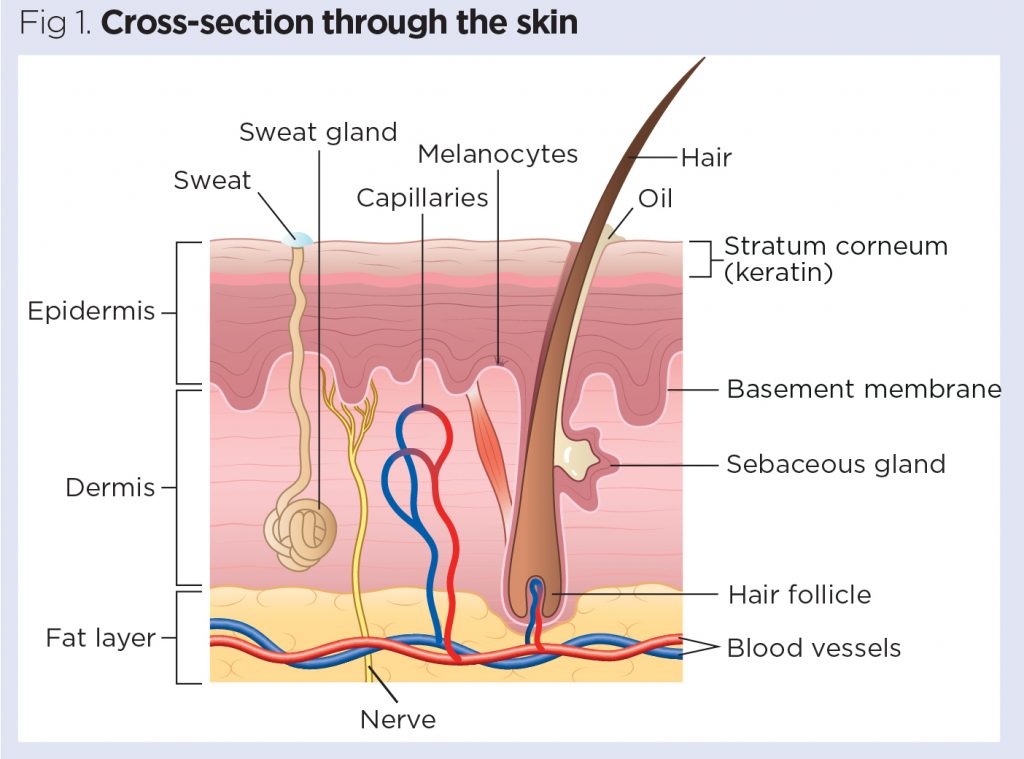
The skin is the largest human organ. It has three layers: the epidermis, the dermis, and the hypodermis. The epidermis is the outer layer, formed by a stratified, squamous epithelium composed mainly of keratinocytes and also dendritic cells (melanocytes, Merkel cells, and Langerhans cells). The epidermis is divided into four layers according to keratinocyte morphology and the degree of differentiation into cornified cells (the outermost layer is called the stratum corneum). The dermis is the middle layer, basically made up of collagen and amorphous connective tissue containing nerve and vascular networks, epidermal appendages, fibroblasts, macrophages, and mast cells. The hypodermis or subcutaneous tissue is a real endocrine organ composed of lobules of adipocytes separated by fibrous septa formed from collagen and blood vessels. The skin and its various components can communicate with other tissues and self-regulate through the production of cytokines, neurotransmitters, hormones, and their corresponding receptors. These neuro-immuno-endocrine functions are tightly networked to central regulatory systems. The skin is also a vast reserve of stem cells to rejuvenate the body surface and repair wounds. All of these structures allow the skin to perform vital functions, including protection against physical, chemical, and biological agents; prevention of excess water loss; and regulation of temperature. In addition, the skin constitutes the sensory organ for touch and environmental sensing [5]. The skin is divided into several layers, as shown in. The epidermis is composed mainly of keratinocytes. Beneath the epidermis is the basement membrane (also known as the dermo-epidermal junction); this narrow, multi-layered structure anchors the epidermis to the dermis. The layer below the dermis, the hypodermis, consists largely of fat. These structures are described below.
Epidermis
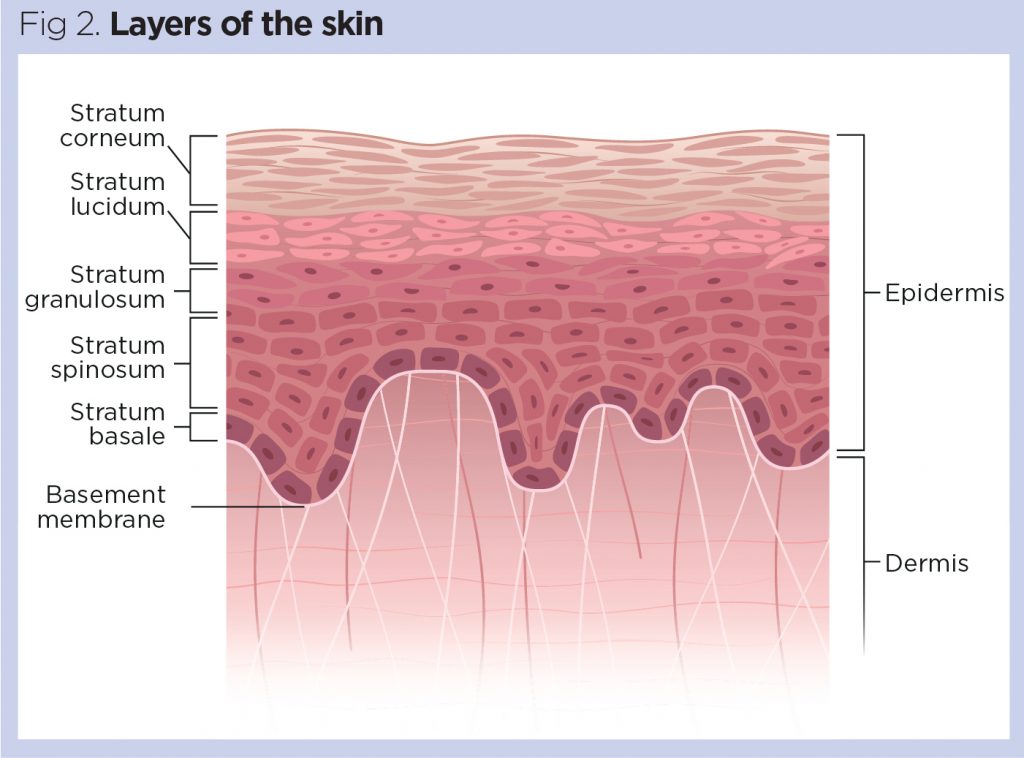
The epidermis is the outermost layer of the skin, composed of a stratified squamous epithelium that primarily comprises keratinocytes in various stages of differentiation. Keratinocytes produce the protein keratin and are the major building blocks (cells) of the epidermis. As the epidermis is avascular (lacking blood vessels), it is entirely dependent on the underlying dermis for nutrient delivery and waste disposal through the basement membrane. The primary function of the epidermis is to act as a physical and biological barrier to the external environment, preventing penetration by irritants and allergens. At the same time, it prevents the loss of water and maintains internal homeostasis. The epidermis is composed of layers; most body parts have four layers, but those with the thickest skin have five. [6] The layers are:
• Stratum corneum (horny layer); ¢ The stratum corneum is composed of several layers of hexagonal shaped non- viable, certified cells called coenocytes. Every coenocytes is enclosed by a protein casing which is filled with keratin proteins having water retaining property.
• Stratum lucidum (only found in thick skin – that is, the palms of the hands, the soles of the feet, and the digits): It is a thin, clear layer of dead skin cells found only in thick skin, like the palms and soles. It lies between the stratum granulosum and stratum corneum and helps protect the skin by reducing friction.
• Stratum granulosum (granular layer); The cells move upward to reach stratum granulosum where they become flat and enucleated.
• Stratum spinosum (prickle cell layer): As the cells from stratum basale mature, they move upwards to form the next layer, which is stratum spinosum. The cells in this layer are connected by intercellular bridges called desmosomes. Stratum spinosum contains Langerhans cell which are dendrites, and are formed in the bone marrow. Langerhans cells play a crucial role in immunological reactions related to skin.
• Stratum basale (germinative layer). It is the deepest layer of epidermis present just above the dermis, and consists of dividing and non- dividing keratinocytes. The inner basal surface of epidermal keratinocytes consists of small structures called hemi desmosomes. Basal cells consist of a pigment called melanin, produced by melanocytes.
Dermis
The dermis forms the inner layer of the skin and is much thicker than the epidermis (1 5mm). Situated between the basement membrane zone and the subcutaneous layer, the primary role of the dermis is to sustain and support the epidermis. [12] The main functions of the dermis are:
• Protection;
• Cushioning the deeper structures from mechanical injury;
• Providing nourishment to the epidermis;
• Playing an important role in wound healing.
The network of interlacing connective tissue, which is its major component, is made up of collagen, in the main, with some elastin. Scattered within the dermis are several specialised cells (mast cells and fibroblasts) and structures (blood vessels, lymphatics, sweat glands, and nerves). The epidermal appendages also lie within the dermis or subcutaneous layers, but connect with the surface of the skin.
Layers of dermis. The dermis is made up of two layers:
• The more superficial papillary dermis;
• The deeper reticular dermis.
The papillary dermis is the thinner layer, consisting of loose connective tissue containing capillaries, elastic fibres, and some collagen. The reticular dermis consists of a thicker layer of dense connective tissue containing larger blood vessels, closely interlaced elastic fibres, and thicker bundles of collagen. It also contains fibroblasts, mast cells, nerve endings, lymphatics, and epidermal appendages. Surrounding these structures is: -
• Allows nutrients, hormones, and waste products to pass through the dermis;
• Provides lubrication between the collagen and elastic fibre networks;
• Gives bulk, allowing the dermis to act as a shock absorber.
Mast cells contain granules of vasoactive chemicals (the main one being histamine). They are involved in moderating immune and inflammatory responses in the skin. Blood vessels in the dermis form a complex network and play an important part in thermoregulation. These vessels can be divided into two distinct networks:
• Superficial plexus – made up of interconnecting arterioles and venules lying close to the epidermal border, and wrapping around the structures of the dermis, the superficial plexus supplies oxygen and nutrients to the cells;
• Deep plexus – found deeper at the border with the subcutaneous layer, its vessels are more substantial than those in the superficial plexus and connect vertically to the superficial plexus.
Hypodermis
The hypodermis is the subcutaneous layer lying below the dermis; it consists largely of fat. It provides the main structural support for the skin, as well as insulating the body from cold and aiding shock absorption. It is interlaced with blood vessels and nerves.
Functions of Skin: [4]
· Protective barrier: obstructs the entry of extraneous objects and microbes.
· Prevents dehydration.
· Thermoregulation: sustains an appropriate body temperature.
· Tactile perception: interprets incoming stimuli.
· absorbs mechanical shock.
· aids in excretion through sweat.
Types of Facial Cleansers
1. Soaps: Cleansing agents produced through the saponification of fats or oils with alkalis like sodium or potassium hydroxide.
2. Super fatted Soaps: Soaps enriched with additional fats or oils to enhance moisturizing properties.
3. Beauty Bars: Solid cleansing bars formulated with various additives to cleanse and moisturize the skin, often containing fragrances.
4. Dermatological Bars or Cakes: Specialty cleansing bars tailored for specific skin types or conditions, such as acne-prone or sensitive skin.
5. Liquid Cleansers: Fluid formulations including facial liquid cleansers, typically containing surfactants and water to cleanse dirt, oil, and makeup from the skin the predominant form of soap is derived from a blend of oils and lipids, sourced from either botanical or animal origins, combined with alkali substances such as sodium or potassium salt
Product Types of Cleansers:
· Bar Soap
· Syndet Bars
· Gels
· Scrub
· Creams and Lotion
· Toner
· Masks
· Cleansing Wipes
· Bath Salts
· Bath Oil
· Bubble Bath
Surfactant Used in Facial Cleansers
Surfactant, an abbreviation for surface active agent, is an amphiphilic molecule that has both hydrophilic and hydrophobic/lipophilic parts. In cosmetics, surfactant is commonly used as a detergent in facial cleansing. The function herein is to lower the interfacial tension at the dirt/water and skin/water interfaces, there by detaching the dirt from the skin surface. The dirt can also be removed in an emulsified form. Surfactants tend to form aggregates called micelles, where the surfactants hydrophobic groups are directed towards the interior of the cluster and the polar heads are directed towards water. The micelle is a polar aggregate of high-water solubility without much surface activity. It is only the surfactant monomers that are capable of lowering surface tension. [2]
Surfactant Are Classified into Four Groups
1. Anionic Surfactant
2. Cationic Surfactant
3. Nonionic Surfactant
4. Amphoteric Surfactant
Anionic Surfactant: are the most widely utilized variety, accounting for around 60% of the yearly production of surfactants worldwide. Their heads are hydrophilic and negatively charged.
Cationic Surfactant: Compared to anionic surfactants, cationic surfactants are positively charged and usually show less detergency. however, they can be used as antimicrobial pre servatives due to the considerable bactericidal activity against a wide range of microorganisms. [4]
Nonionic Surfactant: second largest surfactant groups, and has no electrical charge on its head, so it is normally compatible with all other types of sur factant. The nonionic surfactants are also used as thickeners for shampoos, as emulsifiers and suspending agents in cosmetics, pharmaceuticals and foods
Amphoteric Surfactant: Usually, amphoteric surfactants have two charged groups that have opposing signs. As pH levels rise from low to high, they go through a transition from a net cationic state to a zwitterionic state and finally to a net anionic state. This naturally occurring pH dependent change affects the foaming, wetting, and detergency of surfactants.
Facial Cleansing Stick: Concept and Formulation
Facial cleansing sticks are solid and dissolve into creamy suds that help rinse away dirt, oil, impurities and more once paired with water. Due to their compact size, cleansing sticks are extremely portable and can carry without fear of spillage. It offers a completely different way of cleansing the skin after a long day out. [1] Skin cleanser remove dirt, sebum, oil and dead skin cells ideally without damaging or irritating the skin. Cleansing sticks are stored in a twist-up tube and applied directly to the face. When applying a facial cleansing stick, it also gently massages the skin as the stick roll around on the skin.
Advantages of Facial Cleansing Sticks
Travel friendly and portable: Their solid, compact form means no spills and easy packing, perfect for gym bags, purses, or travel.
Mess free and easy application: They are applied directly to a damp face in gentle circular motions. Not required to pour the product into hands.
Product conservation: The twist up tube design allows you to use just the right amount of product, minimizing waste that can sometimes occur with liquid formulas.
Easy to use: simple to apply in circular motions on damp skin, lather and rinse.
Gentle on skin: They are designed to cleanse without stripping the skin of essential moisture, which is especially beneficial for dry or sensitive skin. Formulated with mild surfactants, cleansing sticks help maintain skin moisture and minimize irritation.
Comparison of Facial Cleansing Stick and Liquid Facial Cleansers
|
|
Facial cleansing stick |
Liquid facial cleanser |
|
Physical form |
Solid or semisolid |
liquid |
|
Water content |
low |
high |
|
Application |
Direct application on face |
Applied via hands |
|
Travel convinence |
High |
low |
|
Product wastage |
Minimal |
High |
MATERIALS AND METHODS
Ingredients
|
Ingredients |
%w/w |
|
Distilled water |
12% |
|
Glycerin |
22% |
|
Sodium cocoyl isothionate |
30% |
|
Cocamido propyl bentaine |
5% |
|
Lactic acid |
0.1% |
|
Rice wax |
7% |
|
Lavender oil macerate |
5% |
|
tocopherol |
0.5% |
|
Sodium benzoate |
0.8% |
Preparation of Facial Cleansing Stick [1]
Heat phase A contents like distilled water and glycerin in a beaker. Add sodium cocoyl isothionate and cocamido propyl betaine slowly while stirring. Heat gently to 70 -750c until surfactants are dissolved. Add lactic acid stir well.
Phase B: Melt rice wax at 70-750c in an another beaker. Add tocopherol and lavender oil macerate while still warm.
Phase C: slowly add phase B into phase Awhile stirring. Add sodium benzoate and Pour the final mixture into stick molds. let it solidify at room temperature.
Evaluation of Facial Cleansing Stick
Physical Appearance:
The sample was prepared and its physical appearance was evaluated.
Determination of spreadability:
The spreadability of test samples was determined using 0.5g test formulation was placed within a circle of 1cm diameter premarked on a glass plate over which a second glass plate was placed. A weight of 500g was allowed to rest on the upper glass plate for 5 minutes. Spreadability refers to the area covered by a fixed amount of sample after the uniform spread of sample on the glass slide. The increase in the diameter due to spreading of the test formulation was noted. [1]
Foamability test:
The foaming ability of a formulation is tested to assess its foam production and stability. In this method, 1 ml of the formulation is taken in a 100 ml graduated cylinder, and distilled water is added to make up to 50 ml. The cylinder is closed and shaken vigorously for 10 seconds to produce foam. The foam volume is recorded after 1 minute to determine initial foaming. The cylinder is then left undisturbed, and the foam volume is noted again after 10 minutes. The difference in foam volumes indicates the stability and effectiveness of the formulation in generating lasting foam.
pH of the facial cleansing stick is measured by a digital pH meter at room temperature, which was caliberated with standardized buffer solutions.
Study of stability testing:
Samples of cleansing stick was kept in stability chamber at a temperature of 28ºC±2ºC and relative humidity 60±65 RH for one month and the changes obtained if any noted.
Determination of Anti-microbial activity
Cup-plate Method
The inoculum S. aureus culture is prepared in nutrient agar broth medium. Placed a sterile disc saturated with the formulated sample and a marketed one asceptically by using forceps in the petridish. The disc was allowed to diffuse and after sometime, the plates were incubated at 370C for 24 hours. After 24 hours the petridish were observed for ZOI and the diameter of zone of inhibition is measured in millimeters.
Washability test:
The formulation was easily removable by washing with tap water.
Evaluation of Breaking point:
Breaking point was done to determine the strength of Cleansing stick. The weight was gradually increased by a specific value (10 gm) at specific interval of 30 second and weight at which breaks was considered as the breaking point. [3]
CONCLUSION
Facial cleansing is a fundamental step in skincare contributing to the removal of surface impurities, oil and dirt from the skin surface. Facial cleansing sticks are convenient and modern alternative to traditional liquid cleansers. Development of a convenient, travel-friendly, and mess-free cleansing format enhancing user experience. Facial cleansing sticks have the potential to become an important part of future skincare products.
ACKNOWLEDGEMENTS:
We want to offer this endeavour to GOD ALMIGHTY for all the blessings showered on us during the course of this review. We take the privilege to acknowledge all those who helped in the completion of the review. At first, we express a deep sense of gratitude and indebtedness to the Department of Pharmaceutics of Mar Dioscorus College of Pharmacy for helping in the completion of our review. We are extremely grateful to our Principal for her guidance and valuable suggestions, which helped to complete our work. We are deeply obliged to Mrs. Subhi SS, our guide as well as mentor, for her guidance, immense knowledge, insightful comments, constant support, and encouragement, which helped us complete our work within the time schedule. We express our sincere gratitude to Mrs. Anupama Jayaraj, our co-guide, for sharing her expertise by giving constructive comments and suggestions upon reviewing our study.
REFERENCES

Subhi S. S., Anupama Jayaraj, Archana S. S.*, Anuja Ani, Azna K., Formulation and Evaluation of Facial Cleansing Stick, Int. J. of Pharm. Sci., 2026, Vol 4, Issue 1, 489-497. https://doi.org/10.5281/zenodo.18165058
 10.5281/zenodo.18165058
