
Rajashri Shahu College of Pharmacy, Markhel, Maharashtra, India
The present study was designed to develop and evaluate herbal anti-cancer tablets through the selected bioactive compounds from plant origin. For the preparation of this tablet, herbal extracts including Lantana camara along with pharmaceutical excipients such as lactose, starch, talc magnesium stearate, acacia vanilla and methyl paraben were used. Direct compression method was adopted for preparation of the formulation it is generally used method for the production of solid dosage forms, as compared with other methods is easier to prepare and also cheaper. Some of the well-known medicinal plants were elected for this study on the basis of their anticancer potential like Curcuma longa, Withania somnifera and Camellia sinensis. The herbal extracts were prepared by appropriate method of extraction and were formulated into tablets along with other suitable excipients to ensure stability its compressibility and satisfactory pharmaceutical properties. By assessing pre-compression characteristics such angle of repose, bulk density, tapping density, Carr's index, & Hausner ratio for the manufactured granules, the powder mixes flowability and compressibility were evaluated. Following tablet preparation, thickness, hardness, friability, weight variation, and disintegration time were assessed. Alkaloids, flavonoids, tannins, phenolic compounds, saponins, and other biologically active chemicals with anticancer action were found in the extract after initial phytochemical testing was carried out as previously mentioned. Additionally, cancer cell lines like HeLa and MCF-7 can be used to evaluate the anticancer activity of the prepared herbal remedy. All the evaluation parameters was at a range that were acceptable based on pharmaceutical limitations indicated which implies the preparation herbal anti-cancer tablets republished in range. The formulation exhibited good physical properties and sufficient mechanical strength, which may justify its potential as a herbal anticancer dosage form.
Introduction Medicinal plants have traditionally been a relevant source of pharmacologically active agents for the prevention and treatment of diseases2. Plant-origin medicines were used for the management of several health ailments in traditional medicine systems since ancient times. This systematic and scientific approach of understanding about medicinal plants offers an enormous repertoire of bioactive phytoconstituents which may be used as lead molecules for the discovery of modern pharmaceuticals. Recent advances in a tool called the scientist’s pipeline have enabled researchers to find and classify large volumes of biologically active compounds from plants. Many plants were reported to have anticancer, antiinflammatory, antidiabetic, antimicrobial, antifungal, hepatoprotective and antioxidant as well as anthelmintic activities. Lantana camara Linn., a blooming ornamental shrub related to the Verbenaceae family, is an example of a medicinal plant. The plant is known by several names, includes West Indian panama, Spanish flag, wild sage, and Surinam tea plant. Lantana camara is frequently employed in herbal therapy to treat a variety of illnesses. Among the traditionally used medicinal plants, turmeric is one of the most making it significant in modern pharmacotherapy due to its diversity of biologically active phytochemicals. Cancer is a serious problem of global health and at present become 2ndleading cause of death across the globe. The incidence rate of cancer in general also continues to increase and is expected to especially explode in the coming decades. Cervical cancer based on the various types of malignancies is one of the most common cancers affecting women, and prostate cancer is considered one of the most frequent solid tumors in men. Conventional cancer therapies such as radiation therapy and chemotherapy are expensive and cause unwanted side effects. It is these shortcomings that have led to a significant interest in exploring naturally sourced phytocompounds as viable therapeutic agents. The anticancer activities of plant extracts and essential oils compounds ascribed to their bioactive content, capable of tumor growth inhibition or cancer cells apoptosis were illustrated in many studies. Numerous cancer cell lines are sensitive to the diverse cytotoxic activity of essential oils and plant aromatic volatile compounds. The activity of Lantana camara in particular, antimicrobial, antioxidant and cytotoxic activity has been extensively investigated. The predominant pharmacological properties imply that plant may hold extensive therapeutic values in designing new herbal anticancer formulations.[1,2]
PLANT DESCRIPTION:
Lantana camara is a low-growing, upright or semi-scandent shrub with a tetragonal stem, strong, recurved prickles, and a black current-like scent. Plant Size: 2.5 m in spread, 1-3 m in height.
Ovate to ovate-oblong leaves with a serrated tip might be acute or subacute. Both the two sides of leaves are rugose, with tiny hairs covering both sides. The simple, opposite, green leaves are 3–8 cm lengthy and 3–6 cm broad.
The plant features tightly clustered small blooms known as umbels. They are available in a range of colors, including orange, red, yellow, or white. Significantly, these flowers develop color as they mature. The yellow-throated flowers, produced in axillary heads most of the year.
Calyx small; corolla tube slender with lobes spreading c. 6–7 mm in diameter, unequally divided. Further leaves arise from a whorl of four stamens in two pairs with bicarpellary ovary and two ovules.
Inflorescences are globose to ovoid, 2–3 cm in diameter and contain 20–40 sessile flowers.
An extensive root system Enables Lantana camara to emerge new growth after repeated cutting and therefore some vigorous regrowth and a pattern of widespread localization.[3]
GEOGRAPHICAL DISTRIBUTION:
The tropical plant species Lantana camara, sometimes known as widespread lantana, is native to the Caribbean and Central and Northern South America. Due to its rapid expansion, the plant now exists in almost sixty nations, including Brazil, Mexico, Florida, New Zealand, Trinidad, and Jamaica. The plant is indigenous to numerous African nations, including Uganda, Kenya, Tanzania, and South Africa, in addition to Madagascar. Lantana camara is reported to have been introduced in India prior to the 19th century and widely disseminated across regions of the country.
In Indian languages, the plant has different names such as Raimuniya (Hindi), Chaturangi or Arippu (Sanskrit)), Konginipoo (Malayalam), Tantani and Ghaneri (Marathi), Pulikampa (Telugu) & Natahu (Kannada).[4,5]
TAXONOMY:
Kingdom: Plantae
Division: Magnoliophyta
Class: Magnoliopsida
Order: Lamiales
Family: Verbenaceae
Genus: Lantana
Species: Lantana camara[1,4]
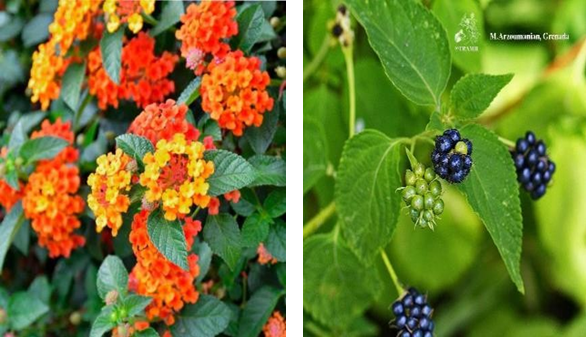
Fig. 1: Morphological features of Lantana camara depicting flowers and fruits
AIM:
Preparation and evaluation of herbal anticancer tablet from Lantana camara leaf extract
OBJECTIVES:
LITERATURE REVIEW:
Lantana camara has been documented to have pharmacological activities and therapeutic potentials Plant has many biologically active constituents which found responsible for various types of medicinal activities as results various phytochemical and pharmacological studies
Lantana camara has been recognized as a significant source of all various types of medicinal usages which can be studied for their pharmacological potential.[6-11]
MATERIALS AND METHODS:
a. Plant Material
Fresh Lantana camara leaves were gathered from the neighborhood. Nanded Markhel (Maharashtra, India). Plant Material Isolation, Verification, and Application in Additional Research Procedures
b. Preparation of Plant Extract
Before being rinsed with distilled water, leaves were first cleaned with tap water to get rid of dust and other impurities. Finally, the (Inf) particle plant material was shade-dried for two days at 30 °C to completely remove any remaining moisture.
After being completely dehydrated, they were ground into a powder with a mortar and pestle. Kazemi et al. 201231 About 20 g the dried powdered plant material was immersed in an appropriate volume of methanol solvent in a vacant container as left for three to four days to allow for the palatable recovery of plant-based substances.
The extract was decanted and filtered with adequate means of filtration. This extract was filtered out, placed in petri dish and dried at room temperature for 2 days to obtain the plant extract.[12,13]
FORMULATION OF HERBAL TABLET:
Table 1: Composition of Lantana camara Extract Tablet Formulation
|
Sr. No. |
Ingredient |
Quantity |
Role |
|
1 |
Lantana camara extract |
2.5 g |
Active ingredient |
|
2 |
Lactose |
2.2 g |
Diluent |
|
3 |
Gum Acacia |
0.075 g |
Stabilizer / Binder |
|
4 |
Starch |
0.125 g |
Binding agent |
|
5 |
Magnesium stearate |
0.05 g |
Lubricant |
Tablet Preparation Method
The Direct Compression Method
The technique most commonly employed to create solid dosage forms in the pharmaceutical sector, direct compression, has been employed to make the tablets.
Here is the process:
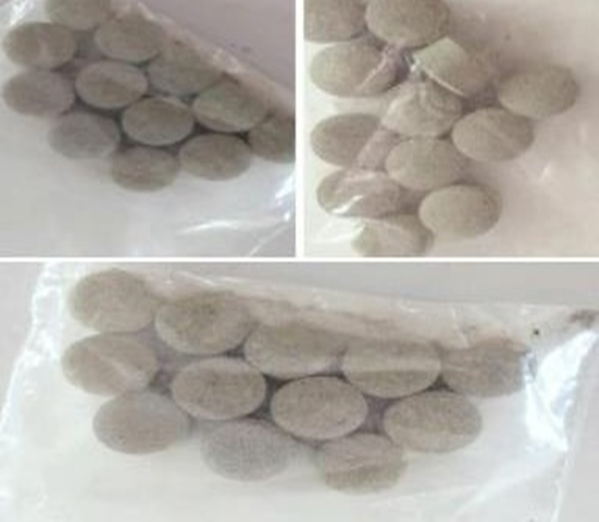
Figure 2: Final Tablet Formulation of Lantana camara Extract
PREFORMULATION STUDIES:
Visual evaluation of organoleptic characters of Lantana camara powder
Table 2: Organoleptic Properties of Lantana camara Extract
|
Sr. No. |
Parameter |
Observation |
|
1 |
Colour |
Greenish |
|
2 |
Odour |
Mucilaginous |
|
3 |
Taste |
Bitter |
The plant extract was dissolved in different solvents (water, methanol and ether) to determine its solubility.
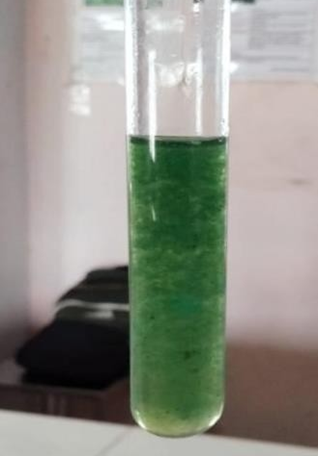
Figure 3: dissolving the plant extract
Table 3: Lantana camara Extract Solubility Profile
|
Solvent |
Solubility |
|
Water |
Completely soluble |
|
Methanol |
Slightly soluble |
|
Ether |
Very poorly soluble |
The extract of plant was measured with the digital pH meter. Instrument was calibrated at acetate buffer solution before measurement. Its pH was 5.8.[10]
The properties of the powder blend are examined using the degree of repose. A conical pile of powder is formed by dropping the powder via a funnel onto a level surface. The formula as follows was used to get the angle of repose:
θ=tan?-12hd
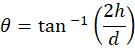
h = height of powder pile
d = diameter of the base
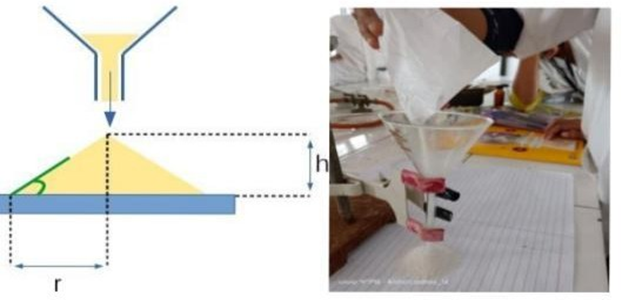
Figure 4: Determination of Angle of Repose of Powder
Table 4: Classification of Powder Flow Properties by Angle of Repose [15]
|
Flow Property |
Angle of Repose |
|
Excellent |
25–30° |
|
Good |
31–35° |
|
Fair |
36–40° |
|
Passable |
41–45° |
|
Poor |
46–55° |
EVALUATION OF TABLETS:
It is dimensional, measurable and controllable. An only variable that has measured in micrometer or another device, tablet thickness. For tablet thickness control, it should be +/−5% variation of standard value. [16]
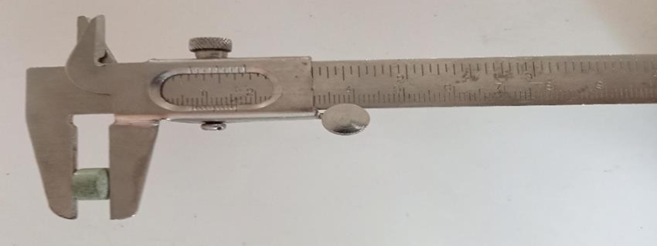
Fig 5: Measuring Thickness of Tablet with Vernier Caliper
In terms of tablet hardness, this is the diameter compression force which compensates for breaking a tablet. To withstand the mechanical shock of handling during creation, packing, and shipping, tablets have to have adequate hardness or strength and resistance to friability. Hardness is often used to gauge a tablet's crushing power. How may the power of the pill be obtained? Use the thumb as a base to smash the tablet between the your two remaining fingers. A rapid breakage is a sign that the tablet is strong enough. A tablet is placed between two anvils in the strength tester, and force is applied to these two anvils to determine the crushing strength, which can break or destroy tablets. They are used as hardness testers. 1. The Monsanto The tester 2. The Strong-Cobb Tester 3. The Pfizer Tester 4. Tester Erwika Fifth. Schleuniger Tester Hardness compressed tablet: 5 — 8 kg. [17]
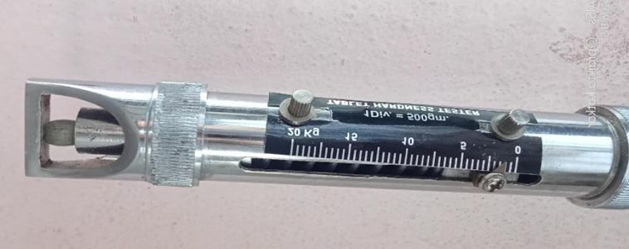
Figure 6: Determination of Tablet Hardness Using Monsanto Hardness Tester
Outcomes Tablets that powder and crumbles upon handling. Non-elegant and consumer acceptance Put really dirty processes into production components Affect on weight variation of tablet or content uniformity as well. Operating concept for the laboratory friability test: The Roche friabilator is used to conduct the malleability test. They are physically dropping a foot through the friabilator which runs for 100 revolutions, because they are made of a plastic chamber that the revolves at 25 rpm. We reassess the medicine. A drop of <0.5 to 1.0% tablet is in limits on average up to October 2023.[18]
%Friability=W0-WfW0×100
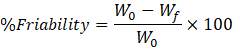
W? = Initial weight of tablets
Wf = Final weight of tablets
Acceptable tablets recorded less than 1% weight loss.
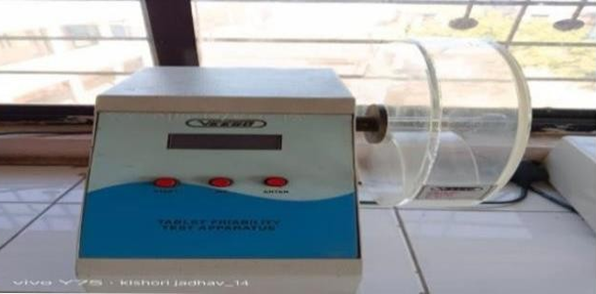
Figure 7: Determination of tablet friability by using friability tester
Table 5: Friability Test Result of Lantana camara Tablets
|
Tablet name |
Initial weight |
Final weight |
Weight variation (%) |
|
Lantana camara tablet |
5.50 |
5.00 |
0.50 |
The United States Pharmacopeia (USP) standards for tablet capacity homogeneity were followed when conducting the mass variation test. An analytical balance (Shimadzu AY220, Kyoto, Japan) was utilized to weigh each of the twenty randomly chosen pills. After calculating the average weight of ten tablets, each tablet's weight was contrasted to the standard.
USP: The percentage within limits (not greater than two units exceed the prescribed value, and no unit depart from more than double numbers). Permitted weight variations are based on the average weight of the tablet.[19]
Weight Variation Limits:
Table 6: Weighing Variation Limits for Tablets according to Pharmacopoeia
|
Sr. No. |
Average Weight of Tablet (mg) |
Maximum % Difference Allowed |
|
1 |
130 mg or less |
10% |
|
2 |
130–324 mg |
7.5% |
|
3 |
More than 324 mg |
7% |
Calculation of Weight Variation:
The percentage change in weight was given by the following equation:
Weight Variation (%)=IWAWAW×100

IW = Weight of single tablet
weight_avg = Average weight of tablets
Observed Weight Variation Data:
Table 7: Change in weight of Lantana camara tablets
|
Individual Weight of Tablet (g) |
Difference from Mean |
(% ) RSD |
|
0.57 |
0.02 |
3.6 |
|
0.54 |
-0.01 |
-1.81 |
|
0.61 |
0.06 |
10.9 |
|
0.56 |
0.01 |
3.7 |
|
0.57 |
0.02 |
3.6 |
|
0.55 |
0 |
0 |
|
0.50 |
-0.05 |
-0.09 |
|
0.48 |
-0.07 |
-12.7 |
|
0.57 |
0.02 |
3.63 |
|
0.54 |
-0.01 |
-1.8 |
Total % RSD = 4.3
An analytical technique called UV-visible spectroscopy may be used to identify chemical species based on how they absorb visible or ultraviolet light, which results in wavelengths that form different spectra. This is done based on the interactions of electromagnetic radiation with matter. In this approach, the compounds absorb radiation in ultraviolet and visible electromagnetic spectrum. The range of 200–400 nm is called as ultraviolet region and that from 800-400 nm belongs to the visible region. The simple inhibition form is valuable in chemical qualitative and quantitative structure analysis.[20]
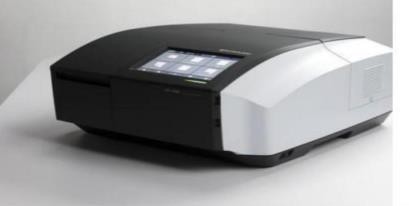
Figure 8: UV–Visible spectrophotometer
To prepare the 0.1 M sodium hydroxide solution:
a clean, dry 1000 ml volumetric flask was filled wit around 100 ml of water that had been distilled. Stirring until everything was dissolved, 4 g of potassium hydroxide was added evenly. A a solution of 0.1 M sodium hydroxide, was prepared by adding pure water to the final volume of 1000 ml after the solute had completely dissolved.
To make a 0.1 M sodium hydroxide solution:
fill a clean, dry 1000 ml flask with with 100 ml of distilled water. The increment addition of ~ 4 g of sodium hydroxide was added with vigorous stirring until it completely dissolved. A final 0.1 M sodium hydroxide solution was prepared by filling up to the desired volume with distilled water, and this was repeated three times (dilution step) after the solute was dissolved in distilled water.[21]
Procedure:
In this study, the disintegration test was performed as per United States Pharmacopeia (USP) guidelines to determine the time taken for tablets to break down into clumps of smaller particles given under certain conditions. The USP breakdown equipment, for for example, consists of six clear tubes that are about three inches long, open at the highest point, and screened by a 10-mesh screen.
For this test, one tablet was placed in each of two tubes that were then positioned bottom up using a basket-type rack assembly and immersed in either 1 liter of disintegration medium (distilled water, simulated gastric fluid or simulated intestine depending on experimental setup) which through out the experiment was maintained at 37 ± 2 °C simulating physiologic conditions.
During the test, the basket rack assembly moved vertically within a range of 5 to 6 cm at an orbital speed from 28 to 32 times per minute. They measured how long it took for the tablets to completely break down into particles small enough to fit through a mesh screen. Disintegration times acceptable for uncoated tablets generally fall within the range of 5 to 30 min.[18,19]
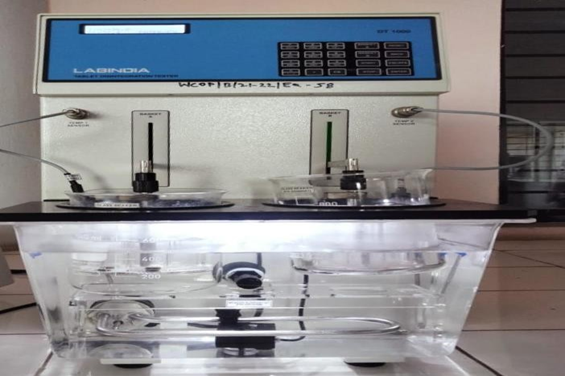
Figure 9: Disintegration test apparatus
The process by which a solid drug material dissolves into a solvent and forms a solution is known as the process of dissolution. The technique of identifying the rate and degree of drug release from a dosage form under circumstances favourable to maximal controlling is known as dissolution testing, and it is a crucial metric for assessing bioavailability (Stier & Chernick, 2016). Standard USP equipment, often known as type I (basket type) and type II (paddle type), was used to conduct the United States Pharmacopeia (USP) dissolution test. This method involved placing a tablet in a web of wires basket that was fastened to the bottom of a revolving shaft driven by an engine with an adjustable speed.
A phosphate buffer served as the dissolution medium into which a tablet-containing basket was dipped inside a dissolution vessel. In a thermostatically controlled water bath, temperature of the medium was kept constant on 37 ± 5°C to better mimic physiological conditions. This process was carried out at a fixed rotating rate of the shaft to allow contact between the dissolution medium and the tablet's surface. At fixed time intervals, a sample was collected to measure the amount of drug released into the dissolution medium as function of time.[16,17]
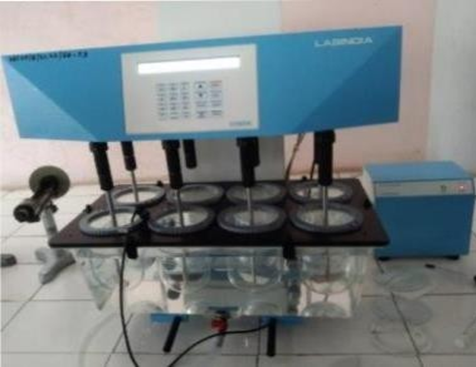
Figure 10: Dissolution test apparatus
RESULTS:
Table 8: Preformulation Studies of Lantana camara Powder
|
Sr. No. |
Parameter |
Observation |
|
1 |
Colour |
Greenish |
|
2 |
Odour |
Mucilage |
|
3 |
Taste |
Bitter |
|
4 |
Solubility |
Completely soluble in water; slightly soluble in methanol |
|
5 |
pH |
5.8 |
|
6 |
Angle of Repose |
28° |
Table 9: Evaluation of Herbal Anticancer Tablet
|
Sr. No. |
Parameter |
Observation |
|
1 |
Hardness |
5 kg/cm² |
|
2 |
Size and Shape |
10 mm, spherical |
|
3 |
Friability |
0.5% |
|
4 |
Weight Variation |
3.5% |
|
5 |
Dissolution Time |
20 minutes |
|
6 |
Disintegration Time |
10 min 10 sec |
CONCLUSION
Tablets were produced for the first time on the basis of Lantana camara leaf extract which was ascertained using direct compression method in this study as herbal anticancer tablets. The physicochemical and pharmaceutical attributes of the produced tablets were acceptable. Appropriate powder properties (a good angle of repose, for example) are indicated in preformulation studies (good flow properties during tablet manufacture). Following the compression, evaluation tests were conducted, and the outcomes, including hardness, friability, density variance, disintegration period, and dissolution time, were determined to be within the proper limits.The results suggest that prepared formulation of herbal tablet had appropriate mechanical strength, stability and pharmaceutical quality. Therefore, Lantana camara may serve as a potential natural source for preparing economical/ herbal anticancer formulations.
REFERENCES



D. N. Shinde, V. J. Zanwar, A. S. Kale, Formulation & Evaluation of Herbal Tablet on Anti-Cancer, Int. J. of Pharm. Sci., 2026, Vol 4, Issue 3, 3613-3624, https://doi.org/10.5281/zenodo.19252962
 10.5281/zenodo.19252962
