
Department of Pharmaceutics, Mar Dioscorus College of Pharmacy,Alathara, Sreekaryam,Thiruvananthapuram
Hydroxyapatite is a biomimetic calcium phosphate mineral that closely resembles the inorganic component of tooth enamel and plays a significant role in enamel remineralization by replenishing lost calcium and phosphate ions. Owing to its high biocompatibility and ability to repair early enamel lesions, hydroxyapatite has gained increasing attention as an alternative or adjunct to fluoride in oral-care formulations.Fish bone, an abundant and underutilized biowaste, serves as a sustainable and cost-effective natural source of hydroxyapatite, offering chemical similarity to biological apatite while supporting environmental waste valorization.This review analyzed peer-reviewed articles published between 2010 and 2025 retrieved from databases including PubMed, Scopus, Web of Science, and Google Scholar.The reviewed literature indicates that fish bone–derived hydroxyapatite exhibits favorable physicochemical properties, effective enamel remineralization potential, and promising applicability in toothpaste formulations. However, the need for standardized extraction methods, long-term safety evaluations, and well-designed clinical studies is consistently emphasized across studies.
The dental caries process is multifactorial. At the molecular level, it is characterized by the loss of mineral from the HAP lattice. Specifically, the metabolism of carbohydrates by oral bacteria causes an initial drop in pH as a result of lactic acid production. When the pH of the oral environment drops below a critical value of 5.5 for enamel, the increased H+ ions couple with free calcium and phosphate ions to shift the equation to demineralization which cause the dissolution of hydroxyapatite crystal and resulting in the loss of calcium and phosphate from the tooth structure. Early carious lesions, also known as enamel white spot lesions, are non-cavitated and capable of remineralization. The white opaque appearance of the lesions is due to the increased porosity of demineralized enamel which in turn results in a change in the refractive index. White spot lesions which are visible on dried enamel are typically confined to the outer enamel and are classified as code 1 using the International Caries Detection Assessment System (ICDAS). White spot lesions which are visible without being dried are deeper into enamel and possibly to the level of dentinoenamel junction (DEJ) and ICDAS code 2. While these lesions are theoretically capable of remineralizing and arresting, if they are left untreated, they may progress into dentin (ICDAS code 3 and beyond); at which point definitive restorations are recommended. [1] Hydroxyapatite, HAp (Ca 10(PO4)6(OH)2), is thermodynamically stable in its crystalline state in body fluid and has a very similar composition to bone mineral. HAp can integrate with bone without causing any local or systemic toxicity, inflammation or foreign body response. For these reasons, HAp has been widely used for biomedical applications particularly in orthopaedic, odontology, and as the coating material for metallic implants. Consequently, methods for synthesising HAp with customisable characteristics have been extensively studied. Although many synthesis methods have been developed, the preparation of HAp with specific characteristics still remains challenging because of the possibility of formation of toxic intermediary products during the synthesis of HAp. Therefore, studies on new parameters of synthesising HAp are still ongoing. [2] Fluoride has long been the predominant ingredient in dental care products aiming at preventing dental caries. A considerable body of evidence highlights the significant reduction of caries particularly through the everyday use of fluoridated toothpaste. It is now well established that fluoride demonstrates the most consistent benefit in preventing dental decay by promoting the topical remineralization of incipient lesion. However, one of the main concerns associated with the use of fluoride-containing products is the increased risk of fluoride ingestion or development of dental fluorosis. Ingestion of excess fluoride during daily oral hygiene routines is common especially in children under the age of six who lack complete control of swallowing. Recently, the Centers for Disease Control and Prevention in the United States have shown that preschoolers and toddlers were exposed to greater amount of fluoride from toothpastes than the one recommended early in life. Recent research has focused on the extraction of hydroxyapatite from natural and sustainable sources, including biowaste materials such as fish bones, eggshells, and animal bones. Fish bone–derived hydroxyapatite is especially promising due to its high calcium content, chemical similarity to biological apatite, low cost, and contribution to waste management and environmental sustainability. Various extraction techniques have been reported to obtain hydroxyapatite with suitable physicochemical properties for dental applications. [3] “This review critically analyzes published literature on fish bone–derived hydroxyapatite, focusing on extraction methods, physicochemical characteristics, and its potential application in remineralizing toothpaste formulations.”
Teeth [4]
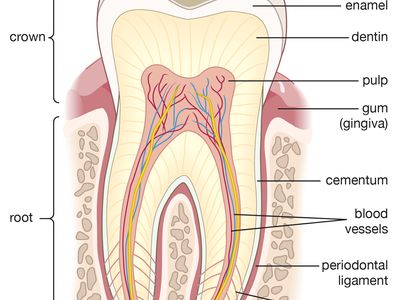
Teeth play a fundamental role in essential physiological functions such as mastication, speech, and facial aesthetics. As highly mineralized structures, they are designed to withstand significant mechanical forces while maintaining structural integrity throughout life. Each tooth is composed of three major hard tissues—enamel, dentin, and cementum—and a soft connective tissue called the pulp, which contains nerves, blood vessels, and cellular components critical for tooth vitality. Enamel, the outermost layer, is the hardest tissue in the human body and primarily consists of tightly packed hydroxyapatite crystals. Beneath the enamel lies dentin, a less mineralized but resilient tissue that provides elasticity and supports the enamel. The root surface is covered by cementum, which anchors the tooth to the surrounding alveolar bone through the periodontal ligament.
Root: The portion of the tooth that extends into the bone and maintains the tooth in place is known as the root. It covers about two-thirds of the tooth. It is made up of various parts:
Neck
The area between the crown and root is known as the neck, or dental cervix. It creates the boundary between the enamel and the cementum, which covers the root. It has three main parts:
Crown
The part of a tooth that is visible is called the crown. It contains three parts:
Toothpaste [4]
Toothpaste is an essential component of modern oral hygiene practices and plays a critical role in maintaining dental health. Used in combination with a toothbrush, toothpaste helps remove dental plaque, food particles, and surface stains, contributing to the prevention of common oral diseases such as dental caries, gingivitis, and periodontal disease. The evolution of toothpaste reflects significant advancements in dental science, public health awareness, and consumer preferences. What began as simple mixtures of abrasives and cleansing agents has developed into a sophisticated formulation containing therapeutic, cosmetic, and functional ingredients designed to address a wide range of oral-care needs.
A typical toothpaste formulation contains abrasives, humectants, binders, surfactants, flavoring agents, preservatives, and active therapeutic ingredients. Abrasives such as silica or calcium carbonate assist in mechanical plaque removal, while humectants (e.g., glycerin, sorbitol) maintain moisture and prevent the product from drying out. Surfactants, most commonly sodium lauryl sulfate, aid in foaming and enhance the dispersion of the paste during brushing. Binders and thickeners ensure uniform consistency, and flavoring agents improve user acceptability.
The most widely used active ingredient in conventional toothpaste is fluoride, which strengthens enamel, enhances remineralization, and inhibits demineralization. Fluoride toothpastes have been instrumental in reducing the global prevalence of dental caries. However, concerns regarding fluoride overexposure—especially in young children—and increasing consumer demand for natural or biomimetic oral-care products have stimulated research into alternative remineralizing agents.
One such promising alternative is hydroxyapatite, a calcium phosphate mineral that closely resembles the natural composition of tooth enamel. Hydroxyapatite-containing toothpastes aim to rebuild enamel through biomimetic remineralization, offering benefits such as enamel repair, reduction of tooth sensitivity, and improved surface smoothness without the potential risks associated with excessive fluoride ingestion. The growing interest in natural and sustainable sources for hydroxyapatite—such as fish bones, eggshells, and biowaste materials—aligns with global trends toward eco-friendly and resource-efficient product development.
Today, toothpaste is not only a preventive tool but also a medium for delivering specialized therapeutic benefits, including whitening, desensitizing, tartar control, and antimicrobial protection. Continuous innovation in formulation and active ingredient technology reflects the dynamic nature of the oral-care industry and its commitment to improving dental health on a global scale.
Ideal properties of toothpaste [5]
Uses [6]
CLASSIFICATION OF TOOTHPASTE [7]
1. Fluoride Toothpastes
2.Antibacterial and Anti-inflammatory Toothpastes
3. Toothpastes for Sensitivity
4. Whitening Toothpastes
5. Toothpastes with Natural Ingredients
6. Special Toothpastes for Children
1. Fluoride Toothpastes: Fluoride is one of the most commonly used active components in toothpaste and plays a key role in caries prevention. Research indicates that fluoride concentrations of 1000–1450 ppm effectively strengthen enamel and provide protection against caries. However, fluoride toothpastes must be used cautiously in children.
2. Antibacterial and Anti-inflammatory Toothpastes: Ingredients like triclosan and chlorhexidine inhibit microbial growth. Products such as Lacalut Active and Parodontax arewidely used in cases of periodontitis and gum inflammation. These toothpastes typicallycontain low-abrasive agents, antiseptics, and plant extracts to soothe gum tissues.
3. Toothpastes for Sensitivity: Brands like Sensodyne and Elmex Sensitive are based on potassium nitrate and strontium salts. These substances reduce signal transmission to tooth nerves, thereby minimizing pain perception.
4. Whitening Toothpastes: Toothpastes such as Crest 3D White and Colgate Optic White include abrasive particles, hydrogen peroxide, or baking soda to remove surface stains. However, long-term use may lead to enamel erosion.
5. Toothpastes with Natural Ingredients: Recently, products like R.O.C.S., SPLAT, and Himalaya, based on herbal extracts, have gained popularity. These toothpastes typically do not contain parabens, SLS, or synthetic preservatives, though their efficacy may sometimes be lower than that of fluoride-containing pastes.
6. Special Toothpastes for Children: Products such as Elmex Kids and R.O.C.S. Baby are low in abrasiveness, pleasant in taste, and formulated with safe ingredients. The fluoride concentration in these pastes should not exceed 500 ppm to reduce the risk of ingestion.
Advantages of Toothpaste [8]
1. Helps Remove Plaque and Maintain Oral Hygiene
2. Contains Therapeutic Agents: Most toothpaste includes active ingredients such as:
3. Prevents Dental Caries
4. Freshens Breath
5. Reduces Tooth Staining
6. Helps Manage Tooth Sensitivity
7. Affordable and Easy to Use
8. Supports Gum Health
Disadvantages of Toothpaste
1. Risk of Fluoride Overexposure
2. Abrasivity Can Damage Enamel
3. Allergic Reactions
4. Whitening Toothpastes Offer Limited Results
5. Antimicrobial Toothpastes May Disrupt Oral Micro biome
6. Cost Variability
MATERIALS AND METHODS [9]
Materials
The materials for the present review consisted of published scientific literature related to hydroxyapatite, fish bone–derived hydroxyapatite, biomimetic remineralization, and toothpaste formulations. Peer-reviewed research articles, review papers, and comparative studies available in recognized scientific databases were considered as the primary sources of information.
Methods
A systematic literature search was carried out using electronic databases including PubMed, Scopus, Web of Science, and Google Scholar. Relevant studies published in the English language between 2010 and 2025 were identified using keywords such as “fish bone hydroxyapatite,” “biowaste-derived hydroxyapatite,” “hydroxyapatite toothpaste,” “biomimetic remineralization,” and “fluoride-free toothpaste.” Boolean operators were applied to refine the search and improve relevance.
Studies were included if they reported on the extraction, characterization, or dental application of hydroxyapatite derived from fish bone or other natural sources, as well as studies evaluating remineralization efficacy in toothpaste formulations. Both in vitro, in vivo, and clinical studies, along with relevant review articles, were considered. Articles were excluded if they lacked scientific validity, were not peer reviewed, or did not directly address the objectives of the review.
The selected literature was critically analyzed with emphasis on extraction techniques, physicochemical properties, particle size characteristics, remineralization performance, and formulation aspects of hydroxyapatite-based toothpaste. Data from the included studies were synthesized to identify current trends, advantages, limitations, and research gaps in the development of fish bone–derived hydroxyapatite as a sustainable remineralizing agent.
Extraction Methods of Fish Bone–Derived Hydroxyapatite [10]
Several methods have been reported for extracting hydroxyapatite from fish bone, with the extraction technique significantly influencing the purity, crystallinity, and suitability of the material for dental applications.
Thermal calcination is the most commonly employed method, in which cleaned fish bones are heated at high temperatures to remove organic components and obtain crystalline hydroxyapatite. This method is simple, cost-effective, and scalable; however, excessive temperatures may increase particle size and reduce surface area.
Alkaline treatment, often used as a pre-treatment or alternative approach, involves treating fish bones with alkaline solutions to eliminate organic matter while preserving the mineral structure. This method can produce hydroxyapatite with finer particles and improved surface properties, though thorough washing is required to remove residual alkali. Chemical precipitation utilizes calcium precursors derived from fish bones reacted with phosphate sources to form hydroxyapatite under controlled conditions. This method allows better control over particle size and morphology, often yielding nano-sized hydroxyapatite with enhanced remineralization potential, but involves greater processing complexity.
Overall, thermal calcination offers economic feasibility, while alkaline treatment and chemical precipitation provide improved control over material characteristics for toothpaste applications.
FORMULATION OF TOOTHPASTE [11]
The formulation of toothpaste involves carefully selecting and combining ingredients to create a product that addresses specific oralcare concerns and delivers desired benefits. Here is a basic outline of the formulation process:
METHOD OF PREPARATION [12]
Characterization Techniques [13]
Various characterization techniques have been reported in the literature to confirm the structural and physicochemical properties of fish bone–derived hydroxyapatite intended for dental applications. They are:
Remineralization Efficacy of Hydroxyapatite-Based Toothpaste [14]
|
Study
|
Hydroxyapatite Source |
Evaluation Method |
Key Findings |
||||
|
O’Hagan-Wong et al., 2022 (Odontology) |
Synthetic / biomimetic HA |
|
Significant inhibition of demineralization and enhanced enamel remineralization compared to control |
||||
|
Chatzidimitriou et al., 2025 (Journal of Dentistry) |
HA-based fluoride-free toothpaste |
pH cycling, SEM analysis |
Effective remineralization of initial caries lesions with enamel surface repair comparable to fluoride toothpaste |
||||
|
Sevagaperumal & Periyasamy, 2024 (Int J Clin Pediatr Dent) |
Nano-hydroxyapatite |
Surface microhardness, SEM |
ncreased enamel microhardness and occlusion of interprismatic spaces |
||||
|
Fish bone–derived HA |
In vitro enamel remineralization model |
|
CONCLUSION
The present study successfully demonstrates the synthesis of hydroxyapatite (HA) from natural fishbone through thermal treatment and its application in toothpaste formulation. Fishbone, an abundant and sustainable biowaste, proved to be an effective calcium-rich precursor for producing hydroxyapatite with properties comparable to biological apatite found in human enamel and dentin. The conversion process effectively removed organic components and yielded HA suitable for oral care applications.
The formulated fishbone-derived HA toothpaste showed promising characteristics, including acceptable physicochemical properties and potential remineralization capability. Due to its chemical similarity to tooth mineral, hydroxyapatite contributes to enamel surface repair, occlusion of dentinal tubules, and reduction of tooth sensitivity. The fluoride-free nature of the formulation also highlights its suitability as a safer alternative for long-term use, particularly in populations at risk of fluorosis.Overall, the utilization of fishbone-derived hydroxyapatite in toothpaste formulation offers a cost-effective, eco-friendly, and biologically compatible approach for preventive oral care. This study supports the potential of natural-source hydroxyapatite as an efficient remineralizing agent and encourages further in vivo studies and clinical evaluations to validate its long-term efficacy and antimicrobial performance.
REFERENCES

Praveena M. V., Dr. Ganesh Sanker S., Bhavya D., Sandeep S., Jinsa Kabeer, Fish Bone–Derived Hydroxyapatite as a Sustainable Remineralizing Agent in Toothpaste: A Comprehensive Review, Int. J. of Pharm. Sci., 2026, Vol 4, Issue 2, 2595-2604. https://doi.org/10.5281/zenodo.18668605
 10.5281/zenodo.18668605
