
Institute of Technology & Management, GIDA, Gorakhpur, Uttar Pradesh, India 273209
Superficial fungal infections, such as dermatophytosis and candidiasis, are prevalent and difficult to manage due to limited skin permeability, inadequate bioavailability, and the adverse effects of systemic administration of traditional antifungal agents. Herbal substances provide a safer choice, but their therapeutic effectiveness is compromised due to instability and insufficient penetration within the stratum corneum Ethosomal gel is a type of vesicular drug delivery system which has recently?been developed as an effective means to circumnavigate these hindrances. Ethosomes, consisting of phospholipids, ethanol, and water, improve the transdermal delivery, vesicle deformability, drug stability, and permit controlled and sustained?release of the encapsulated actives The aim of this study is to investigate and validate Arachis hypogaea (Peanut) leaf extract from among the herbal extracts containing flavonoids, phenolics and tannins which have?strong antifungal properties for the development of herbal ethosomal gels. The preparation consists of an optimization of gelling agents, phospholipids concentration, ethanol concentration, vesicle size and pH. The evaluation parameters include the physiochemical properties, vesicles characterization, in-vitro/ex-vivo permeation and antifungal activity. Herbal ethosomal gels exhibit better skin penetration, increased stability, paucity of systemic side effects along with the possibility of synergistic effect with multi herbal extracts, which makes them a natural and effective topical antifungal treatment with?potential .We envision further clinical evaluation and commercialization of these formulations as the new rationale in safe and effective antifungal
When pathogenic fungal species successfully infiltrate the host and proliferate within bodily tissues, fungal infections, also known as mycoses, result. These infections may just affect exterior, keratin-rich tissues like the epidermis, hair shafts, and nails, or they may spread to invasive forms that endanger internal organs, depending on the level of tissue involvement. An increase in people with compromised immune systems, such as those with HIV infection, those with long-term metabolic conditions like diabetes mellitus, and patients undergoing cytotoxic or immunosuppressive treatments, is closely linked to the rising global burden of mycotic infections [1].
Fungal infections, termed mycoses, develop when pathogenic fungal species successfully invade the host and multiply within body tissues. Based on the depth of tissue involvement, these infections may be limited to external, keratin-rich structures such as the epidermis, hair shafts, and nails, or may progress to invasive forms that compromise internal organs. The growing global burden of mycotic infections is strongly associated with an increase in individuals with impaired immune defenses, including those affected by HIV infection, chronic metabolic disorders like diabetes mellitus, and patients receiving cytotoxic or immunosuppressive treatments [1]. Fungi are heat-tolerant eukaryotic organisms that predominantly thrive in environments characterized by warmth and high humidity. Mycotic infections are categorized based on the anatomical location involved and the extent of tissue penetration, and are classified into superficial (cutaneous), subcutaneous, and systemic or deep fungal infections [2]. Mycoses are infectious conditions that arise when pathogenic fungi infiltrate human tissues and cause cellular damage through colonization and invasive growth. These infections represent a major global public-health concern, with a disproportionate impact on low- and middle-income countries and individuals with compromised immune function. Epidemiological studies indicate that superficial fungal infections affect over one billion people annually, while invasive and systemic mycoses are responsible for more than 1.5 million deaths each year [3]. Fungi comprise a diverse kingdom of eukaryotic microorganisms that include unicellular yeasts, filamentous molds, and dimorphic species capable of switching between morphological forms in response to environmental cues. In contrast to prokaryotic bacteria, fungal cells possess a membrane-bound nucleus and a structurally complex cell wall composed primarily of chitin, glucans, and mannoproteins, components that represent important targets for antifungal drug development [4]. Opportunistic mycotic infections typically develop in individuals with weakened immune defenses, resulting from conditions such as HIV/AIDS or from medical interventions including cytotoxic chemotherapy, solid organ transplantation, and prolonged exposure to antibiotics or corticosteroids [5].
Ethosomes: An Overview
Ethosomes represent a new generation of flexible vesicular carriers that have been tailored for improved skin delivery of drugs through transdermal and dermal routes [6Ethosomes differ from conventional liposomal systems due to their elevated ethanol content, which modifies the vesicular membrane by increasing its flexibility. This enhanced deformability enables more efficient transport across the stratum corneum while maintaining the skin barrier’s structural integrity [7]. These vesicular systems are capable of delivering both water-soluble and lipid-soluble therapeutic agents, making them adaptable platforms for a wide range of pharmaceutical applications
Composition:
Ethosomes are typically composed of four main components:
|
Component |
Example |
|
Phospholipids |
Phosphatidylcholine (soy/egg), Phosphatidylserine |
|
Ethanol |
20–45% w/w (acts as penetration enhancer) |
|
Water (Aqueous Phase) |
Purified water |
|
Active Drug |
Diclofenac, Clotrimazole, Curcumin |
|
Optional Additives |
Cholesterol, Glycerol, Propylene glycol, Stearylamine |
1. Ethanol (20–45%) Co-solvents (optional) Phospholipid
Vesicular bilayers are mainly formed from phospholipids such as phosphatidylcholine derived from soy or egg sources [8]. Interactions between Ethosomes and skin lipid layers increase vesicular deformability, allowing passage through the narrow intercellular channels of the stratum corneum. In addition, ethanol at concentrations of 20–45% enhances transdermal transport by increasing membrane fluidity [9]. The amount of ethanol is carefully optimized to maintain vesicle integrity while ensuring effective skin permeation [10].
2. Water (Continuous Phase of Ethosomal Dispersions)
An aqueous medium serves as the continuous phase that disperses the phospholipid-based vesicles [11] . It promotes phospholipid molecule hydration for bilayer formation in the process of ethosome formation. The vesicles in an aqueous medium form a stable colloidal dispersion, and the medium is used to entrap hydrophilic drugs in the aqueous core of the vesicles. The size, zeta potential, and overall stability of the vesicles are also affected by the water-to-ethanol ratio. The equimolar ratio contributes to optimal vesicle self-assembly and avoids aggregation, which is important for reproducible topical or transdermal delivery of a drug [12].
Mechanism of Action
The activity of the ethosomal system for transdermal and dermal drug delivery is connected mainly with the synergistic action of ethanol, phospholipids, and the skin barrier. The process is multifactorial and includes several reinforcing events that allow the passage of hydrophilic and lipophilic molecules into the stratum corneum.[19].
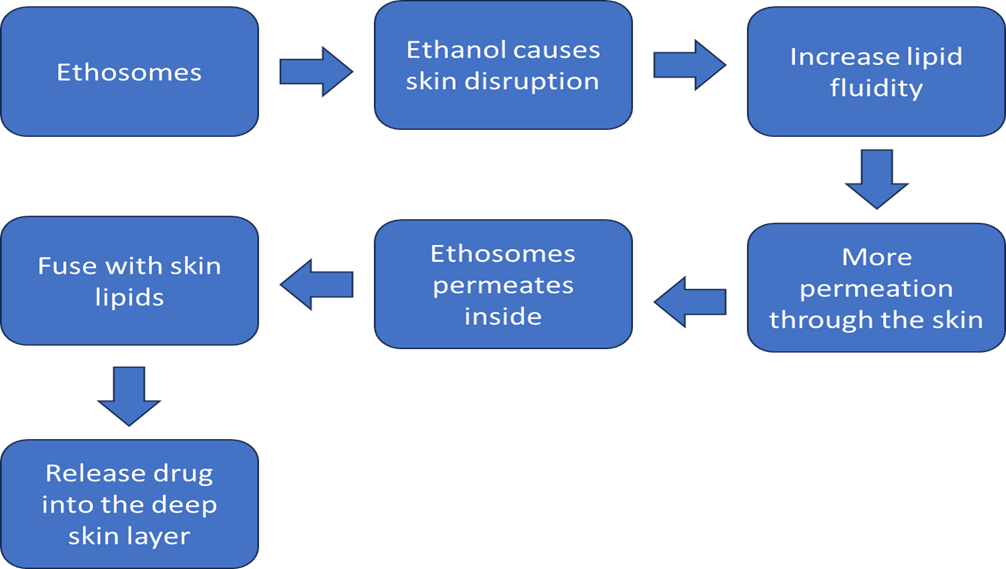
Ethanol functions as a penetration enhancer by breaking down the highly ordered stratum corneum lipid structure. It enhances lipid fluidity, decreases the transition temperature of skin lipids and their barrier function [20]. Such a softening effect facilitates the penetration of vesicular systems through the skin and enhances skin drug diffusion and partitioning. Ethanol is also responsible for the partial extraction of lipids from the stratum corneum, which increases the penetration ability of ethosomal vesicles. [21].
Phospholipid-based ethosomes are very deformable and flexible vesicles that allow them to go with the flow of skin lipids and make their way through the lipids in between cells. [22].
After reaching the skin surface, the ethosomes enriched with ethanol interact with stratum corneum lipids, and the drug is transferred into the skin through the fusion of vesicles and mixing of lipids. [23]. This fusion process improves the drug retention in deeper skin layers along with facilitating controlled and sustained release of drug in the layers of the epidermis and dermis [24].
Ethosomal systems can effectively entrap both hydrophilic and lipophilic drugs, as a result of their special bilayer structure which is formed by phospholipids and ethanol. [25].
The hydrophilic core can entrap water-soluble drugs, and the lipid bilayer can be solubilized with lipophilic compounds. [26].
This bivalent encapsulation property allows ethosomes to carry various types of drugs, providing better bioavailability and improved skin deposition [27].
Advantages of Ethosome
Ethosomes are superior phospholipid-based vesicular systems that employ ethanol as a co-solvent, bestowing a number of advantages over traditional vesicular systems including liposomes and niosomes [28]. The distinctive nature of phospholipid, ethanol, and water in the TC solution endows the TC with excellent skin permeation, high drug loading, and enhanced formulation stability.
Ethanol and phospholipids synergistic effect makes the per mean ability of ethosomal content through the skin very high. Ethanol makes the lipids more fluid both in the membrane of the vesicle and in the layer of the stratum corneum and this helps the vesicular encapsulated drug to go deeper into the skin. [29],
The phospholipids (such as soy or egg phosphatidylcholine) employed in ethosomes are natural and biocompatible constituents of the cell membranes.Ethosomal systems are therefore safe in so far as their application on the skin meets the requirements of long term use in topical and transdermal drug delivery. [30].
Ethosomes are particularly efficient in carrying water-insoluble herbal extracts and phytoconstituents, which normally display less bioavailability as a consequence of poor solubility. [31].ethanol and phospholipids facilitated the solubility and permeation of lipophilic natural products including flavonoids, alkaloids and terpenloids and by forming stable ethosomal complexes. [32]
Unlike conventional liposomes, ethosomes are more physically and chemically stable in storage. [33]. Ethanol serves as a co-solvent with stabilizing properties that inhibit vesicle aggregation and the release of entrapped drugs.
Ethosomal Gel: Formulation and Composition
Ethosomal gels are a semisolid system in which ethosomal vesicles are dispersed in a suitable gel-forming agent and are appropriate for both topical and transdermal application. Ethosomal gels combine gel and ethosomal vesicles for better stability and ease of application. Compared to the liquid form of ethosomal suspensions, the ethanol and water contents in ethosomal gels are lower, and their proton NMR spectra show weaker intensity of the peaks. The gel matrix enhances patient compliance, increases the residence time of the drug on the skin, and allows for controlled release of hydrophilic and lipophilic substances [34].
Gelling Agents
Gelling agents are essential for the transformation of ethosomal dispersions into stable, convenient gels without affecting the integrity of vesicles and their spreadability. Polymers such as Carbopol, hydroxypropyl methylcellulose (HPMC), and Poloxamer are used routinely.[35]
Carbopol (Carbomer):
Carbopol polymers are synthetic high-molecular-weight cross-linked polyacrylic acid and have been widely employed for many years because of high gelation efficiency, clarity and stability [36]. They are able to closely incorporate ethosomal suspensions without vesicle rupture and offer pseudoplastic flow behaviour, which enhances the spreadability on the skin surface.
HPMC (Hydroxypropyl Methylcellulose):
HPMC is a non-ionic, biocompatible cellulose derivative that acts as a stabilizer for vesicles and helps sustain the viscosity of the gel. It is especially appropriate for ethosomal gels containing herbal or thermosensitive drugs, as it inhibits vesicle aggregation without compromising homogeneity. [37].
Poloxamer (Pluronic F127):
Poloxamer-based gels are thermosensitive, which means they are liquid at low temperatures and turn into a gel at skin temperature (~32–37 °C) [38]. This characteristic allows for simple application and prolonged drug release from ethosomal vesicles. Poloxamer also improves skin hydration and offers a mild, non-irritating feel. The type and concentration of the gelling agent depend on the required viscosity, drug compatibility, and release pattern of the formulation. [39].
Preparation Methods
Various techniques are used for the preparation of ethosomal gel based on the physicochemical properties of the drug, thermosensitive nature and the requirements of the formulation.:
a) Cold Method
The cold process is widely used and appropriate for thermolabile drugs. In this method, phospholipids and the drug are dissolved in ethanol under stirring at room temperature. Under constant stirring, water (or hydroalcoholic phase) is added dropwise to a solution of ethosomes. The resultant ethosomal suspension is then added to the gel base (Carbopol/HPMC/Poloxamer) with mild stirring until a consistent gel is formed. [40],
b) Hot Method
In the hot process, the phospholipids and drug are solubilized in ethanol at an elevated temperature (40–50 °C). The aqueous phase at the same temperature is added to the organic phase with stirring to obtain ethosomes. After cooling to room temperature, the ethosomal dispersion is mixed with the pre-hydrated gel base. [41].This technique can be applied to the drugs which are stable in gentle heating and results in homogeneous vesicles size.
Modified Ethanol Injection Method
phospholipids and drug in ethanolic solution are injected into the aqueous phase with stirring, by using a syringe or a peristaltic pump in this method. Due to solvent diffusion into the aqueous phase and the interfacial deposition of phospholipids, ethosomes are spontaneously formed [42] This modified procedure is better adapted to provide a tight size distribution of vesicles with high entrapment efficiency and no limitation for gel incorporation.
Factors Affecting Gel Performance
The ethosomal gel’s performance is affected by multiple factors of formulation and processing, collectively impacting drug release, stability, and skin permeation efficiency [43].
Phospholipid Concentration:
An increase in the concentration of phospholipids results in better vesiculation and entrapment but also leads to an increase in vesicle size and a decrease in the clarity of gel [44]. The stability and rate of drug release are both influenced by the optimum phospholipid content.
Ethanol Percentage:
Ethanol (20–45%) has a marked effect on vesicle fluidity and deformability. Higher amounts of ethanol enhance skin permeation, but could lead to reduction of vesicle stability. [45] Thus, the Control ethosomal gel dose was the most appropriate to determine the effect of the ethanol content. The effect of the ratio of ethanol was very important for the effectiveness of ethosomal gel. An ideal proportion of ethanol is critical for the effectiveness of ethosomal gel. An optimal balance between ethosome size and ethanol concentration is required for effectiveness of ethosomal gel. Consequently, the control ethosomal gel dose was considered the most suitable to evaluate the effect of the ethanol content. Maintaining a proper ratio of ethanol is essential for the efficiency of ethosomal gel. Therefore, the maintenance of the optimal ratio of ethanol is very important for effectiveness of the ethosomal gel. Therefore, an appropriate balance/compromise between ethosome size and concentration of ethanol is necessary for effectiveness of the ethosomal gel. Hence, the control ethosomal gel dose was the best candidate to evaluate the effect of the ethanol content. Keeping a proper ethanol proportion is crucial for ethanol gel application.
Vesicle Size:
The smaller vesicles (100–200 nm) allow for better skin penetration and homogeneous distribution in the gel matrix while larger vesicles could increase drug retention on skin surface [46].
pH:
The pH of the ethosomal gel (usually 5.5–7.4) should be skin-friendly to prevent skin irritation and to maintain the stability of the phospholipids [47]. Departure from this range may influence the charge and the vesicle aggregation
Viscosity:
The viscosity of gels affects both drug release rate and skin adhesion. Drug diffusion is reduced with increasing viscosity, but residence time on the skin is increased. Thus, it must be optimized to achieve an appropriate balance between spreadability and sustained release [ 48].
Incorporation of Herbal Extracts
Neem (Azadirachta indica)
The neem extract contains high concentration of bioactive compounds like azadirachtin, nimbin and nimbidin which have antimicrobial (antibacterial and antifungal) and anti-inflammatory properties. But these substances are poorly water soluble and have limited skin absorption. Loading into ethosomal gels significantly improves skin delivery and antimicrobial activity, in particular against Staphylococcus aureus and Candida albicans. [49]. Ethosomes enhance drug retention in the epidermal layers and thereby increase the duration of action of formulations based on neem extract [50]
Potential for Arachis hypogaea (Peanut) Leaf Extract
Resveratrol, luteolin, and kaempferol, which have antioxidant, anti-inflammatory, and antimicrobial activities, are among the bioactive polyphenols and flavonoids present in the leaves of Arachis hypogaea (peanut plant)[51]. Although the pharmacological potential of these compounds is high, it has a poor solubility in water and low permeability through skin which making it unable to be directly applied on skin.
Incorporation of peanut leaf extract into ethosomal gel systems could offer the following advantages:
Enhanced Solubility: Ethanol is a co-solvent in ethosome that enhanced the solubility of polyphenolic compounds like resveratrol and luteolin [52].
Improved Skin Penetration: The synergy of ethanol and phospholipids enhances fluidization of skin lipids, which, in turn, facilitates the deeper dermal penetration of phytoconstituents. [53].
Stabilization of Antioxidants: Phospholipids shield vulnerable flavonoids against oxidation and degradation in the process of formulation and storage. [54].
Sustained Release: The gel matrix allows the drug to reside for an extended period of time at the site of application, producing a sustained antioxidant and anti-inflammatory effect. [55].
Consequently the present work was to formulate ethosomal gel of Arachis hypogaea leaf extract as a new safe biocompatible approach for anti-inflammatory, antioxidant and skin protective application. Further studies investigating stability of phytochemicals and skin permeation as well as in vivo efficacy would be desirable to confirm its therapeutic potential.
Herbal Antifungal Agents Used in Ethosomal Gels
Herbal antifungals possess high anti-fungal activity, are biocompatible and have fewer side effect and thus became the focus of attention in the last years. Loading such compounds into ethosomal gels leads to an improvement of their cutaneous delivery, stability and therapeutic potential, especially in the treatment of superficial and topical mycotic infections. [56]. Ethosomes, which are made up of phospholipids and a high concentration of ethanol (20–45%), act as good carriers for delivering the substances contained in them deep in to the skin and also protect phytochemicals from degradation. [57].
Mechanism of Action of Herbal Antifungal Agents
Anti-fungal action of herbal substances is mainly through various synergistic actions which interfere the life cycle and the growth of fungus:
Cell Membrane Disruption
Inhibition of Fungal Enzymes
Herbal antifungals may disrupt fungal metabolism by acting on crucial enzymes, such as chitin synthase, β-glucan synthas e, and cytochrome P450-dependent enzymes involved in the biosynthesis of ergostrol.Inhibition of these enzymes leads to defective synthesis of the cell wall and membrane formation, which in turn halts the growth and reproduction of the fungus [60]. Certain compounds such as curcumin and neem extract components are said to target various enzyme systems in the fungi [61]
Reactive Oxygen Species (ROS) Generation
Several herbal bioactives induce oxidative stress in fungal cells by elevating the levels of intracellular ROS, resulting in oxidative damage of proteins, lipids and DNA. Excessive ROS buildup leads to apoptosis-like cell death in fungal cells [62]. For example, allicin1 from garlic and resveratrol from peanut leaves are reported to elicit ROS2-induced antifungal activity [63]
Advantages of Herbal Antifungal Agents in Ethosomal Gels
Improved Skin Penetration: Ethosomes facilitate the transport of hydrophilic and lipophilic herbal antifungal drugs through the stratum corneum by disrupting the barrier function of skin lipids. [64].
Phytochemical stability: Phospholipid vesicle encapsulation shields phenolic and other sensitive compounds (curcumin, eugenol, allicin, etc.) from oxidation and hydrolysis[65].
Sustained Release: The gel medium permits a sustained release of the antifungal with concomitant prolongation of the therapeutic effect and a decrease in dosing frequency. [66].
Reduced Irritation: Ethosomal gel-based delivery of herbal substances [ETHOSOMAL GEL] shows minimal skin irritation as opposed to alcohol-based tinctures or traditional creams. [67].
Evaluation of Herbal Ethosomal Gels
The assessment of herbal ethosomal gels is necessary to maintain quality and to confirm the safety and efficacy of the formulation. Ethosomal gels are sophisticated delivery systems in which phospholipid vesicles entrap herbal actives and enable enhanced dermal delivery.Proper evaluation results in these gels being physically stable, pharmaceutically acceptable, and therapeutically efficient. [68].
Physicochemical Evaluation
Both patient acceptance and drug performance are influenced by physicochemical properties. Typical parameters are:
Appearance and Homogeneity
The gel should be smoothly textured without lumps, phase separation or air bubbles. Uniform gels represent uniform dispersion of ethosomal vesicles and are essential for uniform drug delivery. [69].
pH Measurement
The pH value of the topical gels should be near to the skin pH (5.5–6.5) to prevent irritation and to maintain its bio compatibility. pH can also affect the stability of vesicles and the release of drugs. [70].
Viscosity
Viscosity affects the spreadability, retention, and release profile of the formulation and can be determined by rotational viscometer or Brookfield viscometer. The optimal viscosity allows an easy application and provides a long skin contact time to achieve an adequate bioavailability of the drug. [71].
Spreadability
While applying gel to skin, tests the Slip and Drag or parallel plate methodologies. Patient compliance: How evenly the gel can be spread over the affected area is an important factor for uniform coverage. [72].
Vesicle Characterization
Ethosomes are vesicular carriers for both hydrophilic and lipophilic herbal actives.The key parameters are:
Vesicle Size
Measured by dynamic light scattering (DLS) or electron microscopy. Smaller vesicles (usually 100–300 nm) have a better penetration ability for stratum corneum. [73].
Zeta Potential
Determine the surface charge of the vesicles, Which is related to the physical stability of the vesicles. Values of ±30 mV are indicative of stability for colloidal system as particles will repel each other due to the electrostatic forces and hence will not aggregate. [74].
Polydispersity Index (PDI)
Reflects the size distribution of vesicles; PDI < 0.3 indicates uniform vesicle population, essential for reproducible skin penetration [75].
In-vitro and Ex-vivo Studies
This investigations offer insights into drug release, permeation and stability
In-vitro Drug Release
Performed in Franz diffusion cells using synthetic membranes. Evaluates the release rate and release extent of herbal actives from ethosomal gel with time.Aids in determination of best formulation composition and release kinetic profiles [76].
Ex-vivo Skin Permeation
Conducted on rat, porcine, or human cadaver skin to evaluate dermal penetration, flux, and retention. Crucial to verify that herbal actives penetrate deeper skin layers. [77].
Stability Studies
Assess physical, chemical and microbial stability under various conditions (e.g., temperature, humidity, light). o Stability studies confirm that the herbal actives are still potent in storage. [78].
Antifungal Activity Testing
Evaluation of antifungal activity is to make sure that the herbal ethosomal gel is effective in treatment.:
Agar Diffusion Method
The results of the study on the inhibition of Theòrnelysin resistance development were examined. The zone of inhibition of fungal growth was measured with strains such as C. albicans, A. niger, and dermatophytes. The ethosomal gel demonstrated superior antifungal action compared to the free extract. [79].
Broth Dilution Method
The broth dilution method is a widely accepted quantitative assay used to determine the Minimum Inhibitory Concentration (MIC) of antimicrobial agents. In this procedure, serial dilutions of the test substance are prepared in a nutrient broth, followed by inoculation with a standardized microbial suspension. The MIC is defined as the lowest concentration of the compound that prevents visible microbial growth after incubation. This method is highly reliable for evaluating antimicrobial potency, performing dose–response studies, and optimizing therapeutic doses for experimental or pharmaceutical applications [80]. Both microdilution and macrodilution formats are used depending on sample volume requirements, with microdilution preferred for higher throughput and precision [81]
Enhanced Skin Penetration
The high content of ethanol in ethosomal gels renders both the vesicular bilayer and the skin lipid matrix fluidized and subsequently, vesicles are allowed to penetrate the stratum corneum more deeply and in an easy manner. Herbal actives, which generally possess poor water solubility and skin permeability, are more effectively delivered into the deep epidermal layers and dermis, leading to enhanced therapeutic outcomes. Studies have demonstrated that ethosomal systems enhance transdermal delivery of herbal extracts such as curcumin, neem, Aloe vera with rapid onset of action [81].
Controlled and Sustained Release
The vesicular nature of ethosomes allows for the controlled release of herbal actives over a longer time span. This release profile is responsible for maintaining therapeutic drug concentration in the skin and leads to less frequent applications, which subsequently improves patient compliance. Controlled release also prevents drug degradation and prolongs antifungal activity.[82].
Reduced Systemic Side Effects
The systemic exposure will be reduced by targeting the delivery of herbal actives to the target site (skin or superficial fungal infections). This lowers the chance of undesirable systemic effects, which is important for strong antifungal substances. Localized action is also advantageous for sensitive groups of patients, such as children or those with liver or kidney problems [83].
Improved Stability and Bioavailability of Herbal Actives
Several herbal constituents (such as curcumin, flavonoids, terpenoids) are chemically unstable in traditional topical formulations. Ethosomal encapsulation shields these actives against oxidation, hydrolysis and photodegradation, leading to enhanced shelf-life and therapeutic efficacy. The improved skin penetration and controlled delivery leads to a better bioavailability and consequently to an enhanced pharmacological effect of the herbal extract, thus the herbal extract pharmacological effect is maximized. [84].
CONCLUSION
Herbal ethosomal gels could be a better and innovative platform for topical antifungal treatment having therapeutic efficacy of natural herbal phytoconstituents and peculiarity of modern transdermal delivery system. These gels improve the penetration, stability and bioavailability of herbal actives and provide site specific and sustained drug delivery with reduction in systemic side effects. The use of peanut (Arachis hypogaea) leaf extract as an antifungal agent is a natural and new approach and is based on its bioactive components that include flavonoids, phenolics, and tannins which said to have the strongest antifungal activities.. In addition, the ethosomal gel system could be also combined with other herbal extracts for the potential synergistic antifungal and clinical effects. Thus, the peanut leaf based herbal ethosomal gel can be a non-toxic, efficacious, and a marketable solution to combating superficial fungal infections, with prospects of translating the work into multi-herbal formulations, clinical trial and large scale production for wider therapeutic application in the near future.
REFERENCES


Sadhavi Tripathi, Dr. Prabhudatta Panda, Ethosomal Herbal Gels: A Novel Approach for Topical Delivery of Antifungal Agents, Int. J. of Pharm. Sci., 2026, Vol 4, Issue 3, 2755-2771. https://doi.org/10.5281/zenodo.19190379
 10.5281/zenodo.19190379
