
Bharat Institute of Technology, Mangalpally, Ibrahimpatnam, Rangareddy, Telangana, India.
Herbal shampoos have grown in popularity due to their natural components and supposed advantages for hair health. This study describes the formulation of a herbal shampoo using plant extracts recognized for their therapeutic properties, such as Aloe vera, Hibiscus, and Amla. The shampoo was prepared to offer cleansing, hydrating, and strengthening effects while reducing the use of harsh chemicals. The formulation process involved adjusting the proportions of surfactants, thickeners, and herbal extracts to obtain the required consistency and stability. The final product was assessed for its physicochemical characteristics, antimicrobial potential, and user acceptance through sensory testing. The findings showed that the herbal shampoo demonstrated desirable attributes, making it a suitable alternative to conventional synthetic shampoos
Shampoos are among the most commonly used cosmetic products for cleansing the hair and scalp in everyday life. Herbal shampoos are cosmetic formulations that, through the use of traditional Ayurvedic herbs, are intended to clean the hair and scalp similarly to regular shampoos. They are used to remove excess oils, dandruff, dirt, environmental impurities, and more.
Herbal shampoo is a type of cosmetic product that utilizes plant-based herbs as an alternative to the synthetic shampoos available in the market. Herbal shampoos have become significant because people today prefer natural products over chemical ones, as they have been shown to promote better health. The awareness and demand for herbal-based cosmetic products are increasing, mainly because these products are considered safe and free from adverse effects.
2. ANATOMY OF HAIR :
Hair is composed of nearly 95% keratin, a fibrous, helical protein (shaped like a coil) that forms an essential part of the skin and its appendages (body hair, nails, etc.).
The structure of hair consists of three distinct layers:
Medulla: The innermost portion of the hair shaft, consisting of an amorphous, soft, and oily material.
Cuticle: The thin, protective outer covering that contains nutrients beneficial for hair development. It is highly keratinized, with scale-like cells arranged in overlapping layers, measuring about 60 micrometers in length and approximately 6 micrometers in width.
Cortex: The principal part of the hair, containing long keratin chains that provide strength, elasticity, and flexibility. The cortical cells are held together by an intercellular “cement” rich in lipids and proteins.
Hair Growth Cycle:
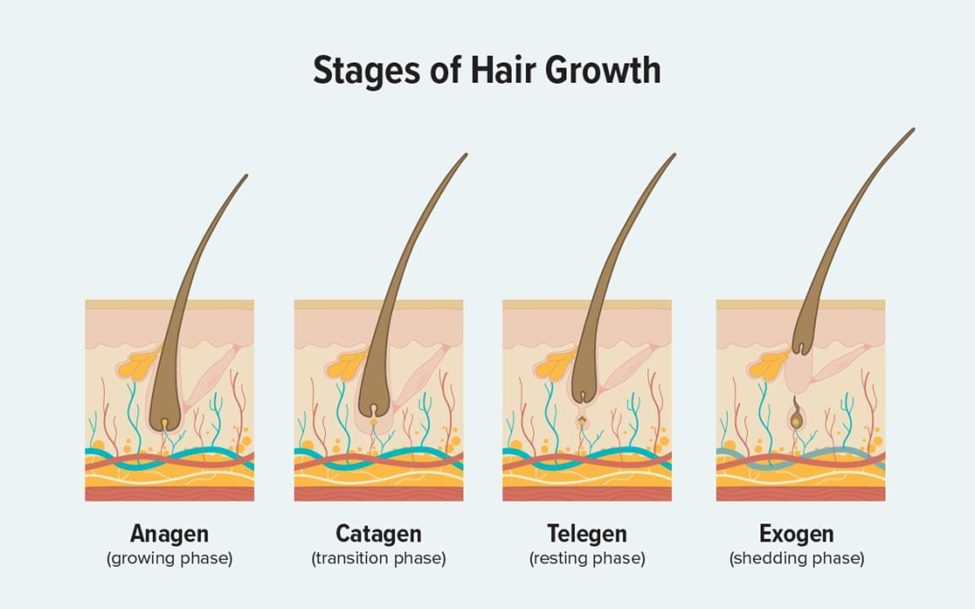
The hair growth cycle consists of four stages:
Anagen (growth phase): The active growing stage, lasting for several years.
Catagen (transition phase): In this short phase, the hair follicle contracts and hair growth slows down.
Telogen (resting phase): The dormant stage where hair growth halts and a new hair initiates growth, gradually pushing the old one out.
Exogen phase: The final stage of the cycle, during which the hair strand fully detaches from the scalp and is shed
Hair Care :
“Hair texture and shine are generally linked to the surface characteristics of hair, whereas the strength of hair depends on the hair cortex. For this reason, hair products that enhance the structural soundness of hair fibers and improve tensile strength are available, along with formulations that boost hair volume, minimize frizz, improve hair manageability, and encourage new hair growth. Interestingly, modern cosmetic preparations are designed to cleanse hair of debris and to restore and enhance hair physiology. For instance, intensive conditioning agents can temporarily replenish the F-layer, improving moisture retention in the cortex and restoring some of the diminished physical qualities of hair. Thus, the increase in hair luster is a major advantage of contemporary products.”
3. How Shampoo works & why shampoo is preferred:
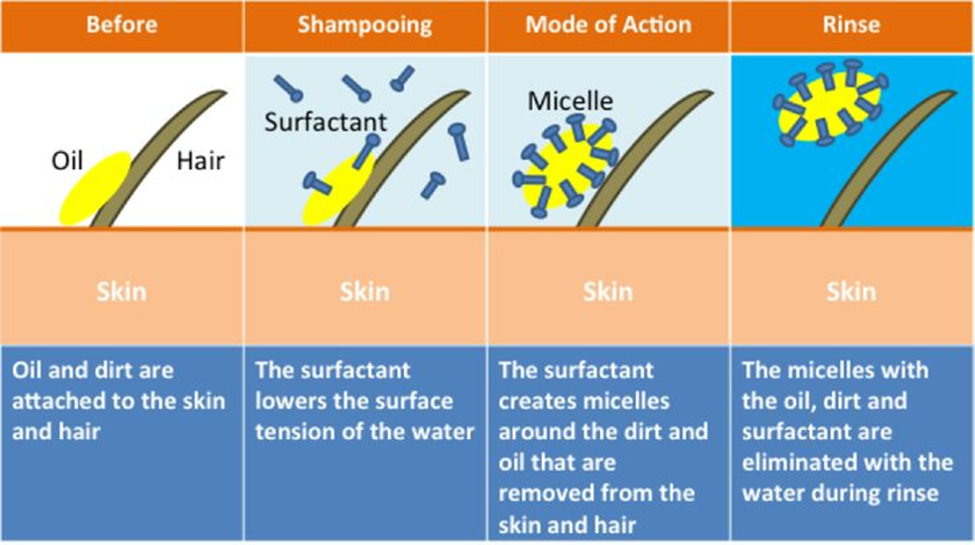
Shampoo cleanses by removing sebum from the hair. Sebum is an oil released by the hair follicles that is easily absorbed by the hair strands and forms a protective coating. Although sebum safeguards the protein framework of the hair from damage, this protection has a drawback. It tends to attract dirt, styling residues, and scalp flakes. Surfactants detach the sebum from the hair shafts and thereby eliminate the impurities attached to it. While both soaps and shampoos contain surfactants, soap binds to oils with such strong affinity that it removes them more aggressively.
The chemical processes involved in hair cleansing are similar to those of conventional soap. Healthy, undamaged hair has a water-repelling (hydrophobic) surface to which skin lipids like sebum adhere, but water is initially resisted. These lipids do not come off easily when the hair is rinsed with plain water. Anionic surfactants greatly lower the interfacial surface tension and enable the removal of sebum from the hair shaft. The non-polar oily substances on the hair surface are solubilized into the micellar structures of the shampoo and are washed away during rinsing. There is also significant removal through a “roll-up” mechanism, where the surfactant lifts the oil layer off the hair.
Drawbacks for herbal shampoo:
Ideal properties of herbal shampoo:
4. Ingredients & Methods of Formulation:
|
Ingredient |
Quantity (%) |
Primary Function |
|
Neem leaves powder |
9% |
Antibacterial, scalp health |
|
Hibiscus flower powder |
12% |
Conditioning, shine |
|
Aloe vera powder |
7% |
Moisturizing, soothing |
|
Shikakai powder |
22% |
Natural detergent, cleansing |
|
Bhringaraj powder |
5% |
Promotes hair growth |
|
Amla powder |
25% |
Anti-dandruff, strengthens roots |
|
Soap nut powder |
20% |
Foaming, gentle cleanser |
|
Rose oil |
q.s |
Fragrance, calming |
|
Gelatin |
q.s |
Gelling agent, binding |
Formulation:
The formulation of the herbal shampoo was prepared according to the specified formula. To the 10% gelatin solution, the herbal extract was incorporated and blended by continuous shaking at intervals of 20 minutes. Additionally, 1 ml of lemon juice was introduced with steady stirring. To enhance the fragrance of the preparation, an adequate amount of essential oil (rose oil) was included, and the final volume was adjusted to 100 ml using the gelatin solution
5. Evaluation Parameters of Herbal Shampoo:
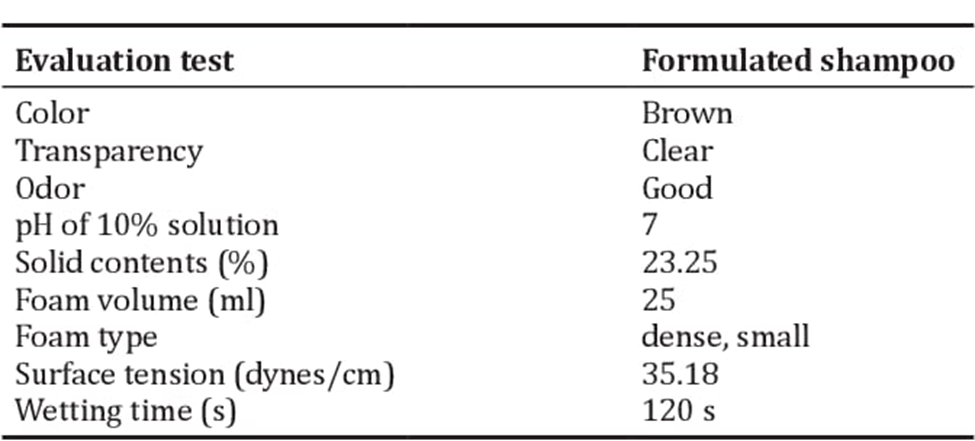
The formulated shampoo underwent assessment for overall product performance, including examination of organoleptic attributes, pH value, physicochemical parameters, and solid residue content. To ensure product quality, specific analytical tests were performed to determine surface tension, foam volume, foam persistence, and wetting time in accordance with standard procedures.
1. Visual assessment:
The developed formulation was examined for its appearance, including color, transparency, scent, and foam characteristics.
2. pH Determination:
The pH of a 10% v/v solution of the herbal shampoo in distilled water was measured using a pH analyzer at ambient temperature.
3. Determination of solid content percentage:
Approximately 4 g of the shampoo was weighed into a dry, clean evaporating dish. The liquid fraction was removed by heating on a hot plate. After complete drying, the weight and percentage of solid content were calculated.
4. Dirt dispersion:
Two drops of the shampoo were introduced into a test tube containing 10 ml of distilled water. One drop of India ink was added, the tube was sealed, and shaken ten times. The distribution of ink within the foam was observed and classified as none, slight, moderate, or heavy.
5. Foam stability test:
Foam stability was evaluated using the cylinder shake method. About 5 ml of a 1% shampoo solution was placed in a graduated cylinder and shaken vigorously ten times. Foam height was recorded after 1 minute and again after 4 minutes.
6. Stability study:
The prepared shampoo was subjected to a stability evaluation at a controlled room temperature of 25–30°C for a period of 4 weeks.
7. Skin irritation test:
A small quantity of the herbal shampoo was applied to the skin for 5 minutes, rinsed off, and monitored for any signs of irritation or inflammation.
8. Microbial examination:
A sterile petri dish was filled with 1 ml of the shampoo under aseptic conditions and allowed to solidify. The plates were incubated at 37°C for 24 hours and inspected for microbial growth.
6. Advantages and Disadvantages of herbal shampoo:
Advantages of Herbal Shampoo:
Disadvantages of Herbal Shampoo:
7. Marketed herbal shampoos:
List of Few Popular Brands Are:
CONCLUSION
Herbal shampoo offers a natural, effective, and gentle alternative to conventional synthetic shampoos. Formulated with plant-derived ingredients, it provides cleansing, conditioning, and therapeutic benefits without the harsh effects commonly associated with chemical-based products. The incorporation of herbal extracts not only supports scalp health but also nourishes the hair, making it suitable for long-term use and ideal for individuals with sensitive skin or those seeking chemical-free hair care solutions.
Compared to synthetic shampoos, herbal formulations stand out due to their biodegradability, minimal side effects, and lower risk of irritation. They help maintain the natural balance of the scalp, promote healthier hair growth, and contribute to reduced environmental pollution. Although they may show gradual results and have a shorter shelf life, their overall safety profile and holistic benefits make them a preferable choice for sustainable and gentle hair care.
In essence, herbal shampoos combine traditional knowledge with modern formulation techniques to deliver a safe, eco-friendly, and health-conscious approach to hair cleansing and maintenance, making them an increasingly valuable alternative to synthetic counterparts.
REFERENCES

P Likhitha, P. Tejaswini, P. Vinayasree, N. Vijay, N. Naresh, Azka Fathima, Eco-Friendly Herbal Shampoo: Formulation, Benefits, Testing, Int. J. of Pharm. Sci., 2026, Vol 4, Issue 3, 3099-3105. https://doi.org/10.5281/zenodo.19216749
 10.5281/zenodo.19216749
