
Pulla Reddy Institute of Pharmacy, Jawaharlal Nehru Technological University, Dundigal , Hyderabad, Telangana, India, 502313.
Data-driven decision-making throughout the drug discovery and development process is made possible by artificial intelligence (AI), which has become a revolutionary tool in pharmaceutical research. Conventional drug research is linked to expensive expenses, long lead times, and poor success rates. AI techniques such as machine learning (ML), deep learning (DL), natural language processing (NLP), and reinforcement learning (RL) are increasingly applied to target identification, hit discovery, lead optimization, and clinical trials. AI-driven methods speed up innovation, lessen the burden of experiments, and improve prediction accuracy. The uses, methods, benefits, difficulties, and potential applications of AI in drug development are covered in this paper.
Artificial intelligence (AI) has emerged as a powerful tool transforming the landscape of drug discovery and development.[1] Conventional drug discovery is a time-consuming, costly, and high-risk process, often requiring over a decade and substantial financial investment, with a high rate of failure in later stages. The integration of AI technologies, including machine learning, deep learning, natural language processing, and reinforcement learning, offers innovative solutions to overcome these challenges. By enabling the analysis of large-scale biological, chemical, and clinical datasets, AI facilitates rapid identification of novel drug targets, prediction of molecular interactions, and optimization of lead compounds.
Target validation, virtual screening, pharmacokinetic prediction, and toxicity assessment are just a few of the steps of drug development where AI-driven methods improve efficiency and accuracy.[2] Additionally, by finding novel therapeutic applications for currently available medications and customizing therapies based on patient-specific data, AI promotes drug repurposing and personalized medicine. The use of AI in drug discovery is fraught with difficulties, including data quality, model interpretability, and regulatory concerns, despite its bright future. The applications, benefits, drawbacks, and potential applications of AI technologies in the pharmaceutical sector are highlighted in this paper, which also emphasizes how these technologies are transforming drug research and development.[3]
AI Technologies in Drug Discovery :
By facilitating data-driven analysis and predictive modelling across various pharmaceutical datasets, artificial intelligence (AI) technologies are essential to contemporary drug discovery.[4] Among them, pharmacokinetic and toxicological profiles are estimated, biological activity is predicted, and quantitative structure–activity relationship (QSAR) models are developed using machine learning (ML). Early drug development decision-making is improved by machine learning methods like support vector machines, random forests, and k-nearest neighbors that effectively handle structured chemical and biological data.
In order to evaluate intricate chemical structures and protein–ligand interactions, deep learning (DL), a subset of machine learning, makes use of sophisticated neural network architectures including convolutional neural networks (CNNs), recurrent neural networks (RNNs), and graph neural networks (GNNs). These models work especially well for de novo drug creation, molecular property prediction, and image-based screening.[5] In order to facilitate knowledge integration and hypothesis creation, natural language processing (NLP) is used to extract insightful information from extensive biological literature, patents, and clinical trial data.
By improving molecular structures using iterative reward-based systems, reinforcement learning (RL) significantly improves drug design by facilitating the creation of novel compounds with desired attributes.[6] When combined, these AI technologies greatly increase the efficiency of pharmaceutical research by speeding up drug discovery, increasing predicting accuracy, and lowering experimental costs.
Applications of AI in Drug Discovery :
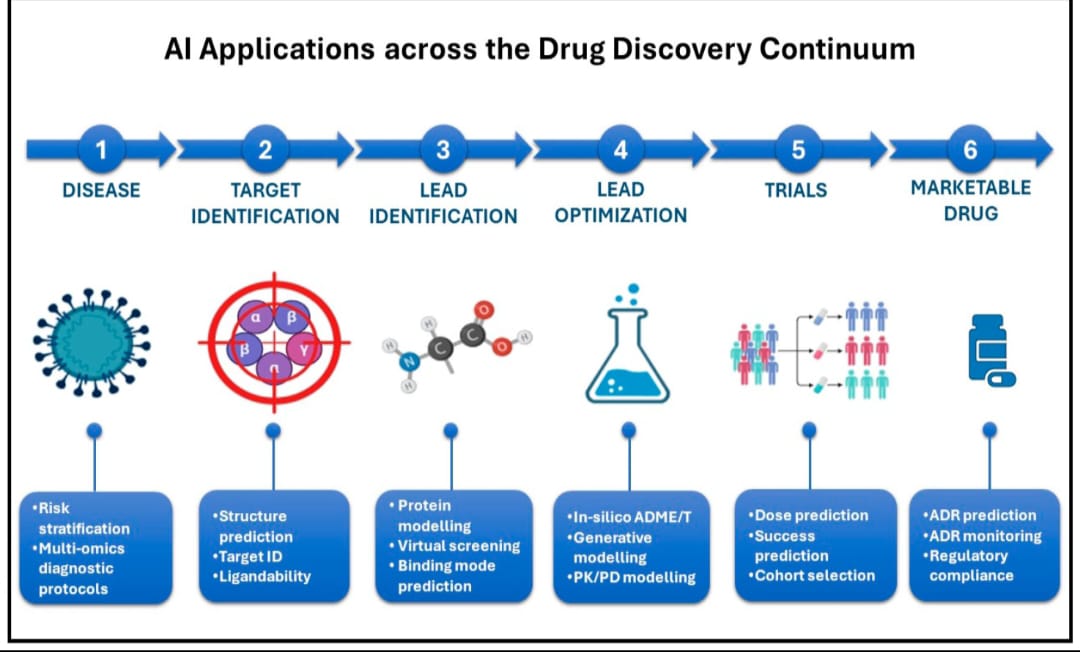
By facilitating quick data processing and precise predictive modeling, artificial intelligence (AI) has greatly improved several phases of drug research.[7] Target identification and validation is one of the main uses, where AI examines transcriptomics, proteomics, and genomes data to find biological pathways and targets linked to disease. AI-driven virtual screening methods effectively assess vast chemical libraries in hit identification to find possible lead compounds with high binding affinity and specificity.
AI is also widely utilized in lead optimization, where it improves pharmacokinetic, selectivity, and efficacy by predicting structure–activity relationships (SAR) and refining chemical compounds. AI models also make it easier to anticipate absorption, distribution, metabolism, excretion, and toxicity (ADMET) profiles accurately, which lowers the number of late-stage medication failures. Another crucial use is drug repurposing, in which AI uses clinical databases and biological networks to find novel therapeutic uses for already-approved medications.[8]
Additionally, by using patient-specific data to maximize therapy outcomes, AI helps precision medicine and biomarker discovery. AI has emerged as a crucial instrument for expediting the creation of safe and efficient medicinal medicines by increasing prediction accuracy and simplifying experimental procedures.[9]
AI in Drug Development:
By raising productivity, cutting expenses, and improving decision-making across the preclinical and clinical stages of drug development, artificial intelligence (AI) is becoming more and more important.[10] AI models are used in preclinical development to forecast toxicity profiles and pharmacokinetic and pharmacodynamic characteristics based on in silico simulations. These methods speed up candidate selection and lessen ethical issues by reducing reliance on lengthy in vitro and animal research. By optimizing excipient selection and forecasting stability, solubility, and drug–excipient interactions, AI also aids in the development of formulations.[11]
AI helps with better trial design and execution in clinical development. In order to find appropriate patient groups, machine learning algorithms examine genomic data, electronic health records, and patient registries. This improves recruitment efficiency and guarantees better stratification. Clinical trials become more focused and statistically sound as a result. Additionally, AI-driven prediction models can predict treatment responses, adverse medication reactions, and clinical outcomes, which lowers the risk of late-stage failures.[12]
AI also makes it possible to monitor clinical trials in real time using wearable technology and digital biomarkers, which allows for ongoing data collecting and the early identification of safety issues. Natural language processing is used in pharmacovigilance to evaluate medical literature and adverse event reports, enhancing risk assessment and post-marketing surveillance.[13]
By producing extensive datasets that facilitate safety and efficacy assessment, AI also supports regulatory decision-making. Notwithstanding these benefits, issues like model transparency, regulatory acceptance, and data uniformity still exist. However, AI is still changing drug research by providing a more effective, accurate, and patient-focused method of introducing novel treatments to the market.[14]
Advantages of AI in Drug Discovery :
Drug discovery can benefit greatly from artificial intelligence (AI), which increases productivity, accuracy, and efficiency.[15] The substantial decrease in time and expense related to the drug discovery process is one of the main advantages. AI allows for quick analysis of big datasets, speeding up target identification, hit finding, and lead optimization, while traditional methods are labor-intensive and time-consuming.[16] As a result, the process from initial screening to clinical candidate selection proceeds more quickly.
By modeling intricate biological systems and chemical interactions using sophisticated algorithms, AI also improves prediction accuracy. This lowers the possibility of late-stage failures by increasing the accuracy of forecasts pertaining to pharmacokinetic characteristics, toxicity, and efficacy. AI also makes high-throughput virtual screening possible, which enables researchers to effectively assess millions of chemicals without requiring a lot of laboratory testing.[17]
AI's capacity to facilitate drug repurposing by finding novel therapeutic applications for already-approved medications, which shortens development times and lowers related risks, is another significant benefit. By incorporating patient-specific data to customize treatments for better clinical outcomes, AI also advances personalized medicine. Additionally, automating repeated procedures boosts productivity in research workflows and lowers human error.[18] All things considered, AI-driven methods improve decision-making and expedite the drug discovery process, making it more inventive and economical.
Challenges and Limitations :
Despite its revolutionary promise, artificial intelligence (AI) in drug discovery has a number of drawbacks and difficulties.[19] The quality and accessibility of data is one of the main issues. Large, well-curated, and standardized datasets are necessary for AI models; yet, biological and chemical data are frequently biased, heterogeneous, or incomplete, which might affect the model's dependability and performance. Furthermore, a lot of AI models operate as "black boxes," making it challenging for academics and regulatory bodies to comprehend and verify the underlying decision-making processes.[20]
The generalizability of AI models is another important drawback. Reduced prediction reliability may result from models trained on particular datasets performing poorly when applied to novel or varied biological systems. It is still difficult to integrate AI technologies with current experimental methods; this calls both extensive infrastructure and interdisciplinary knowledge.[21]
The application of AI in drug discovery is further complicated by ethical and regulatory concerns, especially those pertaining to data protection, accountability, and openness. Furthermore, widespread adoption may be constrained by significant initial investment costs and the requirement for qualified personnel.[22] Despite these obstacles, it is anticipated that ongoing developments in data science, model interpretability, and regulatory frameworks will overcome these constraints and improve the efficient use of AI in drug discovery.[23]
FUTURE PERSPECTIVES
With ongoing developments anticipated to further revolutionize pharmaceutical research, artificial intelligence (AI) in drug discovery an d development has a very bright future.[24] The integration of AI with multi-omics data, such as genomics, proteomics, metabolomics, and transcriptomics, is one of the major emerging directions. This allows for a more thorough understanding of disease mechanisms and makes it easier to find new treatment targets. By facilitating the creation of highly customized treatment plans, this systems-level approach is expected to improve precision medicine.[25]
Another crucial area of development is explainable artificial intelligence (XAI), which aims to increase the interpretability and transparency of AI models.[26] Gaining the trust of researchers and regulatory bodies, as well as guaranteeing adherence to changing regulatory norms, will depend on this. It is also anticipated that the integration of real-world data, such as wearable device outputs and electronic health records, will enhance post-marketing surveillance, patient monitoring, and clinical trial design.[27]
The development of novel chemical entities with optimum pharmacological properties is expected to be accelerated by the use of generative AI and reinforcement learning in de novo drug creation.[28] Additionally, using cutting-edge technology like quantum computing could greatly increase processing power, enabling more precise molecular simulations and forecasts.[29]
In order to standardize data, enhance model validation, and create strong rules for AI adoption, cooperation between academics, business, and regulatory agencies will be essential. Despite current obstacles, continued advancements are anticipated to improve the effectiveness, affordability, and dependability of AI-driven drug discovery, which will eventually hasten the creation of safer and more potent medicinal molecules.[30]
CONCLUSION
With its substantial advantages over conventional approaches, artificial intelligence (AI) has become a game-changing strategy in drug research and development. AI makes it possible to analyze complicated biological and chemical data effectively by combining cutting-edge computer methods including machine learning, deep learning, natural language processing, and reinforcement learning. Target identification, hit discovery, lead optimization, and pharmacokinetic and toxicity profile prediction have been significantly improved as a result, cutting down on drug development time, expense, and attrition rates.
Additionally, AI-driven tools have improved pharmacovigilance, patient classification, and clinical trial design, leading to more accurate and patient-centered treatment approaches. Despite these advantages, there are still important issues that must be resolved for wider application, such as data quality, model interpretability, regulatory approval, and connection with current workflows.
The importance of AI in pharmaceutical research is anticipated to be significantly strengthened by future advances, such as explainable AI, the integration of multi-omics data, and improvements in computer capacity. In summary, artificial intelligence (AI) is a potent and developing tool that has the ability to completely transform drug research and development, ultimately increasing the effectiveness, precision, and success rate of introducing novel therapeutic medicines to the market.
REFERENCES





Ranga Akash, Komirelly Priyanka, Kothakapu Vishali, Prattipatti Mallika, Nuthikattu Venkatesh, Artificial Intelligence in Drug Discovery and Development: A Review, Int. J. of Pharm. Sci., 2026, Vol 4, Issue 4, 2019-2025, https://doi.org/10.5281/zenodo.19552118
 10.5281/zenodo.19552118
