
Department of Pharmaceutical Analysis, Gokaraju Rangaraju College of Pharmacy, Osmania University, Hyderabad, Telangana- 50009.
White Analytical Chemistry (WAC) is a sustainable analytical method that combines Green Analytical Chemistry principles with analytical capabilities and practical application. It balances analytical efficiency, environmental safety, and practical application, ensuring accessibility, dependability, and environmental friendliness. Assessment instruments like the Green Analytical Procedure Index (GAPI), Analytical GREEness Metric (AGREE), and the Berlin Green Analytical Index (BAGI) help evaluate adherence to WAC principles. These resources enable researchers to create, evaluate, and improve analytical techniques that are precise, environmentally, and socially conscious.
White Analytical Chemistry (WAC) is a new analytical science concept that builds on Green Analytical Chemistry (GAC), which has been gaining attention for its ability to design and manufacture materials with lower environmental impact. GAC focuses on reducing toxic reagents and solvents, reducing waste generation. However, sustainable chemistry, a larger term, encompasses social, financial, and environmental implications of the synthesis and use of created materials. To address GAC's limitations and fill a gap in the field, Nowak et al. proposed WAC, a relatively recent method developed in 2021[1]. The WAC concept, based on the Green/Red/Blue color model, classifies analytical approaches as white by combining ecological factors (green) and functionality (red and blue requirements). It includes rules such as toxic features, sample volume, solvents, waste, energy consumption, and direct effects from 12 GAC principles. The approach also includes four red principles (scope of application, detection and quantification limits, precision and trueness) and four blue principles (efficiency of total cost and time spent during the analytical process). Several metric instruments have been developed to measure greenness, including the Eco-Scale, the National Environmental Methods Index (NEMI), the Green Analytical Procedure Index (GAPI), and the Analytical Greenness Calculator (AGREE). These instruments help quantify the degree of compliance with GAC principles in qualitative and quantitative terms [2].
The implementation of Green Analytical Chemistry (GAC) principles involves balancing the method's greenness with its potential usefulness. The utility of a method is determined by its analytical efficiency and practical and economic aspects like cost, speed, and simplicity. This review paper covers recent breakthroughs in WAC-based biological, food, and environmental applications. The key ideas of WAC have been successfully tested in most recently published studies. The research aims to apply the green, red, and blue criteria relating to ecological and functional elements of analytical methodologies to previously reported studies, making this the first review paper to evaluate WAC concepts in culinary, environmental, and biological applications.
2. FROM GREEN TO WHITE: -
The transition from Green Analytical Chemistry (GAC) to White Analytical Chemistry (WAC) is a significant shift in analytical research. GAC focused on reducing environmental impact through solvent use, safer reagents, and energy use, but often overlooked other factors like cost, analyst safety, and performance [3]. As analytical demands expanded globally, researchers realized that prioritizing environmental impact could lead to tradeoffs in price, precision, and practicality. WAC, a broader framework, balances environmental responsibility with economic feasibility, safety, social responsibility, and analytical efficiency, ensuring green, safe, cost-effective, high-performing, and widely applicable analytical methods [4].
3. RED ASPECT - ENSURE ANALYTICAL PERFORMANCE
The Red component in White Analytical Chemistry (WAC) prioritizes analytical integrity while addressing criticisms of green chemistry, balancing performance with environmental and economic considerations, ensuring sustainability and usefulness. Red Component parameters include Accuracy, Precision, Sensitivity, Selectivity/Specificity, Robustness, Linearity, Range, and Limit of Detection (LOD) and Limit of Quantification (LOQ).
Analytical performance is crucial for accurate results in regulatory settings like clinical diagnostics, pharmaceutical quality control, and food safety testing, with economic viability and environmental sustainability requiring strong scientific standards. Instruments for Assessing Red Aspects are Protocols for method validation (such as ICH Q2(R1) guidelines) Dashboards for performance data in method development software and standard method comparison [5].
Example: - The red element ensures that modifications to a green HPLC system, such as substituting ethanol for hazardous acetonitrile, are permitted only if performance measurements remain within necessary limits.
4. GREEN ASPECT: AN ANALYSIS OF ENVIRONMENTAL RESPONSIBILITY
Green Analytical Chemistry (GAC) is a growing field that focuses on minimizing environmental impact while maintaining method quality and applicability. Its 12 Principles emphasize operator safety, real-time analysis, hazardous materials, energy consumption, and waste prevention.Green Component parameters include Use of Safer Solvents and Reagents, Miniaturization of Analytical Techniques, Waste Reduction, Energy Efficiency, In-Situ and Real-Time Analysis, Operator and Environmental Safety etc.Instruments for Evaluating the Green Aspect measure the greenness of analytical techniques, apportioning penalty points based on waste production, energy use, and reagent toxicity [6].
The Green Analytical Procedure Index, or GAPI, visually summarizes greenness using a color-coded pictogram, Analytical GREEnness Metric Approach, or AGREE: A comprehensive tool that provides a radar diagram and a numerical score (0–1) based on the 12 GAC principles. To help chemists make ecologically conscious choices, these tools are frequently incorporated into method development [7].
The green component in analytical performance promotes labs to minimize environmental impact, adhere to environmental standards, and encourage sustainable chemical techniques. It complements red and blue to create thorough, ethical analytical techniques.
Example: - Utilizing low-toxicity solvents like ethanol for solid-phase microextraction or dispersive liquid-liquid microextraction can improve the method's green profile without compromising performance.
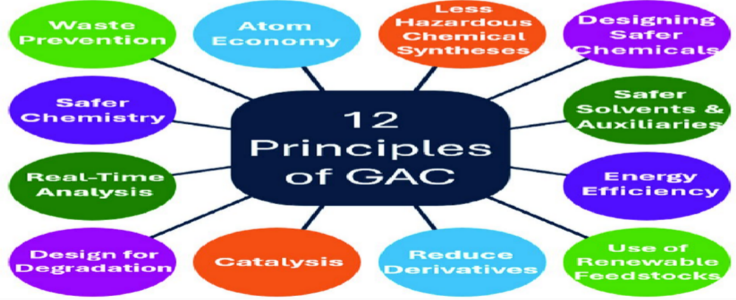
Fig No 1: -12 Principles of Green Chemistry
5. BLUE ASPECT: ECONOMIC VIABILITY AND PRACTICALITY
The Blue component of the White Analytical Chemistry (WAC) architecture was established by Nowak and colleagues (2021), guaranteeing the practicality, affordability, and use of analytical techniques. This dimension fills in the gaps between ideal lab conditions and real-world limitations including budget, schedule, personnel, and equipment availability [8]. Blue Component parameters include Cost-Effectiveness, Time Efficiency, Ease of Operation, Portability and Miniaturization, Instrumental Accessibility and Maintenance, Scalability and Regulatory Compliance.
The Blue component in analytical chemistry empowers chemists to select affordable materials and create processes suitable for labs and industrial environments. It balances performance, sustainability, and practicality, ensuring high-performance, environmentally friendly techniques are available in labs with limited resources and developing nations. Ignoring the Blue component may result in theoretical or underutilized methods.[9].
Instruments for Assessing the Blue Aspect is Although Blue currently has fewer standardized evaluation tools than the Red and Green components, the following methods are frequently employed: Breakdown of costs per analysis,Time metrics per sample, Systems of scoring that are easy to use,Checklists or surveys based on difficulties in implementing a strategy, incorporating blue score, as suggested by Nowak et al., into the RGB-WAC radar display.
Example:- For pesticide analysis, a highly selective and environmentally friendly GC-MS approach may need costly columns, time-consuming calibration, and hours per sample. Its Blue profile is improved by introducing a miniature QuEChERS sample prep, employing conventional GC columns, and automating data processing to cut costs and complexity.
PRINCIPLES OF WAC
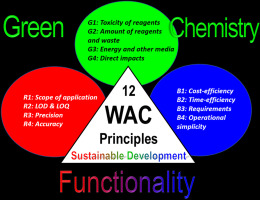
Fig No: 2: -12 principles of WAC for functionality and sustainability
7. TOOLS FOR ASSESSING RBG ASPECT:
White Analytical Chemistry (WAC) combines practical applicability (blue), greenness (green), and analytical performance (red). Several assessment tools are used to determine if approaches adhere to these principles they are: -
8. GAPI (GREEN ANALYTICAL PROCEDURE INDEX): -
From sample collection to final measurement, the environmental impact of an analytical process is assessed using the semi-quantitative GAPI technique. Each of the 15 fields is tinted green, yellow, or red, signifying minimal, moderate, or high environmental impact, respectively, in this color-coded pentagram that displays the rating visually. It provides a thorough assessment of the method's environmental friendliness by addressing aspects including sample preparation, reagent type and quantity, energy usage, and waste generation. A color code is used to rate these factors:
Green: minimally harmful to the environment
Yellow: modest effect
Red: strong effect
An illustration of how "green" a process is is provided by the result, which is shown as a pictogram, usually a pentagram. GAPI is primarily manual or excel-based, without specialized standalone software, and does not require value or color checking [11].
GAPI Score = (Number of green × 2) + (Number of yellow × 1) + (Number of red × 0)
Table: 01: - GAPI principles and related colours
|
Sr. No. |
Principle |
Subparts |
Color |
|
1. |
Sample preparation and analysis |
||
|
A. |
Collection |
In-line On-line(or)at-line Off-line |
Green Yellow Red |
|
B. |
Preservation |
None Chemical or physical PhysicochemicaL |
Green Yellow Red |
|
C. |
Transport |
None Required |
Green Yellow |
|
D. |
Storage |
None Under normal conditions Under special conditions |
Green Yellow Red |
|
E. |
Type of method: direct (or)indirect |
No sample preparation Sample procedures eg. Filtration and decantation Extraction required |
Green Yellow |
|
F. |
Scale of extraction |
Nanoextraction Microextraction Macroextraction |
Green Yellow Red |
|
G. |
Solvents/reagents used |
Solvent-free methods Green solvents/reagents used |
Green Yellow |
|
|
|
Non-green solvents/reagents used |
Red |
|
H. |
Additional treatments |
None Simple treatments (extract cleanup, solvent removal,etc.) Advanced treatments (derivatization, mineralization, etc.) |
Green Yellow Red |
|
2. |
Reagents and solvents |
||
|
A. |
Amount |
<10mL(<10g) 10–100mL(10–100g) >100mL(>100g) |
Green Yellow Red |
|
B. |
Health hazard |
Slightly toxic, slightly irritant; NFPA health hazard score is 0(or)1 Moderately toxic; could cause temporary in capacitation; NFPA=2or3 Serious injury on short-term exposure; known(or)suspected small animal carcinogen; NFPA=4 |
Green Yellow Red |
|
C. |
Safetyhazard |
Highest NFPA flammability, in stability score of 0(or)1. No special hazards. Highest NFPA flammability or instability score is 2or3, or a Special hazard is used. Highest NFPA flammability or instability score is 4 |
Green Yellow Red |
|
3. |
Instrumentation |
||
|
A. |
Energy |
≤0.1kWhpersample ≤1.5kWhpersample >1.5kWhpersample |
Green Yellow Red |
|
B. |
Occupational hazard |
Hermitization of the analytical process Emission of vapours to the atmosphere |
Green Red |
|
C. |
Waste |
<1mL(<1g) 1–10mL(1–10g) >10mL(<10g) |
Green Yellow Red |
|
D. |
Waste treatment |
Recycling Degradation, passivation No treatment |
Green Yellow Red |
|
4. |
Pre-analysis process |
||
|
A. |
Yield |
>89% 70–89% <70% |
Green Yellow Red |
|
B. |
Temperature/time |
Room temperature, <1h Room temperature,>1h Heating, <1hCoolingto0?C Heating>1h, Cooling |
Green Yellow Red |
|
5. |
Relation to the green economy |
||
|
A. |
Number of rules met |
5–6 3–4 1–2 |
Green Yellow Red |
|
6. |
Reagents and solvents |
||
|
A. |
Health hazard |
Slightly toxic, slightly irritant; NFPA health hazard score is 0 or 1 Moderately toxic; could cause temporary in capacitation; NFPA=2or3 Serious injury on short-term exposure; known or suspected small animal carcinogen; NFPA=4 |
Green Yellow Red |
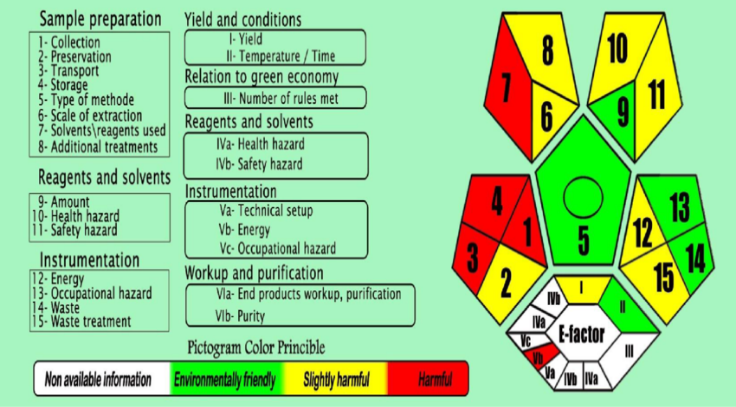
Fig No:-3:- Pictogram For The GAPI Greenness Assessment Tool
9. AGREE (Analytical GREEnness Metric):-
An analytical method's compliance with the 12 Principles of Green Analytical Chemistry (GAC) can be assessed using the quantitative and visual AGREE tool. It provides a circular pictogram and a numerical score ranging from 0 to 1. High sustainability is shown by green spaces. Areas that are red or yellow draw attention to greenness's shortcomings. The overall ranking is influenced by the individual scores assigned to each of the 12 GAC principles (minimum sample size, low energy, cleaner solvents, etc.). There is a dedicated software tool for Aggree available [11].
Excel-based or created in 2020 by Pena-Pereira et al. It does the following: Evaluation of the Twelve Green Analytical Chemistry Principles Making a circular diagram with color coding The value in the middle of the circular pictogram represents the overall greenness of the analytical procedure and is assigned a final score between 0 and 1.
0 = completely non-green (very subpar environmental performance)
1 = completely green (satisfies all 12 principles of Green Analytical Chemist
Table: 02: - Principles covered by AGREE tool along with scoring
|
Sr. No |
Principle |
Subparts |
Score |
|
1. |
Methods of direct analysis must be used in order to prevent sample treatment.
|
Remote sensing without sample damage Remote sensing with little physical damage Non-invasive analysis In-field sampling and direct analysis In-field sampling and on-line analysis On-line analysis At-line analysis Off-line analysis External sample pre-and treatment and batch analysis (reduced number of steps) External sample pre-and treatment and batch analysis (large number of steps) |
1.00 0.95 0.90 0.85 0.78 0.70 0.60 0.48 0.30 0.00 |
|
2. |
Minimal sample size and minimal number of samples are goals. |
Ultra-micro analysis 100(mg or μL) Micro analysis 1 10(mg or μL) Semi micro analysis 10 100(mg or μL) Macro analysis>100(mg or μL) |
- 1 - According to eq.Score=- 0.142×ln (amount of sample in gormL)+ 0.65 |
|
3. |
In situ measurements should be performed. |
In-line On-line At-line Off-line |
1.00 0.66 0.33 0.00 |
|
4. |
Integration of analytical processes and operations saves energy and reduces the use of reagents. |
3orfewer 4 5 6 7 8ormore |
1 0.8 0.6 0.4 0.2 |
|
5. |
Automated and miniaturized methods should be selected. |
Automatic, miniaturized Semi-automatic, miniaturized Manual, miniaturized Automatic, not miniaturized Semi-automatic, not miniaturized Manual, not miniaturized |
0.0 1.0 0.75 0.50 0.50 0.25 0.00 |
|
6. |
Derivatization should be avoided |
CAS lookup (The CAS number of the derivatization agent should be selected in the software. The corresponding score is then automatically included.) |
Score= DA1xDA2 x x DAn 0.2 |
|
7. |
Large-scale analytical waste generation should be prevented, and appropriate analytical waste treatment should be offered. |
0.1or lower(gorml) 1.00 10(gorml) 0.40 25(gorml) 0.25 100(gorml) |
1.00 0.40 0.25 0.10 |
|
8. |
Multi analyte or multi parameter methods are preferred versus methods using one analyte at a time. |
Analytes determined during1h 10 50 70 |
0.00 0.50 0.90 1.00 |
|
9. |
The use of energy should be minimized |
<0.1kWhpersample 1.5kWhpersample >1.5kWhpersample |
1.0 0.5 0.0 |
|
10. |
Reagents obtained from renewable source should be preferred |
No reagents All reagents are bio-based Some reagents are bio-based None of the reagents are from bio-based sources |
1.0 1.0 0.5 0.0 |
|
11. |
Toxic reagents should be eliminated or replaced. |
No reagents If yes than calculate by formula |
1 Score=- 0.156xln (amount of reagent or solventingo r mL)+ 0.5898 |
|
12. |
The safety of the operator should be increased. |
No threats selected One threat selected Two threats selected Three threats selected Four threats selected |
1.0 0.8 0.6 0.4 0.2 |
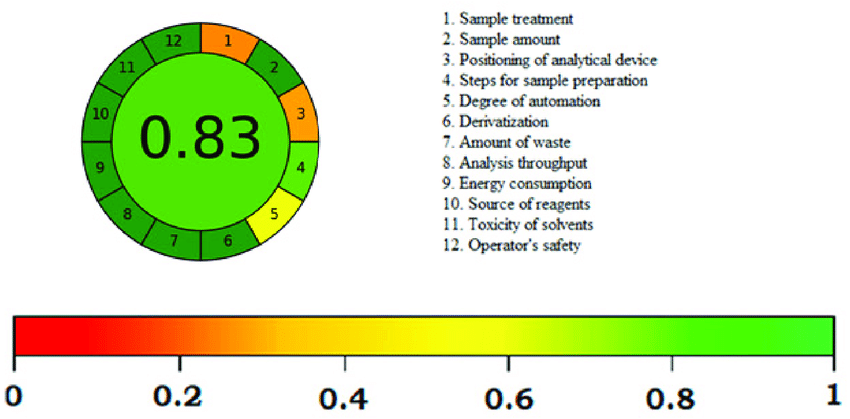
Fig No:- Pictogram For The AGREE Greenness Assessment Tool
10. BAGI – Berlin Green Analytical Index: -
A quantitative technique called BAGI was created to evaluate an analytical method's greenness. It was created as a substitute for more qualitative instruments such as GAPI. gives a score, such as out of 10 or 100, to indicate how "green" an approach is [3] . BAGI is a weighted grading method that evaluates analytical processes in relation to sustainability, practicality, and performance metrics. It is useful in areas like clinical diagnostics, food analysis, pharmaceutical quality control, and environmental monitoring since it enables equitable comparison of various approaches. BAGI encourages open decision-making when implementing analytical techniques that support sustainability objectives, shifting from a one-dimensional assessment of greenness to a comprehensive, multifaceted assessment of sustainability.
Table: 03:- Pri nciples Covered By BAGI Tool Along With Scoring
|
Sr. No |
Principle |
Sub parts |
Score |
|
1. |
Type of analysis |
Qualitative Screening Quantitative Quantitative and confirmatory |
2.5 5 7.5 10 |
|
2. |
Number of analytes that are simultaneously determined |
Single element |
2.5 |
|
Multi-element analysis for 2–5 compounds of the same chemical class |
5 |
||
|
|
|
Multi-element analysis for 6–15 compounds of the same chemical group or 2–15 compounds of different chemical classes |
7.5 |
|
Multi-element analysis for > 15 compounds |
10 |
||
|
3. |
Analytical technique- instrumentation |
Instrumentation that is not commonly available in most labs (SFC, 2D-GC, 2D-LC, LC-MS/MS, GC–MS/MS, etc.) |
2.5 |
|
Sophisticated instrumentation (LC-MS, GC–MS, ICP-MS, homemade interfaces, homemade automatic systems, etc.) |
5 |
||
|
Simple instrumentation available in most labs (UV, HPLC-UV, HPLC-DAD, UHPLC, FAAS, ETAAS, ICP-OES, GC-FID etc.) |
7.5 |
||
|
Simple in operation portable instrumentation (smart-phone based detectors, portable GC, etc.) |
10 |
||
|
4. |
Number of samples that can be simultaneously treated |
1 2–12 13–95 >95 |
2.5 5 7.5 10 |
|
5. |
The sample preparation scale |
Multi-step sample preparation required (e.g. LLE, SPE and/or derivatization) |
2.5 |
|
Miniaturized extraction sample preparation (SPME, DLLME, MEPS, SBSE, d-SPE, FPSE, etc.) |
5 |
||
|
Simple, low-cost sample preparation required (e.g. protein precipitation) |
7.5 |
||
|
Not required or on-site sample preparation if required |
10 |
||
|
6. |
Number of samples that can be analysed per hour |
<1 or 1 2–4 5–10 >10 |
2.5 5 7.5 10 |
|
7. |
Type of reagents and materials |
Need to be synthesized in the lab with advanced equipment or know-how (specially designed metal-organic frameworks, modified nanomaterials, etc.) |
2.5 |
|
Need to be synthesized in the lab with common instrumentation and in a simple way |
5 |
||
|
Commercially available reagents not common in QC labs (derivatization reagents, SPE cartridges, SPME fibers, etc.) |
7.5 |
||
|
Common commercially available reagents (methanol, acetonitrile, HNO3, nitrogen or other common gasses, etc.) |
10 |
||
|
8. |
Requirement for preconcentration |
Preconcentration required. Legislation criteria met after complicated stages (e.g. extraction, evaporation, and reconstitution). |
2.5 |
|
|
|
Preconcentration required. Required sensitivity is met with one-step preconcentration. |
7.5 |
|
No preconcentration required. Required sensitivity and/or legislation criteria are met directly. |
10 |
||
|
9. |
The automation degree |
Manual treatment and analysis |
2.5 |
|
Semi-automated with non-common devices (e.g. homemade systems) |
5 |
||
|
Semi-automated with common devices (e.g. HPLC autosampler) |
7.5 |
||
|
Fully automated with novel technology advanced devices (robotics, lab-in-syringe, etc.) |
10 |
||
|
10. |
The amount of sample |
>1000 µl. (or mg) bioanalytical samples: 100 ml. (or g) food/environmental |
2.5 |
|
501–1000 µl (or mg) bioanalytical samples; 51–100 ml. (or g) food/environmental |
5 |
||
|
100–500 µl (or mg) bioanalytical samples; 10.1–50 ml. (or g) food/environmental |
7.5 |
||
|
<100 µl. (or mg) bioanalytical samples, <10 ml (or g) food/environmental |
10 |
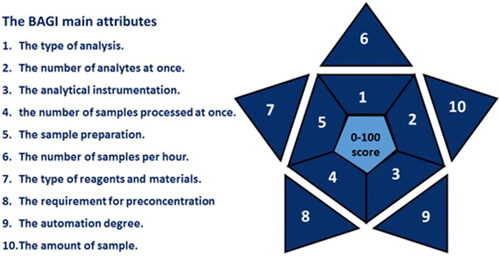
Fig No: -5: - Pictogram for The BAGI Greenness Assessment Tool
11. ADVANTAGES OF WAC: -
1. Holistic approach: Takes into account not only environmental friendliness but also practical considerations (cost, applicability) and analytical performance (accuracy, precision).
2. Environmental protection: Encourages energy-efficient techniques, less waste, and cleaner solvents.
3. Resource conservation: -Lowers energy usage, reagent usage, and sample size.
4.Excellent analytical performance guarantees results' sensitivity, selectivity, and dependability.
5. Practical applicability: Emphasizes approaches that are easily accessible, reasonably priced, and easy to apply.
6. Supports sustainability goals: By striking a balance between environmental, social, and economic factors, it aligns with the UN SDGs.
7. Promotes innovation: Promotes the creation of automated, portable, and small-scale analytical methods.
8. Enhances safety: By lowering exposure to dangerous substances, analysts and the environment are protected.
9. Encourages standardization by offering resources for methodical method evaluation.
10. Global applicability: It can be used in the fields of forensic, clinical, food, pharmaceutical, and environmental sciences.
12. APPLICATIONS OF WAC: -
1. Analysis of Pharmaceuticals uses fewer solvents and more environmentally friendly methods to guarantee drug quality control. Example: drug testing using spectroscopic techniques or miniature HPLC.
2. Monitoring of the Environment using environmentally acceptable techniques to detect pollution, pesticides, and heavy metals. Example: portable sensors for checking the quality of water.
3. Low reagent consumption analysis of pesticide residues, pollutants, and additives for food safety. Example: Miniaturized QuEChERS for fruit pesticide residues
4. Medical Diagnostics creation of reasonably priced and easily accessible tests for medical laboratories. Example: point-of-care biosensors for cholesterol or glucose.
5. Science of Forensics regular research using easy, green, and validated technologies. Example: Minimal solvent usage for quick drug or alcohol testing.
6. Control of Industrial Quality more environmentally friendly analytical techniques for production monitoring and manufacturing. Example: Spectroscopic process analysis in chemical industries.
13. CHALLENGES AND LIMITATIONS: -
1. Keeping three things in balance (Red, Green, Blue) Optimizing analytical performance, environmental effect, and practical applicability all at once is challenging.
2. Subjectivity in assessment instruments When using scoring methodologies, tools like RGB12 and GAPI (semi-quantitative pictogram) require some subjective assessments.
3. Low adoption and awareness Many labs are still using outdated techniques and lack the necessary training to apply WAC evaluation tools.
4. Cost and technological obstacles Systems that are automated, portable, or miniature may be expensive to purchase initially, which limits their availability in underdeveloped areas.
5. Problems with data comparability The same approach may produce various outcomes depending on the tool used, which makes standardization difficult.
6. Complex techniques are still required. Greener options cannot yet completely replace highly sensitive but resource-intensive technologies (LC-MS/MS, for example) for some analytes.
7. Acceptance by regulators In contrast to established conventional methodologies, regulatory agencies could be hesitant to adopt new WAC-based approaches.
14. FUTURE AND RESEARCH OPPOURNITIES: -
1. Creation of Greener Sample Processing expansion of solvent-free and miniature extraction methods (such as solid-phase and microextraction).
2. Progress in On-Site and Portable Analysis expansion of lab-on-a-chip, point-of-care, and field-deployable sensors for real-time monitoring.
3. Utilizing Digital Technologies utilizing machine learning, chemometrics, and artificial intelligence (AI) to analyze data, optimize processes, and make more environmentally friendly decisions.
4. Better Instruments for Assessment Additional improvement of RGB12, AGREE, BAGI, and GAPI to lower subjectivity and improve technique comparability.
5. Eco-Friendly Instrumentation creating instruments that use less energy, need less maintenance, and have longer lifespans.
6. Wider Use applying WAC concepts to cutting-edge industries like clinical diagnostics, biotechnology, environmental remediation, and nanomaterials.
7. Adoption in Industry and Regulation Promoting global standards and recommendations for implementing WAC principles in regular quality.
15. CONCLUSION: -
White Analytical Chemistry (WAC) is a technique that combines analytical performance, environmental sustainability, and practical applicability in various fields like pharmaceutical analysis, environmental monitoring, forensic science, food safety, and clinical diagnostics. It uses eco-friendly techniques to monitor drug stability, reduce solvent usage, and identify contaminants. Measures like the Berlin Green Analytical Index, Analytical GREEnness Metric, and Green Analytical Procedure Index evaluate adherence to WAC principles, promoting uniformity and transparency in sustainability evaluations. However, WAC faces challenges like lack of environmentally friendly reagents and high equipment costs. Future research should integrate WAC principles with AI and machine learning for automated analytical workflows.
REFERENCES

M. Prathibha Bharathi*, T. Bhavana, D.Vijaya Durga, K. Malleshwari, A Review on White Analytical Chemistry, Int. J. of Pharm. Sci., 2026, Vol 4, Issue 1, 1314-1326. https://doi.org/10.5281/zenodo.18237080
 10.5281/zenodo.18237080
