
Raosaheb Patil Danve College of Pharmacy Badnapur, Jalna
Herbal cosmetics are formulated, using different cosmetic ingredients to form the base in which one or more herbal ingredients are used to cure various skin ailments. The name itself suggests that herbal cosmetics are natural and free from all the harmful synthetic chemicals which otherwise may prove to be toxic to the skin. Compared to other beauty products, natural cosmetics are safe to use. Cosmeceuticals are cosmetic-pharmaceutical hybrid products intended to improve the health and beauty of the skin by providing a specific result, ranging from acne-control and anti-wrinkle effects, to sun protection. Cosmeceuticals have medicinal benefits which affect the biological functioning of skin depending upon type of functional ingredients they contain. These are cosmetic products that are not just used for beautification but for different skin ailments. These products improve the functioning/texture of the skin by boosting collagen growth by eradicating harmful effects of free radicals, maintains keratin structure in good condition and making the skin healthier. There are numerous herbs available naturally having different uses in cosmetic preparations for skincare, hair care and as antioxidants. The current review highlights importance of herbal cosmetics, the herbs used in them and their advantages over the synthetic counterparts.
Now-a-days the usefulness of herbs in the cosmeceutical production has been extensively increased in personal care system and there is a great demand for the herbal cosmetics. Cosmetics are the substances is to be applied to the human body for cleansing, beautifying, promoting attractiveness, and altering the appearance without affecting the body’s structure or functions.
The word cosmetic was derived from the Greek word “kosm tikos” meaning having the power, arrange, skill in decorating. Cosmeceuticals have undoubtedly taken over the personal care industry across the globe.
Despite the prevalent confusion about its definition and scope, it would not be an exaggeration to state that almost 30% to 40% of any dermatologist’s prescription count across the world consists of a cosmeceutical.
The term was coined in 1984 by Dr. Albert Kligman of the University of Pennsylvania describing a hybrid category of products mid-way on the spectrum of cosmetics and pharmaceutical.
A cosmeceutical is consensually accepted to exert a ‘pharmaceutical therapeutic benefit’ but not necessarily a ‘biological therapeutic benefit.’
For Dr. Kligman, cosmeceutical represented “a topical preparation that is sold as a cosmetic but has performance characteristics that suggest pharmaceutical action. The scope of cosmeceuticals has been almost exponentially expanding, e.g., with the discovery of alpha-hydroxy acids for exfoliation and skin rejuvenation, different formulations of topical vitamin C, and an overflowing basket of antioxidants, amongst.
The aptness of the term ‘cosmeceutical’ gained more ground as it represented a new breed of cosmetic products, which provided effects beyond simple cosmetic enhancement but fell short of qualifying for a drug or pharmaceutical Cosmeceuticals are a type of cosmetic product which contain biologically active ingredients purported to be of medical benefit (Martin and Glaser, 2011; Draelos, 2015; Sotiropoulou et al., 2021.
In cosmetics arena, the word “cosmeceuticals” is used to define a cosmetic product which amalgamates both drug and cosmetics. Cosmeceuticals have medicinal benefits which affect the biological functioning of skin depending upon type of functional ingredients they contain.
These are cosmetic products that are not just used for beautification but for different skin ailments.
These products improve the functioning/texture of the skin by boosting collagen growth by eradicating harmful effects of free radicals, maintains keratin structure in good condition and making the skin healthier.
There are numerous herbs available naturally having different uses in cosmetic preparations for skincare, hair care and as antioxidants. The current review highlights importance of herbal cosmetics, the herbs used in them and their advantages over the synthetic counterpart In recent days a new hot concept is trending in cosmetic industry which is known as “Cosmeceuticals”.
Cosmeceuticals are the leading segment of the natural personal care industry. Basically cosmeceuticals are nothing but the combination of the cosmetics and pharmaceuticals. According to FD&C act, cosmetic is defined as a substance which is intended to be rubbed, poured, sprinkled, or sprayed on, introduced into, or otherwise applied to the human body for cleans, beautify, promote the attractiveness, or altering the appearance.
Pharmaceuticals are essentially drug products. According to FD&C act drugs are defined as a substance intended for use in the diagnosis, cure, mitigation, treatment, or prevention of disease or it is intended to affect the structure or any function of the human or any other animal’s.
DEFINITION & CONTROVERSIES:-
The most practical definition of this term may be – a cosmetic product that is purported to have therapeutic action capable of affecting the skin positively beyond the time of its application. Although the term cosmeceutical is steeped in dermatology literature and dominates academic discussions, symposia, and lectures around the world, it is strangely interesting that almost four decades after coining the term, this category of skincare products is still not formally recognized by the United States Food and Drug Administration (US-FDA) or the European Union.
REGULATIONS & LICENSING OF COSMECEUTICAL:-
Ideally, the registration protocol for a cosmeceutical should not be as complicated as for drugs. Of course, as per Good Clinical Practices [GCP], clinical studies with adequate power should be essential to demonstrate the intended activity of the cosmeceutical for treatment of the particular minor skin disorder or ‘condition,’ and there must be an assurance that safety requirements are optimal and that there are no expected side effects. in the United States, this implies that a subclass of drugs (cosmeceuticals) are registered similarly as over-the-counter products. Currently, cosmeceuticals are a segregated subclass within the domain of a cosmetic or drug. In Europe and Japan.
CONCENTRATION OF ACTIVE INGREDIENT & LABELLING:-
The issue becomes more convoluted when the basis of the drug vs. cosmetics differentiation centers on the concentration of the active ingredient. At the moment, sunscreen-containing products are classified as cosmetics, provided the sun protection factor (SPF) is below 4,[6] while high SPF sunscreens still have approval for sale over the counter (OTC). Similarly, while the FDA regards lactic acid at 12% as a drug, the same ingredient in lower concentrations is permitted in cosmetics. Regrettably, regulations appear to completely ignore the effect of vehicles, stabilizers, and other excipients.
WORKING DEFINITION:-
For this activity, backed by a plethora of literature on the issue, a cosmeceutical may be characterized as: 1. The product has pharmaceutical activity and is usable on normal or near-normal skin. 2. The product should possess a defined benefit for minor skin disorders (cosmetic indication). 3. The product possesses a very low-risk profile.
COSMECEUTICALS INDICATIONS :-
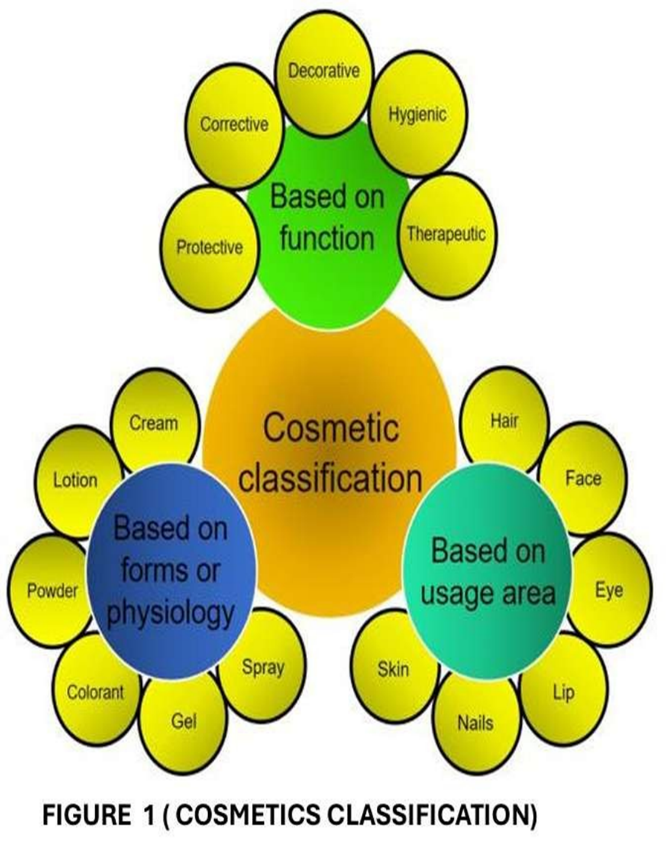
1. Anti-aging Agents
2. Antioxidants
3. Depigmenting / Whitening Agents
4. Anti-acne Agents
5. Moisturizing & Hydrating Agents
6. Sunscreen & Photoprotective Agents
7. Anti-inflammatory Agents
8. Exfoliating Agents
B. Classification Based on Origin of Ingredients
1. Herbal / Natural Cosmeceuticals
2. Synthetic Cosmeceuticals
3. Biotechnology-derived Cosmeceuticals
4. Marine-derived Cosmeceuticals
5. Nanotechnology-based Cosmeceuticals
C. Classification Based on Type of Product
1. Topical Creams & Lotions
2. Serums
3. Gels & Ointments
4. Face Masks & Patches
5. Sunscreens
6. Hair-care Cosmeceuticals
7. Oral Nutricosmetics
COSMECEUTICAL PRODUCTS AVAILABLE IN MARKETS:-
1. SKIN CARE PRODUCTS:-
2. HAIR AND SCALP PRODUCTS:-
3. OTHER COSMETICS PRFODUCTS:-
4. EXAMPLE OF COSMECEUTICAL PRODUCTS BRANDS:-
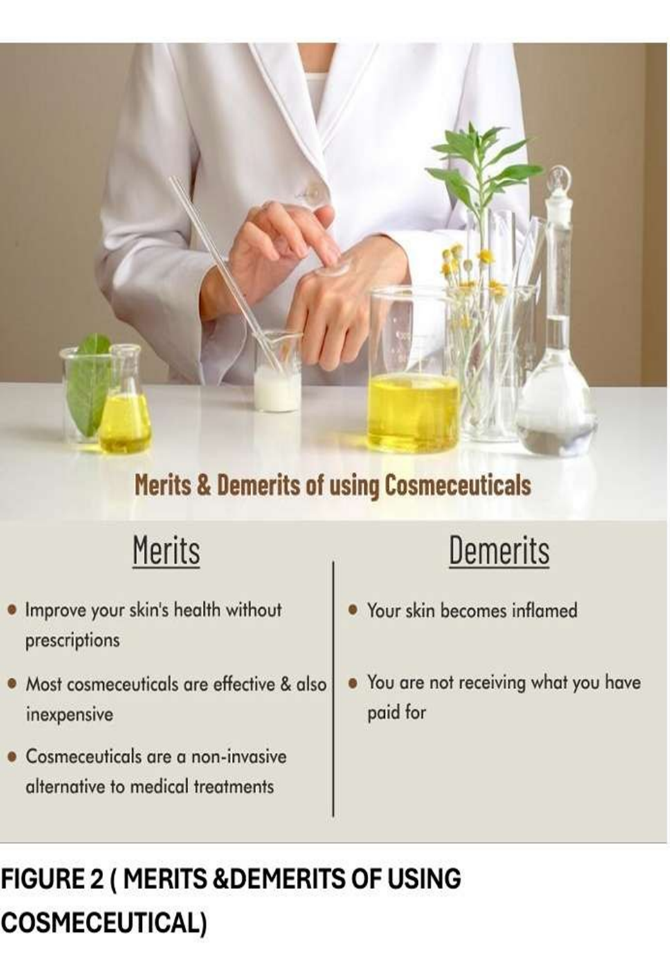
ADVANTAGES:-
DISADVANTAGES:-
NEED OF STUDY:-
The rapid growth of the cosmeceutical sector has created a demand for scientific investigation to establish the efficacy, safety, and long-term benefits of active cosmetic ingredients. Although cosmeceuticals are widely used for improving skin appearance, aging management, pigmentation control, and acne treatment, many formulations reach the market without sufficient clinical validation. Consumers today prefer products with measurable biological activity, such as antioxidants, peptides, growth factors, botanical extracts, nanocarriers, and skinrepair agents. Studying cosmeceutical products helps evaluate their percutaneous absorption, stability, bioavailability, and therapeutic potential, thereby ensuring their performance is scientifically justified. People expect cosmetics to not only enhance appearance but also deliver therapeutic benefits such as anti-aging, skin lightening, hydration, and acne reduction. This demands products backed by scientific validation.
Most herbal cosmeceutical ingredients vary depending on region, season, and extraction method. There is a strong need to develop standardized processes to ensure consistent quality, purity, and potency.
Many cosmeceutical products make claims without sufficient clinical proof. More laboratory studies, clinical trials, and dermatological evaluations are required to validate product efficacy and safety.
Skin acts as a strong barrier, making it difficult for active ingredients to reach target sites. Research on nano-delivery systems (liposomes, nanoparticles, nanoemulsions) is needed to enhance penetration and controlled release.
Most products are tested for short-term effects only. Long-term usage effects, especially for retinoids, acids, and nano-formulations, need more extensive safety testing.
Active ingredients like Vitamin C, retinoids, and plant extracts degrade in light, heat, or oxygen. Research is needed to develop stabilizers, encapsulation systems, and protective packaging.
Modern skincare products contain several actives at once, which may interact and reduce efficacy or cause irritation. More research is required on compatibility and synergistic effects.
Skin type, age, climate, and genetics vary from person to person. There is a need for AI-based and personalized formulations to suit individual skin requirements.
Consumers are demanding natural and environmentally safe products. Research is needed on biodegradable ingredients, green solvents, and sustainable packaging materials.
Some cosmeceuticals cause redness, burning, or sensitivity. More hypoallergenic, non-comedogenic, and dermatologically tested formulations are needed.
To protect sensitive ingredients from oxidation, advanced packaging like airless pumps, UV-protected bottles, and vacuum-sealed containers are required.
Cosmeceuticals fall between cosmetics and pharmaceuticals, and regulations vary by country. There is a need for clear global standards for safety, efficacy, and labeling.
High-quality cosmeceuticals are expensive due to costly raw materials and technology. Research is required to develop affordable yet effective formulations.
Exploration of new herbal ingredients, marine resources, probiotics, peptides, and enzyme-based actives is needed to enhance product innovation.
Urban pollution and digital exposure are rising concerns. More research is required to develop products that protect against PM 2.5, UV, HEV, and IR light.
To determine which actives are more effective and safer, more comparative studies between natural and synthetic ingredients are needed.
Users often misuse products or have unrealistic expectations. Educational materials, proper labeling, and dermatologist-guided usage instructions are needed.
AIM:-
STUDY AND OVERVIEW OF COSMECEUTICAL PRODUCTS
OBJECTIVE:-
CONCLUSION
Cosmeceuticals have emerged as one of the most dynamic and rapidly growing segments of the cosmetic and pharmaceutical industries. Through the integration of biologically active ingredients, these products bridge the gap between traditional cosmetics and therapeutic agents, offering enhanced benefits for skin and hair health. The review of literature highlights the significant progress made in the development of cosmeceutical ingredients such as retinoids, peptides, antioxidants, botanical extracts, vitamins, alpha hydroxy acids, and novel bioactive compounds. The need for stricter regulatory guidelines is also evident. While cosmeceuticals provide promising therapeutic benefits, the lack of a unified regulatory framework across countries creates challenges in ensuring quality, safety, and efficacy. Overall, the study concludes that cosmeceuticals represent a promising and scientifically significant area with substantial scope for further research and product development.
SUMMARY
Cosmeceutical products represent a rapidly expanding category that lies between cosmetics and pharmaceuticals, offering both aesthetic enhancement and therapeutic benefits. The literature review highlights significant research on bioactive ingredients such as retinoids, peptides, antioxidants, botanical extracts, vitamins, and AHAs, demonstrating proven effects on skin rejuvenation and hair health. Additionally, the project examines the regulatory challenges faced by cosmeceuticals due to the absence of a globally standardized classification system. The analysis of currently marketed products shows a wide range of formulations designed for anti-aging, sun protection, brightening, acne control, hair nourishment, and scalp treatments. Overall, this study provides a detailed understanding of cosmeceuticals, emphasizing their scientific foundation, therapeutic relevance, and potential for future development. Further research is needed to establish stronger regulatory frameworks, ensure long-term safety, and improve the clinical validation of active ingredients.
REFERENCES




Dnyaneshwar Ghuge, Datta Korde, Pawan Hanute, Rushikesh Thorat, A Review on Study and Overview of Cosmeceutical Products, Int. J. of Pharm. Sci., 2025, Vol 3, Issue 12, 588-597. https://doi.org/10.5281/zenodo.17804061
 10.5281/zenodo.17804061
