
Vidyaniketan Institute of Pharmacy and Research Centre, Bota, India
Kidney stones, also called nephrolithiasis, affect many people today because of how lifestyles have changed. In the last ten years, there has been renewed interest in studying medicinal plants as a possible source of natural remedies. Herbal medicine might become an important part of the medical system for treating diseases in the coming years. Many studies show that using medicinal herbs could be a helpful way to treat kidney stones. Plants contain different active substances, like polyphenols, flavonoids, saponins, furanochromones, alkaloids, and terpenoids, which might help stop kidney stones from forming. These natural resources have a variety of active compounds, including phenolic acids, flavonoids, and terpenoids, which have been found to have strong potential in preventing kidney stones. However, most of the studies on these natural substances are still in early stages. Future research, especially in clinical settings, could help prove how effective these treatments might be in real-world situations.
Kidney stones are a health problem that affects people of all genders, races, and ages. It is thought that this condition is becoming more common in many parts of the world. Along with the effects of global warming, how people eat may be a big reason for this increase. About 12% of people around the world will develop kidney stones at some point in their lives. Having kidney stones can increase the chances of getting chronic kidney disease by 60% and end-stage kidney disease by 40%. It has also been linked to a type of kidney cancer called papillary renal cell carcinoma.
In recent times, there has been more interest in using herbal products because of the high cost and side effects of surgeries and medical procedures.
For a long time, people and animals have used medicinal plants as a main source of food and medicine. Today, many researchers are studying natural resources like herbs and old techniques used by people like Ibn Sina . Medicinal plants can help ease the pain from kidney stones and stop the formation of new ones. They can also help remove stones from the kidneys. These plants are used to treat different types of kidney stones, including calcium oxalate, uric acid, struvite, and cysteine. The use of herbal medicine is part of the development of modern society .
Causes of Kidney Stone
Kidney stones happen when the body doesn't make enough urine to wash away minerals, which then turn into crystals. Some main reasons for this include not drinking enough water, eating too much salt, being overweight, and having certain health issues like gout, inflammatory bowel disease, or urinary tract infections. Also, eating too much meat, foods high in oxalates, and some types of supplements can lead to kidney stones.
Symptoms of Kidney Stone
A kidney stone often doesn't cause any pain until it moves inside the kidney or travels into one of the ureters. The ureters are the tubes that carry urine from the kidneys to the bladder. If a kidney stone gets stuck in a ureter, it can block the urine flow.
This can make the kidney swell and cause the ureter to tighten. This can be really painful. When this happens, you might feel:
The pain from a kidney stone can change as the stone moves through your urinary system.
For example, the pain may move to a different part of your body or get worse.
Pathophysiology of Kidney Stone :
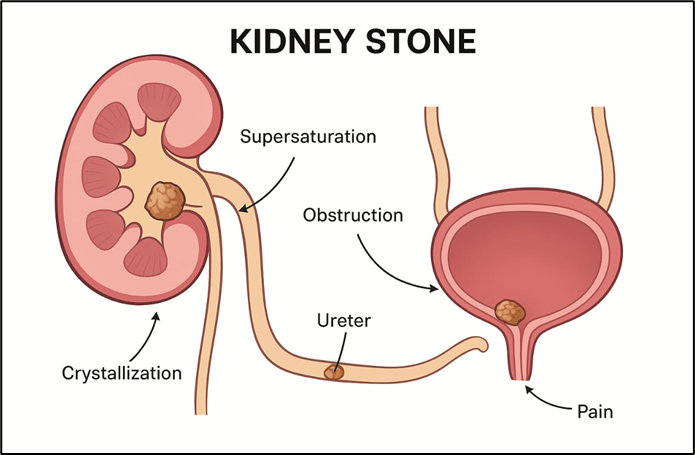
Fig. Pathophysiology of Kidney Stone
Stone growth starts with the formation of crystals in supersaturated urine which then adhere to the urothelium, thus creating the nidus for subsequent stone growth. The biological processes that anchor crystals to the urothelium are incompletely understood. Many, but not all, calcium oxalate stones develop on Randall's plaques which are composed of calcium phosphate (= hydroxyapatite) crystals. These grow to erode the urothelium, forming a nucleus for calcium oxalate deposition.
More recent ideas look at how certain molecules on the surface of cells can either help or stop crystals from sticking. When the lining of the urinary tract gets damaged and heals after a stone forms, these molecules may appear more on the cell surface, making it easier for new crystals to stick. This is why it's said that a stones beget stones because there might be a leftover piece of a stone that can help form new ones, and/or these molecules may increase to make crystal sticking more likely. Preventing stones involves finding and reducing the factors that lead to crystal formation.
Some things, like not producing enough urine, having less citrate in the urine, or having urine that is too acidic, can help this happen. Also, stones can form around things like organic material.
Stages of Kidney Stones :
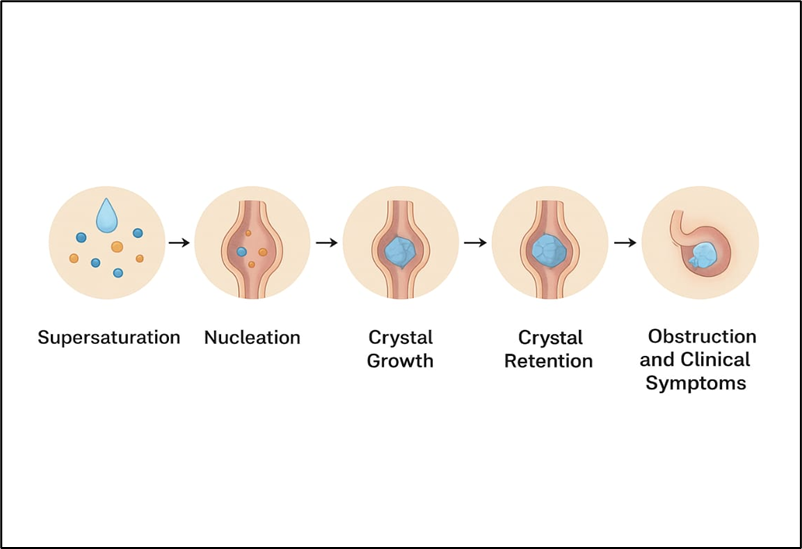
Fig. Stages of Kidney Stone
Plants used in treatment of kidney stone :
|
Sr. No. |
Plant Name |
Family |
Part Used |
Extracts |
Active Constituents |
|
1. |
Kurdu |
Amaranthaceae |
Roots and Seeds |
Ethanolic |
Flavonoids, saponins, phenols, peptides. |
|
2. |
Punica granatum |
Lythraceae |
Fruits and Bark |
Aqueous |
Polyphenols, flavonoids, tannins. |
|
3. |
Nigella sativa |
Ranunculaceae |
Seeds |
Ethanolic |
Proteins, saponins, alkaloids, fatty acids. |
|
4. |
Crateva nurvala |
Capparaceae |
Bark and Stem |
Ethanolic |
Flavonoids, steroids, fatty acids, amides. |
|
5. |
Cynodon dactylon |
Poaceae |
Rhizomes and Roots |
Juice and hydroalcoholic |
Triterpenoids, alkaloids, glycosides, essential oils. |
|
6. |
Petroselinum crispum |
Apiaceae |
Leaves, seeds and roots |
Ethanolic and aqueous |
Essential oil, flavonoids, vitamins. |
|
7. |
Aerva lanata |
Amaranthaceae |
Leaves, flowers and roots |
Ethanolic and aqueous |
Flavonoids and Alkaloids. |
|
8. |
Visnaga daucoides |
Apiaceae |
Fruits |
Aqueous |
Flavonoids and essential oils. |
|
9. |
Asparagus racemosus |
Asparagaceae |
Roots |
Ethanolic and aqueous |
Polysaccharides and mucilage. |
|
10. |
Lablab purpureus |
Fabaceae |
Seeds and leaves |
Methanolic and aqueous |
Flavonoids, saponins, tannins, and alkaloids. |
|
11. |
Origanum vulgare |
Lamiaceae |
Leaves, flowers and stem |
Aqueous and methanolic |
Flavonoids, polyphenols and sterols. |
|
12. |
Pistacia lentiscus |
Anacardiaceae |
Leaves |
Aqueous and ethanolic |
Fatty acids, steroids, and volatile oils. |
|
13. |
Rubus idaeus |
Rosaceae |
Young roots |
Aqueous |
Flavonoids, vitamins and fatty acids. |
|
14. |
Rubia cordifolia |
Rubiaceae |
Roots |
Hydroalcoholic and ethanolic |
Terpenoids and glycosides. |
|
15. |
Solanum virginianum |
Solanaceae |
Fruits and roots |
Ethanolic and methanolic |
Alkaloids, fatty acids and flavonoids. |
CONCLUSION
Medicinal plants provide a natural, affordable way to help manage kidney stones. They work by helping the body pass more urine, reducing harmful chemicals, and stopping stones from forming. Some plant-based treatments may also help break down stones and lower the chance of them coming back, with fewer side effects than usual medical treatments. But more research is needed to make sure these plants are safe, work well, and are used correctly. In general, using medicinal plants can be a helpful addition to treating and preventing kidney stones.
REFERENCES

Abhishek Gaikwad, Kalyani Deshmukh, Apeksha Fulsundar, Viraj Shelke, A Review on Medicinal Plants Used in Treatment of Kidney Stone, Int. J. of Pharm. Sci., 2025, Vol 3, Issue 12, 2197-2203. https://doi.org/10.5281/zenodo.17915578
 10.5281/zenodo.17915578
