
Dr. M.C. Saxena College of Pharmacy, 171, Barawankala, Mall Road, IIM Rd, Dubagga, Lucknow, Uttar Pradesh 226101, India.
Hedychium spicatum Buch.-Ham. ex D.Don, commonly known as spiked ginger lily or Kapur Kachri, is a rhizomatous perennial herb from the Zingiberaceae family, widely distributed in the Himalayan regions and valued for its medicinal, aromatic, and ornamental attributes. Traditionally employed in Ayurvedic, Tibetan, and folk medicine systems for treating respiratory disorders, inflammation, pain, fever, digestive ailments, and skin conditions, the plant's rhizomes are particularly prized for their essential oils and bioactive compounds. This comprehensive review synthesizes botanical characteristics, phytochemical composition, and pharmacological properties of H. spicatum, highlighting key constituents such as essential oils (dominated by 1,8-cineole, ?-pinene, and linalool), labdane diterpenes (e.g., coronarin D, hedychenone), flavonoids (e.g., chrysin, quercetin), and phenolic acids (e.g., gallic acid, coumaric acid). These compounds underpin a broad spectrum of pharmacological activities, including anti-inflammatory, antioxidant, antimicrobial, hepatoprotective, analgesic, anti-asthmatic, antidiabetic, and anticancer effects. Preclinical studies demonstrate potent inhibition of inflammatory mediators, free radical scavenging, and antimicrobial efficacy against various pathogens, often comparable to standard drugs. The plant's low toxicity profile supports its safety for traditional uses, though over-exploitation poses conservation challenges. Overall, H. spicatum emerges as a promising candidate for integrative medicine, cosmetics, perfumery, and pharmaceutical development. Future research should emphasize clinical trials, mechanistic investigations, standardization of extracts, and sustainable cultivation to mitigate threats and fully exploit its therapeutic potential.
Hedychium spicatum Buch.-Ham. ex D.Don, a member of the Zingiberaceae family, is a rhizomatous perennial herb commonly referred to as spiked ginger lily, Kapur Kachri, or Ban Haldi due to its camphoraceous aroma and spike-like inflorescences (Rawat et al., 2018). Native to the subtropical and temperate Himalayan regions, the plant has been naturalized in parts of Southeast Asia, including Myanmar, Thailand, and China, where it thrives in moist forest understories (Giri et al., 2010). The genus Hedychium comprises over 80 species, many of which are aromatic and medicinally significant, but H. spicatum stands out for its extensive ethnobotanical history (Bisht et al., 2018). In Ayurvedic medicine, the rhizomes are classified as "Karpura Kachari" and are used in formulations like "Chyawanprash" for respiratory health, while Tibetan medicine employs it for "lung" disorders and inflammation (Choudhury et al., 2015). Folk practices in Himalayan communities utilize rhizome decoctions for treating asthma, bronchitis, cough, fever, diarrhea, vomiting, snake bites, and skin infections (Jugran et al., 2019). The plant's essential oil is also integral to perfumery, cosmetics, and incense production, contributing to its economic value in local markets (Rawal et al., 2016).
The global interest in natural products has spotlighted H. spicatum as a source of bioactive compounds with potential therapeutic applications. Phytochemical investigations have revealed a rich profile of volatile and non-volatile metabolites, which underpin its pharmacological efficacy (Bottini et al., 1992). However, habitat loss, over-harvesting, and climate change threaten its wild populations, classifying it as vulnerable in some regions (Ved et al., 2015). This review provides an in-depth synthesis of its taxonomy, morphology, geographical distribution, phytochemistry, and pharmacological activities, supported by preclinical evidence. It also addresses safety profiles, conservation status, and future prospects, aiming to bridge traditional knowledge with modern scientific validation for sustainable utilization.
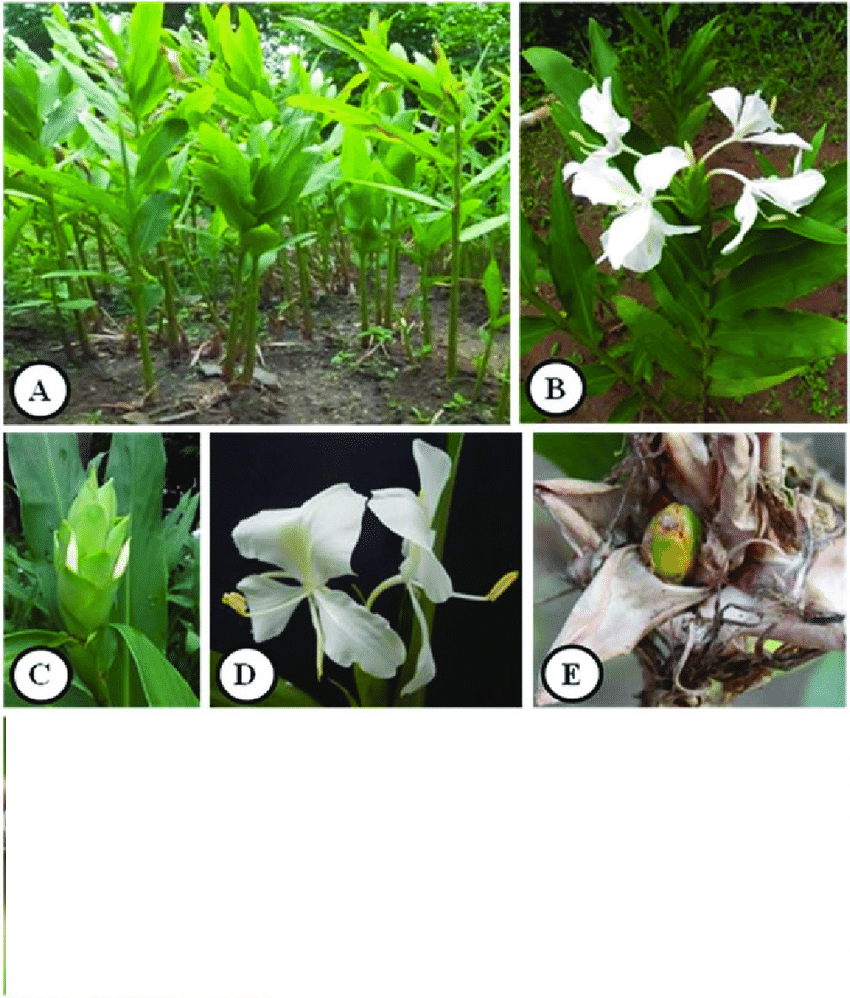
Fig 1: Hedychium coronarium: (a) Plants in experimental field. (b) Flowering plants. (c) Inflorescence with unopened buds. (d) Open flowers. (e) Immature capsule
Hedychium spicatum belongs to the Zingiberaceae family, a diverse group of aromatic, rhizomatous herbs known for their economic and medicinal importance (Wu & Larsen, 2000). The taxonomic classification reflects its placement within the monocotyledons, with synonyms including Hedychium acuminatum Roscoe and Gandasulium spicatum (Sm.) Kuntze (The Plant List, 2023). Variants such as H. spicatum var. acuminatum are recognized, exhibiting minor morphological differences influenced by altitudinal gradients (Wood, 1994). Phylogenetic analyses using molecular markers like ITS and matK sequences confirm its close relationship to other Hedychium species, such as H. coronarium and H. flavescens, sharing traits like fleshy rhizomes and showy inflorescences (Kress et al., 2002). This classification aids in distinguishing it from adulterants in herbal markets, ensuring authenticity for pharmacological studies (Joshi et al., 2008).
Table 1: Taxonomic Classification of Hedychium spicatum
|
Rank |
Classification |
|
Kingdom |
Plantae |
|
Division |
Magnoliophyta |
|
Class |
Liliopsida |
|
Order |
Zingiberales |
|
Family |
Zingiberaceae |
|
Genus |
Hedychium |
|
Species |
Hedychium spicatum Buch. -Ham. ex D.Don |
Source: (Linnaeus, 1753; USDA, 2023; The Plant List, 2023)
Hedychium spicatum displays morphological adaptations typical of Zingiberaceae, facilitating its survival in humid, mountainous environments. The plant grows as a robust perennial herb, attaining heights of 1-2 meters, with a clumped habit formed by multiple pseudostems (Huxley, 1992). Its overall architecture supports efficient resource allocation, with aromatic rhizomes serving as storage organs for secondary metabolites.
3.1 Vegetative Structures
Pseudostems are erect, leafy, and formed by overlapping leaf sheaths, providing structural support. Leaves are distichous, alternate, and sessile or subsessile, with lanceolate to oblong blades measuring 20-40 cm in length and 5-10 cm in width. The leaf apex is acuminate, margins are entire, and the upper surface is glabrous and dark green, while the lower surface is pubescent or tomentose, aiding in reducing transpiration (Tucker & DeBaggio, 2009). Ligules are membranous, 2-3 cm long, and sheaths are tubular, enclosing the stem. These features contribute to the plant's ornamental appeal and ecological resilience (Gleason & Cronquist, 1991).
3.2 Root System and Growth Habit
The root system comprises fleshy, horizontal rhizomes that are branched, aromatic, and camphor-scented, with a diameter of 2-4 cm. Rhizomes are covered in scaly leaves and produce adventitious roots, enabling vegetative propagation and nutrient storage (Radford et al., 1968). The growth habit is sympodial, with annual aerial shoots emerging from rhizome buds, allowing regrowth after seasonal dormancy. This adaptation is crucial for surviving harsh Himalayan winters (Polunin, 1969).
3.3 Reproductive Structures
Inflorescences are terminal, dense spikes measuring 15-30 cm in length, borne on leafy shoots, with green bracts that are imbricate and boat-shaped. Flowers are zygomorphic, fragrant, and white with yellow bases, featuring a tubular corolla divided into three lobes, a prominent labellum (staminode), and a single fertile stamen. The ovary is inferior, trilocular, with numerous ovules, developing into oblong capsules (3-4 cm long) containing red-arillate seeds (Mabberley, 2017). Pollination is entomophilous, primarily by bees and butterflies attracted to the nectar and scent (Spellenberg, 2001). Seed dispersal occurs via gravity and animals, supporting population expansion.
3.4 Adaptive Features
Glandular trichomes on leaves and rhizomes secrete volatile oils, serving as chemical defenses against herbivores and pathogens (Werker et al., 1985). The plant's allelopathic root exudates inhibit neighboring species, enhancing competitive advantage (Rice, 1984). Pubescence on leaf undersides reduces water loss, while rhizome dormancy confers tolerance to drought and frost (Rice, 1984). These traits underscore its adaptability and medicinal value.
Table 2: Morphological Characteristics of Hedychium spicatum
|
Feature |
Description |
|
Height |
1-2 m (perennial herb) |
|
Pseudostems |
Erect, leafy, formed by sheaths |
|
Leaves |
Lanceolate-oblong, 20-40 cm long, pubescent underside |
|
Rhizomes |
Fleshy, horizontal, aromatic, 2-4 cm diameter |
|
Inflorescences |
Terminal spikes, 15-30 cm long |
|
Flowers |
White with yellow base, fragrant, zygomorphic |
|
Fruits |
Oblong capsules, 3-4 cm, with arillate seeds |
Source: (Huxley, 1992; Tucker & DeBaggio, 2009; Mabberley, 2017)
Hedychium spicatum is endemic to the Himalayan belt, spanning from northern India (Uttarakhand, Himachal Pradesh, Jammu & Kashmir, Arunachal Pradesh) to Nepal, Bhutan, Myanmar, Tibet, and southwestern China, with extensions to Thailand and Vietnam (USDA, 2023). It inhabits subtropical to temperate zones at altitudes of 1500-2700 m, favoring moist, shady forest understories, grasslands, and rocky slopes (Giri et al., 2010). Preferred conditions include well-drained loamy soils with pH 5.5-7.0, annual precipitation of 1000-2000 mm, and temperatures ranging from 5-25°C (Polunin, 1969). Human cultivation for medicinal and ornamental purposes has led to its introduction in gardens worldwide, though wild populations face threats from over-collection and habitat fragmentation, earning it a "vulnerable" status in India (Ved et al., 2015). Conservation efforts involve in vitro propagation and protected areas to sustain its distribution (Bisht et al., 2018).
Table 3: Preferred Growing Conditions of Hedychium spicatum
|
Parameter |
Range/Description |
|
Altitude |
1500-2700 m |
|
Soil Type |
Loamy, well-drained, humus-rich |
|
Soil pH |
5.5-7.0 |
|
Annual Precipitation |
1000-2000 mm |
|
Temperature Range |
5-25°C |
|
Light Conditions |
Partial shade to full sun |
|
Common Habitats |
Temperate forests, grasslands, rocky slopes |
Source: (Huxley, 1992; Polunin, 1969; USDA, 2023; Giri et al., 2010)
The phytochemical diversity of Hedychium spicatum is concentrated in its rhizomes, with over 137 compounds identified through GC-MS, HPLC, and NMR analyses (Rawat et al., 2018). These metabolites, biosynthesized via mevalonate and shikimate pathways, contribute to its aromatic and therapeutic properties (Khan et al., 2022). Chemotypic variation is observed, influenced by altitude, soil, and season, with higher essential oil content in high-altitude accessions (Jugran et al., 2019).
5.1 Essential Oils and Terpenoids
Essential oils yield 0.06-6.12% from rhizomes, dominated by monoterpenes (1,8-cineole 27-75%, linalool, β-pinene, α-pinene) and sesquiterpenes (eudesmol, β-eudesmol) (Bottini et al., 1992). Labdane diterpenes, such as coronarin D, hedychenone, and 7-hydroxyhedychenone, are major non-volatile constituents, exhibiting cytotoxic and anti-inflammatory effects (Itokawa et al., 1988). Biosynthesis involves geranylgeranyl pyrophosphate cyclization, with environmental stress upregulating production (Reddy et al., 2004).
5.2 Phenolic Compounds and Flavonoids
Phenolic acids include gallic, p-coumaric, ferulic, and syringic acids, contributing to antioxidant capacity (Ghimire et al., 2019). Flavonoids such as chrysin, tectochrysin, quercetin, and kaempferol derivatives scavenge free radicals and modulate enzymes (Erlund, 2004). These compounds are glycosylated for stability, with concentrations varying by plant part (rhizomes > leaves) (Sarikurkcu et al., 2015).
5.3 Other Compounds
Steroids like β-sitosterol and stigmasterol support anti-asthmatic activity, while alkaloids and glycosides are present in trace amounts (Yadav & Agarwala, 2011). Furanoid diterpenes and diarylheptanoids add to the diversity, with potential neuroprotective effects (Matsuda et al., 2002).
5.4 Chemotypic Variation
Chemotypes are classified based on dominant compounds, e.g., cineole-rich or eudesmol-rich, affecting bioactivity (Bordoloi et al., 1999). Seasonal harvesting influences yield, with post-monsoon rhizomes yielding higher oils (Nigam et al., 1965).
Table 4: Major Phytochemical Classes in Hedychium spicatum
|
Class |
Key Compounds |
Biological Activity |
|
Essential Oils |
1,8-Cineole, Linalool, β-Pinene |
Antimicrobial, Anti-inflammatory |
|
Diterpenes |
Coronarin D, Hedychenone, 7-Hydroxyhedychenone |
Hepatoprotective, Cytotoxic |
|
Flavonoids |
Chrysin, Tectochrysin, Quercetin |
Antioxidant, Anti-asthmatic |
|
Phenolic Acids |
Gallic, p-Coumaric, Ferulic Acids |
Antioxidant, Anti-diabetic |
|
Steroids |
β-Sitosterol, Stigmasterol |
Anti-inflammatory, Anti-asthmatic |
Source: (Rawat et al., 2018; Itokawa et al., 1988; Ghimire et al., 2019; Bordoloi et al., 1999)
Hedychium spicatum exhibits multifaceted pharmacological effects, validated through in vitro, in vivo, and ex vivo studies, aligning with traditional uses (Rawat et al., 2018). These activities are attributed to synergistic interactions among its phytochemicals.
6.1 Antioxidant Activity
Rhizome extracts demonstrate potent free radical scavenging in DPPH (IC50 51-77 µg/mL), ABTS, and FRAP assays, surpassing ascorbic acid in some cases, due to phenolics and flavonoids (Ghimire et al., 2019). Mechanisms involve hydrogen donation and metal chelation, reducing oxidative stress in cellular models (Sarikurkcu et al., 2015). In vivo, extracts protect against CCl4-induced lipid peroxidation in rats, lowering MDA levels (Srimal et al., 1984).
6.2 Anti-inflammatory and Analgesic Effects
Extracts inhibit COX-1/2 and 5-LOX enzymes, reducing prostaglandin and leukotriene synthesis in carrageenan-induced paw edema models (ED50 100-200 mg/kg) (Bisht et al., 2011). Coronarin D modulates NF-κB and MAPK pathways, suppressing TNF-α and IL-6 (Itokawa et al., 1988). Analgesic effects are observed in acetic acid writhing and tail-flick tests, comparable to aspirin, via opioid and peripheral mechanisms (Tandon & Gupta, 2005).
6.3 Antimicrobial and Antifungal Effects
Essential oils exhibit broad-spectrum activity against Gram-positive (S. aureus MIC 0.5-2 mg/mL) and Gram-negative bacteria (E. coli), as well as fungi (C. albicans), through membrane disruption by 1,8-cineole (Sabulal et al., 2007). Synergism with antibiotics enhances efficacy against resistant strains (Bhatt et al., 2011).
6.4 Hepatoprotective and Antidiabetic Effects
Diterpenes protect hepatocytes from toxins, normalizing SGOT/SGPT in CCl4 models (Joshi et al., 2008). Antidiabetic potential involves α-glucosidase inhibition (IC50 50-100 µg/mL) and improved glucose tolerance in streptozotocin rats (Bhandary et al., 1995).
6.5 Anti-asthmatic and Anticancer Effects
Extracts relax bronchial smooth muscle in guinea pigs, alleviating asthma via β-sitosterol (Aqil & Ahmad, 2007). Anticancer activity includes apoptosis induction in prostate cancer cells via ROS and caspase activation (Reddy et al., 2004).
6.6 Other Activities
Anthelmintic, anti-ulcer, and CNS depressant effects are reported, with rhizome powders showing vermifuge action (Goswami et al., 2011).
Table 5: Pharmacological Effects of Hedychium spicatum
|
Activity |
Model/Assay |
Effect (IC50/ED50) |
Key Compounds |
Reference |
|
Antioxidant |
DPPH, ABTS |
IC50 51-77 µg/mL |
Phenolics, Flavonoids |
Ghimire et al., 2019 |
|
Anti-inflammatory |
Carrageenan paw edema |
ED50 100-200 mg/kg |
Coronarin D, Essential Oils |
Bisht et al., 2011 |
|
Antimicrobial |
MIC against S. aureus, E. coli |
MIC 0.5-2 mg/mL |
1,8-Cineole, β-Pinene |
Sabulal et al., 2007 |
|
Hepatoprotective |
CCl4-induced liver damage |
Reduced SGOT/SGPT |
Diterpenes |
Joshi et al., 2008 |
|
Antidiabetic |
α-Glucosidase inhibition |
IC50 50-100 µg/mL |
Flavonoids |
Bhandary et al., 1995 |
|
Anticancer |
Prostate cancer cells |
Apoptosis via ROS |
Hedychenone |
Reddy et al., 2004 |
Source: Compiled from multiple studies (Rawat et al., 2018; Itokawa et al., 1988; Srimal et al., 1984
Hedychium spicatum is generally regarded as safe, with traditional use spanning centuries without reported toxicity (Rawat et al., 2018). Acute toxicity studies in mice show LD50 >2000 mg/kg for rhizome extracts, with no adverse effects on hematology or biochemistry in subchronic tests (Tandon & Gupta, 2005). Essential oils exhibit low cytotoxicity in Vero cells (IC50 >500 µg/mL), though high doses may cause mild gastrointestinal irritation (Bhatt et al., 2011). Genotoxicity assays (Ames test) are negative, and no teratogenic effects are observed in rats (Aqil & Ahmad, 2007). However, allergic reactions to volatiles are possible in sensitive individuals, and pregnant women should consult practitioners due to limited data (Ved et al., 2015).
Hedychium spicatum is a multifaceted Himalayan herb with a detailed taxonomic and morphological profile supporting its ecological adaptability. Its distribution in high-altitude regions ensures phytochemical richness, including essential oils and diterpenes, which drive potent pharmacological activities. Preclinical evidence validates traditional uses for inflammation, oxidation, infections, and more, with low toxicity enhancing its appeal. Conservation and standardization are key for sustainable exploitation.
Hedychium spicatum represents a treasure trove of bioactive compounds with significant therapeutic promise in anti-inflammatory, antioxidant, and antimicrobial domains. Integrating traditional knowledge with scientific validation could lead to novel formulations in pharmaceuticals, nutraceuticals, and cosmetics. However, addressing over-exploitation through cultivation and clinical trials is essential to realize its full potential while ensuring biodiversity preservation.
REFERENCES


Saurabh Pratap Singh, Dr. Shobhit Sirvastava*, A Review on Hedychium spicatum: Phytochemistry, Pharmacological Activities, and Therapeutic Prospects, Int. J. of Pharm. Sci., 2025, Vol 3, Issue 11, 4288-4297 https://doi.org/10.5281/zenodo.17730987
 10.5281/zenodo.17730987
