
Matoshri Miratai Aher College of Pharmacy, Karjule Harya.
Euphorbia hirta, also referred to as garden spurge or asthma weed, is a plant species that has gained considerable interest because of its rich pharmacological characteristics and customary applications across cultures. E. hirta, a member of the Euphorbiaceae family, has been the focus of several investigations examining its pharmacological potential, development, and formulation. The earliest known treatments for humanity are herbal remedies. India is well-known throughout the world for its Ayurvedic therapy. Traditionally, Euphorbia hirta has been used to treat respiratory conditions (cough, coryza, bronchitis, asthma), and childhood worm infestations, dysentery, jaundice, acne, gonorrhea, digestive issues as well as tumors. Euphorbia hirta's phytochemical screening showed that the plant contained reducing proteins, fats, oils, gums, mucilages, terpenoids, alkaloids, steroids, tannins, and sugars glycoside, cardiac glycosides, coumarin, and saponin.
Herbal medicine is the oldest form of medicine known to mankind. It was the mainstay of many early civilizations and still the most widely practiced form of medicine in the world today. Plants generally produce many secondary metabolites which are bio-synthetically derived from primary metabolites and constitute an important source of many pharmaceutical drugs. The plant is characterized by the presence of milky white latex, which is moreor less toxic. Latices of E. ingens, E. tirucalli, E. mey, and E. triangularis are possible sources of rubber. The roots have long been used in various traditional medicine systems to treat various ailments. Roots of R. communis have diuretic, anticancer, anti-inflammatory, anthelmintic, hepatoprotective, antibacterial, and antispasmodic A combined decoction of R. communis root and Gokhuru (Tribulus terrestrisLinn.) with common salty can reduce kidney stones. Roots of R. communis contains saponins (lupeol and erandone), steroidal ester (ricinusterryl benzoate), phenolic compound (ricipentatriacontanol), flavonoids 486 (rutin, quercetin, isoquercetin, and kaempferol), and fatty acid esters (indole-3-acetic acid, 1-Oleio- 2-palmitoglyceryl phosphate) .
Keywords:
Mankind
Oldest medicine
Medicinal property
Synonyms: Ephorbia hirta , Mankind ,Dugdhika, Chamaesyce hirta (L.) Millsp., Euphorbia pilulifera L., Euphorbia capitata Lam., and Euphorbia indica Lam.
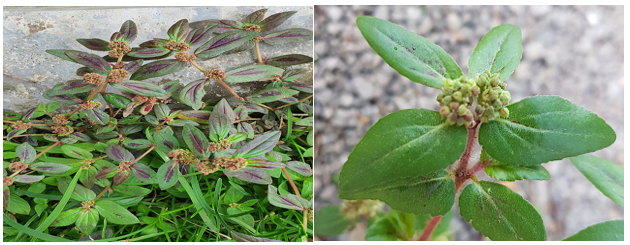
Fig: Ephorbia Hirta Plant
Geographical source:
The plant is distributed across Northern America (United States, Mexico), Southern America (e.g., Brazil, Guatemala, Argentina), Africa (e.g., South Africa, Nigeria, Ethiopia), Asia (e.g., India, Thailand, Philippines), and Australasia.
Table: Taxonomical Classification
|
Sr.no |
Classification |
Scientific name and common name |
|
1 |
kingdom |
Plantae |
|
2 |
SubKingdom |
Viridiplantae |
|
3 |
Division |
Tracheophyta |
|
4 |
Subdivision |
Spermatophytina |
|
5 |
Class |
Magnolipsida |
|
6 |
Order |
Malpighiales |
|
7 |
Family |
Euphorbiaceae |
|
8 |
Genus |
Euphorbia |
|
9 |
Species |
Euphorbia hirta |
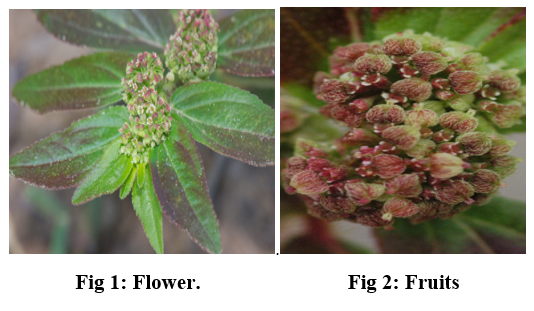
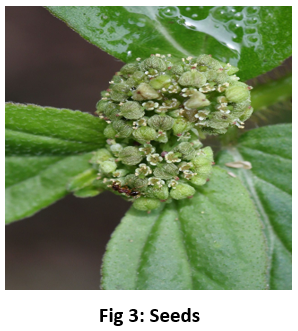
Morphological character: Euphorbia hirta belongs to the plant family Euphorbiaceae and genus Euphorbia. It is a slender-stemmed, annual hairy plant with many branches from the base to top, spreading up to 40 cm in height, reddish or purplish in color. Leaves are opposite, elliptic - oblong to oblong- lanceolate, acute or subacute, dark green above; pale beneath, 1- 2.5 cm long, blotched with purple in the middle, and toothed at the edge. The fruits are yellow, three- celled, hairy, keeled capsules, 1-2 mm in diameter, containing three brown, foursided, angular, wrinkled seeds .
Flowers are unisexual and typically bloom year-round. Male flowers feature sessile structure, fringed, linear bracteoles, a single stamen, and lack a periapt.
Fruits described as allomorphic pistillate exhibit characteristics including a yellow, three-lobed capsule that is three-seeded. The capsules are keeled and contain three brown, four-sided, angular, and wrinkled seeds. The base of the fruit is truncate and hairy, with each seed measuring 1-2 mm in diameter.
Seed characteristics include very small size, oblong shape (measuring 0.57 to 0.70 mm in length and weighing 0.065 mg per seed), a slightly wrinkled texture, and a four-sided pinkish-brown appearance, with the absence of a caruncle (Noda et al. 1984).
Microscopic study:
1. Microscopic study of Leaf's
A. Leaf's Transverse Section (T.S.)
Dorsiventral leaf (upper side of a differentiated palisade).
Higher epidermis:a single cell layer Thick cuticle covering non-glandular trichomes that are both unicellular and multicellular (very characteristic) Palisade material: One or two elongated cell layers beneath the upper epidermis Pliable parenchyma: Large air gaps and loose parenchyma has crystals of calcium oxalate, which are common in Euphorbia bundle of veins : kind of collateral Phloem below, xylem towards the topenclosed by a thin sheath of parenchymatous bundles
Epidermis lower: There are stomata. Anisocytic (unequal cell) stomata are frequently Pubescence is denser (many hairs).
B. Epidermal Peel on the Leaf Surface
Most stomata are anisocytic, though they can occasionally be paracytic. Trichomes Simple, unicellular, and non-glandular Uniseriate, multicellular, and frequently hooked Pattern of venation: Reticulate
2. Microscopy study of Stems
Stem's T.S.
The epidermis One-layered dense layer of hairy trichomes that are both unicellular and multicellular Cortex Collenchyma beneath the skin Calcium oxalate crystals dispersed throughout the parenchyma. The pericycl has fibers that frequently form a discontinuous ring .Bundles of blood vessels: Open and collateral Phloem outside, xylem toward the center Pith Big, parenchymatous contains latex cells occasionally.
3. Microscopy of Roots
Younger roots have an epidermis (piliferous layer).
The cortex wide area Parenchyma with thin walls There could be latex ducts. The endodermis Unique Casparian stripes The pericycle causes lateral roots to grow. Xylem Radial configuration
Polyarch or tetrarch (four or more arms) Phloem switches between the xylem arms.
Extraction Procedure of Ephorbia hirta.
1. Gathering (collection)
1. Gather aerial parts (leaves, stems, flowers) or whole, healthy plants.
2. After the dew has evaporated, prefer the morning hours.
3. Gather from places free of pollution, roadside dust, and pesticides.
4. Steer clear of plants that are discolored or infected with fungus.
5. Put the plant material in paper or cloth bags that are clean and breathable.
2. Cleaning
Cleaning involves the following steps: first, remove soil, insects, dried leaves, and foreign matter by hand. Next, quickly rinse the plant material with clean water to eliminate dirt without soaking, as soaking may lead to the loss of active compounds. Shake off any excess water and then spread the material on a clean cloth to air-drain for 10–20 minutes.
3. Drying
To avoid mold and maintain phytochemicals, drying is crucial.
A. Shade Drying (Highly Suggested)
1. On sanitized trays or cloth, thinly spread the plant parts.
2. Stay out of direct sunlight and in a well-ventilated, shaded area.
3. Every day, turn the material.
4. Let the material dry for five to seven days, or until it is crisp.
4 . Storage
Keep in an air-tight amber container until extraction.
Medicinal Uses
The plant has historically been used to treat a number of conditions, including gastrointestinal disorders (diarrhoea, dysentery, intestinal parasitosis, bowel complaints, digestive issues), respiratory conditions (cough, cold, asthma, bronchitis, hay fever, emphysema), urogenital apparatus (diuretic, kidney stones), genital apparatus (metrorrhagic, agalactosis, gonorrhoea, urethritis), conjunctivitis, corneal ulcer), and tumours. It is used as ear drops to treat wounds, boils, and scars in south India. The plant's latex is typically applied to warts and cuts to prevent infection by pathogens. It works well for treating ulcers as well. The plant is also consumed as a vegetable.
Pharmacological properties
1. Antimicrobial Action : Using the methanol extract, which demonstrated the ability to combat Shigella species that cause dysentery in the Vero cell line, the antibacterial activity of E. hirta was identified and validated. The plant extract's non-cytotoxic concentration was tested for antibacterial activity against the pathogen's different dosages. As a result, the extracts were shown to be potent antibacterial agents that were not cytotoxic. Nystatin and a methanol extract from E. hirta leaves were used to test the antimicrobial activity on Candida albicans. Using the Vero cell line, the antibacterial properties of compounds extracted from Camellia sinensis L. and the methanol extract of Euphorbia hirta L. were investigated against Shigella spp. that cause dysentery.
2. Anti-inflammatory activity: In a mouse model of phorbol acetate-induced ear inflammation, the n-hexane extract of E. hirta's aerial parts demonstrated anti-inflammatory effects. The effect was dose-dependent.
3. Anthelmintic activity: The anthelmintic efficacy of the aqueous crude extract of E. hirta Linn was studied in 20 Nigerian dogs that were naturally infected with nematodes. Results of this study show that the aqueous crude extracts of E. hirta after its administration into local dogs produced a significant increase (p< 0.05) in PCV, RBC, Hb conc., TWBC and lymphocyte counts. The fecal egg counts also showed a remarkable and significant reduction in the levels of the identified helminthes [20]
4. Antiasthmatic action: According to reports, Hirta has an antiasthma tic action as a result of the calming impact on the bronchial tubes and a respiratory depressant effect [23] Effect of Euphorbia hirta against asthmatic rats shows curative quality. In the end, it lowers WBC levels. (neutrophils, basophils, and eosinophils) that are elevated as a outcome of the inflammatory reaction. Additionally, a review reveals that it transforms the dense fibrin network into a delicate form. According to reports, it relaxes the bronchial tubes. characteristic brought about by the flavonoid and quercitrin.
Chemical Constituents:
Several researchers have examined E. hirta, and several active components have been identified. From the methanolic extract of E. hirta, afzelin (I), quercitrin (II), and myricitrin (III) have been separated. Rutin (IV), quercitin (V), euphorbin-A (VI), euphorbin-B (VII), euphorbin-C (VIII),kaempferol, gallic acid, and protocatechuic acid have all been identified through chemical analysis of E. hirta. Additionally, β-amyrin, 24-methylenecycloartenol, β-sitosterol, heptacosane, nnonacosane, shikmic acid, tinyatoxin, choline, camphol, and quercitol derivatives containing rhamnose and chtolphenolic acid are found in E. hirta.
Pharmacological Activity: Examined chemical components from Euphorbia hirta Linn's aerial portion. Chromatographic methods were used to separate and purify these chemical components, and chemical analysis was aided by structural clarification.Scopoletin (1), scoparone (2), isoscopoletin (3), quercetin (4), isorhamnetin (5), pinocembrin (6), kaempferol (4), luteolin (8), and acid (9) were the remaining nine chemicals. For the first time, chemicals 1-3 and 5-8 were identified from this plant. isolated, identified, and described a microbiological straining from Euphorbia hirta rhizospheric soil. The strain was identified as a motile rod bacterium that was gram-positive and had a terminal spore. The strain was determined to be Hay Bacillus KC3 by the synthesis of the 16srRNA gene sequence.
CONCLUSION:
Euphorbia hirta L. shows promise as a botanical resource with a variety of pharmacological characteristics and therapeutic uses. It has shown successful in treating a number of health ailments, such as bacterial infections, diabetes, asthma, and infertility problems, according to extensive study. Euphorbia hirta's mechanisms of action and therapeutic potential can be better understood by identifying its bioactive secondary metabolites.
REFERENCES


Varpe Amruta*, Devkate Dipali, Kardile Pratiksha, Salve Rohan, Khodade Gayatri, Palange Sanika, Dr. Rahane Rahulkumar D., A Review of Medicinal Uses and Pharmacological Activities of Euphorbia Hirta, Int. J. of Pharm. Sci., 2025, Vol 3, Issue 12, 257-263 https://doi.org/10.5281/zenodo.17786500
 10.5281/zenodo.17786500
