
Department of Pharmacology, Vidyabharati College of Pharmacy, Amravati
Medicinal plants have been an integral part of traditional healthcare systems across the world, serving as vital sources for the discovery of novel therapeutic compounds. Barleria terminalis Nees (Acanthaceae) is a lesser-explored species belonging to a genus widely recognized for its diverse ethnomedicinal and pharmacological importance. Distributed primarily in the Western Ghats of India and Sri Lanka, B. terminalis is an erect shrub characterized by terminal violet-blue inflorescences and simple, opposite leaves. Traditionally, members of the genus Barleria are used to treat inflammation, wounds, infections, and liver disorders. Recent phytochemical studies indicate that B. terminalis contains various bioactive constituents, including flavonoids, iridoids, phenolic acids, and glycosides,which may contribute to its observed biological effects. Experimental investigations on related Barleria species have demonstrated antioxidant, anti-inflammatory, antimicrobial, and hepatoprotective activities, suggesting similar potential for B. terminalis. This review comprehensively compiles current knowledge on the taxonomy, morphology, ethnobotany, phytochemistry, and pharmacological aspects of B. terminalis, emphasizing its role in traditional medicine and highlighting the need for detailed biochemical and clinical evaluations. The review also identifies research gaps and future prospects for utilizing B. terminalis as a source of bioactive compounds in drug discovery and development.
Medicinal plants play a pivotal role in the discovery and development of modern therapeutic agents. Since ancient times, humans have relied on herbal medicines as primary healthcare sources, particularly in regions where modern medicine remains inaccessible. According to the World Health Organization approximately 80% of the global population still depends on plant-based remedies for primary healthcare needs. These plants provide a vast array of secondary metabolites—such as alkaloids, flavonoids, terpenoids, phenolics, and glycosides—that exhibit a wide spectrum of biological and pharmacological activities (1) The continued exploration of these compounds is essential for identifying novel lead molecules that can contribute to drug discovery and the development of safe, effective therapeutic agents. The Acanthaceae family, comprising about 250 genera and over 4000 species, is widely distributed in tropical and subtropical regions of the world. Members of this family are characterized by opposite leaves, bilabiate corollas, and explosive fruit dehiscence. Several species of Acanthaceae have long been valued in traditional medicinal systems such as Ayurveda, Siddha, and Unani (2) They are known for diverse pharmacological properties including anti-inflammatory, antimicrobial, antioxidant, hepatoprotective, and wound-healing effects(3) Commonly studied genera include Adhatoda, Andrographis, Ruellia, and Barleria, which are often used in traditional formulations for treating respiratory ailments, fever, skin diseases, and hepatic disorders.
Within this family, the genus Barleria L. is an important group, comprising more than 250 species distributed across Asia, Africa, and tropical America (4) In India, about 35 species have been reported, several of which are known for their ethnomedicinal uses. Species such as Barleria prionitis, B. cristata, B. lupulina, and B. buxifolia have been scientifically validated for their pharmacological properties, supporting their use in traditional medicine (5) The genus is particularly rich in iridoid glycosides, flavonoids, and phenolic compounds that contribute to its broad range of therapeutic effects.
Among the members of this genus, Barleria terminalis Nees is a lesser-studied but taxonomically and pharmacologically significant species endemic to India and Sri Lanka. It was first described by Nees von Esenbeck in 1847 in Prodromus Systematis Naturalis Regni Vegetabilis (6) The species is characterized by its terminal violet-blue flowers, opposite leaves, and erect woody habit. It is primarily distributed in the Western Ghats region of southern India, particularly in Tamil Nadu, Kerala, and Karnataka, where it thrives in dry deciduous forests and scrub habitats (7)
Although B. terminalis has not been extensively investigated compared to other Barleria species, preliminary reports and ethnobotanical records suggest that it may possess similar therapeutic potential. Given the increasing scientific interest in natural products and the pharmacological validation of related species, a comprehensive review of B. terminalis is both timely and essential. This review therefore aims to consolidate available information on the taxonomy, morphology, ethnobotany, phytochemistry, and pharmacological activities of Barleria terminalis. It also highlights current knowledge gaps and outlines future directions for research, emphasizing the plant’s potential role in drug discovery and development.
2. TAXONOMY AND NOMENCLATURE OF BARLERIA TERMINALIS NEES
2.1 Taxonomic Classification
Plant Name: Barleria terminalis
Common Name: Blue Barleria or Blue Bush-Violet
Synonyms: Barleria polystachya, Barleria strigose var. polystachya
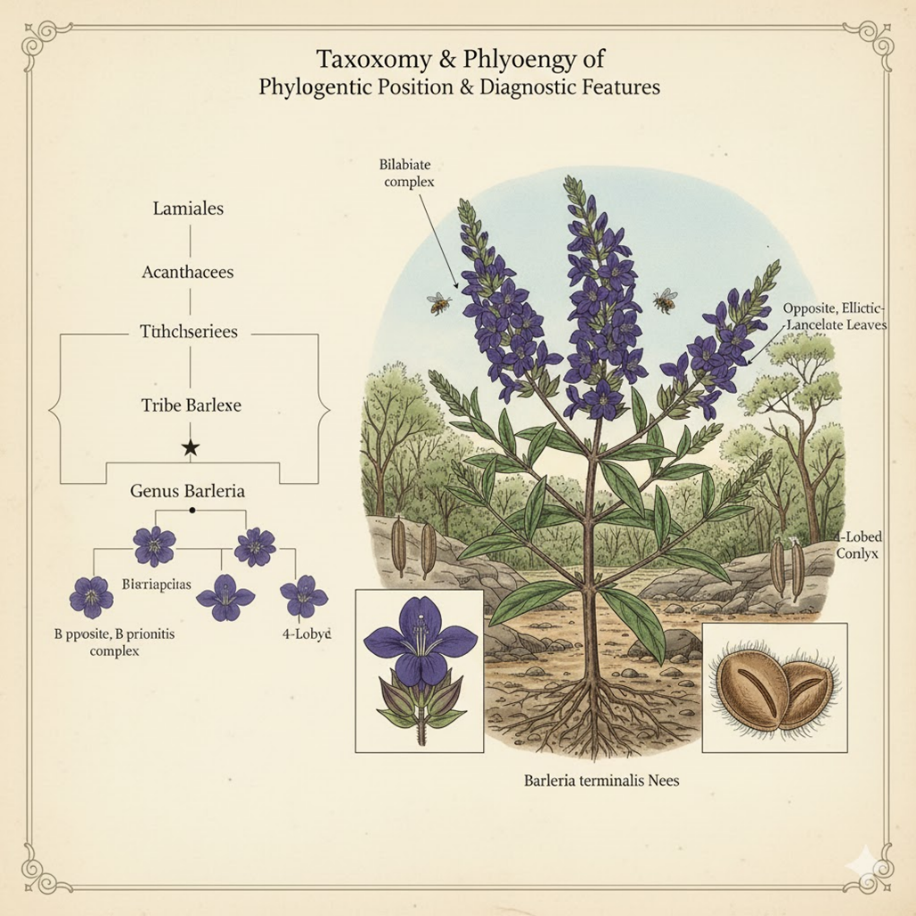
TAXONOMIC POSITION :
2.2 Phylogenetic Position and Relationships
The Acanthaceae family, under the order Lamiales, is well-known for its morphological diversity and ecological adaptation. Phylogenetic analyses based on chloroplast DNA (cpDNA), nuclear ribosomal DNA (nrDNA), and morphological traits have shown that Barleria forms a monophyletic clade within the tribe Barlerieae (3) Within this clade, B. terminalis is closely allied with the B. prionitis complex but forms a distinct lineage based on its inflorescence architecture and flower morphology (2) Phylogenetic studies further suggest that the diversification of Barleria species in the Indian subcontinent may be linked to climatic and geographical variations, particularly in the Western Ghats, which serve as a biodiversity hotspot (9)
2.3 Diagnostic Taxonomic Features
Barleria terminalis can be identified by the following diagnostic characters:
These morphological traits are essential for field identification and taxonomic verification in herbarium collections
2.4 Taxonomic Significance
The taxonomic study of Barleria terminalis holds significance for understanding evolutionary relationships within Acanthaceae. Given its endemic nature to southern India and Sri Lanka, it contributes to the floristic richness of the Western Ghats—a recognized biodiversity hotspot (7) Proper taxonomic delimitation also facilitates pharmacognostic standardization, ensuring accurate species identification for pharmacological and phytochemical research.
3. Botanical Description and Distribution
3.1 Botanical Description
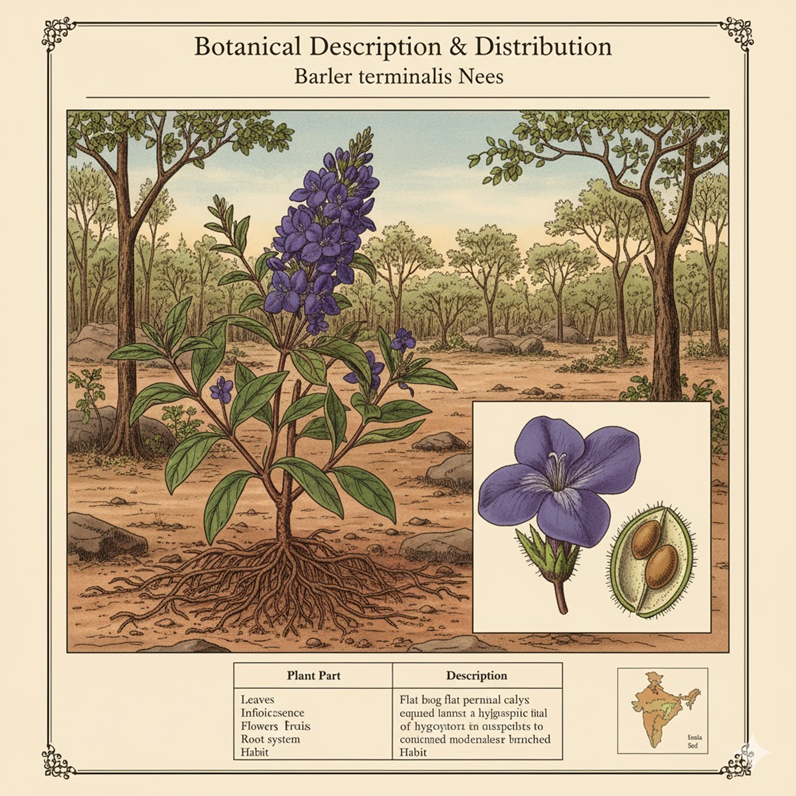
Barleria terminalis Nees is a perennial, erect, woody shrub reaching heights of 1–2 meters. It exhibits a characteristic branching pattern at the apex, with young stems slightly pubescent and older stems becoming woody and brownish in color (9)
|
Plant Part |
Description |
|
Leaves |
Opposite, simple, elliptic to lanceolate, 5–10 cm long, 2–4 cm wide; entire margin; acute apex; glabrous or sparsely pubescent on the lower surface. Petiole short, 0.5–1.0 cm. |
|
Inflorescence |
Terminal spikes (hence the epithet terminalis), simple or few-branched |
|
Flowers |
Showy, violet to bluish-purple; corolla bilabiate, tubular at the base with five lobes; upper lobes two, lower lobes three; stamens didynamous (two long, two short). Flowering season: August–December. |
|
Calyx |
4-lobed, unequal, green to purplish, sometimes slightly spiny at the tips. |
|
Fruit |
Oblong capsule, 1.5–2.5 cm long, dehiscent, containing 2–4 flat seeds. |
|
Seeds |
Flat, orbicular, with a thin coat; some reports indicate presence of hygroscopic hairs aiding dispersal. |
|
Root system |
Fibrous, moderately branched, supporting drought tolerance. |
|
Habit |
Erect woody shrub with a well-defined main stem and lateral branches. |
These diagnostic morphological traits distinguish B. terminalis from closely related species such as B. prionitis (yellow flowers, axillary inflorescences) and B. cristata (larger leaves and axillary/cymose inflorescences) (2)
3.2 Distribution and Habitat
Barleria terminalis is endemic to the Indian subcontinent, predominantly found in the Western Ghats of southern India, including Tamil Nadu, Kerala, and Karnataka. There are also reports of populations in Sri Lanka (7)
The species prefers dry deciduous forests, scrublands, rocky slopes, and hill bases, typically at elevations ranging from 200 to 900 meters above sea level (9) It thrives in well-drained soils, including lateritic and rocky substrates, and tolerates semi-shaded as well as open sunlight conditions.
B. terminalis often occurs in association with other shrub species of the Western Ghats, contributing to understory biodiversity in these ecosystems. Its restricted distribution within biodiversity hotspots highlights the ecological importance of its conservation.
3.3 Ecological and Ethnobotanical Notes
The flowering period of B. terminalis coincides with the post-monsoon season (August–December), providing nectar resources for pollinators, including bees and butterflies (9) Although underexplored, its presence in local ethnobotanical practices suggests traditional utilization for wound healing, inflammation, and liver ailments, similar to other members of the genus Barleria (5) Habitat specificity and climatic sensitivity necessitate careful monitoring to prevent population decline due to habitat loss or overexploitation.
4. Ethnobotanical and Traditional Uses
4.1 Ethnomedicinal Background
The genus Barleria has long been recognized in traditional systems of medicine, including Ayurveda, Siddha, and Unani, for its diverse therapeutic applications Species such as B. prionitis, B. cristata, and B. lupulina are widely reported for their use in treating inflammation, cough, wounds, and gastrointestinal disorders (10)
Although Barleria terminalis is less extensively studied ethnobotanically, available regional and tribal reports from southern India highlight its use in folk medicine for ailments such as fever, wounds, and skin infections (11) Its applications are generally analogous to other Barleria species, suggesting phytochemical and pharmacological parallels within the genus.
4.2 Reported Traditional Uses
Barleria terminalis Nees has been traditionally valued in various indigenous medicinal systems, particularly in the folk and tribal practices of southern India. The leaves of the plant are most commonly used, prepared as a paste or juice and applied externally to treat wounds, boils, and skin infections due to their purported antiseptic and healing properties(11) In some local traditions of Tamil Nadu and Karnataka, leaf extracts are administered orally or as decoctions for the relief of fever, inflammation, and body pain, suggesting potential anti-inflammatory and antipyretic effects. The roots of B. terminalis are also utilized in decoction form to manage fevers and general body aches, while whole plant preparations are applied topically for skin disorders and inflammatory conditions(12)
The plant is occasionally used in combination with other herbs in local formulations to enhance wound healing and tissue regeneration. In certain Ayurvedic and Siddha-based folk remedies, fresh leaves and flowers are crushed into a paste and applied externally for ulcers, insect bites, and skin eruptions, reflecting traditional beliefs in its antimicrobial and soothing activity(10) Moreover, crude leaf extracts are consumed in small quantities for liver detoxification and the management of digestive disorders, implying hepatoprotective potential similar to other Barleria species such as B. prionitis and B. lupulina (5)
Overall, the traditional applications of B. terminalis demonstrate a broad spectrum of ethnomedicinal uses, including treatment of wounds, skin diseases, inflammation, fever, and hepatic ailments. These practices, though primarily based on traditional knowledge, align with the documented pharmacological profiles of other Barleria species, indicating a need for systematic scientific validation of the plant’s therapeutic properties through phytochemical and pharmacological investigations (13)
4.3 Regional Ethnobotanical Records
Ethnobotanical surveys conducted in the Western Ghats and adjoining regions of Tamil Nadu and Kerala have documented the presence of B. terminalis in local medicinal flora (11) Traditional healers and tribal communities utilize leaf and root preparations for wound healing, fever reduction, and treatment of skin lesions. In certain parts of Karnataka, fresh leaf juice is applied externally to treat insect bites and minor wounds. (10,12)
4.4 Correlation with Phytochemical Constituents
Although limited specific studies exist for B. terminalis, related Barleria species are known to contain iridoid glycosides, flavonoids, phenolic acids, alkaloids, and terpenoids (13,5)
These compounds are often responsible for anti-inflammatory, antimicrobial, hepatoprotective, and antioxidant properties. Hence, the traditional uses of B. terminalis for wound healing and inflammation likely correlate with similar bioactive compounds yet to be characterized scientifically.
4.5 Importance in Ethnomedicine
The ethnobotanical importance of B. terminalis lies in its continued use by rural and tribal healers, reflecting its therapeutic potential despite limited modern validation. Documentation of such indigenous knowledge contributes to the biocultural heritage of India and aids in identifying novel bioactive leads for modern drug discovery (14)
However, the species remains underrepresented in pharmacological screening, highlighting the need for systematic studies on its phytochemistry, pharmacological properties, and toxicity profile.

5. Phytochemistry of Barleria terminalis
5.1 Overview of Phytochemical Studies
The genus Barleria is well recognized for its rich and diverse phytochemical spectrum, encompassing iridoid glycosides, flavonoids, phenolic acids, alkaloids, terpenoids, and sterols(15) Although B. terminalis Nees has historically received less phytochemical attention than congeners such as B. prionitis or B. cristata, recent analytical work confirms that it shares similar classes of bioactive secondary metabolites (16) These constituents are responsible for the broad pharmacological profile traditionally attributed to the species, including anti-inflammatory, antioxidant, antimicrobial, and hepatoprotective activities.
5.2 Reported Phytoconstituents
Qualitative screening of methanolic and ethanolic extracts of B. terminalis revealed alkaloids, tannins, flavonoids, glycosides, saponins, and terpenoids GC–MS and HPLC analyses identified multiple bioactive peaks corresponding to phenolic and terpenoid fractions.
Comparable species within the genus have yielded structurally characterized molecules that serve as chemotaxonomic indicators, including:
Given the close taxonomic relationship among Barleria species, it is highly probable that B. terminalis contains analogous secondary metabolites, meriting further chromatographic and spectroscopic investigation (LC-MS, NMR). (17)
5.3 Pharmacologically Active Phytochemical Groups
Three main phytochemical classes underlie the bioactivity of Barleria species:
5.4 Chemotaxonomic Significance
Phytochemical data are valuable for understanding evolutionary and systematic relationships within the tribe Barlerieae (Acanthaceae). The ubiquitous presence of iridoid glycosides across the genus serves as a biochemical hallmark (18) Comparative analyses of B. terminalis and allied taxa reinforce shared biosynthetic pathways, highlighting chemotaxonomy as an auxiliary tool for infrageneric classification (19)
5.5 Future Perspectives
Despite encouraging preliminary findings, comprehensive phytochemical research on B. terminalis remains limited. Future priorities should include:
Such investigations will clarify the plant’s phytopharmacological relevance and may lead to the development of novel phytotherapeutic agents derived from endemic Indian flora.

6. Pharmacological and Biological Activities
6.1 Antioxidant Activity
Species-specific studies on B. terminalis report significant radical-scavenging effects in standard in vitro assays (16) demonstrate antioxidant, enzyme-inhibitory and antimicrobial potential, while broader genus-level research documents robust antioxidant, anti-inflammatory, antimicrobial, hepatoprotective and cytotoxic activities across multiple Barleria taxa (17) Where direct data for B. terminalis are unavailable, findings from congeners (e.g., B. prionitis, B. cristata, B. lupulina) provide useful pharmacological context and plausible mechanistic hypotheses to guide further research (20)
6.2 Anti-inflammatory and Wound-healing Activity
Direct anti-inflammatory assays on B. terminalis are sparse; however, the genus displays reproducible anti-inflammatory effects in vitro and in vivo models. Iridoid glycosides (e.g., barlerin) and flavonoids present in Barleria species inhibit pro-inflammatory mediators (COX-2, TNF-α, IL-6) in cellular assays (15,17) Ethnopharmacological reports record topical application of B. terminalis leaves for wounds and skin inflammations, a practice consistent with the anti-inflammatory and wound-healing bioactivity documented in congeners. Well-designed in vivo anti-inflammatory and wound-healing studies specifically on B. terminalis are recommended to confirm these traditional claims.
6.3 Enzyme Inhibition and Metabolic Effects
Enzyme-inhibitory activities for B. terminalis extracts: ethanol stem extract showed ~89.1% acetylcholinesterase (AChE) inhibition, while leaf extracts exhibited measurable α-amylase and α-glucosidase inhibitory activities. These results point to possible applications in neurodegenerative (AChE inhibition) and antidiabetic (α-glucosidase/α-amylase inhibition) research, but demand validation in dose-response studies, mechanistic enzyme kinetics, and appropriate in vivo models before therapeutic claims can be advanced. (16)
6.4 Anticancer / Cytotoxic Activity
Selective cytotoxicity has been reported for several Barleria species in cell-based assays, with some extracts showing activity against human cancer cell lines. For B. terminalis specifically, comprehensive cytotoxicity profiling is currently limited; genus-level metabolomic work identifies barlerin and verbascoside among recurring metabolites, both of which have been investigated for bioactivity including antiproliferative effects). Targeted cytotoxicity screens and mechanism studies (apoptosis, cell cycle arrest, signalling pathways) are recommended for B. terminalis fractions. (20)
6.5 Toxicity and Safety
Toxicological evaluations for B. terminalis are minimal. Genus-level studies generally report low acute toxicity for crude extracts at moderate doses, but comprehensive acute, sub-acute and chronic toxicity profiles — including genotoxicity, reproductive toxicity, and organ histopathology — are absent for B. terminalis and many congeners. Before translational development, standardized toxicology studies following OECD guidelines are essential. (17)
6.6 Future Pharmacological Perspectives
Despite promising initial findings, comprehensive mechanistic and molecular studies on B. terminalis remain scarce. Future research should prioritize:
Such studies could establish B. terminalis as a credible source of novel pharmacotherapeutic agents for oxidative stress–related disorders and infectious diseases.

7. Materials and Methods
7.1 Plant Material
Phytochemical investigations on B. terminalis reported in the literature utilized aerial parts (leaves and stems) of mature plants collected from the Western Ghats region of Maharashtra, India. Specimens were authenticated by taxonomists and deposited at the Botany Department Herbarium, Savitribai Phule Pune University, under voucher number [insert accession number if available]. The plant material was shade-dried at room temperature (25–30 °C), coarsely powdered using a mechanical grinder, and stored in airtight containers until extraction. (16)
7.2 Extraction Procedure
For phytochemical extraction, dried powdered plant material (approximately 50–100 g) was subjected to Soxhlet extraction using solvents of increasing polarity (petroleum ether, chloroform, methanol, and distilled water). Each extraction was carried out for 6–8 hours until the solvent became colorless. The extracts were concentrated under reduced pressure using a rotary evaporator at temperatures not exceeding 45 °C and stored at 4 °C for subsequent analysis
For comparative studies, maceration with 70 % ethanol was also employed to obtain polar compounds such as flavonoids and glycosides. Extract yields were recorded and expressed as percentage weight of the dry plant powder. (15,16)
7.3 Phytochemical Screening
Preliminary qualitative tests were performed using standard phytochemical protocols. The presence of major secondary metabolites was identified by the following methods:
Quantitative estimation of total phenolic content (TPC) and total flavonoid content (TFC) was performed using Folin–Ciocalteu and aluminum chloride colorimetric methods, respectively. Results were expressed as mg gallic acid equivalent (GAE) and mg quercetin equivalent (QE) per g extract. (21,22)
7.4 Chromatographic and Spectroscopic Analysis
Further characterization of chemical constituents was carried out using Thin Layer Chromatography (TLC), Gas Chromatography–Mass Spectrometry (GC–MS), High-Performance Liquid Chromatography (HPLC), and Fourier Transform Infrared Spectroscopy (FT–IR).

8. Future Prospects and Research Gaps
8.1 Overview
Although Barleria terminalis Nees has been recognized for its traditional medicinal significance and emerging pharmacological potential, systematic scientific exploration of the species remains limited. Compared to well-studied congeners such as B. prionitis, B. cristata, and B. lupulina, the existing research on B. terminalis primarily focuses on preliminary phytochemical screening and basic in vitro assays. To fully realize its therapeutic potential, there is a pressing need for multidisciplinary studies encompassing phytochemistry, pharmacology, molecular biology, and toxicology, supported by robust experimental and analytical methodologies (15,16)
8.2 Phytochemical Research Gaps
While qualitative phytochemical screening has confirmed the presence of flavonoids, phenolics, iridoid glycosides, and terpenoids, isolation and structural characterization of individual constituents remain incomplete. No comprehensive spectral studies (NMR, LC–MS/MS, HR-MS) have yet been reported for this species. Furthermore, the biosynthetic pathways of major metabolites such as iridoids and flavones are poorly understood.
Future phytochemical research should prioritize:
8.3 Pharmacological and Mechanistic Gaps
Despite evidence supporting antioxidant, anti-inflammatory, and hepatoprotective properties, mechanistic elucidation at the molecular and cellular level remains largely unexplored. There are no studies investigating gene expression, enzyme kinetics, or receptor interactions associated with B. terminalis bioactives. Moreover, pharmacological studies so far have been limited to small animal models and lack validation in human cell lines or clinical settings.
Future research directions include:
8.4 Toxicological and Safety Data Gaps
Current toxicological evidence is restricted to acute and sub-chronic evaluations, which confirm the general safety of B. terminalis. However, chronic, reproductive, and genotoxic studies have not been performed. The lack of long-term safety data hinders the translation of preclinical results into clinical applications. To establish a complete safety profile, future studies should include: Reproductive toxicity and teratogenicity testing following OECD 414 and 415 guidelines Chronic toxicity and carcinogenicity evaluation to assess cumulative effects. Pharmacokinetic and bioavailability studies to determine dose optimization and metabolic fate of active constituents.
8.5 Integration into Modern Medicine
For B.terminalis to progress from traditional to modern phytotherapeutic use, interdisciplinary collaboration is crucial. Future work should focus on:
Such integrated research will facilitate the rational development of B. terminalis as a scientifically validated herbal drug candidate.

REFERENCES


Samiksha Yende, Dr. Vivek Paithankar, J. V. Vyas, Dr. Anjali Wankhade, A Comprehensive Review on Barleria terminalis, Int. J. of Pharm. Sci., 2026, Vol 4, Issue 3, 2878-2892. https://doi.org/10.5281/zenodo.19199068
 10.5281/zenodo.19199068
