
Vignan Pharmacy College, Vadlamudi, Guntur, Andhra Pradesh, India
A wide range of artificial intelligence (AI)-related subjects in drug development are covered in the review. It also provides a brief overview of the latest developments in medication research produced by the pharmaceutical sector in collaboration with different AI. Every scientific fact has been influenced by technological and computing advancements. AI has emerged as a key element in every branch of science and technology, from basic engineering to medicine. AI has had a significant impact on healthcare and pharmaceutical chemistry. In recent years, computer-assisted medication synthesis has surpassed more traditional methods. Artificial Intelligence is often used to speed up and enhance drug design procedures. The simplicity with which the target proteins may be identified using AI significantly raises the success rate of the created medication. AI technology is used at every stage of the drug design process, which significantly reduces the health risks associated with preclinical research and saves costs. Large volumes of pharmaceutical data and the machine learning process serve as the foundation for artificial intelligence (AI), a potent data mining tool. The result is the use of AI in virtual screening, activity scoring, de novo drug design, and in silico assessment of drug molecule properties (toxicity, excretion, metabolism, distribution, and absorption). AI firms have partnered with pharmaceutical businesses to expedite drug research and the healthcare system.
The ability to think logically is a fundamental aspect of intelligence and has long been the focus of AI research. One significant turning point in this field was the theorem-proving software developed in 1955–1956 by Allen Newell, J. Cliford Shaw, and Herbert Simon of the RAND Corporation and Carnegie Mellon University. Artificial Intelligence (AI) is the capacity of a computer-controlled robot or digital computer to do tasks that are normally performed by intelligent beings [1]. The phrase is commonly used in the pursuit of creating AI systems that possess human-like cognitive capacities, including reasoning, meaning-finding, generalization, and experience-based learning. Since the development of the first digital computers in the 1940s, it has been known that computers can be taught to perform extraordinarily difficult tasks [2].
The pharmaceutical industry of today only approves drugs following an extensive and expensive drug development process. The bulk of medications take ten years or longer to reach the pharmaceutical market and cost billions of dollars. Drug development takes more time and money as a result. In order to overcome these limitations, the AI approach seems more promising and ought to produce fruitful drug development initiatives [3]. New technologies including medications, prostheses, and developing and sophisticated robotics are all utilizing AI. Identifying therapeutic targets, recommending compounds from data libraries with chemical modifications, and occasionally repurposing the medicine are further advantages of AI in the drug development process [4].
The primary structure:
It is clear that recent advancements in AI have produced a variety of technologies that may find application in the production of pharmaceutical goods. In a time of intensifying competition, the "winners" will be those who can adopt and use this technology as a tactical weapon. It is challenging to put potential into practice because, in cases where applications have been successful, there is an opportunity to increase production while simultaneously improving uniformity and quality [5] (Fig. 1).
AI objectives:
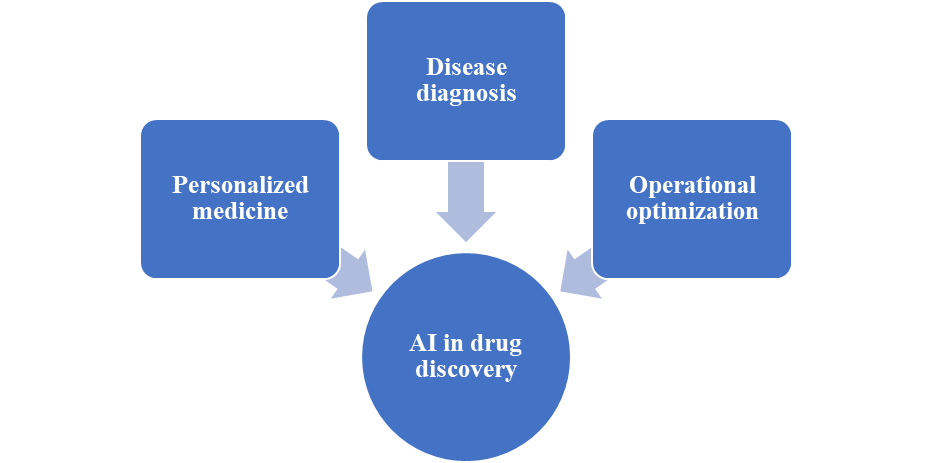
Fig:1 AI in drug discovery
Literature review:
A database of formulas for immediate-release pills was modelled in a study using model trees, a type of artificial intelligence. The model's performance was compared to artificial neural networks, which are widely recognized and employed in the fields of pharmaceutical product formulation. The predictability of the developed models was assessed using the correlation coefficient (R2). Multivariate linear equations obtained from model tree research were able to forecast outcomes with a quality comparable to neural network models. Medication dissolving characteristics, tablet tensile strength, and disintegration time. Nevertheless, these formulas revealed more significant information that had been concealed in the formulation database. It is determined that model trees, as a transparent technology, are helpful resources for formulators. [7]
The author used KinomeX, an AI-based online platform based on kinase chemical structure analysis, to ascertain the poly pharmacology of the enzymes. DNNs, or deep neural neutrons. This platform's DNN was trained using 14,000 bioactivity data points gathered from over 300 kinases. As a result, it helps with the development of different modifiers by assessing a drug's general selectivity towards the kinase family and specific kinase subfamilies. Ligand Express, Cyclica's cloud-based proteome-screening AI system, is one noteworthy example. Identifying receptors capable of both This technique is used to achieve on-and off-target interactions with a certain tiny molecule. This makes it easier to understand the possible side effects of the medicine [8].
AI has also been utilized to help with medication repurposing and to prevent poly pharmacology by predicting drug-target interactions. Repurposed medications are immediately eligible for Phase II clinical trials. Additionally, this lowers spending because it costs $8.4 million to relaunch an existing medication rather than $41.3 million to introduce a brand-new pharmaceutical entity.The "guilt by association" technique, which can be knowledge-based or computationally driven, can be used to forecast the unique relationship between a drug and a disease. In computationally driven networks, the machine learning (ML) approach—which employs techniques like logistic regression, neural networks, support vector machines (SVM), and deep learning (DL)—is widely used. ML methods such as PREDICT, SPACE, and logistic regression platforms consider a drug's gene expression profile when repurposing it [9].
The fundamental idea behind AI in pharmaceutics:
There are two main areas where AI is developing, The first category consists of software and technology techniques that mimic human experience and make inferences from a set of rules, such as expert systems. The second category includes artificial neural networks (ANNs), which are devices that simulate how the brain functions. One of artificial neural networks' greatest advantages is their capacity for generalization.
Because of these qualities, they are highly effective in addressing formulation optimization concerns in the creation of pharmaceutical goods [10]. (Table 1)
How AI operates:
Developing an AI system entails meticulously imitating human traits and abilities in a machine and leveraging its processing capacity to surpass human capabilities. A thorough investigation of the topic is necessary to comprehend the many AI subdomains and how they might be used in various industrial domains.
Machine learning: Machine learning (ML) is the process of teaching a computer to infer and decide using past information. It analyses historical data and looks for patterns to determine the relevance of these data points and draw a possible conclusion without depending on human experience [20].
Deep learning (DL): Deep learning is a machine learning approach. Deeper networks were trained by DL's revitalized neural network in the 2000s. It trains a machine to read inputs through layers in order to categorize, infer, and predict the result. For instance, by going through in-depth layers of activity vectors and determining the connection strengths that motivate these vectors by knowing the stochastic gradient, it aids in understanding the complex internal representations required to comprehend the challenging language or analyze the objects [21].
Networks of neurons (NN): These systems function similarly to brain cells in humans. They are a collection of algorithms that capture the interaction between several underlying factors, simulating the functioning of the human brain [17].
Natural language processing (NLP) is the ability of a machine to read, understand, and interpret a language. Once a computer understands what the user is trying to say, it will respond properly [15].
Computer vision: Computer vision algorithms try to understand an image by breaking it down and analysing different parts of the object. This helps the machine learn from a collection of photographs and identify them, allowing it to generate better findings based on previous observations [11].
Cognitive computing: Algorithms for cognitive computing try to replicate how the human brain works and produce the intended outcomes by evaluating text, audio, visuals, and other inputs in a manner similar to that of humans. Take advantage of free courses on AI applications as well [16]. (Figure 2).
Table-1 List of AI based Tools for drug discovery
|
Tools |
Description |
|
Alpha fold |
Protein 3D structure prediction [10] |
|
Chemputer |
A more standardized format for reporting a chemical synthesis procedure [11] |
|
DeepChem |
A python-based AI tool for various drug delivery task predictions [12] |
|
Deep neural net-QSAR |
Molecular activity predictions [13] |
|
Deep tox |
Toxicity predictions [14] |
|
Delta vina |
A scoring function for rescoring protein–ligand binding affinity [15] |
|
Hit dexter |
ML models for the prediction of molecules that might respond to biochemical assays [16] |
|
Neural graph fingerprints |
Property prediction of novel molecules [17] |
|
NNScore |
Neural network-based scoring function for protein ligand interaction [18] |
|
ODDT |
A comprehensive toolkit for use in chemoinformatics and molecular modelling [19] |
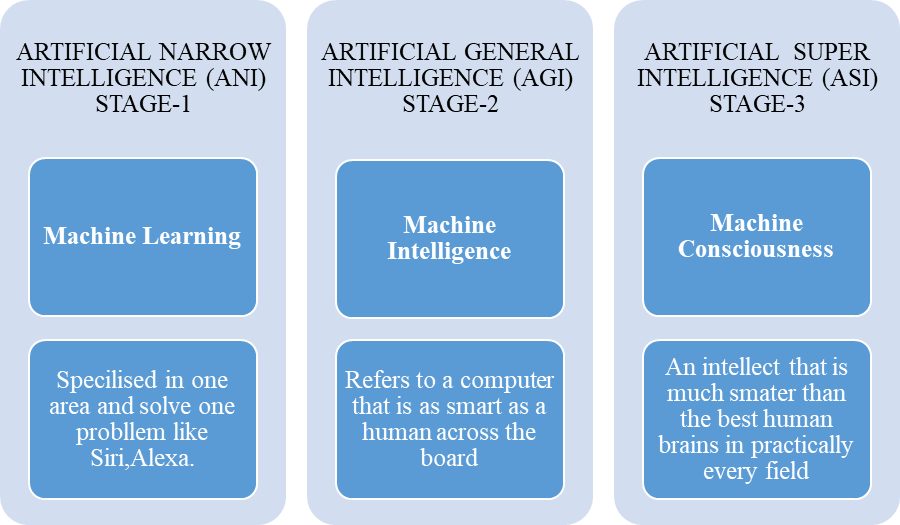
Fig-2 Types of artificial intelligence
AI applications in medication distribution and pharmaceuticals:
When an AI system is used to control processes like manufacturing or clinical trials, the benefits of long-term learning are frequently lost after training. Despite the relatively recent adoption of Quality by Design (QbD) methodology, the pharmaceutical business has improved, and the most recent industry 4.0 initiatives appear to depict a rapidly developing sector [22]. It is therefore very likely that an early AI application will be implemented if it is created. Unlike other scientific domains, pharmaceutical sciences may result in delays in the standardization and codification of data. For AI to be trained successfully in the former, data collection and standardization are crucial [23].
Applications of AI in the pharma sector:
AI application:
Here are a few instances of AI in data processing,
AI in healthcare:
Administration: To reduce human error and increase efficiency, AI systems are helping with routine administrative tasks. Medical note transcriptions using natural language processing (NLP) assist in organizing patient data for easier reading by physicians.
Telemedicine: In non-emergency situations, patients can get in touch with an AI system at a hospital to enter their vital signs, study their symptoms, and decide if they need medical help. Medical professionals' burden is reduced when they are only given the most critical cases.
Enhanced diagnosis: Thanks to computer vision and convolution neural networks, artificial intelligence (AI) can now analyze MRI scans to search for tumors and other malignant growths at an exponentially faster rate than radiologists can, with a noticeably less margin of error.
Robotic surgery: Robotic surgery can do surgeries consistently around-the-clock without experiencing fatigue and has a very narrow margin of error. Because of their great degree of precision, they are less invasive than conventional methods and can reduce the amount of time patients need to recuperate in the hospital.
Vital stats monitoring: To determine how well a person is doing, their health must be continuously assessed. The use of wearable technology is growing, but the data is not easily available and requires analysis to yield meaningful insights.
Because vital signs can predict changes in health before the patient is aware of them, several applications have the potential to save lives [25].
Advantages of AI:
Disadvantages of AI:
Next-generation AI for 3D-printed medications:
AI and the pharmaceutical 3D printing (3DP) pipeline can cooperate. The traditional "one size fits all" approach to medicine needs to give way to the administration of customized drugs. Pharmaceutical 3DP can provide tailored drugs in the clinic, but it now requires the expertise and presence of certified 3DP professionals.
None of the many common process optimization methods, such as mechanistic modelling and finite element analysis (FEA), can fully optimize the several phases of pharmaceutical 3DP [26].
Machine learning, on the other hand, can provide intelligent optimization at every stage in the production of 3DP pharmaceuticals. By doing this, the need for continuous expert input into the creation of 3DP medications will eventually be removed, lowering barriers to the clinical application of the technology. [27]
Nanotechnology with AI:
AI has been increasingly important in the pharmaceutical industry, pharmaceutics, and drug delivery because to current molecular commodities' longer production periods, higher costs, and decreased productivity [28]. But even the creation of the present formulas is predicated on costly, time-consuming, and unpredictable research that is rife with errors [29]. A new system called "computational pharmaceutics" is integrating big data AI and multiscale modelling methodologies into pharmaceutics, suggesting a substantial shift in the paradigm of drug delivery. Over the past ten years, algorithms and processing power have grown exponentially, leading to the development of this system [30]. Examples of efforts being made to apply AI techniques to pharmaceutical product development include in vitro-in vitro correlation, drug distribution, physical stability, in vivo pharmacokinetic parameters, pre-formulation of physical and chemical properties, and activity prediction [31] (Fig. 3).
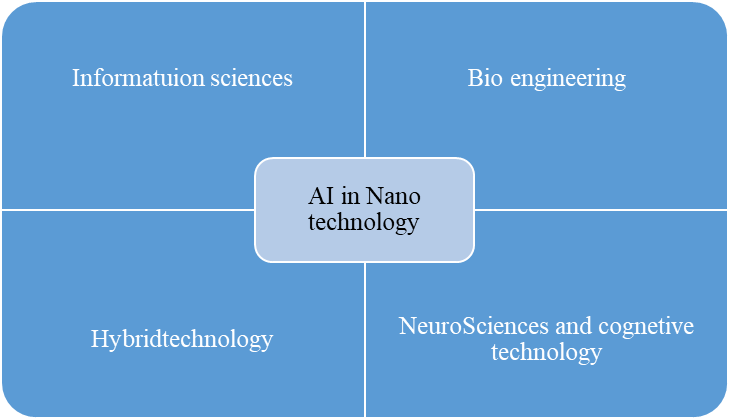
Fig:3 AI in Nano technology
AI to forecast novel therapies:
AI advancements and a renewed interest in uncommon disease treatments. More than 350 million individuals worldwide are currently afflicted by more than 7000 rare diseases.
Ten million dollars has been raised by Heal, a biotech business based in the United Kingdom,
to develop new drugs for rare diseases. Another Swiss biotech company, T Herachon, has received $60 million to develop drugs for rare genetic diseases [32].
The pharmaceutical industry's use of AI:
Collaborating with or purchasing IT firms and AI startups Numerous pharmaceutical companies reach out to specialized enterprises and start-ups engaged in AI-powered drug research. This allows them to use their expertise and resources to develop promising therapy candidates based on accepted ideas and experience [33].
Academic interaction: Business-academia collaborations are expected to grow as pharmaceutical companies begin to embrace AI.
Developing internal knowledge and providing employees with the resources they require.
R&D challenges and open scientific initiatives: Compared to earlier methods, this practical AI adoption strategy for drug development carries a lower financial risk [34] (Table 2).
Table-2 AI development
|
AI development: |
|
|
Aggregation and synthesizing information |
Combines new ribonucleic acid (RNA) sequencing technologies with proprietary machine learning |
|
Understanding disease mechanism |
Examination of genome-wide screening give a thorough explanation of the 3D structure of proteins. Identify the proteins that control the cell cycle. The development of the next generation of cancer treatments developing learning models for computer vision and medicine. |
|
Generating novel drug candidates Generating novel drug candidates |
Convolutional neural networks, or structure-based deep networks CNN Check compound libraries for disease-fighting effectiveness. Network-based method for machine learning estimates the bioactivity of tiny molecules. Determine the biologic targets. Determine each metabolite mass's identity. |
Pharma companies have several obstacles while trying to implement AI, such as: (Investment, Productivity, AI human inferences)
CONCLUSION:
AI has shown promise in a number of drug research domains. AI can assist scientists with pharmaceutical development and delivery design, planning, quality management, maintenance, and quality control. Although it is not a panacea and won't cause drastic improvements right away, it could boost productivity, offer insightful information, and reveal fresh viewpoints in the pharmaceutical development process. The pharmaceutical industry is presently going through a radical change as new science and practices are developed, carefully managing risk. AI's ability to integrate numerous novel and unfamiliar fields will be used to gauge its performance in the cutting-edge drug research and development process. This field offers applications of AI in data management, drug research, diabetes treatment, digital consulting, and other areas. There is ample evidence that medical AI can significantly improve the way both physicians and patients provide healthcare in the twenty-first century.
|
Abbreviations: |
|
|
AI |
Artificial Intelligence |
|
ML |
Machine learning |
|
SVM |
Support vector machine |
|
DNN |
Deep neural neutrons |
|
NN |
Neural network |
|
DL |
Deep learning |
|
ANN |
Artificial neural network |
|
NLP |
Natural language processing |
|
QbD |
Quality by design |
|
3DP |
3D printing |
|
FEA |
Finite element analysis |
|
DUB |
Deubiquitinase |
|
CNN |
Convolutional neural network |
REFERENCE

Malneni Dhrani, Yemineni Samatha, Sundarapu Lakshmi Prasanna, Medisetty Madhumitha, D. Anusha, Kallam Naga Sricharan Reddy, The Emergence of Artificial Intelligence and Technology in The Pharmaceutical Industry, Int. J. of Pharm. Sci., 2025, Vol 3, Issue 11, 3099-3108. https://doi.org/10.5281/zenodo.17659220
 10.5281/zenodo.17659220
