
Ideal Institute of Pharmacy, Wada – 421303, Maharashtra, India.
Background Starfruit (Averroha Carambola) is a fruit that is popular through the world and is thought to offer numerous health and nutritional benefits. Starfruit is a great , low calorie snack that is high ,in antioxidants , fiber and vitamin c. Antioxidant , hypoglycemic , hypotensive , hypocholestrolemic , anti-inflammatory , anti infective and anticancer are among the nutritional and therapeutic qualities of starfruit. Plants are very complex organisms that are produce medicinally important natural products. Objective A starfruit is a source of vitamin C, which provides antioxidant benefits that help the body fight free radicals and strengthen the immune system. This fruit's vitamin C content supports overall health by assisting in toxin removal, reducing inflammation, and improving the body's ability to fight infections like colds and flu. Methods In a preliminary authorized procedure, 27 senior people with a mean (±SD) age of 69.5±5.3 years were given star fruit twice a day for four weeks after a two-week control phase. Oxidative stress indicators included total antioxidant capacity, glutathione, malondialdehyde, protein hydroperoxide, multivitamins like l-ascorbic acid (Vit C), retinoic acid (Vit A), and tocopherol (Vit E), and lipid profile indicators like triglycerides, cholesterol, high-density lipoprotein-cholesterol (HDL-C), and low-density lipoprotein-cholesterol (LDL-C). During the 4-week period, the star fruit extracts' amounts of vitamins C, A, and E were also assessed. Results When comparing the antioxidant status after 4 weeks of consumption to the two-time evaluation during the baseline periods, a significant improvement was seen, with reduced levels of protein hydroperoxide and malondialdehyde, increased total antioxidant capacity, and significantly higher levels of vitamin C and vitamin A. In the 2-week control period, all parameters did not show any statistically significant differences. Vitamin E and glutathione, however, did not vary statistically. Comparing the two baseline periods, the HDL-C level was also greater and the LDL-C level was much lower. However, there was no difference in the levels of cholesterol or triglycerides. Small amounts of vitamins C and A were found in the star fruit extract. Conclusion According to this early study, drinking star fruit juice twice a day for a month enhanced the antioxidant status and vitamin levels of older adults. It also improved the lipoproteins associated with vitamin C and vitamin A in the star fruit extract.
A popular fruit in tropical and non-tropical regions alike is the star fruit (Averrhoa carambola). The fruit of this plant is harvested in various parts of the world, particularly in South-East Asia. It has numerous therapeutic and nutritional use. Star fruit is thought to be a great source of minerals and natural antioxidants.(1) Star fruit, also called "Kamarakh," or Averrhoa carambola L., is a native of Malaysia and a member of the Oxalidaceae family. Its delightfully sweet and sour flavor complements its unique star-shaped look . The word "Karmaranga" in Sanskrit means "carambola," which is a gastronomic starter. A. carambola is a long-lived, resilient tree that can withstand drought . (2) "Food appetizer" is the Sanskrit term karmaranga, from whence the name carambola is derived.(3) Pharmacological tests have shown that star fruit has anti-inflammatory, antibacterial, antifungal, anticancer, anti-ulcer, hypocholesterolemic, hypoglycemic, and hypotensive properties. According to its chemical makeup, star fruit is also renowned for its abundance of phenolics, which include flavonoid C-glycosides like carambolaflavone and carambo laside M.(4) Polyphenolic compounds included in star fruit may have anti-diabetic properties, per some research. These compounds have the potential to improve insulin sensitivity and reduce insulin resistance. The mineral potassium, which is necessary for blood pressure regulation, is present in star fruit.(5) Starfruit can be eaten in two stages. When it is still green and unripe, it can be used as a vegetable in savory recipes and is frequently pickled or cooked. It is a delicious, luscious fruit that turns yellow when it is mature. Indeed, starfruit, or Averrhoa carambola as it is named in science, is a fruit with many culinary and possibly therapeutic use. The following summarizes the main characteristics of starfruit and its possible health advantages. Fruit and Vegetables That Are Edible: Nutritional Value: Dietary fiber, potassium, vitamin C, and vitamin A are all abundant in starfruit. It is a nutritious addition to your diet because it is low in calories.
Traditional Medicine: Because of their possible health benefits, many elements of the starfruit tree—such as the leaves, fruit, and roots—have been utilized in traditional medicine throughout history.(6) Additionally, it boosts immunity, which aids in the elimination of harmful substances and the defense against common diseases. The star fruit's insoluble dietary fibers reduce cholesterol, promoting heart health. Additionally, it promotes healthy digestion and guards against colon cancer.(7) The star fruit, also called the carambola (Averrhoa carambola L.), is a visually appealing member of the Oxalidaceae family and is referred to as "Golden Star." Iron, fiber, and vitamins A and C are abundant in the fruit, which is primarily eaten fresh or in juice. Jam, jelly, and fermented or unfermented beverages can be made from the ripe fruit . The star fruit is green, yellowish green, unripe, semi-ripe, and ripe in appearance. It has a tart, fruity scent and is perishable.(8) Its hypoglycemic properties are thought to be especially helpful for those with diabetes mellitus, and it has been marketed as a conventional treatment for the disease. However, in patients with both normal and poor baseline renal function, increased star fruit consumption has been linked to the development of oxalate nephropathy.(9) The tree is grown all over the world in tropical regions. In addition to its many common names, it is also known as "Kamrakh" in Hindi and Gujrati, "Star fruit" in English, "Kamranga" in Bengali, Karambal in Marathi and Konkani, Karambal-drakshi, Kaparakshi hannu (Kannada), "Carmbala" in Marathi and "Konkani," "Kaparakhi hannu" in Kannada, "Chaturappuli and Vajrappuli" in Malayalam, Karmanga in Oriya, Thambaratham in Tamil, Ambanamkaya (Telugu), and Kordoi, Rohdoi in Assam.(10)

Figure 01 :- A.Carambola (A); Whole plants (B); Fruits (C);
Flowers & woods (D) (11)
MATERIAL & METHODS
The literature on the pharmacological activities, chemical components, traditional uses, botanical description, and toxicities of A. carambola was gathered, examined, and summarized in this review. Elsevier, ScienceDirect, PubMed, Web of Science, Wiley, Springer, SciFinder, ACS Publications, CNKI, WanFang, Google Scholar, Baidu Scholar, The Plant List Database, and other literature sources (Ph.D. and MSc dissertations) were among the internationally recognized scientific databases from which all of the data was methodically collected. Every article that has been written about A. carambola in any language has been included and referenced. Titles and abstracts served as the foundation for the identification and analysis of the gathered materials. We also looked through the retrieved publications' reference lists to find more pertinent papers. The ChemBioDraw Ultra 14.0 program was used to depict the chemical structures of each isolated substance.(12)
ORIGIN & DISTRIBUTION
It is thought that the Molucccas and Ceylon are where the starfruit first appeared. However, it has been grown in Malaysia and Southeast Asia for a long time. In Taiwan, India, and the Southern Chinese provinces of Fukien, Kuangtung, and Kuangsi, it is frequently grown. It enjoys modest popularity in various South Pacific islands, including Tahiti, New Caledonia, and Netherlands New Guinea, as well as in Guam and Halalii, and it is fairly well-liked in the
Philippines and Queensland, Australia.(13)
The plant is found all over India, although it is most prevalent in the states of Gujarat and Maharashtra. It may be native to Malaysia and is grown all across the tropics (14)
STARFRUIT PLANT VARITIES
The Department of Agriculture in Malaysia has registered nineteen different types of starfruit. But of these 19 types, only two—"Belimbing Besi" (B10) and "Belimbing Madu" (B17)—are widely recognized as the greatest commercial clones. The United States (USA) grows starfruit plants for their fruits in addition to Malaysia.
Taiwan possesses its own assortment of accessions to starfruit plants, including The commercial cultivar A. carambola is grown in Malaysia, and its fruits are sold extensively throughout the country, mostly to European markets. In Malaysia, starfruits are grown in four states: Johor, Pahang, Negeri Sembilan, and Selangor. Tean Ma, Dah Pon, Mih Tao, and Fwang Tung in Thailand.
CLASSIFICATION
Scientific Name: Averrhoa carambola
Kingdom: Plantae – Plants
Subkingdom: Tracheobionta -Vascular plants
Superdivision: Spermatophyta
Division: Magnoliophyta – Flowering plants
Class: Magnoliopsida – Dicotyledons
Subclass: Rosidae
Order: Geraniales
Family: Oxalidaceae – Wood-Sorrel family
Genus: Averrhoa Adans. – averrhoa
Species: Averrhoa carambola L. – carambola
TRIBAL USE OF A.CARAMBOLA
|
Sr. No |
Plant Part |
Tribal Use |
|
1 |
Root |
Chronic headaches, spermatorrhea, epitaxis, and arthralgia are all treated with the root. The roots that contain sugar are said to have anti-poison properties. |
|
2 |
Bark |
Using sandalwood and Alyxia sp., the inner bark is prepared and applied to prickly heat. |
|
3 |
Leaves |
The crushed leaves or shoot are administered externally to cure ringworm, tinea, colds, hedache, and chickenpox. |
|
4 |
Flower |
The cooked flower has antihelmintic properties and is used to treat malaria, fever, and subcalorism. In Java, the blossoms are used into salads. |
|
5 |
Fruit |
The ripe fruits or their juice can be consumed to combat fever. Eye ailments are treated with a fruit-based slave. It is also suggested as a diuretic for bladder and renal issues. Ripe fruit is regarded in Ayurveda as a tonic, digestive, and biliousness-causing agent. |
|
6
|
Seed |
A mixture made from crushed seeds has mild toxicating properties and functions as an ernmenagogue and galactogogue. For those suffering with gastroenteritis and asthma, the powdered seeds act as a sedative. |
BOTANICAL DESCRIPTION
Averrhoa carambola trees grow slowly, have short trunks, a bushy, broad, rounded crown, many branches, and can grow to a height of 6 to 9 cm. It thrives in conditions that are moist, humid, and noticeably dry. It does well in tropical and subtropical climates. It can tolerate minor water logging and prefers a clay loam soil that drains well and has a pH of 5.5 to 6.5. It is tolerant of salt and drought.(15)
A balimbing tree is a little tree that is no more than six meters tall. Red and white flowers show up near the bases of leaves or on bare branches. The pinnate leaves measure roughly 15 centimeters in length. Smooth and typically found in five pairs, the leaflets are elliptical to ovate-lanceolate, with the bottom ones being smaller and the top ones being around five centimeters long. Pannicles measure 5 to 6 millimeters in length, are axillary, and have a bell form. The calyx is reddish-purple. Purple to brilliant purple petals frequently have white edges. Fruit has five longitudinal, sharp, angular lobes and is succulent, green to greenish yellow, and about 6 centimeters long. Seeds are arillate, and within three years, seedlings have been reported to yield fruit. August through March is the season.(16)
VERNACULAR NAMES (17)
Sanskrit : Karmaranga
English : Starfruit , chinese gooseberry
Hindi : Kamrakh , Karmal
Bengali : Kamranga
Assamese : Kordoi , Rohdoi
Gujarati : Kamrakh
Marathi : Karambal
Telugu : Ambanamkaya
Tamil : thambaratham ,Tamarattai
Malayalam : Caturappuli
Sinhala : Kamaranga
Filipino : Balimbing
Indonesian : Belimbing
Malay : Belimbing
GEOGRAPHIC DISTRIBUTION
Traditionally, A. carambola is thought to have come from Malaysia, although there have also been theories that it was brought to Asia by Spanish galleons from tropical America. In addition to flourishing in the hot, humid tropics and subtropical regions like Egypt and Israel, A. carambola can resist brief freezing temperatures as low as -3°C. Its broader geographic range allows it to thrive in climates that fall between 32°N and 30°S. Although pH 5.5 to 6.5 is suitable for well-drained soils, it can withstand pH 5 to 8.5. It is now widely grown and distributed throughout most of the world including in Asia (China and India), Africa (Madagas and Tanzania), North America (Mexico and Honduras), Oceania (Australia and French Polynesia), South America (Brazil and Bolivia), and other regions .(18)
TAXONOMY
A. carambola is a member of the Oxalidaceae family, which includes over 900 species in seven genera, including Averrhoa, Sarcotheca, Eichleria, Biophytum, Dapania, Oxalis, and Sarcotheca. Three species are primarily found in the genus Averrhoa: A. carambola, A. bilimbi L., and A. dolichocarpa Ruhayah and Sunart. A. carambola is a plant that bears edible, sharply ridged, yellow-brown fruit that is usually referred to as star fruit or carambola.(19)
NUTRITIONAL VALUE OF STARFRUIT
The averrhoa carambola is a rich source of essential nutrients. It is an excellent source of naturally occurring antioxidants such as gallic acid in gallotannin forms, L-ascorbic acid, and (-)epicatechin . 35.7g calories, 0.38g proteins, 9.38g carbohydrates, 0.80g-0.90g dietary fiber, 0.8g fat, 4.4-6.0mg calcium, 0.32 1.65 mg iron, 15.5-21.0mg phosphorus, 2.35 mg potassium, 0.003-0.552mg of carotene, 4.37mg tartaric acid, 9.6mg oxalic acid, 2.2mg α-ketoglutaric acid, and 1.32mg citric acid can all be obtained from 100g of this fruit. Furthermore, 100 g of the fruit also contains a variety of amino acids, including 0.03–0.038 mg of thiamine, 0.019–0.03 mg of riboflavin, 0.294-0.38 mg of niacin, 3 mg of tryptophan, 2 mg of methionine, and 26 mg of lysine. (20)
CULTIVATION (21)
CLIMATE
The carambola should be categorized as tropical or sub-tropical since mature trees can withstand brief freezing temperatures and suffer minimal harm at 27º F (-2.78º C).
As far north as St. Petersburg on the west coast and Daytona Beach on the east coast of Florida, the tree can be found in protected areas. In India, it grows as high as 4,000 feet (1,200 meters). Every tree in a valley in the interior of Israel died from the hot, dry winds that prevailed. The one that Carambola need moisture to thrive, and the optimal rainfall distribution throughout the year should be rather uniform. Fruit quality and flavor are said to be at their peak in Australia when yearly rainfall is 70 inches (180 cm) or slightly higher.
ALTITUDE
The optimal altitude for starfruit is 4,000 feet (1,200 meters).
SOIL
Carambolas do not have a lot of soil preferences; they thrive in rich loam, thick clay, sand, and limestone. It is susceptible to water logging and prefers soil that is mildly acidic (PH 5.5 to 6.5).
PROPAGATION & MANAGEMENT
The most crucial techniques for growing star fruit are
1. Air layerying
2. Grafting
Grafting has 2 types :-
1.Bud Grafting
2.Wedge Grafting
PHARMACOLOGICAL ACTIVITES
ANTI OXIDANT
Star fruit may effectively scavenge reactive oxygen species (ROS) and other free radicals due to its high antioxidant activity. Gallic acid, alkaloids, proanthocyanidins, vitamin C, β-carotene saponins, flavonoids, and tannins are all abundant in the fruit.(22)
carambola is a promising antioxidant in the pharmaceutical and functional food industries, based on the effectiveness and potency of its crude extracts or bioactive components(23)
Antioxidant used liquid chromatography and mass spectroscopy to examine the polyphenolic antioxidants found in the juice and residue extract of Averrhoa carambola fruit.(24)
It has antioxidants that may aid in the body's defense against dangerous free radicals.(25)
ANTI INFLAMMTAORY
The anti-inflammatory chemicals found in star fruit may aid in lowering the body's level of inflammation.(26) The physiological process of inflammation, which occurs in response to endogenous or exogenous stimuli during the aging process, results in an increase in the secretion of cytokines such as C-reactive protein (CRP), interleukin-6 (IL-6), interleukin-1 (IL-1), and tumor necrosis factor-alpha (TNF-) (27) In an investigation to assess the bactericidal and anti-inflammatory qualities of an aqueous extract of Averrhoa carambola stem used to treat dysuria, it was found that intraperitoneally, the averrhoa carambola stem extract exhibited stronger activity over a longer period of time and comparable anti-inflammatory effects to acetyl salicylic acid at a dose of 300 mg/kg during the first hour (28) Ethanolic extract of star fruit leaves applied topically decreased edema in the croton oil-induced ear edema model of inflammation in a dose-dependent way.(29)
ANTI HYPERGLYCEMIC
Diabetes mellitus is a chronic hyperglycemic disease that may be brought on by a markedly reduced sensitivity to insulin, disruption to insulin signaling, a non-autoimmune origin, or an insulin shortage. With its incidence steadily increasing worldwide, this condition presents a serious public health care challenge. The main characteristics of type 2 diabetes mellitus are β cell malfunction and insulin resistance, which result in decreased insulin production. Patients with diabetes mellitus who develop diabetic kidney disease may pass away. A. carambola's antidiabetic potential has been thoroughly investigated in a number of research over the last five years utilizing a range of experimental models. The results showed that A. carambola and its glycosides have exceptional antidiabetic properties & characteristics, as well as insights into the underlying systems, which are yet not entirely understood.
The fundamental process by which A. carambola crude extracts or bioactive compounds have anti-hyperglycemic effect.(30)
ANTI ULCER
A water-alcohol extract of A. carambola leaves' gastroprotective activity in rats. A model of ulcers caused by acidified ethanol showed notable anti-ulcer efficacy. The acute-stress ulcerogenic mouse models and indomethacin, however, showed no protective effects. They came to the general conclusion that A. carambola exhibited little anti-ulcer activity.(31)
Starfruit may have anti-ulcer qualities, according to some research.(32)
ANTI MICROBIAL
Averrhoa carambola stem extracts were found to have antibacterial action by inhibiting Klebsiella sp. and Staphylococcus aureus, according to a paper by Sripanidkulchai et al. (2002). As demonstrated by minimal bactericidal concentrations (MBC) of 125 mg/ml and 15.62 mg/ml, respectively. Once more, using the disc diffusion method, Mia Masum Md. et al. (2007) examined the antimicrobial activity of Averrhoa carambola and found that the methanolic extract and its petroleum ether, carbon tetrachloride, chloroform, and aqueous soluble fractions of Averrhoa carambola bark inhibit the growth of a variety of Gram +ve bacteria (Bacillus cereus, B.megaterium, B.subtilis, Staphylococcus aureus, etc.), Gram -ve bacteria (Escherichia coli, Pseudomonas auriginosa, Salmonella typhi, S. paratyphi, etc.), and fungi (Candida albicans, Aspergillus Niger. At 400 μg/disc, the petroleum ether, carbon tetrachloride, and chloroform soluble fractions of the methanol extract were found to create an average zone of inhibition of 8–12 mm, 8–12 mm, and 8–15 mm, respectively.(33) It might have antibacterial qualities that could aid in the fight against specific infections.(34)
HYPOLIPIDEMIC EFFECT
A.carambola has also been studied for its strong anti-hyperlipidemic properties. The ability of carambola leaves to inhibit HMG-CoA reductase, promote enhanced bile acid and cholesterol secretion in the feces, and lower TC and TG levels in the liver are some of the mechanisms that contribute to its hypolipidemic behavior. An in vitro investigation showed that serum lipids had decreased, and that the hepatic tissue damage had been repaired at a dose of 1000 mg/kg. Water-insoluble fiber rich fraction (WIFF) from star fruit pomace has a hypolipidemic impact. In vitro data indicated that administering a WIFF diet reduced serum levels of total cholesterol while raising fecal total lipid, fecal cholesterol, and bile acid concentrations. Carambola may have an antihyperlipdemic effect due to its capacity to increase the excretion of bile acids and cholesterol through stool. Pectin's capacity to lower blood cholesterol levels can be attributed to additional hypolipidemia effect potential. The report notes that pectin administration improved the lipid profile and may make the digestive tract more viscous. The study found that Averrhoa carambola fruit extract enhanced the serum profile and liver histological deterioration while protecting rats from hyperlipidemia-induced liver injury.(35)
ANALGESIC
In certain traditional medical practices, it has been utilized as a pain reliever.
ANTI HELMINTIC
Parasitic infections have been treated using starfruit.
DIABETES
There is curiosity in the possible advantages of starfruit for diabetics. Its fiber and antioxidant content may aid with blood sugar regulation. It is crucial for people with diabetes to take starfruit in moderation because of its inherent sugar content, as consuming too much of it can have negative consequences.
HEART HEALTH
Starfruit has the potential to lower blood pressure and cholesterol, which may help lower the risk of heart disease and stroke. Since excessive consumption might be detrimental to people with specific medical conditions, moderation is crucial once more.
Although starfruit has a lot of potential health benefits, it can be harmful to people who have kidney problems or are taking certain drugs. Oxalate is a chemical found in starfruit that, in vulnerable people, can cause kidney issues. Always get medical advice before implementing major dietary changes or adding starfruit to your diet, particularly if you have underlying medical concerns of other phytochemicals, including flavonoids and polyphenols, as well as vitamin C. These antioxidants are essential in defending cells against oxidative damage, which is linked to aging and a number of chronic illnesses. Consuming more fruits can help control body weight, blood pressure, and cholesterol. This fruit's high phenolic antioxidant content suggests that it could be a fantastic source of antioxidants. This fruit possesses hypoglycemic, anti-inflammatory, anti-ulcer, and antibacterial properties. Because of their nutritional qualities, star fruits can be processed into a variety of goods, including pickles, dried powder, candies, and jams, to keep them from spoiling. Just 100g of this fruit can supply about 30% of our daily needs for vitamin C.(36)

Fig 2. Schematic diagram of potential beneficial effects of Averrhoa carambola (37)
VITAMIN C (38)
Chemistry & Analysis
"Vitamin C" encompasses all compounds that exhibit the biological activity of ascorbic acid, including dehydroascorbic acid, which is its oxidized form. Although isoascorbic acid is commonly used as a food preservative, it exhibits antioxidant properties similar to those of L-ascorbic acid but lacks antiscorbutic activity. The more modern high performance liquid chromatography technologies for assessing vitamin C in foods, pharmaceuticals, and biological specimens have improved the specificity of analysis as compared to earlier methods. To keep the vitamin from quickly deteriorating and easily oxidizing, a preservative must be added when drawing blood or plasma samples for studies on vitamin C status. The
number and caliber of population-based studies that use tissue vitamin C assessments have been limited by this procedure. Vitamin C is found in the majority of vegetable-based foods that comprise Western-style diets, which include citrus fruits, green vegetables, peppers, tomatoes, berries, and potatoes. The amount of vitamin C varies greatly even across different samples of the same fresh fruit or vegetable, and cooking and water loss can cause the amount of vitamin C to drop noticeably.
STRUCTURE OF VITAMIN C

PRODUCTION OF POWDER & PROCESSING OF STARFRUIT (39)
The first step in preparing the star fruit was washing it to get rid of any dirt or debris. It was then dried after being chopped into tiny chips. On a drying sheet, the chips were arranged in a single layer and heated to between 60 and 80 degrees Celsius for 24 hours. The dried star fruit chips were then crushed with a grinder.
PREPARATION OF STARFRUIT POWDER :- (40)

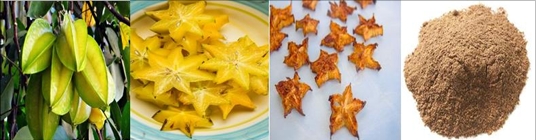
STARFRUIT PROCESSING
PREPARATION OF STARFRUIT JAM (41)

FIG 3. Processing techniques of the starfruit
PROCEDURES IN MAKING STARFRUIT JAM


Fig 4. Processing in making starfruit jam
DISCUSSION
The seasonal sweet-type star fruit, which has good qualities and a unique taste when produced industrially in Thailand, was the subject of this preliminary investigation.(42) A fresh juice supplement taken twice a day for four weeks improved the antioxidant and pro-inflammatory state of older adults. Previous research on extract from sour-type star fruit revealed low retinoic acid (Vit A) and high vitamin C.(43) Oxalates are abundant in star fruit.(44) All antioxidant activities and contents were higher in ripe star fruit (RS) than in green star fruit (GS), with the exception of total ascorbic acid content.(45) Star fruit is a highly perishable fruit with a high moisture content that is rich in nutrients.(46) The sweet star fruit is more common in Thailand due to its greater size and sweet flavor, making it a good choice for future product development. Regrettably, the sour form is uncommon and less grown there.(47) The present investigation additionally shown that the peel of the star fruit had a greater potential for antioxidants than the pulp.(48) A. carambola, the sequenced species, is widely grown and used as an edible fruit. It also has phytomedicinal qualities and is a significant source of vitamins and minerals.(49)
CONCULSION
Popular around the world, the star fruit Averrhoa caram bola is thought to provide a variety of healthful nutritional and therapeutic benefits. Averrhoa carambola fruit's high antioxidant potential may help shield cells from oxidative damage and associated illnesses. The plant also has a large number of secondary metabolites and phytochemicals, which makes it a possible source of high-value phytochemicals for use in the nutraceutical and pharmaceutical industries. The underused fruit crop, which is extremely nutritious, has also shown itself to be a great option for the development of food products. Nevertheless, additional research is necessary to determine the medicinal potential of the plant's various sections.(50) In both in vitro and in vivo research, star fruit extracts have shown a number of potential positive therapeutic qualities, such as antioxidant, hypoglycemic, hypocholesterolemic, anti-inflammatory, cardiovascular, anticancer, and immune-boosting activities.(51)A. carambola has a long history of usage in traditional medicine, and its pharmacological properties support its status as a significant medicinal agent in traditional uses.(52) A clear, thin polymer called nata based on starfruit juice was successfully created. As a substitute substrate, it shows promise for creating nata with beneficial food products.(53).Vitamin C and total phenolic compound are two of the many bioactive substances that have been shown to have anti-inflammatory and antioxidant properties, as well as to improve walking distance for patients with COPD.(54)The study found that star fruit powder-based digestive products fulfilled the required quality standards. (55)
REFERENCES


Vaibhavi Gawad*, Dr. Rajan Kothari, Dr. Sonali Uppalwar, Starfruit Is the Source of Vitamin C, Int. J. of Pharm. Sci., 2025, Vol 3, Issue 12, 2463-2478 https://doi.org/10.5281/zenodo.17939703
 10.5281/zenodo.17939703
