
Sitaram Ayurveda Pvt. Ltd., Kerala, India.
Introduction: Chyavanaprasam K Tab is a novel Ayurvedic tablet formulated to deliver the rejuvenative benefits of traditional Chyavanprasam in a convenient, standardized form, addressing fatigue, boosting immunity, promoting hair growth, and supporting overall physical wellness, with a sugar free composition suitable for diabetic individuals. Materials and Methods: The tablet was prepared using authenticated herbal ingredients collected from Thrissur, Kerala, processed via traditional Ayurvedic techniques. Comprehensive analyses, including organoleptic, physicochemical, microbial, heavy metal, phytochemical, nutritional, and thin-layer chromatography (TLC) tests, were conducted to evaluate quality & safety, Results: The tablet exhibited consistent organoleptic qualities, physicochemical stability, microbial safety and was free from heavy metals with a rich phytochemical profile. Nutritional analysis confirmed the presence of essential micronutrients. TLC validated key herbal constituents with overlapping Rf values. Discussion: The results confirm the tablet’s quality, safety, and therapeutic potential, with bioactives like flavonoids and phenols supporting immunity and fatigue relief, while the incorporated herbs promoting hair growth. The sugar free composition enhances its suitability for diabetic users, while TLC ensures that the Chyvanaprasam K Tab contains the characteristic bands of the raw materials. Used in it. Conclusion: Chyavanaprasam K Tab is a safe, effective, and standardized Ayurvedic supplement, successfully delivering the holistic benefits of Chyavanprasam for modern health needs, including fatigue relief, immune support, hair growth, and overall wellness, with added accessibility for diabetic individuals.
Ayurveda, one of the world’s oldest holistic healing systems, emphasizes the balance of body, mind, and spirit to promote health and prevent disease [1]. Central to Ayurvedic pharmacology is the use of polyherbal formulations, which combine multiple medicinal plants to achieve synergistic therapeutic effects [2]. Among these, Chyavanprasam stands out as a time-honored Rasayana (rejuvenative) formulation, celebrated for its ability to enhance vitality, strengthen immunity, and promote overall well-being [3]. Traditionally prepared as a semi-solid herbal preparation, Chyavanprasam is a complex blend of herbs, spices, and other natural ingredients, with Emblica officinalis as a cornerstone due to its high vitamin C content and potent antioxidant properties [4]. Other key ingredients, such as Withania somnifera, Asparagus racemosus, Piper longum and Tinospora cordifolia, contribute adaptogenic, immunomodulatory, and nourishing effects, making it a versatile supplement for combating fatigue, boosting immunity, promoting hair growth, and supporting overall physical wellness [2,3].
The origins of Chyavanprasam are rooted in ancient Ayurvedic texts, such as the Charaka Samhita and Ashtanga Hridaya, where it is described as a formulation developed to rejuvenate the sage Chyavana, restoring his youth and vitality [1]. Its multifaceted benefits stem from the synergistic action of its ingredients, which address various physiological systems [4]. For instance, Amalaki’s antioxidant properties combat oxidative stress, a key contributor to fatigue and immune suppression [3]. Ashwagandha, an adaptogen, mitigates stress and enhances energy levels, while Sathavari and Vidari nourish tissues, supporting hair growth and overall vitality. Pippali enhances bioavailability and supports respiratory health, contributing to the formulation’s holistic effects [2]. These properties make Chyavanprasam a valuable tool in addressing modern health challenges, including chronic fatigue, weakened immunity due to lifestyle stressors, hair loss linked to nutritional deficiencies, and the need for comprehensive physical wellness [5].
Despite its efficacy, the traditional semi-solid form of Chyavanprasam poses challenges in modern contexts, including variable dosing, and inconvenience for daily use, particularly for individuals with busy lifestyles [3]. Additionally, the sugar content in traditional Chyavanprasam, often incorporated as a base or sweetener, can be a concern for diabetic individuals, limiting its accessibility to this population [4]. To address these limitations, Chyavanaprasam K Tab was developed as a novel tablet formulation by Sitaram Ayurveda Pvt. Ltd., retaining the therapeutic essence of Chyavanprasam while offering standardized dosing & enhanced portability [5]. This innovation aligns with the growing demand for convenient, evidence-based herbal supplements that meet modern quality and safety standards [2]. By transforming Chyavanaprasam into a tablet format, Chyavanaprasam K Tab preserves the essence and therapeutic benefits of the traditional lehyam while offering a convenient and consistent way to deliver its bioactive compounds. This makes it accessible to a wider population seeking natural support for energy, immunity, hair health, and overall wellness [4].
This study aims to provide a comprehensive evaluation of Chyavanaprasam K Tab, focusing on its preparation, quality control, and therapeutic potential. Through rigorous organoleptic, physicochemical, microbial, heavy metal, phytochemical, nutritional, and thin-layer chromatography (TLC) analyses, the tablet’s quality & safety were assessed. The formulation process adheres to traditional Ayurvedic methods while incorporating modern pharmaceutical techniques to ensure uniformity and potency [5]. The presence of key bioactives, such as flavonoids, glycosides, and phenols, was investigated to validate the tablet’s therapeutic claims. Additionally, nutritional profiling was conducted to highlight its role as a supplement enriched with essential micronutrients [3]. By bridging traditional Ayurvedic wisdom with contemporary scientific validation, this study seeks to establish Chyavanaprasam K Tab as a reliable and effective option for promoting holistic health in the modern era.
2. MATERIALS AND METHODS
2.1 Collection of Raw materials
Herbal ingredients for Chyavanprash K Tab were obtained from local markets in Thrissur, Kerala. The Pharmacognosy Division at Sitaram Ayurveda Pvt. Ltd. authenticated each ingredient, which was then stored in the Quality Control Division for reference.
2.2 Preparation of Chyvanaprasam K Tab
The tablet is crafted from a blend of therapeutic herbs, processed according to traditional Ayurvedic techniques. Table 1 lists the ingredients, including their botanical names, plant parts, and forms used
Table 1: Composition of Chyvanaprasam K Tab
|
Sl. No |
Ingredients |
Botanical name |
Parts used |
Form |
|
|
Bilva |
Aegle marmelos |
Rt. |
Dct. |
|
|
Gambari |
Gmelina arborea |
Rt. |
Dct. |
|
|
Patala |
Stereospermum colais |
Rt. |
Dct. |
|
|
Syonaka |
Oroxylum indicum |
Rt. |
Dct. |
|
|
Agnimandha |
Premna corymbosa |
Rt. |
Dct. |
|
|
Bruhati |
Solanum anguivi |
Rt. |
Dct. |
|
|
Kantakari |
Solanum xanthocarpum |
Rt. |
Dct. |
|
|
Prishniparni |
Desmodium gangeticum |
Rt. |
Dct. |
|
|
Salaparni |
Pseudarthria viscida |
Rt. |
Dct. |
|
|
Gokshura |
Tribulus terrestris |
Fr. |
Dct. |
|
|
Bala |
Sida cordifolia |
Rt. |
Dct. |
|
|
Mustha |
Cyperus rotundus |
Rz. |
Dct. |
|
|
Utpala |
Nymphaea stellate |
Rz. |
Dct. |
|
|
Mashaparni |
Vigna radiata |
Rt. |
Dct. |
|
|
Mudgaparni |
Vigna pilosa |
Rt. |
Dct. |
|
|
Pippali |
Piper longum |
Rt. |
Dct. |
|
|
Karkatakasringi |
Pistacia integerrima |
Gl. |
Dct. |
|
|
Sathavari |
Asparagus racemosus |
Rt.Tr. |
Dct. |
|
|
Tamalaki |
Phyllanthus amarus |
Wh.Pl. |
Dct. |
|
|
Ela |
Elettaria cardamomum |
Fr. |
Dct. |
|
|
Jeevanti |
Holostemma ada-kodien |
Rt.Tr. |
Dct. |
|
|
Agaru |
Aquilaria agallocha |
Ht.Wd. |
Dct. |
|
|
Draksha |
Vitis vinifera |
Dr.Fr. |
Dct. |
|
|
Pushkaramula |
Inula racemose |
Rt. |
Dct. |
|
|
Chandana |
Santalum album |
Ht.Wd. |
Dct. |
|
|
Shati |
Kaempferia galangal |
Rz. |
Dct. |
|
|
Ashwagandha |
Withania somnifera |
Rt. |
Dct. |
|
|
Punarnava |
Boerhavia diffusa |
Rt. |
Dct. |
|
|
Kakanasa |
Trichosanthes tricuspidata |
Rt. |
Dct. |
|
|
Guduchi |
Tinospora cordifolia |
St. |
Dct. |
|
|
Vidari |
Ipomoea mauritiana |
Rt.Tr. |
Dct. |
|
|
Vasa |
Adhatoda vasica |
Rt. |
Dct. |
|
|
Amalaki |
Emblica officinalis |
Fr.Rd. |
Dct. |
|
|
Thugakshiri |
Maranta arundinacea |
Rt.Tr. |
Dct. |
|
|
Pippalli |
Piper longum |
Dr.Fr. |
Dct. |
|
|
Twak |
Cinnamomum verum |
St.Bk. |
Dct. |
|
|
Pathra |
Cinnamomum tamala |
Lf. |
Dct. |
|
|
Nagakesara |
Mesua ferrea |
Stmn. |
Dct. |
|
|
Excipients |
|
As Such |
As Such |
2.3 Preparation process
Chyavanprasham K Tab was prepared by using ingredients mentioned in Table 1, followed by traditional Ayurvedic tablet-making techniques to ensure uniformity and potency.
2.4 Organoleptic Analysis
The tablet’s Organoleptic characteristics, including color, smell, and taste, were assessed to confirm consistency with expected Ayurvedic standards [6].
2.5 Physicochemical Analysis
Tests for average weight, friability, hardness, disintegration time, and moisture content were conducted to evaluate the tablet’s structural integrity and suitability for consumption [7].
2.6. Microbial Limit Test
Microbial safety testing was performed as per the guidelines of the Ayurvedic Pharmacopoeia of India. Samples were collected aseptically, and Nutrient Agar (NA) and Sabouraud Dextrose Agar (SDA) were prepared for bacterial and fungal isolation, respectively. pH-adjusted using 1N NaOH or HCl, autoclaved, and poured into sterile Petri dishes. After solidification, 1 g of sample was diluted in 9 ml sterile diluent, and 0.1 ml aliquots from appropriate dilutions were spread on media. NA plates were incubated at 37°C for 24–48 hours, and SDA plates at room temperature for 3–5 days. Colonies were analysed microscopically and biochemically, with counts compared to permissible limits [7].
2.7. Heavy Metal Toxicity Analysis (HMT)
Heavy metal content was determined using Inductively Coupled Plasma-Mass Spectrometry (ICP-MS). A 1 ppm stock solution was made by diluting a 9-element standard in 100 ml SIEMENS water. Calibration standards (0.5–250 ppb) were prepared. Samples (0.2–0.5 g) were digested with 5 ml HNO3, 0.5 ml HCl, and 1 ml H2O2 for 15 minutes, then diluted in 50 ml ultrapure water. The digested sample was nebulized into the ICP-MS, where ion counts indicated metal concentrations [8].
2. 6 Preliminary Phytochemical Analysis
Qualitative tests identified bioactive constituents like carbohydrates, glycosides, flavonoids, phenols, saponins, alkaloids, tannins, and coumarins in water and ethanol extracts of the tablet [9].
2.9 Nutritional profiling
The energy, macronutrient, vitamin, and mineral composition was determined based on standardized food analysis protocols as per AOAC-recommended guidelines [8].
2.10 Thin Layer Chromatography (TLC)
Thin Layer Chromatographic (TLC) fingerprint analysis was performed to separate distinct bands. A 10 g sample was refluxed with 50 ml of methanol for 45 min, then filtered and completely evaporated using a water bath. TLC was conducted using pre coated silica gel 60 F254 Plate as the adsorbent [10].
The methanol extract of the sample drug was applied to the silica gel surface using a fine capillary tube, positioned 2 cm above the lower edge of the plate, and allowed to evaporate. The prepared TLC plate was then carefully placed at a 45° angle inside the development chamber, ensuring that the capillary-spotted area remained above the solvent level.
Development was carried out using a mobile phase consisting of a Toluene and Ethyl Acetate mixture in a 9:1 ratio. The developed plate was examined under UV light at 366 nm.
3. RESULTS
3.1 Organoleptic Analysis
The organoleptic analysis results for Chyvanaprasam K Tab are detailed in Table 2.
Table No-2: organoleptic analysis of Chyvanaprasam K Tab.
|
Sl. No |
Parameters |
Result |
|
1 |
Colour |
Brown |
|
2 |
Odour |
Characteristic |
|
3 |
Taste |
Astringent |
3.2 Physicochemical Analysis of Chyavanaprasam K Tab
The tablet’s physical stability was tested across three batches for weight, friability, hardness, disintegration time, and moisture content, ensuring suitability for oral use. The results are given in Table 3.
Table No 3: Phsicochemical analysis of Chyavanaprasam K Tab
|
Sl. No |
Parameters |
Result |
|
1 |
Average Weight of Tablet |
1000 mg ± 5 % |
|
2 |
Friability |
Not more than 1% |
|
3 |
Hardness |
3-5 kg/cm2 |
|
4 |
Disintegration Time |
Not more than 45 minutes |
|
5 |
Moisture |
Not more than 7 % |
3.3. Microbial Limit Analysis
Microbial tests confirmed the absence of harmful pathogens, with bacterial and fungal counts within safe limits. The results of the microbial analysis are presented in Table 4.
Table No 4: The Microbial analysis of Chyvanaprasam K Tab
|
Sl. No. |
Parameters Tested |
Specification /Range |
Unit |
Result |
|
1 |
Total Yeast and Mold Count |
103 |
CFU/ml |
Absent |
|
2 |
Total Plate Count for Bacteria |
105 |
CFU/ml |
Absent |
|
3 |
E.coli |
Absent |
Present or Absent/ml |
Absent |
|
4 |
Pseudomonas aeruginosa |
Absent |
Present or Absent/ml |
Absent |
|
5 |
Salmonella spp. |
Absent |
Present or Absent/ml |
Absent |
|
6 |
Staphylococcus aureus |
Absent |
Present or Absent/ml |
Absent |
3.4 HMT Analysis
Heavy metal tests showed no detectable levels of toxic metals, ensuring safety. The results are presented in Table 5.
Table No 5: The HMT analysis of Chyvanaprasam K Tab
|
Sl. no. |
Parameters Tested |
Unit of Measurement |
Result |
|
1 |
Cadmium |
mg/Kg |
0.322 |
|
2 |
Lead |
mg/Kg |
Not detected |
|
3 |
Mercury |
mg/Kg |
Not detected |
|
4 |
Arsenic |
mg/Kg |
Not detected |
3.5. Phytochemical Analysis
The table no 6 provides Phytochemical analysis in water and ethanol extracts The Analysis identified key bioactive contributing to therapeutic effects.
Table No 6: The Phytochemical analysis of Chyvanaprasam K Tab
|
Sl No: |
Organic Phytochemical constituents |
Name of the test conducted |
Chyvanaprasam K tab (Water Extract) |
Chyvanaprasam K tab (Ethanol Extract) |
|
1 |
Carbohydrate |
Molisch’s test |
+ |
+ |
|
2 |
Sugar |
Benedict’s test |
- |
- |
|
3 |
Reducing Sugar |
Fehling’s test |
+ |
+ |
|
4 |
Ketose |
Seliwanoff’s test |
+ |
- |
|
5 |
Protein |
Biuret test |
- |
– |
|
6 |
Starch |
K I test |
+ |
- |
|
7 |
Glycoside |
Salkowski test |
+ |
+ |
|
8 |
Flavonoid |
Alkaline reagent |
+ |
+ |
|
9 |
Phenol |
Phenol reagent test |
+ |
+ |
|
10 |
Saponin |
Foam test |
+ |
+ |
|
11 |
Alkaloid |
Wagner’s reagent |
+ |
- |
|
12 |
Tannin |
Ferric chloride test |
+ |
+ |
|
13 |
Coumarin |
NaOH test |
+ |
+ |
|
14 |
Quinone |
H2SO4 Test |
+ |
+ |
3.6 Thin Layer Chromatography
Thin Layer Chromatography (TLC) analysis confirmed the presence of key herbal constituents, evidenced by distinct Rf values. The results, illustrated in figure 1 & Table 8, validate the successful incorporation of major ingredients like Amalaki, Ashwagandha, Vidari, and Pippalli in Chyavanaprasam K Tab
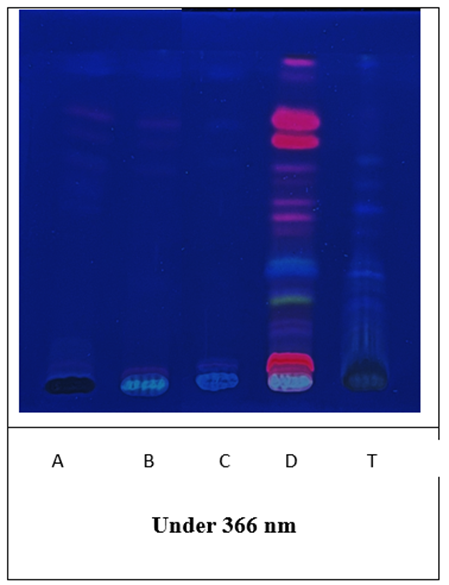
Figure 1- A: Amalaki; B: Ashwagandha; C: Vidari; D: Pippalli; T: Chyavanaprasam K tab
Table No: 8 shows the Rf value of Chyvanaprasam K tab with major Raw materials used
|
No |
Samples |
Rf Values |
|
1 |
A |
0.51,0.59,0.71,0.86 |
|
2 |
B |
0.56,0.60,0.68,0.81 |
|
3 |
C |
0.73,0.79 |
|
4 |
D |
0.05,0.20,0.28,0.30,0.40,0.50,0.55,0.61,0.68,0.81 |
|
5 |
T |
0.22,0.26,0.28,0.42,0.45,0.60,0.81 |
4. DISCUSSION
Chyavanaprasam K Tab represents a modern adaptation of the classical Ayurvedic formulation Chyavanprasam, tailored for convenience and standardized dosing. The organoleptic analysis confirmed a characteristic brown colour, astringent taste, and distinct herbal odour, aligning with traditional expectations for polyherbal formulations. The physicochemical properties, including an average tablet weight of 1000 mg ± 5%, friability below 1%, hardness of 3–5 kg/cm², disintegration time under 45 minutes, and moisture content below 7%, indicate robust structural integrity and suitability for oral administration. These parameters ensure the tablet’s stability during storage and ease of use for consumers.
Microbial limit testing revealed the absence of pathogenic bacteria such as E. coli, Staphylococcus spp., Pseudomonas spp., and Salmonella spp. Total bacterial and fungal counts were also found to be absent, as per the limits specified in the Ayurvedic Pharmacopoeia of India. Heavy metal analysis further confirmed safety, with cadmium at a negligible 0.322 mg/kg and no detectable levels of lead, mercury, or arsenic, ensuring compliance with safety standards for herbal formulations.
Phytochemical analysis identified a rich profile of bioactive compounds, including flavonoids, glycosides, phenols, saponins, tannins, and coumarins, which underpin the tablet’s therapeutic potential. Flavonoids and phenols, known for their antioxidant properties [11], likely contribute to the formulation’s ability to combat fatigue and enhance immunity [12]. Glycosides and saponins support hair growth by improving scalp health and circulation [13], while tannins and coumarins offer anti-inflammatory and antimicrobial benefits, promoting overall wellness [14,15]. The presence of these compounds in both water and ethanol extracts suggests a broad spectrum of bioactivity.
Nutritional profiling revealed a low-calorie composition (3 kcal/100 g) with essential micronutrients such as vitamin C (4 mg/100 g), calcium (8 mg/100 g), and potassium (8 mg/100 g). Vitamin C, primarily from Amalaki, is a potent antioxidant that supports immune function and tissue repair, aiding in fatigue relief and physical wellness [16]. Calcium and potassium contribute to bone health and muscle function [17], respectively, further enhancing the formulation’s role in overall vitality. The absence of fats, cholesterol, and sugars makes the tablet suitable for individuals seeking a health supplement without caloric overload.
Thin Layer Chromatography (TLC) analysis confirmed the presence of key herbal constituents in Chyavanaprasam K Tab, with Rf values of the tablet showing significant overlap with those of major ingredients such as Amalaki, Ashwagandha, Vidari and Pippalli. This overlap, particularly at Rf values like 0.60 and 0.81, verifies the successful incorporation of these therapeutic herbs into the tablet, ensuring consistency with the traditional Chyavanprasam formulation. The use of a Toluene: Ethyl Acetate (9:1) mobile phase effectively separated the complex mixture of compounds, providing a reliable chromatographic fingerprint for quality control.
The therapeutic benefits of Chyavanaprasam K Tab can be attributed to its key ingredients. Emblica officinalis (Amalaki) is renowned for its high vitamin C content and antioxidant properties, which bolster immunity and combat oxidative stress associated with fatigue. Withania somnifera (Ashwagandha), an adaptogen, helps mitigate stress and enhance energy levels, making it effective for fatigue relief and overall vitality. Ipomoea mauritiana (Vidari) and Asparagus racemosus (Sathavari) nourish tissues and support hair growth by improving scalp health and hormonal balance. Piper longum (Pippali) enhances bioavailability and supports respiratory health, contributing to overall wellness. The synergistic action of these herbs, combined with the tablet’s standardized form, makes Chyavanaprasam K Tab a versatile supplement for modern health needs.
5. CONCLUSION
Chyavanaprasam K Tab is a scientifically validated Ayurvedic formulation that effectively translates the traditional benefits of Chyavanprasam into a convenient tablet form. Comprehensive analyses confirmed its sensory consistency, structural stability, microbial safety, and absence of toxic heavy metals. The presence of bioactive phytochemicals, including flavonoids, glycosides, and phenols, supports its efficacy in addressing fatigue, boosting immunity, promoting hair growth, and enhancing overall physical wellness. The nutritional profile, enriched with vitamin C, calcium, and potassium, further underscores its suitability as a daily health supplement. TLC analysis verified the inclusion of key herbal constituents, ensuring quality. Chyavanaprasam K Tab offers a safe, effective, and standardized solution for individuals seeking holistic health benefits, bridging traditional Ayurvedic wisdom with modern pharmaceutical standards.
ACKNOWLEDGMENTS
We express heartfelt gratitude to Dr. D. Ramanathan (Managing Director), Dr. Vignesh Devaraj (Technical Director), and Smt. Janani Ramanathan (Director) of Sitaram Ayurveda Pvt. Ltd. for their continuous support. Special thanks go to Mr. Sandeep V. R. (Chief General Manager – Unit Head) and Dr. Adithya Peethambara Panicker (AGM-M&I) for their expert guidance. We are grateful to Mr. Bijeshmon P.P. (QC Manager) and the QC & R&D team for their dedicated efforts. We also acknowledge the CARe Keralam & Interfield team for their assistance in laboratory analyses.
REFERENCES


Sibi Narayanan*, Reeshma C. R., Smitha Francis, Anju Antony, Veena K., Standardization of Chyavanaprasam K Tab: A Diabetic-Friendly Tablet Based on Classical Chyavanprasam, Int. J. of Pharm. Sci., 2025, Vol 3, Issue 12, 1-10 https://doi.org/10.5281/zenodo.17773735
 10.5281/zenodo.17773735
