
Babasaheb Bhimrao Ambedkar University (A Central University), Lucknow- 226025, Uttar Pradesh, India
Aquatic ecosystems are increasingly at risk from microplastic contamination, which has a wide range of toxicological impacts on creatures at different trophic levels. The purpose of this study is to thoroughly summarise the most recent research (2013–2024) underlying the toxicity of microplastics to aquatic life, with a focus on disturbances to the body immune, respiratory, reproductive system, genetic makeup, and behaviour, and to clarify the cellular and molecular processes, with a focus on oxidative stress induction, endocrine interference, immunological dysregulation, and transgenerational effects.Major scientific databases such as PubMed, Scopus, Web of Science, Google Scholar, and Elsevier were used in the process for a structured literature review. Peer-reviewed research focusing on experimental or observational evidence of microplastic-induced biological impacts in aquatic organisms was one of the inclusion criteria. Non-English articles, non-empirical findings, and studies that just addressed environmental distribution without biological assessment were not included. Mechanistic biomarkers (such as ROS production and antioxidant enzyme regulation), reproductive metrics, behavioural endpoints, and exposure pathways were all taken into consideration while extracting the data.The Findings exhibit that microplastics affected immunological responses, interfered with mitochondrial function, clogged respiratory structures like gills, disrupted endocrine signalling pathways, and caused oxidative stress through the overproduction of reactive oxygen species. Potential transgenerational consequences are suggested by reproductive deficits, such as decreased gamete quality, decreased fertility rates, and developmental abnormalities, in conjunction with epigenetic alterations. Ecological effects are amplified by behavioural changes that impact food, predator avoidance, and locomotion. Limitations include limited long-term field-based studies, heterogeneity in experimental methods, and variance in particle size. The Future perspective of this study will be to emphasise the necessity of multigenerational studies, sensitive biomarker development, standardised methodology, and integrative ecological risk assessments, and to preserve aquatic biodiversity and ecosystem stability, stronger Microplastics; Toxicity; Aquatic Organisms; Physiological disruption, Behavioural Modification; Environmental Pollution.
Microplastic pollution is an unexpected environmental concern brought on by the anthropogenic growth of plastic products. These tiny plastic particles are becoming commonplace pollutants in aquatic habitats, posing intricate and extensive ecological concerns that necessitate thorough scientific research. Plastic particles—smaller than 5 mm—have proliferated across the ecosystem, according to Wright et al. (2013). Their presence in aquatic ecosystems is problematic since they can have detrimental physiological and behavioural effects on both freshwater and marine species (Prata et al., 2019). Teuten et al. (2009) state that air deposition, the breakdown of larger plastics, and direct discharges are the three ways that microplastics might enter aquatic bodies. They interact with biological systems by ingestion, respiratory exposure, and surface adherence, leading to immune suppression, endocrine disruption, oxidative stress, and behavioural alterations (Hwang et al., 2020; Rochman, 2015). This study summarises the literature on microplastic contamination and examines its effects on aquatic life, with a focus on behavioural and physiological disruptions.
1.1 Microplastic Characteristics
Microplastics are categorised into two primary types:
Their types create various impacts on aquatic organisms in multiple harmful ways:
Physical effects show that the ingestion causes intestinal blockage and false satiation, which is a false sense of fullness. Internal lacerations from sharp fragments, the blockage of the gills, and harm to the filter feeders are commonly caused by excessive amounts of suspended sediment, algae blooms, which lead to suffocation and stress and lead to death. The aquatic organisms also experience reduced mobility when entangled with microplastic fibres.Chemical toxicity includes the Leaching of additives that involve plasticisers, flame retardants and stabilisers. These microplastics are tiny plastic particles that carry or transport other harmful pollutants, that is Polychlorinated Biphenyls, Polycyclic Aromatic Hydrocarbons and heavy metals like lead, mercury and cadmium. These absorbed toxins can be released in the digestive tracts after ingestion. Biological impacts include Endocrine disruption affecting growth, development and reproduction. After the ingestion of microplastics, the organism starts acting abnormally and eating differently than it should; this could include things like increased/decreased appetite, unusual aggression, or changes in foraging behaviour. The body of organisms experiences widespread inflammation at. Cellular and tissue level. Hence, instead of using energy for normal processes like growing and developing, the organism uses that energy to try to remove harmful substances from its body, which takes away resources from vital functions.
Ecological consequences include the trophic transfer up the food chain, leading to biomagnification. Exposure to pollutants weakens individual organisms, making them less healthy, less able to reproduce and more susceptible to disease, which leads to a decline in the overall population size. These microplastic pollutants often accumulate in sediments, which can change the chemical composition and physical structure of the sediments
2. Physiological Health Impacts
2.1 Cellular-Level Disruptions
2.1.1 Oxidative Stress Mechanisms
Research by Hwang et al. (2020) demonstrated the potential toxicity of polystyrene microplastic particles, revealing significant cellular stress response. Microplastics in water can lead to oxidative stress in aquatic organisms by causing an overproduction of reactive oxygen species (ROS). ROS are highly reactive molecules such as superoxide anion (O??), hydrogen peroxide (H?O?), and hydroxyl radicals (OH•). When ROS levels are too high and not kept in check by the body's antioxidant defences, they can damage cells. Microplastics can harm cells when they come into contact with or are ingested by them. This can damage cell membranes and organelles, leading to stress within the cells and generating reactive oxygen species (ROS), which can harm the cells further. Additionally, very small particles known as nanoplastics can enter cells and disrupt the function of mitochondria, causing an increase in ROS production.
Mitochondrial membrane potential disruption-
Disruption of Mitochondrial Function: Microplastics can disturb the electrical charge across the mitochondrial membrane, which is crucial for energy production. - Impact on Electron Transport Chain (ETC): This disruption causes electrons to leak out of the electron transport chain, which is responsible for generating energy (ATP) in cells. Increase in Reactive Oxygen Species (ROS): The electron leakage leads to an increase in reactive oxygen species, which are harmful molecules that can damage cells. Release of Cytochrome c: Damaged mitochondria can release a protein called cytochrome c into the cytoplasm. Activation of Apoptosis: The release of cytochrome c initiates a series of events that lead to programmed cell death (apoptosis), further increasing oxidative stress within the cell.
2.1.2 Immunological Responses
Prata et al. (2019) conducted a comprehensive review highlighting multiple immunological challenges: Chronic inflammatory responses- Microplastics can trigger inflammation in the body by activating immune cells like macrophages and neutrophils. These cells produce pro-inflammatory cytokines such as IL-6 and TNF-α, which increase reactive oxygen species (ROS) as part of the immune response to fight off these foreign particles. Over time, this chronic inflammation can cause ongoing oxidative stress, damaging cells and tissues. (Rochman, 2015) Compromised immune cell functionality includes Disrupted Phagocytosis, where Immune cells such as macrophages and neutrophils engulf microplastic particles, mistaking them for pathogens. This leads to reduced efficiency in eliminating real pathogens and an accumulation of undigested plastic debris, causing cellular stress and inflammation (Barboza et al., 2018). Inflammatory Response Dysregulation occurs when exposure to microplastics overactivates the immune response, leading to chronic inflammation and oxidative stress. Prolonged inflammation can cause tissue damage and immune exhaustion, making organisms more vulnerable to infections (Cole et al., 2013). Altered immune cell morphology- Microplastics induce structural changes in immune cells that affect their ability to function efficiently (Sussarellu et al.,2016). Irregular Cell Shape occurs as Studies have shown that exposure to microplastics causes deformations in macrophages and lymphocytes, affecting their ability to move and engulf pathogens (Teuten et al., 2009). Damage to the cell membrane occurs as Microplastic-induced oxidative stress leads to lipid peroxidation, weakening the integrity of immune cell membranes and making them more fragile (Rochman, 2015). Immune Cell Apoptosis also occurs due to Chronic microplastic exposure that triggers programmed cell death (apoptosis) in immune cells, reducing their numbers and overall effectiveness (Hwang et al., 2020).
2.2 Respiratory and Physiological Impacts
Cole et al. (2013) specifically investigated microplastic impacts on marine organisms, revealing:
2.3 Reproductive and Genetic Implications
2.3.1 Reproductive System Alteration-
Sussarellu et al. (2016)conducted their ground-breaking study using Pacific oysters (Crassostrea gigas) exposed to polystyrene microplastics at a concentration of 6 μg/L, which is environmentally relevant. The exposure lasted for two months during a critical reproductive conditioning period. They combined physiological assessments, cellular analyses, and molecular techniques to understand the full spectrum of reproductive impacts. Sperm Impairment occurs as a reduction in motility, where Sperm from exposed male oysters showed a 23% decrease in swimming speed. Morphological abnormalities were seen, as there was an increase in the prevalence of malformed sperm with damaged acrosomes. (Cole et al., 2013) studied effects on copepods (Calanus helgolandicus): 11.3% reduction in offspring production, 40.4% lower hatching success rates. Significant alterations in egg size and quality, Disruption of neuroendocrine signalling pathways that regulate reproduction ATP depletion was also seen. Egg Quality Degradation occurred as there was a reduced oocyte number: 38% fewer eggs were produced in exposed females. Yolk content alterations were found, where disrupted vitellogenesis occurred, leading to inadequate nutrient provisioning. Egg size abnormalities were seen as eggs were more variable, and generally, smaller oocytes were found. Reduced fertilisation rate as a 41% decrease in successful fertilisations when both parents were exposed to microplastics. Abnormal fertilisation envelope formation: Affecting early developmental processes.
2.3.2 Endocrine Disruption
Parental microplastic exposure disrupts biological processes via epigenetic modifications (DNA methylation, histone modification, non-coding RNA alterations, and chromatin condensation during gametogenesis), endocrine disruption (xenoestrogenic activity, receptor binding competition, signal transduction interference, and hormone enzyme modulation), and oxidative stress, indicated by lipid peroxidation in reproductive tissues. Transgenerational inheritance of impacts is made possible by the changed gamete quality caused by these combined effects. Developmental defects in offspring include a severe growth impairment with decreased size and weight, an 18% rise in malformation rates, a 41% drop in survival until metamorphosis, and delayed and asynchronous development. Modified expression of 14 important developmental genes, metabolic reprogramming that impacts reproductive development, the transmission of cellular stress adaptations from one generation to the next, and impaired immunological function that affects reproduction are examples of inheritance patterns at the molecular level. Thus, exposure to microplastics has transgenerational effects that affect future generations through a variety of biological mechanisms, even in the absence of ongoing direct exposure.
3. Behavioural Modification Patterns
The behavioural and neurophysiological mechanisms underlying microplastic-induced ecological disturbances are summarized in Figure 1.
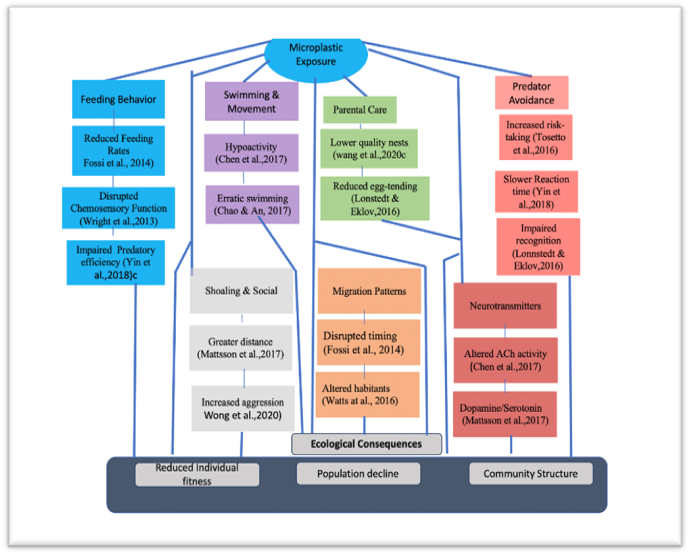
Figure 1. Schematic overview of behavioural, neurochemical, and ecological alterations induced by microplastic exposure in aquatic organisms. Microplastic exposure affects feeding behaviour, locomotion, predator avoidance, parental care, social interactions, and migration
patterns, and neurotransmitter activity, ultimately contributing to reduced individual fitness, population decline, and altered community structure. References cited within the figure correspond to published studies supporting each pathway.
Sensory Processing
4. Methodology
The databases used in this review include PubMed, Scopus, Web of Science, Google Scholar, and Elsevier to ensure a thorough discussion of relevant literature. Studies that met the following requirements were acknowledged in this review: Published between 2013 and 2024. Focused on microplastics' impacts on human health. Peer-reviewed or derived from credible scientific institutions. Studies that lacked empirical data, focused exclusively on environmental impacts, or were not published in English were excluded. Information that has been extracted is in the context of observational research.
5. Findings
Table 1. Summary of Selected Studies on the Effects of Microplastics on Aquatic Organisms, Research Focus, and Major Findings
|
Study |
Research Focus |
Major Findings |
|
Watts et al. (2016) |
Physiological effects on shore crabs |
Microplastics obstruct gills, impairing respiration and causing inflammation. |
|
Hwang et al. (2020) |
Oxidative stress in aquatic organisms |
ROS generation leads to cellular damage and oxidative stress. |
|
Prata et al. (2019) |
Immunological responses |
Chronic exposure suppresses immune defenses, increasing infection risks. |
|
Sussarellu et al. (2016) |
Reproductive impact on oysters |
Reduced sperm motility and developmental issues in larvae. |
|
Barboza et al. (2018) |
Food security and behavior |
Microplastics alter feeding behavior and nutrient absorption. |
|
Sujith et al. (2019) |
Coastal ecosystem impacts in India |
Local species exhibit physiological and behavioural alterations. |
Table 1 summarises several studies that have reported physiological, oxidative, and reproductive impacts of microplastics in aquatic organisms (Watts et al., 2016; Hwang et al., 2020; Prata et al., 2019; Sussarellu et al., 2016; Barboza et al., 2018; Sujith et al., 2019).
Table 2. Method used by various reviews of literature to assess the microplastics in various parts of Aquatic Micro-organisms.
|
Method |
Description |
Reference |
|
Histopathological Analysis |
Using staining methods and microscopy, exposed organisms' tissue damage and inflammation are examined. |
Watts et al. (2016) |
|
Oxidative Stress Biomarkers |
Measurement of antioxidant enzyme activity and reactive oxygen species (ROS) concentrations to assess oxidative damage. |
Hwang et al. (2020) |
|
Reproductive Success Metrics |
Assessment of fertility rates, sperm motility, egg development, and larval viability through controlled breeding experiments. |
Sussarellu et al. (2016) |
|
Regional Pollution Assessments |
Measurement of microplastic distribution and concentrations in Indian water bodies through sampling and filtration studies. |
Kumar et al. (2021) |
|
Molecular and Genetic Studies |
Evaluation of gene expression changes and endocrine disruption markers in microplastic-exposed species. |
Rochman (2015) |
Table 2 presents the methodologies used to assess microplastic toxicity in aquatic organisms, which are summarized in Table II (Watts et al., 2016; Sussarellu et al., 2016; Rochman, 2015; Hwang et al., 2020; Kumar et al., 2021).
CONCLUSION AND FUTURE RESEARCH DIRECTIONS
Microplastic pollution poses a significant threat to aquatic organisms, leading to a range of physiological, metabolic, immunological, and respiratory impairments. Chronic exposure to microplastics results in increased oxidative stress, compromised immune function, respiratory distress, and long-term physiological adaptations. These adaptations, while aimed at survival, often come at the cost of reduced growth, altered metabolism, and impaired reproductive success. The accumulation of microplastics in aquatic ecosystems not only disrupts individual species but also threatens biodiversity and ecosystem stability. Addressing microplastic pollution is essential to safeguard marine and freshwater life, ensuring ecological balance and sustainability. Implement stricter policies to regulate plastic waste disposal and promote alternatives to plastic packaging. Enforce bans on microbeads in personal care products and limit the release of synthetic fibres from textiles. Pollution Prevention and Clean-Up Strategies: Develop advanced filtration technologies to reduce microplastic emissions from industrial and domestic wastewater. Conduct regular clean-up drives in aquatic ecosystems to remove existing plastic pollutants. Scientific Research and Monitoring: Expand research on the long-term physiological effects of microplastics on diverse aquatic species. Develop biomarkers to assess microplastic-induced stress in aquatic organisms for early detection of ecological risks. Public Awareness and Education: Launch educational campaigns to inform the public about the dangers of microplastic pollution. Encourage sustainable consumer choices, such as using biodegradable materials and reducing single-use plastics. Technological Innovations: Promote the development of biodegradable plastics to minimise environmental accumulation. Invest in bio-remediation techniques using microbes or enzymes that can degrade microplastics efficiently.
Disclosure statement
The author(s) declare that there are no conflicts of interest associated with this study.
Acknowledgements
The Authors used generative artificial intelligence (AI) tools (ChatGPT) to assist with language editing and drafting the manuscript text. All content generated by AI was carefully reviewed, revised, and verified by the authors to ensure accuracy and integrity. The authors take full responsibility for the content of this publication.
Declaration:
The authors declare that they have used artificial intelligence (AI) technology in this article. AI technology's involvement in the production of this review article highlights its instrumental role in enhancing the writing efficiency, quality, and depth of our work.
Funding
This research was not supported by any fellowship
REFERENCES

Vaishnavi Mishra, U.V. Kiran, Kamal Jaiswal, Silent Disruption: Mechanistic Pathways of Microplastic Toxicity in Aquatic Organisms, Int. J. of Pharm. Sci., 2026, Vol 4, Issue 2, 3833-3844. https://doi.org/10.5281/zenodo.18753262
 10.5281/zenodo.18753262
