
Khyati College of Pharmacy, Palodia, Ahmedabad
Nonsteroidal anti-inflammatory drugs (NSAIDs) are commonly and widely used for pain and inflammation treatment, diclofenac sodium being one of the most effective agents due to its inhibition of cyclooxygenase (COX) enzymes and modulation of cytokine release. Oral administration of the drug, is frequently associated with gastrointestinal irritation, hepatic metabolism, and systemic side effects. Topical drug delivery has therefore emerged as a safer and effective alternative. Effervescent drug delivery systems (EDDS) increases rate of solubilization, localized drug release, and skin permeation by generating carbon dioxide through acid–base reactions, which also improves hydration of the stratum corneum. These mechanisms results rapid onset of action, increased patient compliance, and reduced systemic exposure. Despite their advantages, moisture sensitivity and potential drug degradation necessitate specialized packaging and stabilizing excipients to maintain efficacy. Clinical studies support the effectiveness of diclofenac topical formulations in musculoskeletal disorders such as arthritis, tendonitis, and sprains. With increasing regulatory focus on eco-friendly and innovative topical formulations, effervescent systems offer a promising platform for safe, effective, and patient-friendly delivery of diclofenac sodium via topical route.
Pain relief drugs such as Nonsteroidal Anti-Inflammatory Drugs (NSAIDs) are widely used for the treatment of both the conditions short term and long term. Many drugs are included in it; diclofenac is more potent to reduce a variety of painful and inflammatory disorders. To improve its therapeutic effectiveness, advanced transdermal delivery systems are combined with permeation enhancers and being explored, as many approaches which can enhance drug penetration across the skin barrier (3). Inflammation itself is a physiological key defence response of the body against harmful stimuli such as pathogens, toxins, tissue damage, and cellular stress (1).
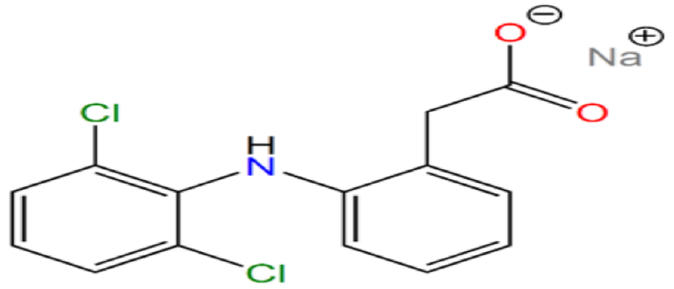
Figure: Diclofenac Sodium
In latest years, effervescent drug delivery systems (EDDS) have widely emerged with pharmaceutical research owing to their distinctive characteristics and advantages over conventional formulations. These systems are designed to release the active drug upon contact with water, producing carbon dioxide gas as a result of the reaction between acidic and basic components (5).
The effervescence not only promotes rapid disintegration and dissolution but also increases the rate of overall bioavailability of the drug (2). Typically, an EDDS formulation encompasses an active pharmaceutical ingredient (API), effervescent agents such as organic acids and alkaline bases, along with binders, disintegrants, and other essential excipients that contribute to stability and performance (4).
LITERATURE REVIEW:
Diclofenac sodium, a phenylacetic acid derivative, is synthesized through chlorination and subsequent amination steps. Its structure, featuring two ortho-chloro substituted phenyl rings, contributes to its potency and stability (20).
Diclofenac acts as a non-selective COX inhibitor, reducing prostaglandin synthesis, leading to analgesic, antipyretic, and anti-inflammatory effects. It also inhibits the lipoxygenase pathway and modulates cytokine release (25).
Diclofenac remnant is harmful for the earth and for aquatic life also, particularly affecting to the ducks and fishes. This led to a proper eco-friendly formulations and proper disposal methods (36).
Formulations such as effervescent baths, gels, nanoparticles, liposomes, and microemulsions have been developed to enhance skin perforation and sustained release of diclofenac, enhancing localized delivery and reducing systemic side effects (37).
Generally, the diclofenac is prescribed to cure the diseases such as musculoskeletal disorders, including arthritis, tendonitis, and sprains. Topical formulations, in detail, have shown strength in pain control while reducing gastrointestinal side effects associated with oral administration (38).
This drug, Diclofenac sodium is highly delicate to light, heat, and moisture, posing challenges in formulation. Effervescent and gel systems require tactful pH control and stabilizing excipients to maintain stability. Including antioxidants and using polymeric carriers have been plan to enhance shelf-life and photostability (39).
The demand of NSAIDS, is increasing day by day in the over- the-counter (OTC) market. The pharmaceutical agencies are developing eco-friendly formulation with low systemic exposure. Many growing trend towards innovation in diclofenac formulations are recently patent which are focus on novel delivery systems (40).
DICLOFENAC SODIUM (ADVANCED INSIGHTS):
Lastly research has been focused on the novel formulations plan for Diclofenac Sodium which may increase topical delivery, improves patient compliance, and decrease systemic side effects. Latest techniques which includes, such as nanoparticle-loaded microneedles, nano-in-micro systems, and lipid-based carriers have been examined to facilitate controlled drug release and targeted delivery to inflamed tissues (35, 37). Preferring, the use of permeability enhancers—both chemical (terpenes, surfactants) and physical (iontophoresis, sonophoresis, microneedling)—has shown appreciable results in increasing transdermal absorption (11, 8).
Amalgam therapies incorporating Diclofenac with other NSAIDs, antioxidants, or herbal extracts have been investigated to increase synergistic anti-inflammatory effects while minimizing adverse events (13, 38). Moreover patient-centric approaches such as effervescent bath bombs or gels with sensory attributes or cooling agents increases compliance and therapeutic experience (24, 17).
Emerging with technologies like 3D-printed topical patches allow for personalized dosing and optimized drug release profiles lining up with the growing trend of precision medicine (40). Recent studies, attention prefer to green formulation strategies and utilizing biodegradable excipients and eco-friendly bases to reduce environmental impact while maintaining drug stability (28,29). Regulatory and market analyses peak the increasing demand for hybrid cosmeceutical and pharmaceutical products which combines therapeutic efficacy with aesthetic interest (40).
In general, these advances prove that Diclofenac Sodium formulations are highly evolving beyond conventional topical systems which integrates novel delivery platforms, patient-compliance, and sustainable practices to maximize clinical efficacy and market acceptance.
EFFERVESCENT DRUG DELIVERY SYSTEM:
Formulations such as Effervescent dosage form have gained significant approach in modern pharmaceutics due to their ability to enhance drug solubility, stability, and patient compliance. Generally, it consist of an acid-base combination which releases carbon dioxide upon contact with water allowing rapid disintegration and drug dispersion (3; 9). The effervescence not only enhances the dissolution rate but also creates a microstreaming effect which can increase the permeability of drugs through the skin when are used in topical delivery systems (7; 8).
Recently, studies conclude that the application of effervescent systems for NSAID delivery, including Diclofenac Sodium, routes such as oral and topical forms have been explored. The drug absorption (4; 6). Moreover, these offer patient-friendly and cosmetically declaring dosage forms, such as bath bombs, patches, etc. which combine therapeutic effects with sensory benefits (5).
Stability remains an analytic consideration in effervescent formulations as moisture sensitivity can lead to premature reactions. Exploring in packaging and formulation plan, including coated granules and upgrade excipient selection, have been reported to diminish these challenges and secure long-term efficacy (9; 10; 11). Finally, effervescent drug delivery systems mean a promising approach for enhancing the presentation of topical NSAID formulations, with going on research focusing on improving stability, skin penetration, and patient acceptability.
GENERAL INFORMATION:
The Drug Diclofenac (DCF) is a widely prescribed nonsteroidal anti-inflammatory drug that to go with the management of pain and inflammation. In recent decade, vast research has highlighted the distribution all over different environmental compartments, including soil and aquatic ecosystems, often at varying concentrations (9). The persistence and behaviour of diclofenac in such environmental matrices have raised concerns regarding its toxicity and ecological impact, leading to the exploration of advanced remediation approaches for effective removal (10). Further, the toxicity of diclofenac and its metabolites through abiotic degradation or indirect exposure via water consumption remains a matter of increasing environmental and public health attention (7).
In the pharmaceutical filed, two major skin-based drug delivery systems have approached to gained prominent: topical and transdermal systems. Both delivery systems offer advantages such as non-invasive administration, avoidance of first-pass metabolism, prolonged drug action, stable plasma drug concentrations, reduced dosing frequency, and enhanced patient adherence (6). In spite of these shared benefits, their objectives and pharmacological outcomes differ considerably.
For successful transdermal drug delivery, physicochemical properties of the drug are critical. Ideally, the molecular weight should be below 500 Da, and the compound should possess optimal lipophilicity to enable permeation through the stratum corneum barrier. Larger and highly hydrophilic molecules, such as peptides, generally fail to penetrate effectively (11). To overcome these limitations, several improvement strategies have been reported, including both physical techniques (e.g., microneedles, iontophoresis) and chemical penetration enhancers, which improve the skin permeability of otherwise poorly permeable drugs (8).
FUTURE PERSPECTIVES:
The implementation of nano systems has emerged as an innovative strategy to enhance the permeability of drugs across the skin. Among these, nanobubbles (NBs) have recently been identified for their potential to significantly advance dermal and cosmetic drug delivery due to their nanoscale size and unique physicochemical properties (19).
The use of topical NSAIDs and transdermal delivery systems have shown exceptional progress in the treatment of pain, inflammation, and certain dermatological conditions. In certain, hydrogels and vesicular carriers such as liposomes and niosomes have denote versatility by not only improving the pharmacokinetics of NSAIDs but also permitting controlled and sustained drug release with targeting deeper skin layers (13). These achievements, challenges such as skin irritation, photosensitivity, and long-term safety remain areas of active research (15).
The combination of pharmaceutical development with clinical practice has made topical and transdermal NSAID delivery a thrilling area of research. Advanced delivery platforms enable personalized treatment approaches, offering enhanced therapeutic outcomes while minimizing risks (16). Within this factors, effervescent delivery systems deserve marked attention due to their unique functional mechanisms. Recent studies have suggested the role of effervescent formulations in enriching pharmaceutical technology and addressing unsatisfied patient needs. These systems is based on excipients such as citric acid and sodium bicarbonate, which undergo an acid–base reaction in the presence of water, releasing carbon dioxide (CO?) (14).
This effervescence system provides dual advantages: a visually appealing bubbling effect and an active contribution to drug delivery. The release of CO? persuade agitation and micro-streaming, which promote drug solubilization and dispersion. Additionally, transient changes in pH and temperature during the reaction may enhance solubility and ionization of the drug, thereby smoothing its permeation across the skin (12). Importantly, the localized hydration produced during effervescence loosens the lipid structure of the stratum corneum, assisting the diffusion of moderately lipophilic drugs such as diclofenac sodium. The mechanical disruption gives rise to bubbling further supports drug penetration (17).
When the comparison is done by conventional topical dosage forms such as gels, creams, or patches, effervescent formulations demonstrate a distinct double mechanism are as follows: (i) rapid disintegration and solubilization for efficient drug release, and (ii) enhanced permeation through hydration and CO?-induced micro-disruption of the skin barrier. These combined effect highlight effervescent topical delivery as a growing approach for NSAIDs like diclofenac, ensuring localized therapeutic action, reduced systemic exposure, and improved patient adherence in market (18).
EXPECTED BENEFITS:
Topical administration of diclofenac sodium through effervescent dosage forms provides several remarkable benefits in comparison of traditional oral and conventional topical preparations. The major advantage falls in the localized delivery of the drug, which allows higher concentrations at the targeted site, such as muscles and joints. This approach is specially valuable in the management of pain and inflammation, as it diminish the requirement for higher systemic doses and minimizes off-target exposure (22).
Other major advantage is the abolition of gastrointestinal side effects commonly associated with oral NSAID therapy. The Oral form of diclofenac administration is directly linked to gastric irritation, ulcer formation, and hepatic metabolism–related problems. Delivering diclofenac by a topical effervescent system, the gastrointestinal tract and first-pass metabolism are bypassed, reduces the likelihood of systemic toxicity (21).
Moreover, effervescent systems leads to improved patient compliance. The unique form of bubbling effect not only improves the aesthetic and sensory charm but also improves drug solubilization and localized skin hydration. These properties collectively gives faster action of drug and improved therapeutic efficacy compared with conventional gels or creams (24).
Overall, this delivery system combines efficacy, safety, and patient acceptability, making the promise for alternative treatment of diclofenac sodium for musculoskeletal and inflammatory disorders (23).
PACKAGING & STABILITY:
Formulations such as, Effervescent formulations are highly sensitive to environmental moisture, as even minimal exposure can led the acid–base reaction, resulting in the dropping of effervescent properties. To ensure stability throughout the product’s shelf life, specialized packaging is necessary. Packaging solutions include airtight and moisture-resistant systems such as aluminium blisters, laminated pouches, and high-density polyethylene bottles supplemented with desiccants. For single-use topical formulations, including bath bomb–like preparations, sealed foil wraps or shrink packaging are typically utilized to minimize environmental exposure (28).
Stability factors become more critical when effervescent formulations contain drug such as diclofenac sodium, as the drug is prone to degradation via hydrolysis, oxidation, or photolysis. Appropriately selection of excipients, pH stabilizers, and antioxidants is important to preserve drug integrity.
Moreover, maintaining the controlled storage conditions, especially cool and dry environments, it is necessary to prevent potency loss and ensure consistent therapeutic performance (29).
By a pharmaceutical quality testing is performed such as , stability testing is indispensable. Both accelerated studies and real-time testing are commonly performed to evaluate the resistance of effervescent formulations to moisture, CO? retention, drug content uniformity, and physical integrity. Optimized packaging not only safeguards the effervescence mechanism but also contributes significantly to maintaining drug effectiveness and patient safety (26,27).
CONCLUSION AND FUTURE DIRECTIONS
The drug Diclofenac sodium constantly is the part of the prescribed NSAIDs for the treatment of musculoskeletal disorders, especially for pain and inflammation. The frequent use of oral administration gives side effect such as GI irritation and systemic adverse effect. Topical delivery has proven as a safer and effective alternative. In this context, effervescent systems give an innovative platform that increases drug solubilization, skin permeation, and patient compliance. The effervescent reaction not only provide rapid disintegration and drug release but also increases skin hydration, a point factor for overcoming the obstacles of the stratum corneum (33).
This review offers the promising of effervescent dosage form by improving the topical delivery of diclofenac sodium which enhances therapeutic efficacy, reduced systemic toxicity, and enhance patient acceptability. Yet, many additional research is required to examine formulation design, evaluation for large-scale manufacturing feasibility, and establish long-term stability. Further, robust clinical trials are needed to confirm their safety and efficacy compared with conventional gels and patches (30).
Moving ahead, effervescent-based topical delivery systems hold potential over diclofenac sodium. Their application could be increased to other therapeutic classes, including antifungals, corticosteroids, and local anaesthetics, by broadening their pharmaceutical and commercial scope in future. With increasing patient requirement for effective, safe, and user-friendly drug delivery options, effervescent topical systems represent a valuable innovation in modern pharmaceutical technology (31; 32).
REFERENCES


Jain Jinal, Vaidehi Gurjar, Dr. Pragnesh Patani, Review on Topical Delivery of Diclofenac Sodium via Effervescent Dosage Form, Int. J. of Pharm. Sci., 2026, Vol 4, Issue 3, 2124-2132. https://doi.org/10.5281/zenodo.19118187
 10.5281/zenodo.19118187
