
School of Pharmaceutical Sciences, JSPM UNIVERSITY, Pune, India
The hyphenated technique is the combination or the coupling of the different analytical techniques. Mainly chromatographic techniques are combined with spectroscopic techniques. Then the separated components of the mixture from chromatographic technique will enter into the spectroscopic technique through an interphase. In GC-MS the separated components from gas chromatography enter to MS which is followed by ionization, mass analysis, and detection of mass-to-charge ratios of ions generated from each analyse by the mass spectrometer. Jet/orifice separator, effusion separator, and membrane separator can be used to connect GC with MS. In LC-NMR coupling the analytical flow cell was initially constructed for continuous-flow to NMR. However, the need for full structural assessment of novel natural products has led to the application in the stopped-flow mode in LC-MS. Use of LC-MS-MS is increasing speedily day by day. Hyphenated techniques such as HPLC coupled to UV and mass spectrometry (LC-UV-MS) have been extremely useful in combination with biological screening for a rapid survey of natural products. Nowadays, various types of LC-MS systems incorporating different types of interfaces are available commercially. The term hyphenated techniques refer to separation, identification, and the hyphenated techniques show better analysis of the samples are components specificity, accuracy, precision
A hyphenated technique is combination or coupling of two different analytical techniques with the help of proper interface. Mainly chromatographic techniques are combined with spectroscopic techniques [1]. In the chromatography, the pure or nearly pure fractions of chemical components in a mixture was separated and spectroscopy produces selective information for identification using standards or library spectra. The coupling of the separation technique and an on-line spectroscopic detection technology will lead to a hyphenated technique [2]. The term hyphenated techniques range from the combination of separation-seperation, separation-identification & identification-identification techniques[3].
The term “hyphenation” was first adapted by Hirsch Feld in 1980 to describe a possible combination of two or more instrumental analytical methods in a single run (Hirschfeld, 1980). The aim of the coupling is to obtain an information-rich detection for both identification and quantification compared to that with a single analytical technique [2].
TYPES OF HYPHENATED TECHNIQUES
B. Triple hyphenated techniques

Figure:1 Schematic presentation of Hyphenation of chromatographic and spectrometric techniques
A. Double hyphenated techniques
1. GC-MS (GAS CHROMATOGRAPHY-MASS SPECTROMETRY)
PRINCIPLE: The basis for gas chromatography/mass spectrometry (GC/MS) is the principle that heat causes a mixture to separate into its constituent substances. Prior to the analyte molecules being eluted into the MS for detection, the sample mixture is separated by the GC-MS instrument [4].
INSTRUMENTATION: Vaporized analytes undergo separation in the GC column when they are passed through it with the aid of heated carrier gas; this carrier is also referred to as the mobile phase (helium). The chemicals separate as a result of interactions between the analyte, mobile phase, and stationary phase. The parameters of the column (length, diameter, and film thickness), the type of carrier gas, the gradient temperature of the column, and the characteristics of the stationary phase all affect the analyte’s separation. As the sample moves through the column, the mixture’s constituent parts separate due to variations in boiling points and other chemical characteristics. Because of their varied adsorption or variations in the partition between the mobile phases, the components have varying elution and retention times. After that, an interphase will allow the mixture’s separated components to enter the MS. Ionisation, mass analysis, and the determination of the mass-to-charge ratios of the ions by each analysis by the mass spectrometer come next. GC and MS can be connected via an interface, such as a membrane separator, jet/orifice separator, or effusion separator. Ionization is a process that separates a molecule into its positive and negative modes in addition to ionizing it [5].

Figure 2: Schematic diagram of GC-MS
APPLICATION:
2. LC-MS (LIQUID CHROMATOGRAPHY – MASS SPECTROSCOPY)
PRINCIPLE: The Liquid Chromatography-Mass Spectrometry (LC-MS) Principle Utilizing an HPLC, the LCMS technology first separates the constituent parts of a mixture before ionizing and separating the ions according to their mass/charge ratio[7].
INSTRUMENTATION:
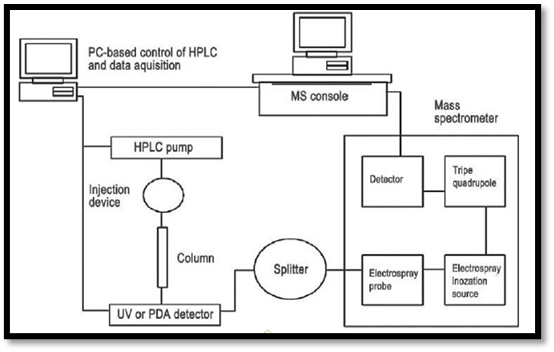
Figure 3: Schematic diagram of LC-MS
Mass spectroscopy is combined with the physical separation of liquid chromatography, or HPLC, in a chemistry technique called LC-MS. A typical automated LC-MS system consists of a mass spectrometer, an LC system, and a double three-way diverter connected to an auto sampler. The diverter usually serves as an automatic switching valve to direct unwanted portions of the eluting from the LC system to trash before the sample enters the MS. Soft ionization techniques are generally used in LC-MS, which reveals mainly molecular ion species with few fragment ions.
A single LCMS run's worth of data is insufficient to confirm the molecule's identity. But the problem has now been resolved by tandem mass spectrometry (MS-MS), which distributes fragments by collision-induced dissociation of the generated molecular ions. The application of LC-MS-MS is expanding quickly every day. When combined with biological screening, hybridized techniques like HPLC coupled to UV and mass spectrometry (LCUV-MS) have proven to be incredibly beneficial for a quick survey of natural compounds [8].
APPLICATION:
3. LC-NMR (LIQUID CHROMATOGRAPHY- NUCLEAR MAGNETIC RESONANCE)
PRINCIPLE: LC separates components in a mixture based on their chemical properties. NMR provides detailed Structural information about the separated compounds. It involves a HPLC separation followed by the Detection of separated components by UV or other methods and ultimately NMR analysis. LC-NMR is a Powerful analytical tool used to resolving complex mixtures[9].
INSTRUMENTATION:
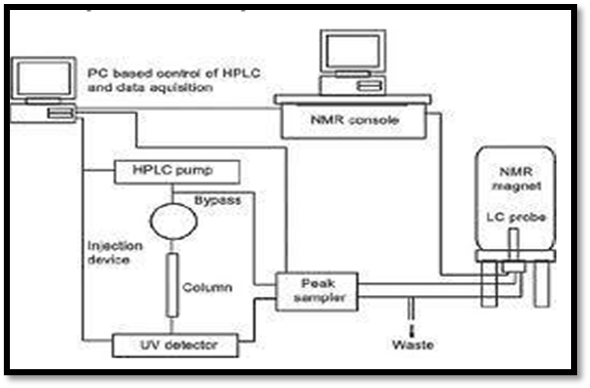
Figure 4: Schematic diagram of LC-NMR (5)
LC-NMR is a highly sensitive method, as its NMR sensitivity can be enhanced through the use of powerful magnetic field magnets and advanced sensitive probes. Additionally, improvements in peripheral technologies like solvent elimination techniques and automated measurement software designed for multicomponent analysis contribute to this enhanced sensitivity. The greater the strength of the external magnetic field, the higher the sensitivity achieved[10]. The enhanced sensitivity has significantly shortened measurement times. Additionally, compounds exhibiting intricate spectra can be readily analyzed due to the increased magnetic field, which enhances signal resolution[11].
APPLICATION:
4. LC-IR (LIQUID CHROMATOGRAPHY-INFRARED SPECTROSCOPY)
PRINCIPLE: The technique that combines liquid chromatography (LC) with infrared spectroscopy (IR) or Fourier-transform infrared spectroscopy (FTIR) is referred to as LC-IR or HPLC-IR. HPLC is regarded as one of the most effective separation methods available today, while IR and FTIR serve as valuable spectroscopic techniques for identifying organic compounds. This is due to the presence of numerous characteristic absorption bands in the mid-IR region that correspond to specific functional groups, such as –OH and –COOH. However, the integration of HPLC and IR presents challenges, and advancements in this combined technique have been notably slow. This is primarily because the numerous absorption bands from the mobile phase solvent in the mid-IR region can often mask the relatively weak signals produced by the sample components [14].
INSTRUMENTATION:
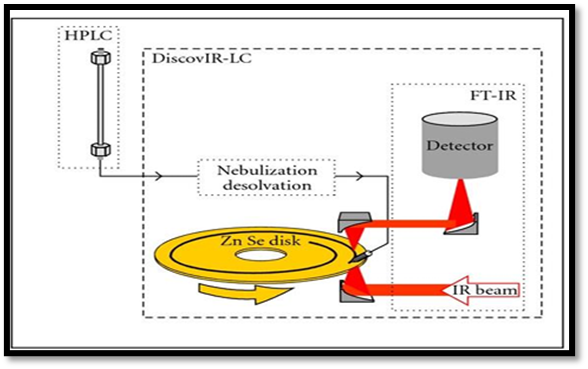
Figure 5: Schematic diagram of LC-IR
Every component ought to be able to be identified in real time with this device without chromatographic resolution being compromised. The most widely used method for this is mass spectrometry (MS), however it has some drawbacks, especially when it comes to differentiating structural isomers like ortho-, meta-, and para-xylene, whose chemical-ionization mass spectra and electron-impact mass spectra are identical. A complementary technique to mass spectrometry is desired for such molecules. An alternative method for this purpose is Fourier transform infrared (FT-IR) spectrometry, which produces unique spectra for the majority of structural isomers [14], [15].
APPLICATION:
5. CE-MS (CAPILLARY ELECTROPHORESIS-MASS SPECTROMETRY)
PRINCIPLE: CE-MS is an analytical method. Mass spectrometry is gaining popularity as a detection technique for capillary electrophoresis (CE-MS). The integration of CE's superior efficiency with the high selectivity of mass spectrometry is highly appealing. CE is capable of handling complex sample matrices, making it an excellent pairing with mass spectrometry for analyzing a wide range of intricate mixtures. Additionally, mass spectrometry can enhance the overall sensitivity of CE analyses when conditions are suitable. One of the key advantages of combining mass spectrometry with any separation technique is the added dimension of separation it provides[17].
INSTRUMENTATION:
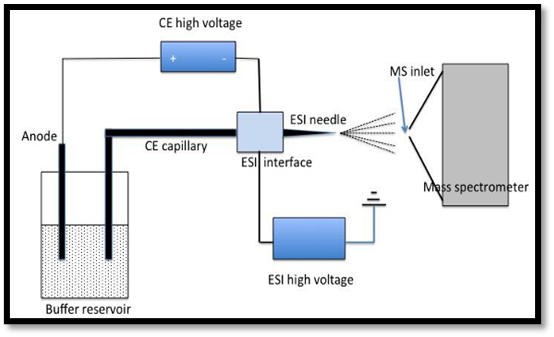
Figure 6: Schematic diagram of CE-MS
CE-MS is a hyphenated technique that links capillary electrophoresis (CE) and mass spectrometry (MS) using long capillaries. This connection can lead to increased analysis times, and there is also a shortage of suitable volatile buffers that are compatible with mass spectrometry[18].
APPLICATION:
6. GC-IR (GAS CHROMATOGRAPHY-INFRARED SPECTROSCOPY)
PRINCIPLE: The technique involves the combination of gas chromatography and infrared spectroscopy. It is highly sensitive and quite costly. Additionally, sample recovery is achievable since infrared spectroscopy is a nondestructive method. In this process, gas chromatography handles the separation, while infrared spectroscopy perform the function identification [22], [23].
INSTRUMENTATION:
Gas chromatography separates the components of the analyte. These components will move through the column. These two techniques are connected via a glass column or vacuum tubes. The interface utilized in this method consists of a small glass pipe coated with gold on the inside, linked to the column by a narrow tube. The light pipe is heated to eliminate condensation and optimize the path length for improved sensitivity.
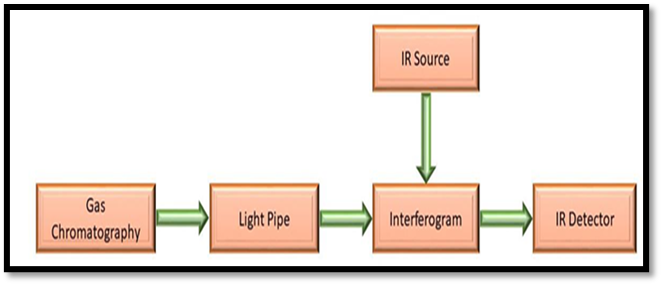
Figure 7: Schematic diagram of GC-IR
APPLICATION:
7. GC-NMR (GAS CHROMATOGRAPHY -NUCLEAR MAGNETIC RESONANCE)
PRINCIPLE:
This technique involves the combination of gas chromatography (GC) and nuclear magnetic resonance (NMR). NMR is utilized to identify the components, while GC separates them. The integration of these methods offers structural information about the molecules of the separated components [25], [26].
INSTRUMENTATION:
The issue arising from combining these two techniques is that in NMR, the samples analyzed are either liquid or solid, while in GC, they exist in a gaseous state. When carrier gas is employed for NMR analysis, it results in a low signal-to-noise ratio at atmospheric pressure. To address this sensitivity issue, microcells are utilized, along with computer systems, to enhance the signal-to-noise ratio [27]. Additional modifications are implemented, including the utilization of more powerful magnets and advanced microprobes [28]. Analytes with boiling points exceeding 65 °C condensed in the transfer capillary and probe head. This issue can be addressed by utilizing a transfer capillary that is heated by a bifilar coil. This coil is made from zero susceptibility wire and is combined with a strong magnetic field [29].
APPLICATI
ON:
8. TLC-MS (THIN-LAYER CHROMATOGRAPHY- MASS SPECTROMETRY)
PRINCIPLE: The versatile instrument is used to isolate unknown compounds from a HPTLC/TLC plate and transfer them into a mass spectrometer for identification or structure elucidation.
INSTRUMENTATION:
The TLC/MS interface can be integrated with any brand of LC-coupled mass spectrometer. It features a plug-and-play installation utilizing two HPLC fittings within a standard HPLC-MS system. This semi-automatic instrument includes an automatic piston movement to create a pressure seal in the HPTLC/TLC zone on both glass plates and aluminum foils. Samples can be directly extracted from the plate using an appropriate solvent delivered by the HPLC/HPTLC pump, allowing for online transfer to the mass spectrometer. Additionally, the system includes automatic cleaning of the piston between extractions[30].
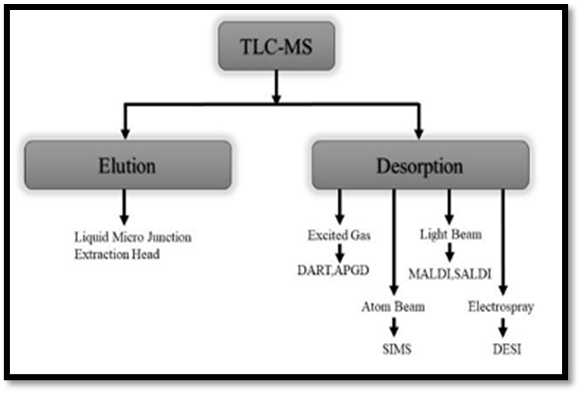
Figure 8: Schematic diagram of TLC-MS
APPLICATION:
B. Triple hyphenated techniques
1.LC/MS/MS (LIQUID CHROMATOGRAPHY-TANDEM MASS SPECTROMETRY)
PRINCIPLE: LC-MS (Mass Spectrometry) is capable of detecting over 300 compounds across various classes with a minimal injection volume. It requires minimal sample preparation, which helps to reduce analysis time. LCMS serves as the initial step in the LC-MS/MS process. This latter technique is significantly more sensitive and specific than LC-MS, offering sensitivity that is approximately 20 to 100 times greater. Its enhanced specificity is due to the incorporation of an additional filtering process during analysis[32].
APPLICATION:
2.GC/MS/MS (GAS CHROMATOGRAPHY TANDEM MASS SPECTROMETRY)
PRINCIPLE: This method combines gas chromatography with tandem mass spectrometry. It is both sensitive and specific, making it suitable for ultra-trace analysis. For qualitative identification using MS/MS, various scans can be employed, including product ion scans, precursor ion scans, and neutral loss scans with a triple quadrupole, as well as product scans using an ion trap. In recent years, the sensitivity of the quadrupole has improved, and its scanning speed has also increased[34].
APPLICATION:
3.GC/IR/MS (GAS CHROMATOGRAPHY–ISOTOPE RATIO MASS SPECTROMETRY)
PRINCIPLE: This principle has resulted in the widespread application of separation preparation systems coupled with mass spectrometers as detectors. This setup is commonly utilized to measure the stable isotope ratios of essential bioelements, such as carbon (C), nitrogen (N), oxygen (O), sulfur (S), and hydrogen (H). A gas chromatography-isotope ratio mass spectrometer (GC–IRMS) consists of four key components: the gas chromatograph, the high-temperature furnace, the water trap, and the isotope ratio mass spectrometer[36].
INSTRUMENTATION:
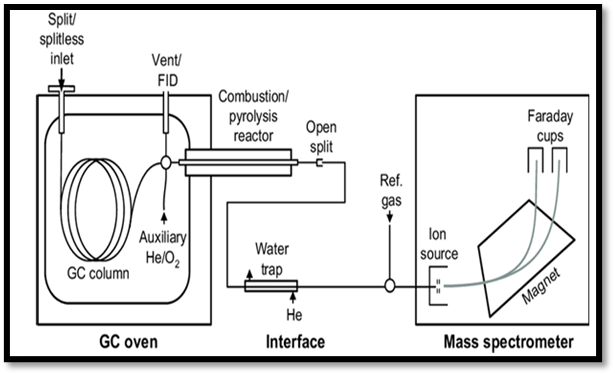
Figure 9: Schematic diagram of GC-IR-MS
The ratios of the light stable isotopes of carbon (13C/12C), hydrogen (2H/1H), nitrogen (15N/14N), and oxygen (18O/16O) in individual chemical compounds are analyzed after separating them from complex mixtures. These isotope ratios in natural substances differ from those in synthetic materials, allowing GC/C/IRMS to identify whether an analyte is synthetic. A key requirement is that the compounds in the sample mixture must be suitable for GC analysis, meaning they must be volatile and thermally stable. Some polar compounds may need additional chemical modification or transformation (derivatization); in these instances, the stable isotope ratio of the derivatization agent must also be measured. Similar to GC/MS processes, the sample solution is injected into the GC inlet, where it is vaporized and transported onto a chromatographic column by a carrier gas, typically helium. As the sample moves through the column, the compounds in the mixture are separated based on their relative interactions with the column's coating (stationary phase) and the carrier gas (mobile phase). For the detection of carbon and nitrogen, the compounds exiting the chromatographic column enter a combustion reactor, which consists of an alumina tube filled with copper, nickel, and platinum wires, maintained at a temperature of 940 °C for oxidative combustion. This step is followed by a reduction reactor, also an alumina tube containing three copper wires kept at 600 °C, which converts any nitrogen oxides into nitrogen. A high-temperature thermal conversion reactor is needed for hydrogen and oxygen detection. Subsequently, water is removed using a water separator that directs the gas stream through a tube made from a water-permeable Nafion membrane, a sulfonated tetrafluoroethylene-based fluoropolymer-copolymer. Finally, the sample is introduced into the ion source of the mass spectrometer via an open split interface [37].
APPLICATION:
APPLICATION OF HYPHENATED TECHNIQUE IN ANALYSIS OF PHARMACEUTICALS
ADVANTAGES OF HYPHENATED TECHNIQUES43
Hyphenated techniques combine multiple analytical methods to enable rapid identification of new natural products and detailed structure elucidation before time-consuming isolation and purification. A major advantage is their ability to detect unexpected chemical species, making them highly valuable in areas such as drinking water and wastewater analysis, drug discovery, biochemistry, and biotechnology.
1. Fast and accurate analysis.
2. Higher degree of automation.
3. Higher sample throughput.
4. Better reproducibility.
5. Reduction of contamination due to its closed system.
6. Separation and quantification achieved at same time.
7. Shorter analysis time.
8. Enhanced combined selectivity and therefore higher degree of information [46].
CONCLUSION
Advances in the hyphenated technique such as LC-MS, GC-MS, LC-NMR, CE-MS and ICP-MS have been made to excellently solve various complex analytical problems in different fields. These techniques solve such problems in time efficient manner, higher degree of automation, higher sample throughput better responsibility. Combination of these techniques gives better analysis of the components. In this review introduction, instrumentation, and applications are explained for every technique.
REFERENCES



Rutuja Solanke, Manjusha Yeole, Sagar Wankhede, Abhijeet Ekhande, Review on Hyphenated Techniques in Pharmaceutical Analysis, Int. J. of Pharm. Sci., 2026, Vol 4, Issue 3, 1825-1838. https://doi.org/10.5281/zenodo.19065159
 10.5281/zenodo.19065159
