
Mar Dioscorus College of Pharmacy, Hermongiri Vidyapeetam, Alathara, Sreekaryam, Thiruvananthapuram.
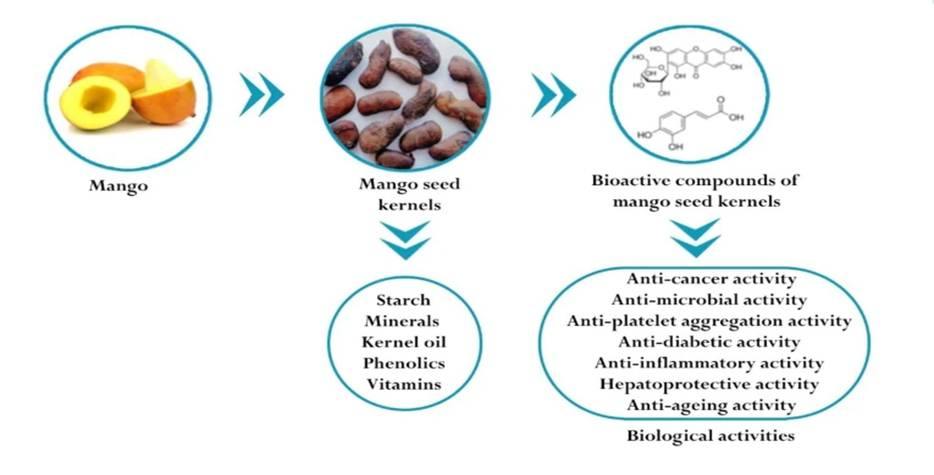
Mango seed kernel (MSK) is a common by-product of mango processing. It is a valuable but often overlooked source of bioactive compounds. This review focuses on extracting MSK using the Soxhlet apparatus and looks at its nutritional, phytochemical, and functional properties. Mango seed kernels are rich in carbohydrates, proteins, and lipids. They also contain important phenolic compounds like tannins, gallic acid, mangiferin, coumarins, flavonoids, and catechins, which provide strong antioxidant activity. The Soxhlet extraction method is highly efficient because it recycles the solvent continuously, allowing for effective recovery of high-boiling and thermally stable compounds. Ethanol is commonly used as the extraction solvent because it improves yield, is safe, and is environmentally friendly. Research shows that finding the right ethanol concentration and solvent volume is key to achieving good extraction efficiency. The extracts obtained have pleasing sensory qualities and contain various phytochemicals that can be applied in nutraceuticals, pharmaceuticals, and cosmetics. Overall, making good use of mango seed kernel through effective extraction offers a sustainable way to manage waste while revealing significant industrial potential. This review highlights the importance of the Mango seed kernel as a natural, cost-effective source of antioxidants and functional ingredients for future product development.
The mango (Mangifera indica L.) is one of the most important tropical fruits in the world, thanks to its pleasant taste and aroma and high nutritional value. It is rich in water, sugars, fibre, minerals, vitamins, and antioxidants [2]. Based on its chemical composition, it is regarded as the king of fruits[2]. During the consumption and processing of mango, a large quantity of by-products in the form of peel and seeds are generated and generally discarded as waste. Mango waste generated at domestic and industrial levels requires attention and a proper solution for its disposal and value addition. In the recent past, mango seed kernels and peel have received great attention, considering their nutritional and pharmaceutical importance. Mango seeds and peel contain a significant amount of proteins, fats, carbohydrates, and some specific bioactive compounds. The mango seed kernel contains 53.34 to 76.81% carbohydrates, 5.20 to 10.48% proteins, 9.84 to 18.0% fat/oil, and 0.26 to 10.60% crude fibre[4]. The mango seed has aroused special scientific interest because it has been reported as a bio-waste with high content of bioactive compounds (phenolic compounds, carotenoids, vitamin C, and dietary fibre).
The mango fruit is classified as a deliquescent drupe; it contains a single seed surrounded by a fleshy mesocarp covered by a fibrous skin. The seed is composed of a woody outer shell (endocarp) that is thick and hard and encloses a kernel. The mango seed can be monoembryonic or polyembryonic. Most of the varieties in India are monoembryonic.[2]
Several studies have shown that mango seed kernels contain various phenolic compounds and can be a good source of natural antioxidants. Gallotannins and condensed tannin-related polyphenols were reported to be present in mango kernels. In addition, polyphenols from dry mango kernel meal were found to contain tannic acid, gallic acid, and epicatechin in the ratio 17:10:1, respectively. The components included tannins, gallic acid, coumarin, ellagic acid, vanillin, mangiferin, ferulic acid, cinnamic acid, and unknown compounds.[3]
MATERIALS AND METHODS
Materials:
Ripe mango seeds were collected from the local market. The seeds were washed with tap water to remove their impurities.
Sample preparation:
Mango seeds were washed and then split as the first step in sample preparation, and the covering layer of the core was removed to obtain the maximum kernel portion. The kernels were then chopped, dried, and made into flour to obtain a small particle size for better solvent penetration. Kernel flour was packaged and placed in the freezer to await the extraction process. [5]
Extraction procedure
Soxhlet extractor: A Soxhlet extractor is a piece of laboratory apparatus invented in 1879 by Franz Von Soxhlet. The Soxhlet extractor is divided into three parts.
1) Boiling flask
2) Thimble
3) Condenser [6]
The extraction process uses a Soxhlet apparatus (Figure 1). For each experimental unit, 50 g of mango kernel flour was used, wrapped in cotton and filter paper, and then placed in a Soxhlet sleeve. This sleeve was inserted into the Soxhlet thimble facing upwards. The solvent was put into the thimble until it was full and flowed into a 3-neck flask of 1000 mL that was under the thimble. The solvent continued to be added until it covered the Soxhlet sleeve. The reflux condenser, which has been connected to a water pump, was then connected to the Soxhlet thimble. The flask was heated using a heating mantle at 80? and adjusted using a thermometer setting. The extraction process continues until the solvent in the thimble becomes clear. The sleeve was removed from the thimble, and the mango seed kernel and solvent were separated by heating the flask until the solvent evaporated and separated from the thimble. The mango seed kernel product in the flask was transferred to a dark packaging container and stored in the freezer.[5]
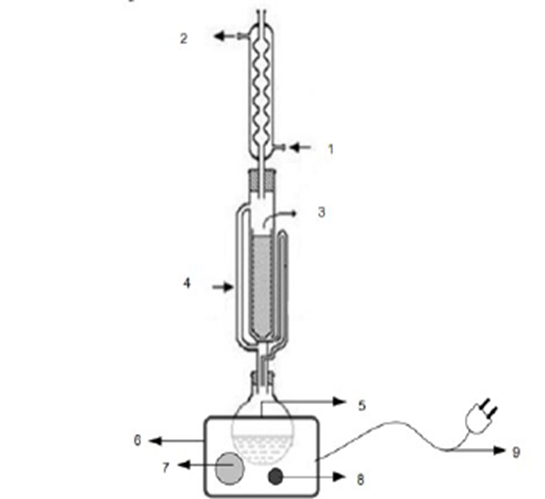
Figure 1. Soxhlet extractor. [5]
CONCLUSION
The mango seed kernel, a major by-product of mango processing, represents an underutilized yet highly valuable natural resource. This review highlights that the mango seed kernel is rich in essential nutrients and diverse phytochemicals, including tannins, gallic acid, mangiferin, flavonoids, and other phenolic compounds that contribute to strong antioxidant activity. The Soxhlet extraction technique appears to be effective and reliable for the separation of bioactive compounds, in particular when ethanol is used as the extraction solvent because of its safety, selectivity, and compatibility with the environment. Optimization of solvent concentration and extraction conditions played an important role in improving yield and increasing phytochemical contents. The extracted MSK showed a high potential for applications in nutraceuticals, pharmaceutical preparations, and cosmetic formulations due to antioxidant, functional, and health-promoting properties. Processing mango seed kernels would not only valorize agro-industrial wastes but also contribute to the sustainable management of natural resources. This review, therefore, reestablishes that MSK is one of the promising, inexpensive sources of natural bioactive compounds of wide industrial relevance.
REFERENCES

Anupama Jayaraj, Sheri P S, Neenu Reji, Ruksana S, Shabna B S, Mango Seed Kernel as a Sustainable Source of Natural Antioxidants: A Comprehensive Review, Int. J. of Pharm. Sci., 2026, Vol 4, Issue 2, 2147-2150. https://doi.org/10.5281/zenodo.18631371
 10.5281/zenodo.18631371
