
NRI College of Pharmacy, Pothavarappadu, Agiripalli, Eluru 521212
Nowadays, cookies are widely consumed snack products, but most commercial cookies contain refined flour and sugar, which are not suitable for diabetic patients. The present study was aimed to formulate and evaluate polyherbal cookies using antidiabetic herbal ingredients such as oats, fenugreek, cinnamon, and stevia. These herbs possess hypoglycemic, antioxidant, and insulin-sensitizing properties. The prepared cookies were evaluated for physicochemical parameters such as moisture content, ash value, organoleptic properties, and phytochemical screening. The results showed acceptable color, taste, texture, and good nutritional composition. Phytochemical analysis confirmed the presence of carbohydrates, flavonoids, and proteins. The formulated cookies may serve as a functional nutraceutical product beneficial in managing blood glucose levels and improving overall health in diabetic patients.
Diabetes mellitus is a chronic metabolic disease that has become one of the most serious global health concerns of modern times due to its escalating prevalence, lifelong nature, and complex pathophysiological consequences. It is characterized by persistent elevation of blood glucose levels resulting from impaired insulin secretion, decreased insulin sensitivity, or both. The condition disrupts the normal metabolism of carbohydrates, lipids, and proteins, thereby affecting nearly every organ system of the body. The disease, once predominantly seen in developed countries, is now increasingly prevalent in developing nations where healthcare resources are limited and awareness remains insufficient. This epidemiological shift has created a growing public health burden marked by increased morbidity, mortality, and economic strain. [1]
The polyherbal approach enhances these benefits by combining multiple medicinal plants to achieve synergistic therapeutic effects. Synergy improves pharmacological efficacy, enhances bioavailability, broadens therapeutic action, and reduces toxicity [2]. Traditional medicine systems have long employed polyherbal formulations for chronic disorders, and modern scientific studies increasingly validate their superiority over single-herb therapies. Polyherbal combinations target multiple metabolic pathways simultaneously, addressing insulin resistance, oxidative stress, inflammation, lipid abnormalities, and pancreatic dysfunction.[3]
Tecoma stans belongs to the family Bignoniaceae and is commonly known as yellow trumpet flower or yellow bells. It is a perennial shrub widely distributed in tropical and subtropical regions. The plant contains important phytoconstituents such as alkaloids (tecomine), flavonoids, glycosides, tannins, and phenolic compounds. These bioactive constituents are responsible for its medicinal properties, particularly its antidiabetic activity.[6]
Tulsi, scientifically known as Ocimum sanctum and belonging to the family Lamiaceae, is commonly known as holy basil and is widely used for its medicinal properties. It contains important phytochemicals such as eugenol, flavonoids, tannins, and essential oils. These constituents contribute to its antidiabetic activity by lowering blood glucose levels, enhancing insulin secretion, and improving glucose metabolism.[7]
Ashwagandha, scientifically known as Withania somnifera and belonging to the family Solanaceae, is an important medicinal plant widely used in traditional medicine. The plant contains active constituents such as withanolides, alkaloids, flavonoids, and steroidal lactones. These compounds possess various pharmacological activities including antidiabetic, antioxidant, and anti-inflammatory effects.[8]
Oats, scientifically known as Avena sativa and belonging to the family Poaceae, are widely used as a nutritious cereal grain. Oats are rich in dietary fiber, especially beta-glucan, along with proteins, vitamins, minerals, and antioxidants.[9] Beta-glucan plays a significant role in controlling blood glucose levels by slowing gastric emptying and delaying glucose absorption in the intestine.[10]
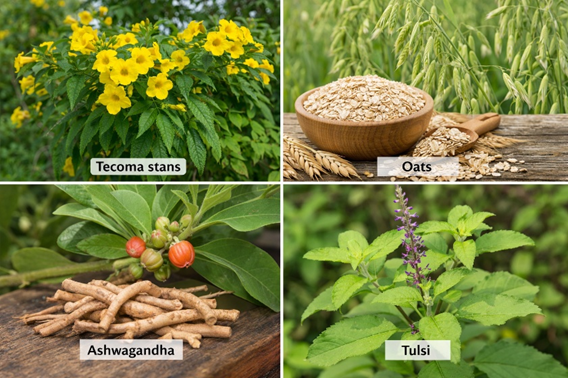
Figure 1: Herbal Ingredients.
Table 1: Ingredients of Polyherbal Antidiabetic Cookies
|
Sr. No |
Ingredient (Common name) |
Scientific name |
Family |
Part used |
Quantity taken |
|
1 |
Tecoma |
Tecoma stans |
Bignoniaceae |
Leaves |
5 g |
|
2 |
Oats |
Avena sativa |
Poaceae |
Seeds |
20 g |
|
3 |
Ashwagandha |
Withania somnifera |
Solanaceae |
Roots |
5 g |
|
4 |
Tulsi |
Ocimum sanctum |
Lamiaceae |
Leaves |
5 g |
|
5 |
Wheat flour |
Triticum aestivum |
Poaceae |
Seeds |
40 g |
|
6 |
Black gram flour |
Vigna mungo |
Fabaceae |
Seeds |
20 g |
|
7 |
Sugar |
Saccharum officinarum |
Poaceae |
Stem (sucrose) |
15 g |
|
8 |
Butter |
— |
— |
— |
25 g |
|
9 |
Baking powder |
— |
— |
— |
1 g |
|
10 |
Milk |
— |
— |
— |
q.s |
|
11 |
Vanilla essence |
— |
— |
— |
Few drops |
Table No 2. list of equipments used
|
Name of Equipment |
Make/Mode |
|
Digital Weighing Balance |
MAB220, WENSAR |
|
Soxhlet Apparatus |
LTSW-5, LAB TECH |
|
Hot Air Oven |
S Clean-135947175, S Clean |
|
Desiccator |
JII-1504, A SKY INSTRUMENT |
METHODS
Preparation of Cookies
Different compositions of cookies were formulated using different ratios of Oats, wheat flour, roasted black-gram flour, Tecoma stans leaves powder, Ashwagandha powder, Tulsi powder, Milk, Flavoring agent (vanilla and cocoa), salt, baking powder, baking soda, butter, artificial sugar (sugar free Natura), and based on the palatability and visual appealing final product were selected for sensory evaluation and nutritional value analysis.
Collection of ingredients
↓
Cleaning and drying of herbal materials
(Tecoma stans leaves, Tulsi leaves, Ashwagandha roots)
↓
Pulverization and sieving of herbal powders
↓
Roasting of black gram flour
↓
Weighing of all ingredients accurately
(Oats, wheat flour, black gram flour, herbal powders, etc.)
↓
Mixing of dry ingredients
(Oats flour + wheat flour + black gram flour + herbal powders +
baking powder + baking soda + salt)
↓
Mixing of wet ingredients separately
(Butter + artificial sugar + milk + vanilla + cocoa)
↓
Addition of wet mixture to dry mixture
↓
Proper kneading to form uniform dough
↓
Rolling and shaping of cookies
↓
Arrangement on greased baking tray
↓
Baking in hot air oven at 160–180°C for 15–20 minutes
↓
Cooling at room temperature
↓
Storage in airtight container
↓
Evaluation of cookies
(Sensory evaluation and nutritional analysis)
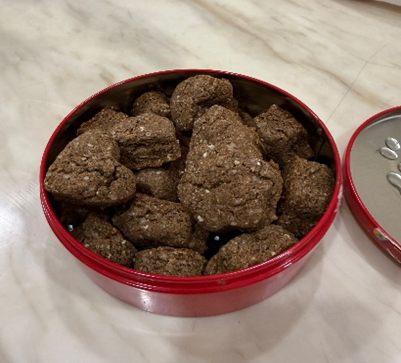
Figure 2. Preparation of cookies
RESULTS:
Moisture content was determined by the method prescribed in the chemical Analysis of the food. As stated in the procedure, sample of the cookies were weighed precisely in a moisture dish and were kept in hot air oven for about 2 hours at 105°C and then it was cooled in desiccators and again weighed. The process of heating was repeated for 30 min. and then again cooled and weighed. The procedure was done until the variance between two successive weighing became lessthan that of 0.001 gm. Moisture content in the test sample was calculated which was based on the equation given below:

Where,
W1 = Weight of moisture dish with sample before drying;
W2 = Weight of moisture dish with sample after drying;
W = Weight of moisture dish.
Total ash content of the prepared cookies was determined by the following procedure. According to the given procedure 1 gm of cookie sample was taken in a tarred crucible and it was burnt on the Bunsen burner until all the carbon was burnt. Then Sample was let to be cooled, weighed and then again the procedure was repeated until the weight became constant. After that the total Ash value were calculated based on the equation given below:

Where,
W2 = Weight of empty dish;
W = Weight of sample taken;
W1=Weight of crucible with sample after complete burn.
For the analysis of total alcohol/Water extractive value, 5 gm of cookies powder sample were taken in 250 ml of volumetric flasks in which 90% ethyl alcohol or Distilled water were added and was kept aside for 24 hours. After the completion of 24-hour samples were filtered and were taken in porcelain dishes. All the samples of alcoholic and water extracts were heated at the temperature of 100°C for evaporation, following samples were cooled down and advance calculations were doneby the following method.
Calculation: 5 gm of sample gives 4x of alcohol extract so 100 gm of sample gives = 80 × x/4 Where, x=Sample after drying. [2]
Nutritional analysis
Protein estimation was done by prescribed procedure in the given DGHS Manual. According to this method 200-300 mg of cookies powder were taken in 4 test tubes and then 3 gm of catalyst (K2SO4+CuSO4) was added in it. 10 ml of concentrated sulphuric acid H2SO4 was added to all tubes and then digested for 3-4 hrs. Later these samples were distilled with boric acid, potassium permanganate and 40% of Sodium hydroxide and then were titrated with acid. This titrant was neutralized with ammonia and by this % of protein was calculated by using following equation.

According to the given procedure, 2 gm of the cookie sample was kept in Soxhlet apparatus with diethyl alcohol and petroleum ether in the ratio of 1:1 for 6 hours then ether was removed by the process of distillation and were dried in hot air oven at 110 ± 1°C and later on was cooled in a desiccator. Taken dried sample was weighed again. The left Residue was washed with 2 to 3 ml of diethyl ether and the same process was repeated until the weight became constant.
% of fat content = (M1-M2) x 100/weight of the sample
Where,
M1 =Weigh of Round bottom flask with fat;
M2 = Weigh of the Round bottom flask.
Carbohydrate estimation was done by the procedure given in DGHS Manual. For estimation of carbohydrate 2 gm of cookie sample powder was taken in a 200 ml of volumetric flask and then 50 ml of lead acetate was added. 6 ml of 0.5 N HCl was added and heated on hot water bath. After heating, the sample was cooled and neutralized with 6 ml of 0.5 N NaOH, lastly the sample volume was makeup upto 200 ml using distilled water, Invert sugar was determined before inversion by Lane and Eynon method.
According to this method 10 ml of mixed Fehling A and B solution was taken in the conical flask and titration was passed out with sample solution within 3 min without inversion by using 1% aqueous Methylene Blue as an indicator.
Reducing sugar % before inversion =F X10/C X R
Where, C = concentration; R = Reading; F = Factor of Fehling solution
Total invert sugar % after inversion =FX10/C X R
C = concentration; R = Reading; F = Factor of Fehling solution
Total carbohydrate = total invert sugar after inversion – invert sugar % before inversion x 0.95
Total energy was valued on the basis of carbohydrates, proteins and fats content of cookie sample.
Energy (Kcal) = Fat × 4 + Protein × 9 + Carbohydrates × 4
Sensory attributes such as flavor, aroma, taste, appearance and odor were evaluated by 9- point hedonic scale, total 64 people participated in this survey. Questionnaires and mouth rinsing water were conferred to taste panelist, through the session product was introduced and questions were explained to the volunteers. The obtained data were analyzed by Microsoft Excel on the basis of age group. [27]
Table 3: Chemical and physiochemical parameter
|
Sr. No |
ChemicChemical and physiochemical parameters |
Results |
|
1 |
Ash content |
7.10% |
|
2 |
Moisture content |
6.91% |
|
3 |
Alkaloid |
Present |
|
4 |
Alcohol extraction |
6.58% |
|
5 |
Water extraction |
5.30% |
|
6 |
Fat content |
14.04% |
|
7 |
Carbohydrate content |
60.51% |
|
8 |
Protein content |
11.65% |
|
9 |
Total energy |
414.9874 Kcal |
Sensory Evaluation
Taste is a strategic parameter of sensory evaluation. The product might be captivating and having an eminent energy but sans of righteous taste it is likely to unaccepted. So, on the basis of sensory evaluation, it is found that due to use of Tecoma stans leaves its mean score was 90-95% among the age group of 18-40.
Flavour
Flavour is an integral part of taste that plays a vital role in the acceptance of any food material. Used flavour of Tecoma stans leaves and coco was found to be highly appreciable among all the volunteer of sensory evaluation because its smell act as an appetizer, because of that it means score on excel was found to be 90-95% .
Aroma and Color
Aroma or fragrance of foods are the indiscernible part of the acceptance and play a crucial role in mouth feel. Aroma is the first sign of consumer to choose any food for consumption as well as color of food product is a sign of acceptance that have a great impact on the choice of any product. Aroma and color show an elegant effect on the acceptance.
The outcome of results showed that strong combined Tecoma stans leaves, Ashwagandha and Tulsi powder’s aroma influenced the people greatly.
Overall Acceptance of Cookies
It is very important for food, snacks, and soft drinks that after taking the bite or ship it must give a palatable and flavourful effect on tongue so it could be taken easily. The results of sensory evaluation on the basis of taste, flavour, crispiness and aroma were found to be appreciable with medicated effect.
CONCLUSION
The present study successfully formulated and evaluated polyherbal antidiabetic cookies using medicinal herbs such as Tecoma stans, Tulsi, Ashwagandha, along with oats and black gram flour. The results of physicochemical and nutritional analysis showed that the prepared cookies possess good nutritional value, with high carbohydrate content (60.51%), adequate protein (11.65%), and fat (14.04%), providing a total energy value of 414.98 kcal. The moisture content (6.91%) and ash value (7.10%) were within acceptable limits, indicating good stability and mineral content. Phytochemical screening confirmed the presence of bioactive constituents such as alkaloids and other beneficial compounds.
Sensory evaluation results indicated that the cookies were highly acceptable in terms of taste, flavor, aroma, color, and overall palatability, with acceptance scores of 90–95%. The incorporation of polyherbal ingredients enhanced both the functional and therapeutic value of the cookies without compromising consumer acceptability.
REFERENCES






B. Aasritha, G. Naga Deepika, K. Shanmukhi, D. Cherishma Sri, M. Nandini, Dr. I. V. Rama Rao, Dr. Y. Ankamma Chowdary, Innovative Polyherbal Cookies for Dietary Management of Diabetes, Int. J. of Pharm. Sci., 2026, Vol 4, Issue 3, 45-51. https://doi.org/10.5281/zenodo.18839400
 10.5281/zenodo.18839400
