
School of Pharmacy, Desh Bhagat University, Mandi Gobindgarh,147301, Punjab, India
The Diabetes mellitus is a metabolic disease that is a problem of the whole world and is classified as a metabolic disorder as diabetes is a condition that is characterized by restricted insulin activity and long-term hyperglycaemia. Traditional antidiabetic medications have restrictive bioavailability, high costs as well as undesirable side effects, thus necessitating exploring nanotechnology-based therapeutic systems. AuNPs have become promising nanocarriers because of their biocompatibility, stability, surface properties that can be readily altered, and because they can be readily functionalized. Plant-based phytochemicals are easier to green synthesize into AuNPs and offer an environmentally-friendly method that increases therapeutic effectiveness with reduced toxicity. Phytoconstituents like polyphenols, flavonoids, alkaloids, and terpenoids serve as natural reducing as well as capping agents, enhancing stability and biological functionality of nanoparticles. Recent research has revealed that AuNPs conjugated with phytochemicals, including quercetin, curcumin, berberine, and resveratrol, have strong antidiabetic and antioxidant activities because they affect ?-amylase and ?-glucosidase inhibition, control the oxidative stress, and enhance insulin sensitivity. Besides, drug delivery via AuNPs increases solubility, extended circulation, and specific release of phytochemicals to pancreatic 8 cells. The synergistic approach of nanotechnology and phytotherapy has a significant possibility in the development of the next-generation therapeutic approaches in diabetes. This review identifies the recent breakthroughs in the field of AuNP-based phytochemical delivery systems, their synthesis, characterization, pharmacological action, and biomedical applications in the treatment of diabetes.
Diabetes Mellitus (DM) is a chronic metabolic disorder characterized by the increased blood sugar levels as a result of the problems with the insulin release, insulin activity, or both [1]. It has become an epidemic in the world with the International Diabetes Federation (IDF) estimating that there were 537 million adults with diabetes worldwide in 2021, which is expected to increase to 643 million by 2030 [2]. This continuously rising trend poses a challenge to the health care systems of the world. The two major categories of the disease include Type 1 diabetes(T1D) which is an autoimmune disease that causes absolute insulin deficiency and Type 2 diabetes (T2D), which is over 90 percent of the diseases and is characterized by insulin resistance and insulin deficiency [3]. The ultimate aim of managing diabetes is to ensure that the amounts of blood glucose remain within a physiological range in order to avoid acute complications, as well as to reduce the risk of devastating long-term macrovascular (e.g., cardiovascular disease) and microvascular (e.g., retinopathy, nephropathy, neuropathy) complications. The modern treatment repertoire consists of insulin treatment (which is necessary due to T1D and progressive T2D) and numerous oral hypoglycaemic drugs like metformin, sulfonylureas, thiazolidinediones, and SGLT2 inhibitors. These treatments have been known to be effective but they have their major limitations. They contain such side effects as hypoglycaemia (particularly in combination with insulin and sulfonylureas), weight gain, gastrointestinal, and in certain instances cardiovascular issues. Moreover, much of current medications are aimed at symptomatic therapy of hyperglycaemia but not on the pathophysiological processes that lead to the progression and complications of the disease, e.g., oxidative stress and chronic inflammation [4]. This scenery highlights how acute and unaddressed is the necessity to develop new and safer, and more effective therapeutic approaches, which can address the causes of diabetes.
1.1. Pharmaceutical Relevance of Phytochemicals in Diabetes
Phytochemicals (cool bioactive compounds of the plants) have begun to have waves in the scientific world in the quest to develop safer and multi-targeted alternatives. I have heard that in traditional medicine many centuries past, plant extracts were utilized to treat the symptoms of diabetes (so, of course, it is not a novelty). Nowadays, a bunch of specific phytochemicals has been identified by modern science: flavonoids (quercetin and kaempferol), alkaloids (berberine), polyphenols (curcumin and resveratrol) and terpenoids, all exhibiting excellent antidiabetic properties [6]. The pharmaceutical usefulness of such compounds is exceedingly astonishing since they operate by acting in various ways. These phytochemicals form a synergistic effect as compared to most of the synthetic drugs which zoom in one single pathway by modifying several processes that cause diabetes. Their activities include: - Increasing the response to insulin and glucose uptake in the peripheral tissues through the activation of the AMPK and PPAR-7 pathways [7]. Preventing the apoptosis and oxidative stress of the pancreatic 8 cells that promote the secretion of insulin. Blocking the enzymes that break down carbohydrates (alpha-amylase, alpha-glucosidase) in the intestines, and, as such, postprandial glucose levels fall. In the same vein, potent antioxidant and anti-inflammatory effects can be added to the mix, which directly negates the oxidative stress and inflammation chronicity (such as chronic inflammation) that are typical in the pathology of diabetes [8]. Despite all that potential, the clinical translation of phytochemicals is thwarted due to their inherent physicochemical unfavourable characteristics of poor aqueous solubility regarding gastrointestinal tolerance, huge first-pass metabolism, and in general, poor oral bioavailability. Even the strongest compounds do not reach the bloodstream or reach target tissues in large concentrations to actually perform their intended action which is actually limiting the usefulness of them in practice.
1.2. Role of Nanotechnology in Enhancing Drug Delivery of Natural Compounds
Nanotech is completely transforming the situation as concerned the entry of phytochemicals into the body. Medical drugs that are delivered using nanoparticles (NDDS) are able to shield the drug against disintegration, enhance its ability to dissolve in water, allow us to regulate the discharge level, and enable the drug to be directed directly to the location of its application. Among the available nanomaterials, gold nanoparticles (AuNPs) are the most suitable in delivering these plant-based compounds. AuNPs have super biocompatibility, in effect are chemically inert, and are low-toxic. We can gratuitously functionalize their surface, and the options are insane. This allows us to optimize their movement and location within the body by adjusting their dimensions and chemistry [10]. When it comes to the treatment and phytochemical delivery of diabetes, AuNPs are the best choice since they: Increase Solubility and Stability Encapsulation or conjugation helps to protect the hydrophobic phytochemicals against the severe environment in the guts and prevents their aggregation. Enhance Bioavailability: AuNPs may be absorbed along the intestinal lining, by a number of endocytic routes, bypassing the classic pre-systemic metabolism. Allow Selective Delivery Their surface can be conjugated with a special ligand, such as carbs or antibodies, to target organs, such as the liver, pancreas or fat tissue, with increased potency and reducing the number of off-target side effects [12]. Provide Synergistic Effects: It is possible by some to indicate that the AuNPs themselves possess inherent anti-hyperglycaemic, antioxidant, and anti-inflammatory effects and thus can be utilized synergistically with the phytochemical-payload to achieve an even greater therapeutic outcome. The Articles in Pharmaceutical Sciences on Gold Nanoparticles (AuNPs) bring to my interest. Nanotech has completely transformed the fields of pharmaceutical science through providing something new in which we can approach the very old and longstanding issues of drug delivery [13]. Of all the series of nanomaterials, gold nanoparticles (AuNPs) have emerged as the best option due to the combined physical, chemical, and biological characteristics. They are biocompatible by nature, tunable, and multi-functional, which makes them ideal in medical applications - diagnostics and imaging, accurate drug delivery and photothermal therapy [14]. This section answers the question of why AuNPs are important in pharma, our synthesis of them, and how we engineer them to be smart in the therapies.
2. Physicochemical and Pharmaceutical Properties Relevant to Formulation
A combination of exceptional physicochemical characteristics, which can be precisely adjusted throughout the synthesis and functionalization, contributes to the suitability of the use of to deliver drugs with AuNPs [37].
Size and Shape: AuNPs are typically prepared within the size range of 1 -100nm, which allows the particles to travel across biological barriers with ease. Their size directly influences the duration of their stay within circulation, the distribution of the same, and the uptake within the body cells [39]. Smaller NPs less than 10nm, are probably cleared very rapidly by the kidneys, but NPs larger than 100nm may become trapped in the spleen and liver. Long circulation sweet spot and the improved permeability and retention (EPR) effect of tutors or inflamed tissues are usually 10-100nm. In addition, gold nanoparticles (AuNPs) have shape, which, in turn, defines their optical properties and surface-area-volume ratio, respectively, that determines their drug loading capacity and cell interactions [42].
Surface Plasmon Resonance (SPR): It is a typical optical phenomenon of AuNPs. When the light strikes the conductive electrons on the surface, they move in unison resulting in a strong absorption and scattering at a given wavelength. The tuning of the SPR peak can be accomplished, e.g., spherical AuNPs are absorbed in the green-blue range (, visible light looks red, whereas gold nanorods can be programmed to be absorbed in the near-infrared (NIR) range, which tissues are relatively transparent [45]. This enables their possible use in bioimaging, photothermal therapy, and light-controlled drug delivery.
Surface Charge and Functionalization: Stability in Suspension and Interaction with Biological Membranes: It is the zeta potential of AuNPs that determines the stability of this material in suspensions and its interaction with biological membranes [47]. The positively charged particles have normally better absorption by the cells due to electrostatic adherence with the negatively charged cell membrane, yet are also more toxic. Particles with negative charges or no charge tend to move through the whole body longer. Noteworthy, gold has a great affinity to thiol groups permitting the stable and effortless binding of diverse molecules using an Au-S bond and drugs, targeting ligands, and polymers can be immobilised on the surface rendering it highly customisable.
Biocompatibility and Inertness: Bulk gold is biologically inert, and has a long history of use in medicine (e.g., in dentistry, rheumatoid arthritis treatment). The equivalent low-reactivity is also true of AuNPs, particularly when they are modified with biocompatible polymers such as polyethylene glycol (PEG). Nevertheless, biocompatibility remains a factor of size, shape and surface chemistry and as such each new formulation must be given careful toxicological testing [15].
2.1. Synthesis Methods for AuNPs with Pharmaceutical Applications
The method of synthesis dictates the critical quality attributes (CQAs) of AuNPs-size, shape, dispersity, and surface chemistry which in turn govern their safety and efficacy. The three primary synthesis routes are chemical, green, and biogenic.
Chemical Synthesis: The most classic and widely used method is the chemical reduction of chloroauric acid (Haul?) using citrate (the Tonkovich method), which produces spherical, water-soluble AuNPs of ~10-20 nm [16]. For finer size control, the Brust-Schifrin method uses a two-phase system (water-toluene) with a strong reducing agent (sodium borohydride) and a thiol stabilizer (e.g., alkanethiols) to produce monodisperse AuNPs in the 1–5 nm range that are soluble in organic solvents. Chemical methods offer excellent control over size and morphology but often involve toxic chemicals and solvents (e.g., CTAB used in nanorod synthesis), which require rigorous purification to avoid cytotoxicity, adding complexity to pharmaceutical scaling.
Green Synthesis: To address the environmental and toxicity concerns of chemical synthesis, green chemistry approaches have been developed [17]. This involves using natural extracts from plants, algae, or fungi as both reducing and stabilizing agents. For example, extracts rich in polyphenols, flavonoids, or terpenoids can reduce Au³? to Au?, forming stable, bio-compatible AuNPs. The advantages are clear: it is eco-friendly, cost-effective, and often results in NPs with inherent biological activity (e.g., antioxidant properties) due to the capping agents derived from the extract. The main challenges are batch-to-batch variability of the biological extract and less precise control over size and dispersity compared to chemical methods.
Biogenic Synthesis (Microbial): This is a subset of green synthesis that utilizes microorganisms like bacteria, yeast, and fungi. These organisms can intracellularly or extracellularly synthesize AuNPs through enzymatic reduction. For instance, the reductase enzyme in Fusarium exospores can efficiently produce AuNPs [18]. While this method is highly sustainable and can produce particles with unique shapes, it is often slower and requires stringent control over microbial culture conditions, making it less amenable to large-scale pharmaceutical production compared to plant-based green or chemical methods.
2.2. Functionalization Strategies for Drug Targeting and Release Modulation
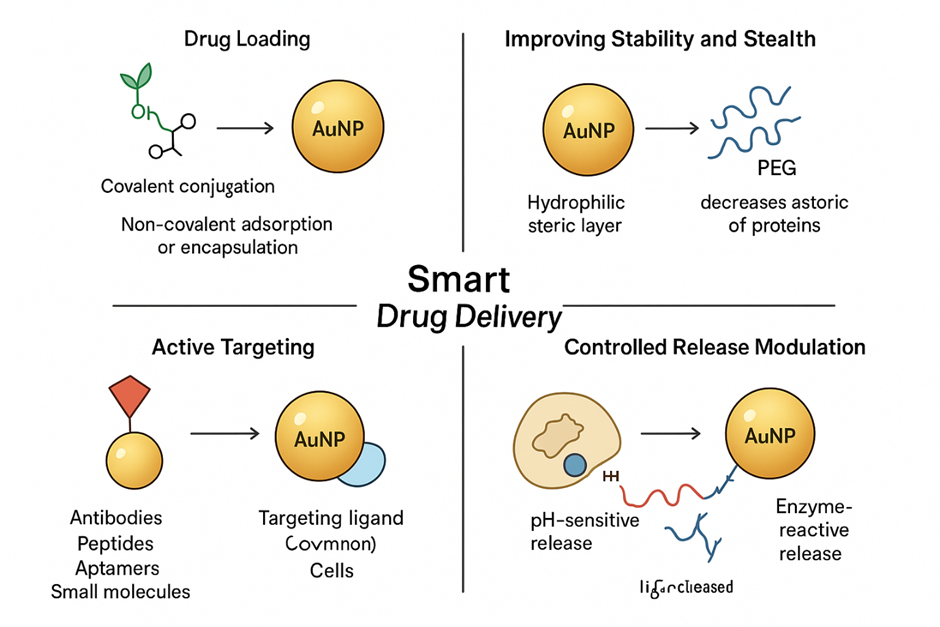
In our course, we get the information that the actual magic of gold nanoparticles (AuNPs) in the delivery of drugs occurs when you employ cool stuff tricks in the functionalization of the calls, transforming those boring metal beads into what are called smart systems, which, in fact, target the cells [19]. Drug Loading: In principle, there are two major methods to simply stick phytochemicals onto AuNPs: Covalent conjugation the effective formation of an actual covalent bond (amide, ester, etc.) between the drug molecule and the gold surface or a stabilizing polymer shell; Non-covalent adsorption or encapsulation in this case the drug merely physiologically adsorbs to the surface or is lodged within a polymer shell or liposome coating the core. The choice of the method is determined by the functional groups of the drug and the rate at which you wish the drug released by the method. Improving Stability and Stealth: To prevent opsonization and clearance by the mononuclear phagocyte system in a short amount of time, we regularly PEG-conjugate AuNPs with polyethylene glycol (PEG). PEG develops a steric layer that is hydrophilic which decreases the adsorption of proteins, prolongs the blood circulation time considerably and allows the particles to passively accumulate in the target tissues due to the EPR effect [20]. Active Targeting; AuNPs are functionalized with targeting ligands that provide cells being targeted with an overexpressed receptor to get beyond passive accrual of nanoparticles and strike with high precision seeing into complications. Common ligands include; Antibodies (baton immunotargetingbodies Antibodies (use in immunotarget Ing) immunotargetingbodies Identities: peptides, including the RGD peptide which binds to the integrins of cancerous cells. Aptamers are high binding affinity short, single-stranded molecules of DNA or RNA. Small molecules small molecules, such as folic acid in cells containing folate receptors. This may be insulin-sensitive cell ligands (such as hepatocytes, adipocytes, or inflamed pancreatic β -cells) in diabetes studies. Controlled Release Modulation: The major property lies in that the drug release is activated at its point of use. This is done well by AuNPs due to its surface plasmon resonance (SPR) [21]. Strategies include: pH-Sensitive Release: pH-sensitive linkers (e.g., hydrazone bonds, etc.) deactivate in the acidic environment of endosomes /lysosomes within cells. Enzyme-Reactive Release: Responsiveness to enzymes Linkers that are cleaved by particular enzymes (e.g., matrix metalloproteinases) expressed in diseased tissues. Light-Released: Utilizing the photothermal effect of Goldings and in particular of nanorods and nano shells. The particles warm upon exposure to NIR light, a heat-labile bond can be broken (e.g. pina), or a heat-sensitive polymer shell can be melted (spatial-temporal) to release drugs accurately.
2.3. Phytochemical Compounds with Antidiabetic Potential
Hey, thus the hunt to find new antidiabetic agents has increasingly been turning to the plant kingdom which is effectively a great storehouse of bioactive material known as phytochemicals. They are natural molecules, they were old, and they are more likely to ionize more than one target at a time which is completely appropriate to do the mechanism of diabetes, which is complex. Phytochemicals are also able to simultaneously target hyperglycaemia, insulin resistance, oxidative stress and inflammation, unlike many single-target synthetic drugs, which provides a considerably more holistic treatment feel [22]. Here we will discuss the principal categories of phytochemical actually exhibiting antidiabetic effects, delve into the pharmacological mechanism of their action, and, above all, identify why we require highly sophisticated delivery vehicles such as gold nanoparticles to deliver them to the target location.
3. Selection Criteria for Pharmaceutical Formulation
The bioactive phytochemicals are not all worthy of conversion to nanoparticles. Their choice to such high level of formulation is predetermined by a complex of particular pharmaceutical and pharmacologic parameters [23].
Familiar Antidiabetic Effectiveness. First of all, there has to be strong scientific data of in vitro, in vivo, and hopefully, clinical research indicating a significant effect on major diabetic parameters: reducing fasting blood glucose levels, increasing glucose tolerance, increasing insulin sensitivity, safeguarding 2 -cell function and alleviating diabetic complications [24].
Poor Bioavailability: The compound is supposed to have intrinsic pharmacokinetic constraints that are unfavourable to its clinical translation.
Low Aqueous Solubility: A lot of polyphenols and flavonoids are highly soluble and thus they cannot be absorbed or dissolved in the gastrointestinal tract.
Low Permeability: lack of efficiency in the influence of passive diffusion across intra intestinal cells [25].
Widespread First-Pass Metabolism: It is subject to hepatobiliary enzyme degradation (e.g. cytochrome P450 enzymes) or conjugation (e.g., glucuronidation, sulfation) before absorption into system circulation.
Poor Permeability: Inefficient passive diffusion across intestinal epithelial cells.
Extensive First-Pass Metabolism: Rapid enzymatic degradation in the liver (e.g., via cytochrome P450 enzymes) or conjugation (e.g., glucuronidation, sulfation) before reaching systemic circulation [26].
Rapid Systemic Clearance: Short half-life in the bloodstream.
Favourable Safety Profile: The drug must possess a large therapeutic index and low intrinsic toxicity as it has been determined by traditional use and toxicology testing. This is to make sure that its bioavailability should be improved by using nano-delivery but that toxicity should not be intensified unintentionally [27].
Existence of Conjugation Functional Groups
To be efficiently loaded onto AuNPs, it is necessary to have the phytochemical have chemical functionalities (e.g., -OH, -COOH, -NH 2) that can be covalently conjugated or adsorbed onto the surface of the nano-particles to be loaded and provide control over loading and release of the phytochemicals [28].
3.1. Flavonoids (Quercetin, Catechins): All flavonoid group members are simply Polyphenols and they are present in abundance- in fruits, vegetables as well as tea. They have potent antioxidant compounds that are the key in combating diabetes.
Quercetin: This flavanol occurs in apples, berries and onions. Its antidiabetic effects are complex: by activating the PI3K/ Akt and AMP-activated protein kinase (AMPK) pathways, it increases glucose uptake in skeletal muscle and adipose tissue; inhibiting hyperglycaemia-induced apoptosis in pancreatic 2 -cells [29].
Favourable safety profile.
The drug should also be of large therapeutic index and of low intrinsic toxicity since it is predetermined through the traditional use as well as toxicology tests. The latter is to ensure that its bioavailability needs to be enhanced through the administration with nano-delivery but that toxicity is not enhanced by chance [30].
3.2. In presence of Conjugation Functional Groups.
The phytochemical must also possess chemical functionalities (e.g., -OH, -COOH, -NH 2) which can be covalently functionally removed on the surface of the nano-particles to be loaded and allow control over loading and release of the phytochemicals.
The best phytochemicals with such characteristics are the ones discussed below hence they will be the most suitable ones when they are considered as those that will be delivered through the gold nanoparticles. They are strong scavengers of free radicals and lower inflammatory cytokines such as TNF- alpha and IL. Nevertheless, quercetin has a very low oral bioavailability (less than 2 percent) that is caused by low solubility, large metabolism, and rapid elimination [31].
Catechins (and especially Epigallocatechin Gallate EGCG): This is one of the most active antioxidant flavonoids which is very abundant in green tea. It enhances the insulin sensitivity through: altering the insulin signalling pathway; it also suppresses major carbohydrate-digesting enzymes (2alpha-amylase and 2alpha- glucosidase) and lowers postprandial glucose spikes. It also causes fatty acid oxidation and protects against diabetic nephropathy and retinopathy [32]. EGCG is however, chemically unstable in both neutral and alkaline intestinal conditions, has low permeability and easily undergoes methylation and glucuronidation, which weaken its use on a therapeutic level badly [33].
3.3. Polyphenols (Resveratrol, Curcumin)
This heterogeneous group has non-flavonoid compounds known to have strong antioxidant and anti-inflammatory those are known.
Resveratrol: Resveratrol is a famous sirtuin 1 (SIRT1) activator (vitamin, grape, red wine); a protein deacetylase that activates longevity and metabolic health. Its stimulation resembles caloric restriction in enhancing the functions of the mitochondria and the insulin sensitivity of the peripheral tissues problems. It also has the effect of activating the AMPK, which enhances glucose intake and suppressing hepatic gluconeogenesis [34]. Clinically, it has demonstrated an advantage in enhancing glycaemic control of patients who have type 2 diabetes. It is however, characterized by a very low solubility in water and high phase II rate of metabolism with a bioavailability of less than 1 percent 7 [35].
Curcumin: Curcumin is the yellow pigment present in turmeric; curcumin is a pleiotropic molecule that exhibits high anti-inflammatory and antioxidant effects. It enhances the insulin resistance through inhibiting the NF-KB inflammatory pathway, and inhibiting the expression of cytokines like TNF-a [36].
It also improves the operation of the β-cells and reduces blood glucose levels in the liver, and prevents diabetic complications such as neuropathy and heart disease. However, in spite of its high potential, curcumin has a negative reputation since it has poor gastrointestinal absorption, hepatic metabolism, and a very low systemic bioavailability, which are the main obstacles to its clinical use [37].
3.4. Alkaloids (Berberine)
Alkaloids are nitrogen compounds, usually containing strong pharmacological potential. An interesting alkaloid is the berberine (present in plants such as Berberis aristata (also known as tree turmeric) and coatis chinensis). It has been applied in traditional medicine long before but the key behind its actual usefulness is the activation of AMPK in the liver, the body, and fat tissue- a sort of reverse-trick into your body to exercise [38]. This causes an increase in glucose uptake and improved fat metabolism and a decrease in liver glucose production. It has proven through clinical trials to reduce blood sugar roughly the same as metformin does. The absorption of Berberine in the gut is low as it is positively charged and expelled by the P-glycoprotein. This is it also possesses a very small half-life and at high doses may make the stomach sick thus nano-encapsulation is being considered by the researchers as a remedy.
3.5. Terpenoids and Other Bioactive
This large class of compounds derived from isoprene units includes various structures with antidiabetic benefits
Ginsenosides: These triterpenoid saponins from Panax ginseng (ginseng) improve insulin sensitivity, promote β-cell survival, and modulate energy metabolism. Their complex structure leads to variable and often low bioavailability [39].
Carnosol and Carno sic Acid: These diterpenes are present in rosemary and sage and are very effective antioxidants and can activate the Nrf2 pathway and increase antioxidant levels in our bodies.
Other Notable Compounds:
Sulforaphane: An isothiocyanate of broccoli which is known as Sulforaphane, activates Nrf2, decreases oxidative stress, and enhances glucose tolerance.
Gym emic Acids (triterpene saponins from Gymtolerance Ema Sylvestre): Known as "sugar destroyers," they inhibit sugar absorption in the intestine and promote β-cell regeneration [41].
Table 1: Key Phytochemicals, Their Actions, and Delivery Challenges
|
Phytochemical |
Main Modes of Action for Diabetes |
Major Absorption and Distribution Hurdles |
Ref |
|
Quercetin (Flavonoid) |
Activates cellular energy sensors (AMPK), Reduces oxidative stress, Counters inflammation |
Poor water solubility, quickly broken down by the body |
[42] |
|
EGCG (Flavonoid) |
Blocks digestive enzymes, Powerful antioxidant, Stimulates energy metabolism |
Chemically unstable, Difficulties crossing gut lining, Rapid elimination |
[43] |
|
Resveratrol (Polyphenol) |
Activates longevity pathways (SIRT1/AMPK), Improves mitochondrial function |
Very poor solubility, extremely rapid breakdown and excretion |
[44] |
|
Curcumin (Polyphenol) |
Suppresses master inflammatory switch (NF-dB), Strong anti-oxidant and anti-inflammatory |
Minimal solubility, very little gets absorbed, Quick metabolic clearance |
[45] |
|
Berberine (Alkaloid) |
Potently activates AMPK, Reduces blood lipid levels |
Limited uptake, pushed out of cells by efflux pumps, can cause stomach upset |
[46] |
|
Ginsenosides (Terpenoid) |
Improves cell response to insulin, Protects insulin-producing beta cells |
Large molecule size hinders absorption, Complex transformation by gut microbes |
[47] |
4. Formulation Strategies for AuNP–Phytochemical Conjugates
To transform the theory of AuNP into the real-world of the treatment will actually require a thorough design and fine-tuning of the formulation to ensure that AuNP-phytochemical hybrids become a reality [48]. It translates to choosing the most appropriate route to couple the phytochemical to the nanoparticle, adjusting the size and the surface properties of the particle to achieve optimal biological activities, encoding it to release the drug at the site of interest and ensuring the stability of both the cargo and the carrier. In the following paragraph, the most important formulation strategies that can be used to define the degree of effectiveness of these advanced nanotherapeutics are explored.

4.1. Encapsulation, Conjugation, and Surface Modification Approaches
Our method of attaching phytochemicals to gold nanoparticles (AuNPs) is of significant concern since it influences drug loading capacity, stability of the attachment, and release of the drug. Normally, we apply two tricks; encapsulation and conjugation and we tend to polish the surface, as well [49].
Encapsulation:
In this method, the phytochemical remains within some sort of bubble be it a layer of lipid or a polymer shell around the AuNP core. The gold core also may even serve as a stabilizer or even a means of photothermal therapy and the bubble is the real drug carrier.
Lipid/Polymer Encapsulation:
In this case, the AuNP is enclosed in a liposome or polymer particle resembling a gold core shell. Curcumin or resveratrol have been used as a hydrophobic goodie that dissolves into the lipid bi-layer or polymer matrix, with a high loading capacity, and protecting the drug, as well, against the external world [50].
Silica Coating:
Here we encircle the AuNP with a mesoporous silica shell. The phytochemical is then wedged into the large pore net where you can load a ton of drug and then cap the pores with so-called gatekeepers to regulate the release. Conjugation: Rather than a bubble we simply adjoin the phytochemical straight to the AuNP surface where a covalent bond (or a coordinate link) is typically formed [51].
Covalent Conjugation:
The most widely used method uses the love affair of gold towards thiols (–SH). We modify the drug to have a thiol-terminated linker, such as PEG-SH, so that it attaches well to the AuNP. Amide coupling of the surface carboxyl groups with amine groups of the drug is also used by us. This provides us with exact specifications on the number of drug molecules on the NP and makes them bonded until we release them.
Avoiding contacts between surfaces is a common practice in the formation of nanopores and nanoparticles [53].
In fact, certain phytochemicals (volumetric golden, in particular, polyphenolic, such as EGCG or quercetin) have the ability to reduce gold ions during green synthesis and stabilize the resulting AuNPs non-covalently: electrostatically, hydrogen bond, 8 -8 stacking. It is easier, but has lower control of loading and release as compared to covalent connections [54].
Surface Modification of Stealth and Targeting: Whichever loading strategy we choose, then we nearly always load the surface again. PEGylation, which is the insertion of PEG chains, is the recommended step to conceal the particles to the immune system and allow an extended length of time in circulation. To achieve active targeting, we attach to the tip of the PEG, or we attach to the surface of the AuNP itself, antibodies, peptides (such as RGD) or small molecules (such as folic acid) so that they bind to particular receptors that are overexpressed on the target cells, e.g. insulin receptors or GLUT transporters [55].
4.2. Optimization of Particle Size, Zeta Potential, and Drug Loading
Our method of attaching phytochemicals to gold nanoparticles (AuNPs) is of significant concern since it influences drug loading capacity, stability of the attachment, and release of the drug. Normally, we apply two tricks; encapsulation and conjugation and we tend to polish the surface, as well [19].
Encapsulation:
In this method, the phytochemical remains within some sort of bubble be it a layer of lipid or a polymer shell around the AuNP core. The gold core also may even serve as a stabilizer or even a means of photothermal therapy and the bubble is the real drug carrier [56].
Lipid/Polymer Encapsulation:
In this case, the AuNP is enclosed in a liposome or polymer particle resembling a gold core shell. Curcumin or resveratrol have been used as a hydrophobic goodie that dissolves into the lipid bi-layer or polymer matrix, with a high loading capacity, and protecting the drug, as well, against the external world [57].
Silica Coating:
Here we encircle the AuNP with a mesoporous silica shell. The phytochemical is then wedged into the large pore net where you can load a ton of drug and then cap the pores with so-called gatekeepers to regulate the release [51].
Conjugation:
Rather than a bubble we simply adjoin the phytochemical straight to the AuNP surface where a covalent bond (or a coordinate link) is typically formed.
Covalent Conjugation:
The most widely used method uses the love affair of gold towards thiols (–SH). We modify the drug to have a thiol-terminated linker, such as PEG-SH, so that it attaches well to the AuNP. Amide coupling of the surface carboxyl groups with amine groups of the drug is also used by us. This provides us with exact specifications on the number of drug molecules on the NP and makes them bonded until we release them.
Avoiding contacts between surfaces is a common practice in the formation of nanopores and nanoparticles.
Physical Adsorption:
In fact, certain phytochemicals (volumetric golden, in particular, polyphenolic, such as EGCG or quercetin) have the ability to reduce gold ions during green synthesis and stabilize the resulting AuNPs non-covalently: electrostatically, hydrogen bond, 8 -8 stacking. It is easier, but has lower control of loading and release as compared to covalent connections [54].
Surface Modification of Stealth and Targeting:
Whichever loading strategy we choose, then we nearly always load the surface again. PEGylation, which is the insertion of PEG chains, is the recommended step to conceal the particles to the immune system and allow an extended length of time in circulation. To achieve active targeting, we attach to the tip of the PEG, or we attach to the surface of the AuNP itself, antibodies, peptides (such as RGD) or small molecules (such as folic acid) so that they bind to particular receptors that are overexpressed on the target cells, e.g. insulin receptors or GLUT transporters [55].
4.3. Controlled and Targeted Release Profiles
The primary benefit of the AuNP systems is that, they allow the us end route to be in the passive release mode, but instead, acquire spatial and temporal control over drug release. It implies that we will be able to directly hit the drug at the target site and limit the exposure of the system to a lowest amount possible [49].
Stimulus-Responsive Release: In principle, you can design AuNP -phytochemical conjugates to release their cargo on the detection of certain internal or external stimuli.
pH-Responsive Release: Endosomes and lysosomes are slightly acidic (p-5.0-6.0) when the nanoparticle has entered a cell, and we can use this fact [58]. One of the strategies to ensure that the particle remains in circulation in blood (pH 7.4) is to approach the drug with acid-sensitive obsidians, like hydrazones or acetals to ensure that the drug is released only when the particle enters the acidic cell interior [59].
Enzyme-Linked Release: In diabetic patients, particular enzymes, including matrix metalloproteinases or esterases are excessively expressed. By designing linkers that these enzymes are capable of cleaving, the drug will release in the exact location that it is required in the sick tissue [60].
Light -Triggered Release (Photothermal): A nice characteristic of AuNPs is that you can release drugs in response to light. On heating the gold nano shells or nano-rods when you shed near-infrared (NIR) waves, they become hot. The fact that a thermosensitive polymer shell (e.g. poly (N -isopropylacrylamide)) can be melted or that a heat-labile covalent bond can be broken provides a rapid burst of drug release with excellent spatial and temporal resolution [61].
Targeted Release: Adding active targeting ligands (see Section) to stimuli-responsive linkers, you have what is known as a so-called double-targeting effect. The nanoparticle is targeted in the first instance (spatial targeting) to the right tissue and in the second instance (temporal targeting), the drug is liberated only after being taken up or when you stimulate it with an external stimulus [62].
4.4. Stability Enhancement of Labile Phytochemicals
Several powerful phytochemicals are very labile that is, they breakdown quickly when exposed to light, oxygen or change in pH during storage and transit along the GI tract. AuNP formulation offers a buffering system [63].
Degradation Protection: A physical protective layer of a polymeric or lipid shell protects the phytochemical by keeping it in a hostile environment. As an example, curcumin entrap into a PLGA shell, or conjugation with an AuNP exhibit markedly slower degradation in physiological buffer than a free form of curcumin [23].
Prevailing Premature Metabolism: To keep the phytochemical from being conjugated and inactivated in the first-pass metabolism, conjugation or encapsulation may be employed to sterically inhibit the site of the relevant metabolic enzyme(s) (e.g., UDP-glucuronosyltransferase). This enables a higher percentage of the active compound to get to the systemic circulation [64].
Better Shelf-Life: A lyophilized, stable suspension of AuNP-phytochemical conjugates can be obtained, which, when reconstituted, offers the labile drug much improved stability and activity than a solution of the free one.
CONCLUSION
As a student, who researches on modern studies, the use of gold nanoparticles (AuNPs) as a phytochemical delivery system is almost a game-changer in the management of diabetes. It directly addresses the difficult pharmacokinetic issues such as low water solubility, low permeability, and rapid metabolism of the phytochemicals that tend to hinder effective phytochemicals. Incorporating the small size, large surface to volume ratio, and easy functionalization of AuNPs, bioavailability and targeting of these natural therapeutic agents can be enhanced drastically.
The combination of nanomedicine and phytochemistry is not only able to enhance pharmacokinetics but it will also be a path to wiser therapeutic approaches. Further AuNP -phytochemical conjugates might be designed to respond to glucose spikes and release drugs in response to monitor shocks in the future, building a dynamic, closed syndrome of treatment based on the concept of personalized medicine on demand and in real-time in relation to the idea of advanced production presented earlier. This trend to the development of the intelligent use of nanotherapeutics is absolutely consistent with the creation of drug delivery systems tailored to the specifics of patient physiology.
However, the key to translating this potential technology out of the laboratory and to the clinic is addressing the obstacles. The toxicological profile of AuNPs should be thorough and provided over a long period to guarantee patient safety. Also, scalable, reproducible and cost efficient GMP compliant synthesis is another important challenge. In brief, although further studies are required, the synergistic approach of gold nanoparticles and phytochemicals appears to be utterly promising in the context of designing the next line of efficient, safe, and tailor-made diabetes therapeutics.
CONFLICT OF INTEREST: No
ACKNOWLEDGMENT: None
REFERENCES

Kuldeep Kumar, MD Nasiruddin Khan, Ashirwad Kumar, Lalu Kumar, Priyanka Paull, Mohit Kumar, Gold Nanoparticles for Diabetics: Delivery of Phytochemical Compounds, Int. J. of Pharm. Sci., 2026, Vol 4, Issue 2, 994-1010. https://doi.org/10.5281/zenodo.18509500
 10.5281/zenodo.18509500
