View Article

  • Gastro Retentive Drug Delivery System: A Review

  • Sharda School of Pharmacy, Pethapur, Gandhinagar, Gujarat – 382610

Abstract

Buoyancy-Driven Drug Delivery Systems (BDDDS), commonly known as floating systems, represent a crucial strategy for optimizing the therapeutic performance of orally administered drugs that exhibit a narrow absorption window. This comprehensive review focuses specifically on the systematic methodology required to design and optimize these complex floating formulations to ensure reliable gastric retention. The review establishes the clinical necessity for prolonged gastric residence time (GRT) in managing chronic conditions, exemplified by the absorption challenges of Dihydropyridine Calcium Channel Blockers. The core of the article details the application of a quality-focused development paradigm for system optimization. This involves the rigorous identification, control, and functional correlation of Critical Material Attributes (CMAs) (e.g., polymer viscosity, concentration) and Critical Process Parameters (CPPs) (e.g., compression force) with the desired Critical Quality Attributes (CQAs). Key CQAs discussed include rapid Floating Lag Time (FLT), extended Total Floating Duration (TFT), optimal swelling kinetics, and stable sustained drug release[5]. By detailing this scientific approach, this review demonstrates how to reliably manufacture BDDDS to deliver predictable and superior performance.

Keywords

Buoyancy-Driven Drug Delivery, Floating Dosage Form, Gastroretentive System, Systematic Optimization, Gastric Residence Time, Critical Quality Attributes, Sustained Release.

Introduction

1.1. Gastroretentive Drug Delivery Systems (GRDDS)

Gastroretentive Drug Delivery Systems (GRDDS) are engineered to counter the limitations of rapid GI transit by physically prolonging the Gastric Residence Time (GRT) [1]. By retaining the dosage form in the stomach, GRDDS maximize drug release at the optimal site of absorption [2]. This strategy is vital for drugs that exhibit site-specific absorption in the upper GI tract, have limited stability at the higher pH of the lower intestinal milieu, or possess short biological half-lives, requiring sustained release at the site of absorption [3].

Objectives [4],

  1. To review the physiological challenges in oral drug delivery, specifically relating to narrow absorption windows in the context of chronic hypertension management.
  2. To outline the fundamental principles and classification of buoyancy-driven gastroretentive drug delivery systems, highlighting their mechanical and formulation differences.
  3. To detail the application of a systematic development paradigm for optimizing the performance of floating systems by identifying and controlling critical variables.
  4. To summarize the essential in vitro evaluation parameters used to characterize the critical performance attributes of buoyancy-driven systems.

1.2. Floating System

This review focuses specifically on the Buoyancy-Driven Drug Delivery System (BDDDS), or floating systems, which are a highly favored GRDDS approach due to their reliability in achieving GRT extension. Flotation is achieved by ensuring the dosage form maintains a net density less than that of gastric fluid (< 1.0 g/mL) by controlled gas generation or effective air entrapment within a hydration barrier [5].
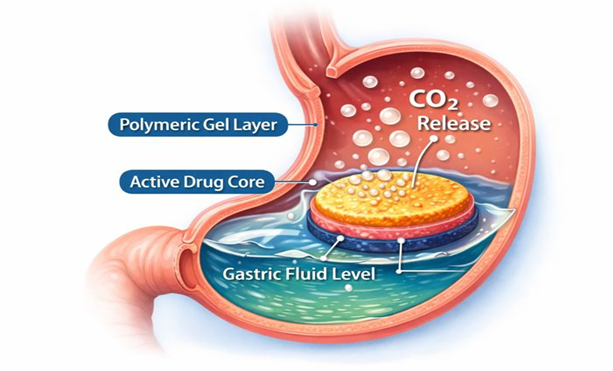
FIGURE: 1 Floating System

The two primary approaches are Effervescent Systems (using gas-generating components like sodium bicarbonate) and Non-Effervescent Systems (using highly porous matrices or swelling hydrocolloids to trap air [6].

Classification of floating system:

  1. Single Unit Floating Dosage Systems
    1. Effervescent system
    2. Non-effervescent Systems
  2. Multiple Unit Floating Dosage Systems
    1. Effervescent Systems
    2. Non-effervescent Systems
    3. Hollow microspheres
  3. Raft forming system

Table: 1 Good Candidates for Gastroretentive Drug Delivery System [7]

Sr. No.

Drug

Drug Category

Bioavailability (%)

Reason for Suitability in GRDDS

1

Verapamil

Calcium channel blocker

20–35

Narrow absorption window in upper GIT and extensive first-pass metabolism

2

Nifedipine

Calcium channel blocker

45–65

Short half-life and better absorption in stomach/upper intestine

3

Omeprazole

Proton pump inhibitor

35–60

Acid-labile drug, acts locally in stomach, benefits from prolonged gastric retention

4

Atenolol

Antihypertensive

40–50

Absorbed mainly in upper GIT; limited colonic absorption

5

Propranolol

Antihypertensive

4–26

High first-pass metabolism and narrow absorption window

6

Verapamil

Antihypertensive

18–35

Requires controlled release and prolonged gastric residence for improved absorption

7

Diltiazem

Calcium channel blocker

40

Short biological half-life and absorption mainly in upper GIT

8

Lidocaine

Local anaesthetic

35

Poor oral bioavailability due to first-pass metabolism; benefits from controlled release

9

Clarithromycin

Antibiotic

50

Used for H. pylori infection; requires prolonged gastric contact

10

Ramipril

ACE inhibitor

28

Absorbed in upper GIT and undergoes first-pass metabolism

Table 2 Gastroretentive Products Available in Market[8]

Brand Name

Drug

Type of Gastroretentive System

Company / Region

Valrelease®

Diazepam (15 mg)

Floating capsule

Hoffmann-La Roche, USA

Madopar® HBS (Prolopa® HBS)

Benserazide + L-dopa

Floating, CR capsule

Roche Products, USA

Liquid Gaviscon®

Al(OH)? + Mg carbonate

Effervescent floating liquid (antacid)

GlaxoSmithKline

Topalkan®

Al–Mg antacid

Floating liquid alginate

Pierre Fabre, France

Conviron®

Ferrous sulphate

Colloidal gel forming floating system

Ranbaxy, India

Cytotech®

Misoprostol (100 µg/200 µg)

Bilayer floating capsule

Pharmacia, USA

Cifran OD®

Ciprofloxacin (0.5–1 g)

Gas-generating floating system

Sun Pharma, India

Rantac OD®

Ranitidine (300 mg)

Floating system

J.B. Chemicals, India

Dompan SR®

Pantoprazole + Domperidone

Floating tablet

Medley, India

Creon 10000®

Pancreatin

Microcapsules

Abbott, India

MATERIALS AND METHODS [9-12].

3.1. Formulation Materials Selection

The optimization process begins with the critical selection of excipients that directly impact both buoyancy and release kinetics.

Table 3: Formulation Materials

Component

Examples

Classification

Critical Material Attribute (CMA)

Role / Impact on FDDS Performance

Active Ingredient (API)

Drug with narrow absorption window

Drug Substance

Solubility, dose, absorption window

Suitable for sustained release and gastric retention; benefits from prolonged gastric residence time

Polymeric Matrix Agents

HPMC, PEO

CMAs

Molecular weight, viscosity grade, concentration

Forms a strong gel layer controlling drug release; enables air entrapment necessary for tablet flotation

Gas-Generating Agents (Effervescent systems)

Sodium bicarbonate

CMAs

Type, particle size, concentration

Generates CO? on contact with gastric fluid; directly influences Floating Lag Time (FLT)

Lubricants & Glidants

Magnesium stearate, talc

CMAs

Concentration

Excess levels can hinder tablet hydration, delay gel formation, and increase FLT; therefore must be minimized

3.2. Manufacturing Process (Generalized Tablet Formulation) [14].

The tablet manufacturing method, typically direct compression or wet granulation, must be precisely controlled to ensure system functionality.

  1. Blending: Ensuring uniform distribution of the API and excipients is paramount.
  2. Granulation (if applicable): Process parameters like mixing time and solvent volume are CPPs influencing blend flowability and final tablet porosity.
  3. Compression: The Compression Force is a Critical Process Parameter (CPP). It must be carefully optimized to provide sufficient mechanical strength (hardness) while maintaining adequate tablet porosity to allow for rapid fluid penetration and subsequent gas/air entrapment, which is essential for buoyancy.

3.3. Pre- and Post-Compression Characterization [15].

Systematic evaluation is performed to link input variables to initial quality outputs:

  • Pre-Compression: Powder blend characteristics (e.g., bulk density, flowability) are measured to ensure process robustness.
  • Post-Compression (Physicochemical): Mechanical strength (hardness, friability) is measured. These are Critical Quality Attributes (CQAs) directly influenced by the CPP, Compression Force.

Evaluation of Powder Blend[16]

a) Angle of Repose

Angle of repose is defined as the maximum angle possible between the surface of a powder heap and the horizontal plane. It is an indirect measure of powder flow property.

  • Lower angle of repose → Better flow
  • Measured by allowing powder to flow through a funnel onto a flat surface.

Formula:

tan?θ=hr

Where:

  • h = height of powder heap
  • r = radius of base

Angle of Repose (°)

Flow Property

< 30

Excellent

30–40

Good

> 40

Poor

b) Bulk Density

Bulk density represents the total density of powder, including interparticle void spaces.

Formula:

Bulk Density=Weight of powderBulk volume

  • Depends on particle size, shape, and packing
  • Important for tablet compression and uniform die filling

c) Percentage Porosity

Porosity indicates the void space within a powder bed and influences hardness, disintegration, and drug release.

Formula:

%Porosity=Void volumeBulk volume×100

or

%Porosity=Bulk volume – True volumeBulk volume×100

2. Evaluation of Floating Tablets [17]

a) Measurement of Buoyancy Capability

Floating behavior is evaluated by measuring resultant weight in:

  • Deionized water
  • Simulated gastric fluid / simulated meal

Observation:

  • High molecular weight polymers with slow hydration rate show better floating
  • Floating is more prominent in simulated meal medium

b) In-Vitro Floating and Dissolution Behaviour

  • Performed using USP dissolution apparatus
  • USP allows dosage form to sink initially before paddle rotation
  • Conventional methods are not always reliable for floating systems

Key Findings:

  • Use of wire sinkers may inhibit swelling
  • Ring/mesh assembly improves reproducibility
  • Drug release depends on:
  • Swelling behavior
  • Surface exposure
  • Drug solubility in water

c) Weight Variation Test

Performed to ensure dose uniformity.

USP Method:

  • Weigh 20 tablets individually
  • Calculate average weight
  • Compare individual weights with limits

Acceptance Criteria:

  • Not more than 2 tablets outside limits
  • No tablet deviates by more than twice the limit

d) Hardness and Friability

Hardness

Defined as force required to break a tablet under diametric compression.

Instruments used:

  • Monsanto tester
  • Pfizer tester
  • Strong-Cobb tester

Friability

Measured using Roche Friabilator.

  • Speed: 25 rpm
  • Revolutions: 100
  • Acceptable loss: < 1%

Formula:

%Friability=Initial weight – Final weightInitial weight×100

e) Particle Size Analysis & Surface Characterization

(For Floating Microspheres and Beads)

Parameter

Method

Particle size

Optical microscopy

Size distribution

Dry state measurement

Surface morphology

Scanning Electron Microscopy (SEM)

f) X-Ray / Gamma Scintigraphy

Used to track the position of dosage form in GIT.

  • X-ray: Uses radio-opaque markers
  • Gamma scintigraphy: Uses γ-emitting radionuclides
  • Enables:
    • Gastric retention time estimation
    • Correlation with drug release

g) Pharmacokinetic Studies

Essential in-vivo evaluation parameter.

Key Parameters:

  • Tmax
  • Cmax
  • AUC (Area Under Curve)

Observation:

  • Floating systems show higher AUC and delayed Tmax
  • Indicates improved bioavailability and prolonged gastric residence

RESULT & DISCUSSION [18-20].

4.1. The Systematic Development Paradigm for Optimization

The core of BDDDS development is the implementation of a systematic, science-driven approach to define the Design Space. This approach uses structured experimental designs to efficiently map the complex relationships between the input CMAs/CPPs and the final CQAs, allowing the formulator to select optimal manufacturing parameters.

The linkage between input and output is crucial for optimization:

  • Optimizing Buoyancy: The Floating Lag Time (FLT), a key CQA, is optimized by adjusting the Polymer Concentration (CMA) and the Compression Force (CPP). A lower compression force may reduce FLT but also compromise mechanical strength, highlighting the need for optimization within the defined Design Space.
  • Optimizing Drug Release: The dissolution profile (CQA) is primarily controlled by the Viscosity Grade of the Polymer (CMA) and its concentration. Higher viscosity grades or concentrations generally lead to a thicker, stronger gel layer, resulting in slower, more sustained release kinetics.

4.2. In Vitro Performance Evaluation

The optimized formulation must demonstrate functionality and consistency through rigorous in vitro testing:

4.2.1. Buoyancy Test

This test directly confirms the success of the optimization regarding gastric retention. The FLT must be rapid (ideally < 1-5 minutes) to prevent premature emptying, and the Total Floating Duration (TFT) must meet the sustained retention target (typically > 8-12 hours).

4.2.2. Swelling Index and Water Uptake

The Swelling Index must be optimized to ensure it provides sufficient volume increase for air entrapment while forming a controlled-release gel barrier. The rate and extent of swelling are measured over time to ensure consistency across batches[21].

4.2.3. Drug Release Studies

Dissolution testing confirms that the release profile adheres to the target requirements. The data are rigorously analyzed using kinetic models (Korsmeyer-Peppas and Higuchi) to ensure the mechanism of release is understood, predictable, and optimized for sustained action [22].

CONCLUSION

The development of Buoyancy-Driven Drug Delivery Systems for drugs with narrow absorption windows is fundamentally an optimization challenge. The adoption of a systematic, quality-focused approach is mandatory to navigate the complex interdependencies between formulation inputs and performance outputs. By defining a robust Design Space and precisely controlling CMAs and CPPs, formulators can consistently produce dosage forms that achieve reliable flotation, optimal swelling, and highly predictable sustained release. This strategic approach ensures the maximum therapeutic benefit for the patient in the long-term management of chronic diseases.

ACKNOWLEDGEMENT

The authors wish to express their profound gratitude to the Head of the Department of Pharmaceutics, Sharda School of Pharmacy, for providing the necessary laboratory facilities and administrative support to conduct the research that forms the foundation of this review. We also thank the Gujarat Technological University (GTU) for the continued opportunity and resources provided to pursue this area of specialization.

REFERENCES

  1. Singh, S., Gulati, M., & Kaur, T. (2021). Floating drug delivery systems: A comprehensive review of recent progress and advancements. Journal of Drug Delivery Science and Technology, 63, 102500.
  2. Sreeja, C., Suseela, C., & Rao, A. S. (2022). Gastroretentive drug delivery systems: A detailed review on recent patents and formulation strategies. Future Journal of Pharmaceutical Sciences, 8(1), 1-17.
  3. Chobanian, A. V., Bakris, G. L., Black, H. R., et al. (2003). The Seventh Report of the Joint National Committee on Prevention, Detection, Evaluation, and Treatment of High Blood Pressure (JNC 7). JAMA, 289(19), 2560–2572.
  4. Alagawany, M., El-Sayed, O. M., & Khalil, R. M. (2020). Novel approaches for enhancing the oral bioavailability of Calcium Channel Blockers using gastroretentive technology: A systematic review. European Journal of Pharmaceutical Sciences, 143, 105151.
  5. Kushkiwala, A.M., Zankhwala, F.M., Patel, M.D. and Raval, A.M. (2024) ‘Flurbiprofen loaded ethosomal gel: Design, optimization, and anti-inflammatory activity’, International Journal of Research and Analytical Reviews (IJRAR), 11(4), pp. 709–713.
  6. Mrs. Fayeja M. Zankhwala, Mr. Amar M. Raval, Ms. Asefabanu M. Kushkiwala, Mr. Sumit P. Sarvaiya, Ms. Komal K. Raval, Ms. Nikitabahen J. Thakar, Ms. Shilpa V. Barjod, Formulation and evaluation of optimized polymer blends for diclofenac diethylamine transdermal system. The Review of Diabetic Studies, 21(S9), 701–708.
  7. Vaghasiya, H., Pandya, P., & Jethava, A. (2023). Optimization of floating matrix tablets: A systematic approach using experimental design. Pharmaceutical Development and Technology, 28(6), 661-671.
  8. Shinde, S., Tadwee, I. and Shahi, S., 2011. Gastro retentive drug delivery system: A review. International Journal of Pharmaceutical Research & Allied Sciences, 1(1), pp.1–13.
  9. Kaur, S., Rawat, H., & Sharma, M. (2021). Hydrogel based gastroretentive delivery systems: An overview of polymers and formulation techniques. Journal of Drug Delivery Science and Technology, 61, 102179.
  10. Garg, R., & Gupta, G. D. (2008). Progress in controlled gastroretentive delivery systems. Tropical Journal of Pharmaceutical Research, 7(3), 1085–1096.
  11. Higuchi, T. (1963). Mechanism of sustained-action medication: Theoretical analysis of rate of release of solid drugs dispersed in solid matrices. Journal of Pharmaceutical Sciences, 52(12), 1145–1149.
  12. ICH Harmonised Tripartite Guideline (2003). Stability Testing of New Drug Substances and Products Q1A(R2). International Conference on Harmonisation, Geneva.
  13. ICH Harmonised Tripartite Guideline (2005). Validation of Analytical Procedures: Text and Methodology Q2(R1). International Conference on Harmonisation, Geneva.
  14. Indian Council of Medical Research (ICMR). (2020). Hypertension in India: Epidemiology and public health challenges. New Delhi: ICMR.
  15. Khan, K. A. (1975). The concept of dissolution rate and the effect of parameters on the rate. Acta Pharmaceutica Jugoslavica, 25(3), 111–122.
  16. Korsmeyer, R. W., Gurny, R., Doelker, E., Buri, P., & Peppas, N. A. (1983). Mechanisms of solute release from porous hydrophilic polymers. International Journal of Pharmaceutics, 15(1), 25–35.
  17. El-Gizawy, S. A., Elgindy, N. A., & Mostafa, H. (2024). Advanced floating techniques for enhancing gastric residence time: Formulation and characterization. International Journal of Pharmaceutics, 650, 123652.
  18. Moës, A. J. (1993). Dosage forms and GI transit problems. International Journal of Pharmaceutics, 92(1-3), 85–94.
  19. Ali, J., Ahmed, M., & Abbas, M. (2023). Role of systematic product development in designing novel drug delivery systems. Current Pharmaceutical Design, 29(15), 1318-1329.
  20. Zhang, W., Chen, J., & Li, Y. (2022). Floating drug delivery systems for improved oral bioavailability: Recent trends and commercialization potential. Journal of Controlled Release, 347, 45-56.
  21. Shah, V. P., Tsong, Y., Sathe, V., & Liu, J. P. (1995). In vitro dissolution profile comparison—Statistics and analysis of the similarity factor, f2. Pharmaceutical Research, 12(suppl 3), 659–664.
  22. Hassan, A. I., Ibrahim, F. E., & Hamza, M. Y. (2024). Systematic approach to the formulation and optimization of gastroretentive dosage forms. Asian Journal of Pharmaceutical Sciences, 19(2), 100778.
  23. World Health Organization (WHO). (2024). Hypertension fact sheet. Retrieved from: https://www.who.int/news-room/fact-sheets/detail/hypertension

Reference

  1. Singh, S., Gulati, M., & Kaur, T. (2021). Floating drug delivery systems: A comprehensive review of recent progress and advancements. Journal of Drug Delivery Science and Technology, 63, 102500.
  2. Sreeja, C., Suseela, C., & Rao, A. S. (2022). Gastroretentive drug delivery systems: A detailed review on recent patents and formulation strategies. Future Journal of Pharmaceutical Sciences, 8(1), 1-17.
  3. Chobanian, A. V., Bakris, G. L., Black, H. R., et al. (2003). The Seventh Report of the Joint National Committee on Prevention, Detection, Evaluation, and Treatment of High Blood Pressure (JNC 7). JAMA, 289(19), 2560–2572.
  4. Alagawany, M., El-Sayed, O. M., & Khalil, R. M. (2020). Novel approaches for enhancing the oral bioavailability of Calcium Channel Blockers using gastroretentive technology: A systematic review. European Journal of Pharmaceutical Sciences, 143, 105151.
  5. Kushkiwala, A.M., Zankhwala, F.M., Patel, M.D. and Raval, A.M. (2024) ‘Flurbiprofen loaded ethosomal gel: Design, optimization, and anti-inflammatory activity’, International Journal of Research and Analytical Reviews (IJRAR), 11(4), pp. 709–713.
  6. Mrs. Fayeja M. Zankhwala, Mr. Amar M. Raval, Ms. Asefabanu M. Kushkiwala, Mr. Sumit P. Sarvaiya, Ms. Komal K. Raval, Ms. Nikitabahen J. Thakar, Ms. Shilpa V. Barjod, Formulation and evaluation of optimized polymer blends for diclofenac diethylamine transdermal system. The Review of Diabetic Studies, 21(S9), 701–708.
  7. Vaghasiya, H., Pandya, P., & Jethava, A. (2023). Optimization of floating matrix tablets: A systematic approach using experimental design. Pharmaceutical Development and Technology, 28(6), 661-671.
  8. Shinde, S., Tadwee, I. and Shahi, S., 2011. Gastro retentive drug delivery system: A review. International Journal of Pharmaceutical Research & Allied Sciences, 1(1), pp.1–13.
  9. Kaur, S., Rawat, H., & Sharma, M. (2021). Hydrogel based gastroretentive delivery systems: An overview of polymers and formulation techniques. Journal of Drug Delivery Science and Technology, 61, 102179.
  10. Garg, R., & Gupta, G. D. (2008). Progress in controlled gastroretentive delivery systems. Tropical Journal of Pharmaceutical Research, 7(3), 1085–1096.
  11. Higuchi, T. (1963). Mechanism of sustained-action medication: Theoretical analysis of rate of release of solid drugs dispersed in solid matrices. Journal of Pharmaceutical Sciences, 52(12), 1145–1149.
  12. ICH Harmonised Tripartite Guideline (2003). Stability Testing of New Drug Substances and Products Q1A(R2). International Conference on Harmonisation, Geneva.
  13. ICH Harmonised Tripartite Guideline (2005). Validation of Analytical Procedures: Text and Methodology Q2(R1). International Conference on Harmonisation, Geneva.
  14. Indian Council of Medical Research (ICMR). (2020). Hypertension in India: Epidemiology and public health challenges. New Delhi: ICMR.
  15. Khan, K. A. (1975). The concept of dissolution rate and the effect of parameters on the rate. Acta Pharmaceutica Jugoslavica, 25(3), 111–122.
  16. Korsmeyer, R. W., Gurny, R., Doelker, E., Buri, P., & Peppas, N. A. (1983). Mechanisms of solute release from porous hydrophilic polymers. International Journal of Pharmaceutics, 15(1), 25–35.
  17. El-Gizawy, S. A., Elgindy, N. A., & Mostafa, H. (2024). Advanced floating techniques for enhancing gastric residence time: Formulation and characterization. International Journal of Pharmaceutics, 650, 123652.
  18. Moës, A. J. (1993). Dosage forms and GI transit problems. International Journal of Pharmaceutics, 92(1-3), 85–94.
  19. Ali, J., Ahmed, M., & Abbas, M. (2023). Role of systematic product development in designing novel drug delivery systems. Current Pharmaceutical Design, 29(15), 1318-1329.
  20. Zhang, W., Chen, J., & Li, Y. (2022). Floating drug delivery systems for improved oral bioavailability: Recent trends and commercialization potential. Journal of Controlled Release, 347, 45-56.
  21. Shah, V. P., Tsong, Y., Sathe, V., & Liu, J. P. (1995). In vitro dissolution profile comparison—Statistics and analysis of the similarity factor, f2. Pharmaceutical Research, 12(suppl 3), 659–664.
  22. Hassan, A. I., Ibrahim, F. E., & Hamza, M. Y. (2024). Systematic approach to the formulation and optimization of gastroretentive dosage forms. Asian Journal of Pharmaceutical Sciences, 19(2), 100778.
  23. World Health Organization (WHO). (2024). Hypertension fact sheet. Retrieved from: https://www.who.int/news-room/fact-sheets/detail/hypertension

Photo
Patel Nrup
Corresponding author

M.Pharm Student, Sharda School of Pharmacy, Pethapur, Gandhinagar, Gujarat – 382610

Photo
Amar Raval
Co-author

Associate Professor Sharda School of Pharmacy, Pethapur, Gandhinagar, Gujarat – 382610

Patel Nrup, Amar Raval, Gastro Retentive Drug Delivery System: A Review, Int. J. of Pharm. Sci., 2026, Vol 4, Issue 1, 734-742. https://doi.org/10.5281/zenodo.18186802

More related articles
Recent Trends on Transdermal Drug Delivery System...
Chetan Mali, Nitin Mali, Srushti Mali, Jayshree Naik, R. R. Patil...
Carboxymethyl Starch as a Pharmaceutical Excipient...
Harita Desai, Atharva Zore, Palak Khania, Virti Vora, ...
A Comprehensive Review on Drug Design: Principles,...
Mayuri Salve, Rutuja Pawar, Shweta Bundhe, Priyanka Suroshe, Avin...
Herbal-Based Exosomal Drug Delivery System...
Swathi Putta, Singampalli Meghana, Sirichandana Kurakual, ...
Related Articles
A Critical Review on Analytical Methods for FDA Approved Drugs: Olaparib...
Akanksha Vishwakarma, Dakshaja Mahavarkar, Akshata Shelke, ...
Design, Synthesis, and Evaluation of Novel Pharmaceutical Co-crystals of an Anti...
Sachin Gholve , Shweta Sarkalwad, Pradnya Kshirsagar, Keshavrao Kulkarni, ...
Recent Trends on Transdermal Drug Delivery System...
Chetan Mali, Nitin Mali, Srushti Mali, Jayshree Naik, R. R. Patil, ...
More related articles
Recent Trends on Transdermal Drug Delivery System...
Chetan Mali, Nitin Mali, Srushti Mali, Jayshree Naik, R. R. Patil, ...
Carboxymethyl Starch as a Pharmaceutical Excipient: A Comprehensive Review of it...
Harita Desai, Atharva Zore, Palak Khania, Virti Vora, ...
A Comprehensive Review on Drug Design: Principles, Approaches, and Recent Advanc...
Mayuri Salve, Rutuja Pawar, Shweta Bundhe, Priyanka Suroshe, Avinash Gunjal, ...
Recent Trends on Transdermal Drug Delivery System...
Chetan Mali, Nitin Mali, Srushti Mali, Jayshree Naik, R. R. Patil, ...
Carboxymethyl Starch as a Pharmaceutical Excipient: A Comprehensive Review of it...
Harita Desai, Atharva Zore, Palak Khania, Virti Vora, ...
A Comprehensive Review on Drug Design: Principles, Approaches, and Recent Advanc...
Mayuri Salve, Rutuja Pawar, Shweta Bundhe, Priyanka Suroshe, Avinash Gunjal, ...