
Yashwantrao Bhonsale College of Pharmacy, Sawantwadi, Sindhudurg, Maharashtra, India 416510
Mosquito-borne diseases are posing a significant global health challenge, indicating the need for safer and more effective repellant. In this study, a novel herbal emulgel was formulated as a mosquito repellent using ethanol extracts of Azadirachta indica, Piper nigrum, and Calotropis gigantea. Suitable emulsifying and gelling agents were incorporated to ensure a stable, smooth, and skin-friendly product. The formulation was evaluated for physical parameters including pH, viscosity, spreadability, and washability, all of which were within acceptable ranges for topical use. Additional tests, such as irritancy studies, FTIR spectroscopy, and stability analysis, confirmed that the emulgel was non-irritant, physically stable, and safe for application. The FTIR analysis supported the compatibility of the herbal extracts within the formulation matrix. Stability studies further demonstrated that the emulgel retained its efficacy and consistency over time. The results validate that the developed herbal emulgel is an effective, natural, and safe alternative to synthetic mosquito repellents. It presents a promising solution for the prevention of mosquito-borne diseases through a plant-based, skin-compatible approach.
The Potential of Azadirachta indica, Piper nigrum, Calotropis giganteae:
Mosquitoes pose a worldwide health risk, spreading illnesses like malaria, dengue fever, and chikungunya. The rising need for natural and environmentally-friendly mosquito repellents has resulted in considerable investigation into plant-derived options. Among these, Piper nigrum (Black pepper), Azadirachta indica (Neem), and Calotropis giganteae (Ruhi) have risen as notable options because of their bioactive substances that interfere with mosquito activity and offer efficient protection.
Azadirachta indica (Neem):
Neem is a versatile tree that offers many advantages in healthcare, farming, personal care, and ecological uses. Medicinally, neem is commonly utilized for skin conditions such as acne, eczema, and psoriasis, and it also supports oral health due to its antibacterial qualities when employed as a natural toothbrush (datun). Neem has been acknowledged for its insect-repelling and insecticidal qualities for a long time. Research on neem-derived mosquito repellents revealed that n-Hexane seed oil cream demonstrated the strongest repellency rates (92.8% and 85.7%). Ethanol-based neem seed cream showed effectiveness at 88.2% and 78.82%. In comparison, n-Hexane neem leaf extract cream displayed 73% and 57.3% repellency. The least effective was the ethanol neem leaf extract cream, with 68% and 55% repellency. These results emphasize the greater effectiveness of neem seed oil over leaf extracts, indicating its better suitability for mosquito repellent products. [1]
Piper nigrum (Black Pepper):
From a medicinal perspective, black pepper aids digestion, enhances gut health, and includes piperine, known for its anti-inflammatory benefits. It supports respiratory wellness by removing mucus and alleviating coughs, could stimulate metabolism to help with weight control, and improves nutrient absorption. Black pepper leaves possess piperine and essential oils that demonstrate powerful insect-repelling characteristics. These substances disrupt the sensory receptors of mosquitoes, hindering their ability to find human hosts. Black pepper can be utilized in different ways, including extracts, essential oils, or ground leaves, providing a safe and eco-friendly option. Adding black pepper leaf extract to formulations such as emulgels, sprays, or creams might increase its repellent effectiveness while enhancing user convenience.[2]
Calotropis gigantea (Ruhi):
In traditional medicine, the leaves, latex, and flowers of Calotropis gigantea are utilized to address skin ailments, respiratory problems, and digestive issues, owing to their antibacterial, anti-inflammatory, and analgesic characteristics. The latex is rich in compounds that may possess anti-cancer and pain-relieving properties. Calotropis gigantea, also referred to as crown flower or milkweed, has been investigated for its effectiveness in larvicidal, repellent, and ovicidal functions. Studies indicate that the extract exhibited a dose-dependent effect on larvicidal activity, achieving up to 94% mortality in mosquito larvae. At higher concentrations (1000 ppm), the extract afforded complete protection for as long as 240 minutes. Analysis of its phytochemical composition revealed the presence of phenolic compounds, flavonoids, alkaloids, tannins, saponins, glycosides, and phytosterols, all of which contribute to its insecticidal effects. [3]
Combining these plants in formulations such as emulgels, creams, or sprays has the potential to improve their effectiveness and durability. Emulgel is one such formulation which is stable and superior system that incorporates poor water- soluble drugs. It can deliver both hydrophilic and lipophilic drugs due to the presence of both aqueous and non-aqueous phases. In recent years, they have been used as a control release formulation. These are biphasic systems that have better drug loading capacity and better stability. Emulgels has both gel and emulsion properties and functions as dual drug control release system.[4]
The incorporation of these natural repellents provides a safer and more environmentally friendly alternative to synthetic repellents, minimizing chemical exposure while ensuring high efficacy against mosquitoes.
Further investigation and advancements in formulation techniques could enhance the application of Azadirachta indica, Piper nigrum, and Calotropis gigantea in the development of effective mosquito repellent products, guaranteeing sustainable and enduring protection against diseases transmitted by mosquitoes.
MATERIALS AND METHODS
Materials:
Table No. 1: Raw Material
|
Sr no. |
Plant Name |
Part used |
|
1 |
Azadirachta indica |
Leaves |
|
2 |
Piper nigrum |
Leaves |
|
3 |
Calotropis Gigantea |
Leaves |
Methods:
The fresh leaves of Azadirachta indica, Piper nigrum and Calotropis gigantea extract were collected from sawantwadi and Insuli region. The collected plant material was identified and authenticated at Department of Botany, SPK College, Sawantwadi. Further the plant material was washed under running tap water and dried under shade. Dried plant material was coarsely powdered and stored in neatly labelled air tight container till the future use.
Solvent extraction was employed where in 50gm of powder was dissolved in 500ml of solvent (methanol, ethanol) and kept in dark for 72 hours. After 72 hours, the extract was then filtered using Whattman's Filter paper and dried on a Hot air oven to evaporate the solvent. A green pasty extract of each plant was obtained having strong smell. This extract was then further subjected to phytochemical test. [5]
1. Tests for Alkaloids:
To the extract, dilute hydrochloric acid was added, shaken well and filtered. With the filtrate, the following tests were performed:
Hager’s Test – Drug solution + few drops of Hager’s reagent formation of crystalline yellow precipitate.
Wagner’s Test – Drug solution + few drops of Wagner’s reagent reddish-brown precipitate.
2. Flavonoid:
Lead Acetate Test - Drug solution+ few drops of lead acetate solution. Formation of yellow precipitate indicates the presence of flavonoids.
3. Test for saponins:
Froth test -After a vigorous shaking of 1 milliliter of extract and 9 milliliters of distilled water, the presence of stable foam was detected.
4. Coumarin test:
Borntrager’s test -1gm of Drug sample + 5-10 ml of dilute HCl + 10 min. boil on water bath and filter + extract of filtrate with CCl4 or benzene + equal amount of ammonia solution to filtrate + shake → appearance of pink to red color → indicate presence of anthraquinone moiety.
5. Test for Tannins
Ferric chloride test - A small amount Drug sample + dissolved in distilled water + 2 ml of 5% ferric chloride solution was added →Formation of blue, green or violet color → indicates presence of phenolic compounds.
6. Tests for Carbohydrate:
Molisch test- 2 mL of Drug solution +Add 2 drops of alcoholic α-naphthol solution and mix gently+1 mL of concentrated H2SO4 along the side of the test tube without mixing →formation of a violet ring → indicating the presence of carbohydrates.
Barfoed’s test – 1 ml of Drug solution+ Barfoed’s reagent were mixed in a test tube and heated on water bath for 2 minutes → Red color due to formation of cupric oxide→ indicates the presence of monosaccharide [6],[7],[8]
Physical identification
The physical identification i.e., physical state, color, odor were determined and identified the purity of drugs i.e Azadirachta indica, Piper nigrum, Calotropis giganteae.[10]
The compatibility of the drugs with the excipients was determined using FTIR spectroscopy. The existence of common peaks were confirmed by comparing the spectra of each drug with the final formulation containing excipients.[10]
Table No. 2: Chemicals/ Reagents
|
Sr. No. |
Name |
|
1 |
Carbapol 940 |
|
2 |
Light Liquid Paraffin |
|
3 |
Span 80 |
|
4 |
Tween 80 |
|
5 |
Propyl Paraben |
|
6 |
Methyl Paraben |
|
7 |
Propylene Glycol |
|
8 |
Ethanol |
|
9 |
Triethanolamine |
Table No. 3: Instruments/ Accessories
|
Sr. No |
Instruments |
|
1 |
Water bath |
|
2 |
Weighing Balance |
|
3 |
pH meter |
|
4 |
Hot air oven |
|
5 |
Incubator |
|
6 |
Auto clave |
|
7 |
Cetrifuge |
Emulgel is the mixture of emulsion and gel together. Therefore, emulsion and gel are prepared separately.
The emulsion was prepared by taking the oil phase i.e. liquid paraffin as a solvent for Azadirachta indica (8% w/w), Piper nigrum (5% w/w) Calotropis giganteae (5% w/w) and span80 in a beaker and in another beaker propylene glycol, methyl paraben and propyl paraben were taken. Then the required amount of tween80 was added in it. Then both oil phase and aqueous phase were heated at 60-70°C and mixed together with continuous stirring by magnetic stirrer at 200 rpm at room temperature, till the emulsion was formed.
The gel phase of emulgel formulation was prepared by dispersing Carbopol 940 in purified water with stirring by mechanical stirrer at 200 rpm. After that the pH of gel was adjusted between 6.0 –6.8 using triethanolamine.
The emulgel was prepared by mixing the emulsion with gel in 1:1 ratio with continuous stirring by a magnetic stirrer at 200 rpm for 60 minutes. pH was adjusted by using triethanolamine.[10]
Table 4. Formulation of emulgel (%w/w)
|
Ingredients |
F1 |
F2 |
F3 |
F4 |
F5 |
F6 |
F7 |
F8 |
|
Liquid Paraffin |
2.5 |
2.5 |
2.5 |
2.5 |
2.5 |
2.5 |
2.5 |
2.5 |
|
Carbapol 940 |
0.25 |
0.50 |
0.75 |
1.00 |
1.25 |
1.45 |
1.55 |
1.6 |
|
Span 80 |
3 |
3 |
3 |
3 |
3 |
3 |
3 |
3 |
|
Tween 80 |
1.5 |
1.5 |
1.5 |
1.5 |
1.5 |
1.5 |
1.5 |
1.5 |
|
Propylene glycol |
5 |
5 |
5 |
5 |
5 |
5 |
5 |
5 |
|
Methyl Paraben |
0.3 |
0.3 |
0.3 |
0.3 |
0.3 |
0.3 |
0.3 |
0.3 |
|
Propyl Paraben |
0.2 |
0.2 |
0.2 |
0.2 |
0.2 |
0.2 |
0.2 |
0.2 |
|
Triethanolamine |
QS |
QS |
QS |
QS |
QS |
QS |
QS |
QS |
|
Purified water |
100QS |
100QS |
100QS |
100QS |
100QS |
100QS |
100QS |
100QS |
a. Physical parameters of Emulgel:
All prepared formulations were visually checked for the color, appearance, phase separation and homogeneity.[10]
b. Irritancy:
Test Mark an area (1sq. cm) on the left-hand dorsal surface. The emulgel was applied to the specified area and time was noted. Irritancy was checked up to 30 min and reported. [11]
c. Washability:
The ease of washing off the gel with water was assessed visually post application. The 1gm prepared emulgel was applied on the surface of the hand and arms and tried washing with tap water without using any detergents or soap. [11]
The Spreadability was expressed in terms of time in seconds taken by two slides to slip off from the emulgel, placed in between the slides, under certain load. Lesser the time taken for separation of the two slides, better the Spreadability. Two sets of glass slides of standard dimensions were taken. The herbal emulgel formulation was placed over one of the slides. The other slide was placed on the top of the formulation, such that the emulgel was sandwiched between the two slides weight was placed upon the upper slides so that the emulgel between the two slides was pressed uniformly to form a thin layer. The weight was removed and the excess of formulation adhering to the slides was scrapped off. The upper slide allowed slipping off freely by the force of weight tied to it. The time taken for the upper slide was noted.
Spreadability= M×L/T Were, M = weight tied to the upper slide (20g) L=length of glass slide (15 cm),T =time taken in seconds. [10]
The viscosity of the prepared formulations was measured using a Brookfield digital viscometer at room temperature, employing spindle no. 64 at 20 rpm for 10 minutes. [10]
The pH of the gels was measured with a digital pH meter at ambient temperature. The pH meter was first calibrated with standard buffers at pH 7. 1 gram of the gel was mixed in a 10 ml solvent of alcohol or water that had been neutralized beforehand, and then the pH meter was submersed in the mixture, recording the pH.[12]
Weigh 6g of emulgel formulation into centrifuge tubes. Centrifuge at 4000 revolutions per minute for 10 minutes. Monitor for phase separation. [10]
The membrane diffusion method was employed to perform in-vitro drug release investigations. Initially, 28.20 g of sodium hydrogen phosphate and 11.45 g of potassium dihydrogen phosphate were dissolved in distilled water to create phosphate buffer (pH 6.8). After thoroughly mixing the solution, the pH was measured. An egg membrane was employed in place of chicken skin. To extract the contents of a raw egg, a tiny hole was cut in it. To dissolve the hard shell, the eggshell was immersed in 0.1 N HCl for three hours. The soft egg membrane was then used for the investigation after being cleaned with distilled water. The egg membrane was coated with one gram of emulgel. Afterwards, the membrane was secured between the donor and receptor sections of a modified Franz diffusion cell. The entire assembly was set up on a magnetic stirrer and placed in a beaker filled with phosphate buffer (receptor medium). The temperature was kept at 37°C and the stirring speed was adjusted to 120 rpm. At regular intervals, take 1 ml samples from the receptor medium. To create a 10 µg/ml solution, combine each sample with 10 ml of buffer. To ascertain medication release, use a UV-visible spectrophotometer to measure absorbance. To keep the loudness consistent, use new buffer for every sample. [10]
FT-IR was used to conduct drug compatibility studies with other excipients. The FT-IR's range was 600–3370 cm-1. In order to determine their interpretation, the wave numbers that corresponded to different peaks seen in physical mixtures were contrasted with those of the pure samples. [10]
The subjects' forearms were meticulously washed with soap and then allowed to dry in the air. The control was maintained within the mosquito cage using the left arm. In 30 seconds, the vector's frequency reached the forearm. The research commenced when the mosquitoes gathered in clusters of over ten. The right arm was carefully removed from the insect cage and washed with a mosquito repellent solution after 30 seconds. The experiment was repeated at 30, 60, 120, 240, and 480 seconds following the same procedure.[12]
RESULTS AND DISCUSSION:
Physical identification of drugs: For the drugs Azadirachta indica, Piper nigrum and Calotropis Gigantea identification studies were done to focus on physico-chemical properties. Three of these drugs are green in colour and as well as bitter odour. These all the drugs are in powder form.
Table 5 evaluation of extract
|
Constituent |
Test |
Azadirachta indica (Neem) |
Piper nigrum (Black pepper) |
Calotropis gigantea (Ruhi) |
|
Alkaloids |
Mayer’s reagent test Wagner’s test |
+ + |
+ - |
+ - |
|
Flavonoids |
Lead acetate |
+ |
- |
+ |
|
Saponins |
Froath test |
+ |
- |
- |
|
Cardiac glycoside |
Borntrager’s test |
+ |
+ |
- |
|
Tannins |
Ferric chloride test |
+ |
+ |
+ |
|
Carbohydrate |
Molish test |
+ |
- |
- |
|
Barfoed test |
+ |
- |
- |
The optimized formulation was homogenous greenish emulgel with excellent consistency, viscous creamy preparation
Table 6. The optimization of the emulsion was performed by optimizing the quantity of emulsifying agent i.e, span 80 and tween 80 with respect to viscosity and stability.
|
Formulation |
Span80 (ml) |
Tween80 (mg) |
Viscosity (cps) |
Stability |
|
|
|
|
|
|
Phase separation |
Creaming |
|
F1 |
3 |
1.5 |
117± 2.00 |
Phase sepration |
observed |
|
F2 |
3 |
1.5 |
118± 1.00 |
Phase separation |
observed |
|
F3 |
3 |
1.5 |
119± 1.00 |
No separation |
Not observed |
The F3 formulation, comprising 3ml of span80 and 1.5ml of tween80, displayed a viscosity of 119 ± 1.00 cps, with no phase separation or creaming, thus F3 was selected as the optimized formulation.
The prepared emulgels were optimized by determining quantity of the polymer and optimum processing variables (stirring speed and stirring time) based on viscosity, spreadability, phase separation, and homogeneity.
Table 7. Optimization of polymer concentration based on viscosity and spreadability.
|
Formulation |
Carbopol 940 (% w/w) |
Viscosity (cps) |
Spreadability (cm) |
|
F1 |
0.25 |
16020±30.000 |
35.51±0.20 |
|
F2 |
0.50 |
18500±35.00 |
36.80±0.25 |
|
F3 |
0.75 |
20200±40.00 |
38.10±0.30 |
|
F4 |
1.00 |
23496±45.00 |
40.20±0.35 |
|
F5 |
1.25 |
26500±50.00 |
42.10±0.40 |
|
F6 |
1.45 |
29120±55.00 |
43.90±0.45 |
|
F7 |
1.55 |
31000±58.00 |
46.10±0.50 |
|
F8 |
1.60 |
32800±60.00 |
48.30±0.55 |
By using F3 emulsion formulation of emulgel was prepared.
The formulation F8 shows optimum viscosity & good spreadability, so the concentration1.60 % w/w of Carbopol 940 was selected or optimized formulation for further studies.
During formulation of emulgels the stirring speed 200rpm for 60 minutes was considered as optimum because F8 formulation shows optimum viscosity excellent homogeneity and phase separation was not observed.
Table 8. Optimization of stirring speed based on viscosity, phase separation and homogeneity.
|
Formulation |
Stirring speed(rpm)for 60 min. |
Viscosity (cps) |
Phase separation |
Homogeneity |
|
F1 |
20 |
19520±10.00 |
Observed |
Poor |
|
F2 |
40 |
19635±13.00 |
Observed |
Poor |
|
F3 |
60 |
20222±10.00 |
Observed |
Poor |
|
F4 |
80 |
21680±21.00 |
Not observed |
Good |
|
F5 |
100 |
21802±10.00 |
Not observed |
Good |
|
F6 |
120 |
22510±20.00 |
Not observed |
Good |
|
F7 |
140 |
23718±25.00 |
Not observed |
Good |
|
F8 |
160 |
24320±10.00 |
Not observed |
Good |
Table 9. Optimization of stirring time based on viscosity phase separation and homogeneity.
|
Formulation |
Stirring time (min.) 200 rpm |
Viscosity(cps) |
Phase separation |
Homogeneity |
|
F1 |
15 |
26137±10 |
Observed |
Poor |
|
F2 |
45 |
26610±10 |
Observed |
Poor |
|
F3 |
75 |
26917±13 |
Observed |
Poor |
|
F4 |
105 |
25012±10 |
Not observed |
Good |
|
F5 |
135 |
25613±15 |
Not observed |
Good |
|
F6 |
165 |
23120±10 |
Not observed |
Good |
|
F7 |
195 |
22312±12 |
Not observed |
Good |
|
F8 |
225 |
21420±10 |
Not observed |
Good |
During formulation of emulgels the stirring speed 200rpm for 120 min. was chosen as optimum because F8 shows optimum viscosity, good homogeneity and phase separation not observed.
Table 10. Physical properties
|
PARAMETERS |
EMULGEL |
|
Color |
Green |
|
Oduor |
Acceptable |
|
Physical Appearance |
Opaque |
|
Texture |
Smooth |
|
Irritancy |
Non-irritant |
|
Washability |
Washable |
|
Spreadability |
48.30±0.55 |
|
Viscosity |
21420±10 |
|
pH |
6.6 |
|
Phase separation |
No phase separation |
In vitro drug release study is done for optimized formulation of emulgel i.e. F8
Table 11: The % drug release record
|
Time (min) |
Absorbance |
Concentration mcg/ml |
Amount of drug |
%Drug release |
%Cum release |
|
60 |
0.4785 |
53.87 |
11.85 |
2.37 |
2.37 |
|
120 |
0.5442 |
136 |
29.92 |
5.984 |
8.354 |
|
180 |
0.5498 |
143 |
31.46 |
6.292 |
14.65 |
|
240 |
0.6502 |
268.5 |
59.07 |
11.81 |
26.45 |
|
300 |
0.6610 |
282 |
62.04 |
12.40 |
38.85 |
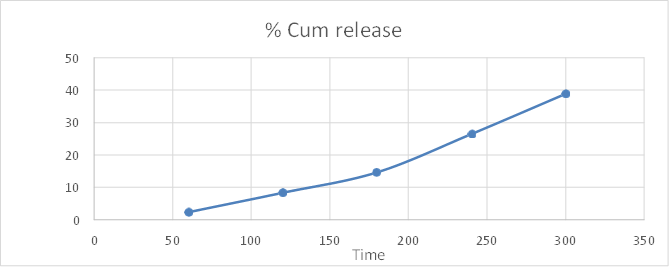

Figure 8

Figure 9

Figure 10

Figure 11
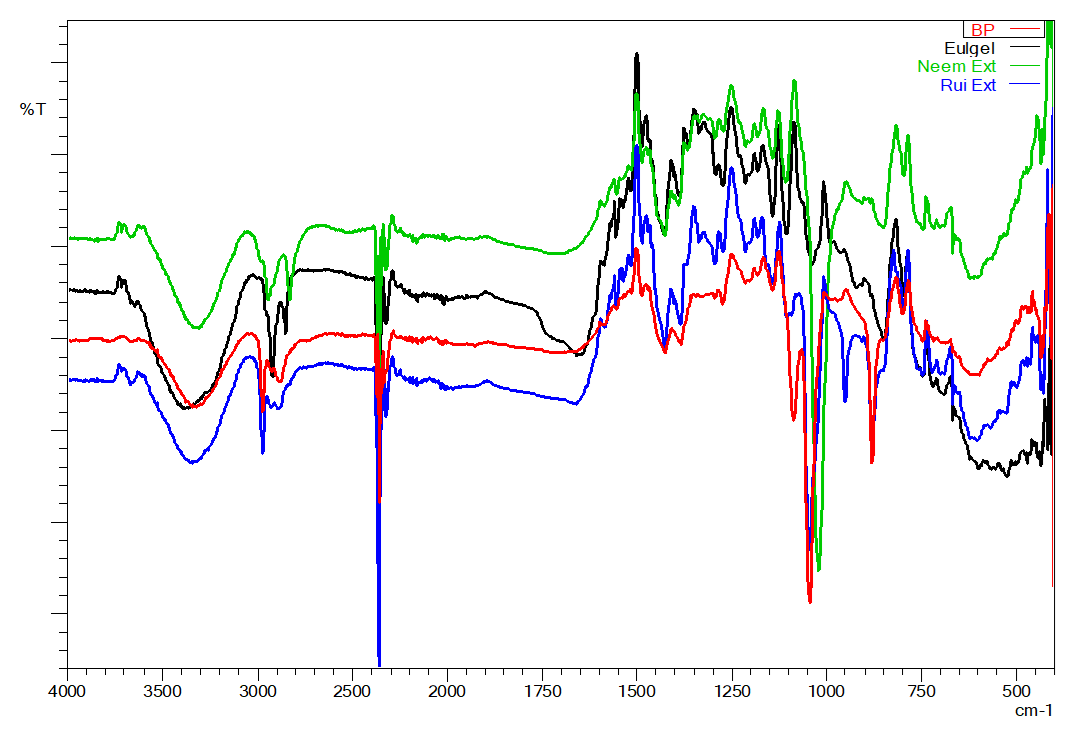
Figure 12
Table 13 FTIR Interpretation of Plant Extracts
|
Range |
Functional Group |
Type of Vibration |
Probable Phytochemicals |
Plant Source |
|
600–900 |
O–H / N–H |
Out of plane blending |
Aromatic rings, Essential oils |
Black pepper, |
|
1030–1100 |
C–O (Alcohol/Ether |
Stretching |
Glycosides, Terpenes |
All three |
|
1420-1460 |
CH? bending / Aromatic C=C |
Bending/Stretching |
Aromatics, Piperine |
All three |
|
~1650 |
C=C / C=O (Amide I) |
Stretching |
Flavonoids, Proteins |
Black pepper, Neem |
|
2920-2970 |
C–H (Aliphatic) |
Stretching |
Terpenoids, Fatty acids, |
Neem, Ruhi |
|
3330-3370 |
O–H / N–H |
Stretching (broad) |
Phenols, Flavonoids |
All three |
FTIR analysis of the polyherbal extract comprising Azadirachta indica, Piper nigrum, and Calotropis gigantea revealed characteristic peaks indicating the presence of key functional groups. Broad O–H/N– H stretching around 3330–3370 cm? ¹ confirms phenolic and flavonoid compounds. Peaks at ~2920– 2970 cm? ¹ denote aliphatic C–H stretches typical of terpenoids and fatty acids. A notable peak at ~1650 cm? ¹ suggests C=C or C=O stretching, supporting the presence of flavonoids or amide linkages. Vibrations in the fingerprint region (1000–1500 cm? ¹) and aromatic bending around 600–900 cm? ¹ further affirm the existence of diverse phytochemicals like alkaloids, glycosides, and essential oils.
The FTIR spectra indicate that the API is compatible with the excipients or drug matrix. No significant chemical interaction was observed based on the preservation of characteristic peaks.
The untreated (control) group drew numerous mosquito landings in under 30 seconds. The arm treated with emulgel demonstrated: No mosquito landings at 30 and 60 seconds. Limited landings at 120 and 240 seconds. Limited landings at 480 seconds. This signified a gradual reduction in repellency as time passed. A cage test is performed to evaluate the efficacy of a polyherbal mosquito repellent emulgel in repelling mosquitoes.
CONCLUSION:
The present study successfully developed and evaluated a novel polyherbal mosquito repellent emulgel containing extracts of Azadirachta indica, Piper nigrum, and Calotropis gigantea. The extracts were confirmed to contain active phytoconstituents like alkaloids, flavonoids, tannins, and cardiac glycosides, contributing to their mosquito repellent properties. The optimized emulgel (F8) exhibited excellent physical properties, such as smooth texture, homogeneity, good spreadability, appropriate viscosity, pH compatibility with skin, non-irritant behavior, and easy washability. The optimized formulation demonstrated sustained and controlled release of active ingredients, enhancing its effectiveness, and significant mosquito repellency over an extended period. The compatibility between herbal extracts and excipients was confirmed through FTIR analysis. Stability studies showed no phase separation. Overall, this polyherbal emulgel provides a safe, effective, natural, stable, and eco-friendly alternative to conventional chemical repellents, presenting a promising approach to prevent mosquito-borne diseases and promote public health with minimized risk of chemical side effects, offering enhanced patient compliance and potential for large-scale production in the future.
ACKNOWLEDGEMENT:
Authors are thankful to the Yashwantrao Bhonsale College of Pharmacy, Sawantwadi and Head of Department of Botany, University of Mumbai for providing all necessary facilities for present work.
CONFLICTS OF INTEREST: NILL.
REFERENCES







Pranali Joshi, Kajal Kothavale, Hemangi Parab, Prafulla Tigote, Misba Bijli, Sanika Shintre, Vijay Jagtap, Formulation and Evaluation of Mosquito Repellent Polyherbal Emulgel as a Novel Approach, Int. J. of Pharm. Sci., 2026, Vol 4, Issue 2, 1113-1124. https://doi.org/10.5281/zenodo.18519439
 10.5281/zenodo.18519439
