
Womens College of Pharmacy, Peth Vadgaoan.
Microemulsions are thermodynamically stable, isotropic systems comprising oil, water, surfactant, and cosurfactant, capable of enhancing the solubility and bioavailability of poorly water-soluble drugs. Their unique physicochemical properties, such as ultra-low interfacial tension, nanometric droplet size, and spontaneous formation, have made them a promising platform in pharmaceutical drug delivery. This review comprehensively explores the formulation principles, evaluation parameters, and applications of microemulsion systems, emphasizing their growing significance in modern pharmaceutics. The discussion covers the evolution of microemulsion science, underlying thermodynamic and kinetic principles, and the role of key formulation components such as oils, surfactants, and cosurfactants. Methods of preparation including phase titration, phase inversion, and design-of-experiments (DoE)-based optimization are analyzed critically. Characterization parameters such as droplet size, zeta potential, rheology, and thermodynamic stability are detailed with their relevance to formulation performance. Furthermore, the review elaborates on diverse pharmaceutical applications spanning oral, topical, parenteral, transdermal, ocular, and nasal drug delivery systems. Recent advancements such as self-microemulsifying drug delivery systems (SMEDDS), hybrid nano–microemulsions, and solidified microemulsion carriers are discussed alongside emerging analytical tools for nanoscale characterization. Challenges related to stability, toxicity, and regulatory approval are also examined, followed by insights into future research directions, including biocompatible surfactants and sustainable formulation strategies. Overall, this review highlights microemulsions as a versatile and adaptable platform with immense potential to revolutionize drug delivery science, offering improved solubility, targeted delivery, and enhanced therapeutic efficacy.
Microemulsions represent one of the most versatile and advanced carrier systems in pharmaceutical formulation, characterized by their ability to enhance solubility, bioavailability, and stability of both hydrophilic and lipophilic drugs. They are thermodynamically stable, optically transparent or translucent, and isotropic mixtures of oil, water, surfactant, and cosurfactant that form spontaneously under appropriate conditions (Lawrence & Rees, 2012). The droplet size of microemulsions typically ranges from 10 to 100 nanometers, which contributes to their high surface area and improved drug dissolution rates (Kumar et al., 2020).
In contrast to conventional emulsions, which are kinetically stable but thermodynamically unstable, microemulsions form spontaneously and remain stable without the need for mechanical agitation (Sharma & Mishra, 2018). This distinction arises from their low interfacial tension and the balanced amphiphilic nature of surfactant-cosurfactant combinations, which promote the formation of stable nanodroplets at the oil–water interface (Tadros, 2013). The small droplet size ensures enhanced absorption and uniform drug distribution, which makes microemulsions a promising approach for delivering poorly water-soluble drugs a challenge that affects nearly 40% of newly developed active pharmaceutical ingredients (APIs) (Pouton, 2017).
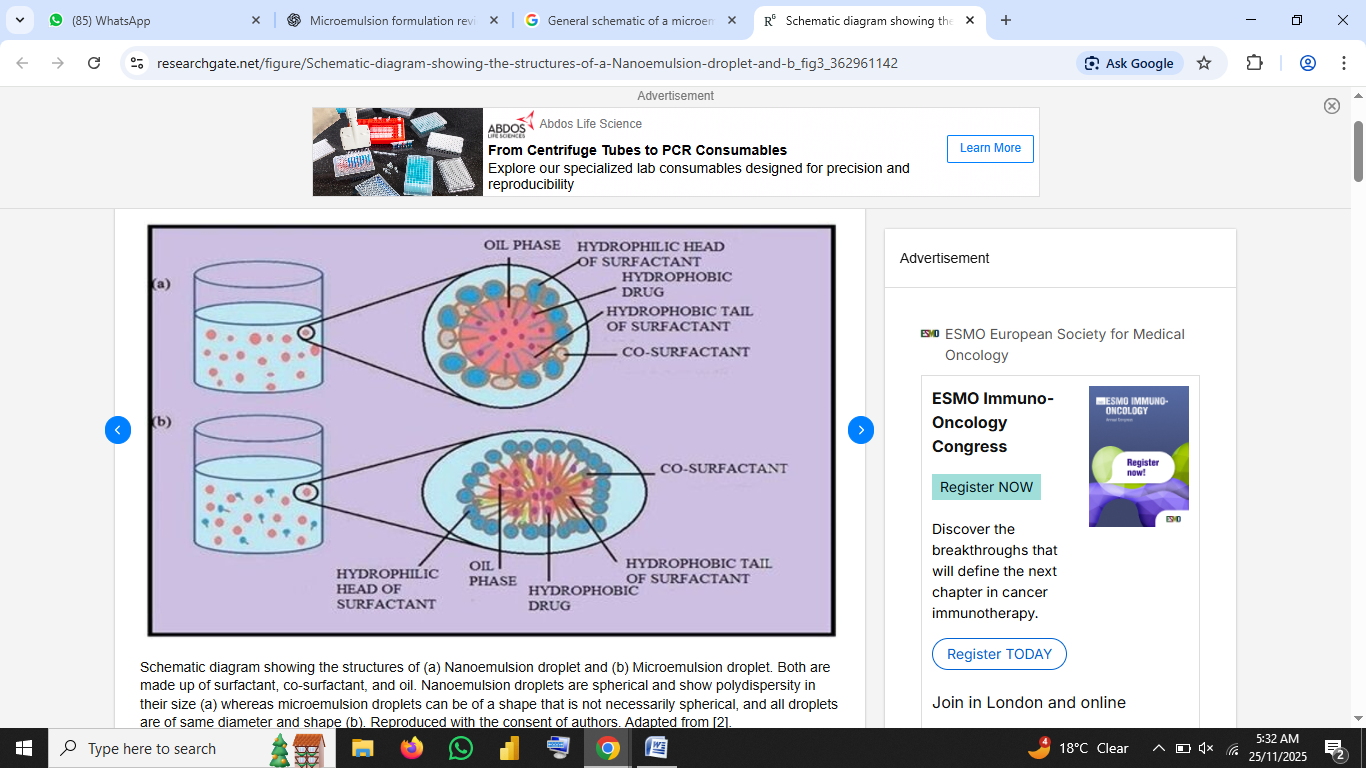
Fig no. 1: General schematic of a microemulsion system showing dispersed nanodroplets stabilized by surfactant and cosurfactant molecules.
Significance in Pharmaceutical Drug Delivery
In the field of drug delivery, the application of microemulsion systems has gained considerable momentum due to their ability to improve drug solubilization, absorption, and bioavailability (Rao & Shao, 2008). Many pharmaceutical agents, particularly those belonging to Biopharmaceutical Classification System (BCS) Class II and IV, exhibit poor aqueous solubility and limited oral absorption (Singh et al., 2017). Microemulsions address this limitation by creating a molecularly dispersed environment that enhances dissolution and diffusion across biological membranes (Date et al., 2010).
From a formulation perspective, microemulsions can be engineered for various routes of administration, including oral, topical, ocular, nasal, parenteral, and transdermal applications (Gupta et al., 2016). For instance, in topical and transdermal delivery, microemulsions enhance drug penetration through the stratum corneum due to their nanometric size and the permeation-enhancing effects of surfactants and cosurfactants (El Maghraby, 2008). Similarly, in oral formulations, they facilitate lymphatic transport, bypassing hepatic first-pass metabolism and improving systemic bioavailability (Patel et al., 2011).
Microemulsions possess several advantages over traditional dosage forms, including ease of preparation, enhanced solubilization capacity, thermodynamic stability, and high drug-loading potential (Azeem et al., 2009). Their spontaneous formation minimizes the need for complex mechanical energy input, unlike nanoemulsions, which require high-shear homogenization or ultrasonication (Kumar et al., 2014). Additionally, microemulsions enable controlled and targeted drug delivery by modulating their composition and microstructure. The continuous or dispersed phase can be modified to achieve desired release kinetics, while surfactant selection allows for biocompatibility and reduced irritation potential (Kreilgaard, 2002).
Another crucial advantage lies in thermodynamic stability. Unlike suspensions and coarse emulsions, microemulsions do not exhibit phase separation, creaming, or flocculation during storage. Their long-term stability makes them particularly suitable for industrial-scale production and commercialization (Florence & Whitehill, 2019). Furthermore, their optical transparency and low viscosity make them ideal candidates for ophthalmic and parenteral preparations, where clarity and isotropy are critical (Ghosh et al., 2011).
The formation of microemulsions is driven by a reduction in interfacial tension between oil and water phases through the use of surfactants and cosurfactants. This phenomenon promotes the dispersion of one phase into another, leading to a thermodynamically stable state characterized by a high degree of entropy (Tadros, 2013). The surfactant molecules align at the interface, reducing free energy and enabling the spontaneous formation of nanodroplets. The balance between hydrophilic and lipophilic tendencies is quantified by the hydrophilic-lipophilic balance (HLB) value, which determines the suitability of a surfactant for forming oil-in-water (O/W) or water-in-oil (W/O) microemulsions (Winsor, 1948).
The primary objective of this review is to provide a comprehensive and critical understanding of the formulation and evaluation of microemulsion systems, with emphasis on their theoretical background, compositional design, preparation methods, and characterization techniques. It aims to highlight the scientific rationale behind component selection and the influence of formulation variables on the physicochemical stability and performance of microemulsions.
Additionally, this review integrates recent advancements in microemulsion research, including novel self-microemulsifying drug delivery systems (SMEDDS), hybrid nano–microemulsion technologies, and solid-state microemulsion carriers. The work further explores the analytical tools used to characterize microemulsion microstructure, such as dynamic light scattering (DLS), transmission electron microscopy (TEM), and small-angle X-ray scattering (SAXS).
Finally, the scope extends to an assessment of current challenges, such as surfactant toxicity, scalability issues, and regulatory hurdles, while outlining future trends emphasizing sustainable and biocompatible excipient choices. Through this analysis, the review underscores the pivotal role of microemulsion systems in enhancing drug delivery efficiency and patient compliance, positioning them as a cornerstone technology in modern pharmaceutics.
The concept of microemulsion systems traces back more than seven decades, evolving through several key stages of scientific discovery and pharmaceutical application. The origin of microemulsions can be attributed to Paul A. Winsor, who, in the late 1940s, first described the thermodynamic and structural characteristics of multiphase surfactant systems (Winsor, 1948). His pioneering work on Winsor phase systems (I–IV) laid the theoretical foundation for understanding how surfactant concentration and hydrophilic–lipophilic balance (HLB) influence the formation of stable, isotropic mixtures of oil and water. These early studies primarily focused on physicochemical equilibria, rather than pharmaceutical applications, yet they provided the crucial insight that the right surfactant–cosurfactant ratio could yield a stable, low-interfacial-tension system the core principle underlying microemulsion formation (Lawrence & Rees, 2012).
The pharmaceutical adoption of microemulsion technology gained momentum in the late 1980s and early 1990s, driven by the urgent need for drug delivery systems capable of improving solubility and bioavailability of lipophilic molecules (Tenjarla, 1999). The increasing number of poorly water-soluble drugs discovered through combinatorial chemistry and high-throughput screening created a strong demand for formulation approaches that could overcome solubility-related limitations (Porter et al., 2007).
Researchers began exploring microemulsion-based carriers for a variety of administration routes, including oral, topical, parenteral, and ocular delivery (Lawrence & Rees, 2012). One of the earliest pharmaceutical applications was the incorporation of cyclosporine A, an immunosuppressant with poor aqueous solubility, into a self-microemulsifying drug delivery system (SMEDDS). The resulting product, Neoral®, launched in the mid-1990s, demonstrated significantly improved oral bioavailability compared to earlier formulations (Miller et al., 1998). This commercial success validated the potential of microemulsion systems in clinical settings and encouraged widespread adoption in the formulation of other hydrophobic drugs.
2.2.Integration with Modern Drug Delivery Technologies
In recent years, the field has witnessed the integration of microemulsion technology with nanocarriers, polymeric systems, and targeted delivery strategies, giving rise to hybrid formulations such as nanoemulsion–microemulsion systems and solid microemulsion matrices (Yukuyama et al., 2016). These innovations have expanded the applicability of microemulsions beyond solubility enhancement to areas such as controlled release, targeted therapy, and biomolecule delivery.
Moreover, the incorporation of computational modeling and molecular dynamics simulations has improved understanding of surfactant packing parameters, interfacial curvature, and thermodynamic stability, enabling the rational prediction of microemulsion behavior under physiological conditions (Fanun, 2011).
Today, microemulsions occupy a prominent place in the formulation scientist’s toolkit, particularly in addressing challenges associated with low-solubility and low-permeability drugs. The development of self-emulsifying and self-microemulsifying drug delivery systems (SEDDS and SMEDDS) has further simplified patient use and manufacturing processes. Ongoing research is now focusing on eco-friendly, non-toxic surfactants and solid-state transformation of microemulsions for improved stability and scalability (Bali et al., 2022).
The historical trajectory of microemulsion development thus reflects a transition from theoretical curiosity to applied pharmaceutical innovation. From Winsor’s foundational studies to contemporary nanocarrier-based systems, microemulsions have evolved into a multifunctional, scientifically mature platform for the next generation of drug delivery systems.
3.1. Mechanism of Formation
The formation of microemulsions involves the interfacial adsorption of surfactant molecules that act as stabilizers between the immiscible oil and water phases. Surfactants possess amphiphilic structures hydrophilic head groups and hydrophobic tails that enable them to localize at the interface, reducing interfacial tension and creating a flexible interfacial film (Ruckenstein & Chi, 2002).
The process generally proceeds through the following mechanistic stages:
According to the surfactant packing parameter theory, the spontaneous curvature (C0C_0C0?) of the interface determines whether an oil-in-water (O/W), water-in-oil (W/O), or bicontinuous microemulsion is formed. The packing parameter PPP is defined as (Israelachvili, 2011):
P=v/a0lcP ?
where vvv is the hydrophobic tail volume, a0a_0a0? is the effective head group area, and lcl_clc? is the chain length.
This relationship helps explain the diversity of microemulsion structures obtained under different formulation conditions.
3.2. Phase Behavior and Microstructure
The phase behavior of microemulsions is complex and influenced by several factors, including temperature, surfactant concentration, oil–water ratio, and HLB value of the surfactant mixture (Lawrence & Rees, 2012).
Microemulsions can exist as several distinct structural types depending on the distribution of oil and water phases:
Winsor (1954) classified these systems into four equilibrium types (Winsor I–IV), which describe the coexistence of microemulsion phases with excess oil and water layers. The transitions among these types are driven by changes in surfactant concentration or temperature, often observed as phase inversion phenomena.
Temperature-dependent phase inversion is a particularly important concept in the Phase Inversion Temperature (PIT) method, where increasing temperature decreases surfactant hydrophilicity, causing a transition from O/W to W/O microemulsion (Shinoda & Kunieda, 1973). This behavior is particularly useful for tailoring formulations for different routes of administration.

Fig no.2: Different structural types of microemulsions: oil-in-water (O/W), water-in-oil (W/O), and bicontinuous forms.
4. Methods of Formulation
The formulation of microemulsions involves combining oil, water, surfactant, and cosurfactant in specific ratios to achieve a thermodynamically stable, isotropic system. The preparation technique significantly influences droplet size, stability, and phase behavior. Several approaches are employed to develop microemulsions, including the phase titration method, phase inversion temperature (PIT) method, high-energy and low-energy emulsification techniques, and optimization using the design of experiments (DoE) framework. The choice of method depends on the physicochemical properties of the components, desired type of microemulsion, and scale of production.
4.1 Phase Titration Method
The phase titration method, also known as the water titration or oil titration method, is one of the most commonly used approaches for preparing microemulsions. In this method, a fixed ratio of oil, surfactant, and cosurfactant (Smix) is prepared, and the aqueous phase is added dropwise under gentle stirring until the mixture turns from turbid to clear and isotropic (Kahlweit et al., 1985). The endpoint corresponds to the formation of a microemulsion.
The transparency and fluidity of the system indicate the transition from a coarse emulsion to a thermodynamically stable microemulsion. The process can also be reversed by adding oil instead of water (oil titration), depending on the desired type of system, whether oil-in-water (O/W) or water-in-oil (W/O). Phase behavior is subsequently mapped using a pseudoternary phase diagram, where the microemulsion existence region is identified (Rao & McClements, 2012).
The primary advantage of the phase titration method is its simplicity and ability to construct detailed phase diagrams, which aid in determining the optimal ratio of components. However, it is a labor-intensive process and not easily scalable for industrial applications due to the stepwise nature of titration.
4.2 Phase Inversion Temperature (PIT) Method
The phase inversion temperature method is based on the temperature-dependent solubility of nonionic surfactants. As temperature increases, the hydrophilic portion of the surfactant becomes less soluble in water, leading to a reduction in surfactant hydrophilicity and eventual inversion of the emulsion type (Shinoda & Kunieda, 1973). At low temperatures, surfactant molecules are hydrated and form oil-in-water (O/W) microemulsions, while at higher temperatures, dehydration of the surfactant head groups leads to water-in-oil (W/O) systems.
The inversion point is termed the phase inversion temperature (PIT), and at this temperature, the surfactant has equal affinity for oil and water, forming a bicontinuous microemulsion (Friberg, 1988). The system exhibits minimum interfacial tension and smallest droplet size at PIT, resulting in enhanced stability and homogeneity (Lawrence & Rees, 2012).
To prepare microemulsions using the PIT method, the surfactant–oil–water mixture is heated gradually to above the PIT and then cooled back to room temperature under controlled agitation. The microemulsion formed at or near the PIT is thermodynamically stable. The advantage of this method lies in its reproducibility and suitability for temperature-sensitive formulations, although it is restricted to nonionic surfactants that display temperature-dependent solubility changes.
4.3 High-Energy Emulsification Techniques
High-energy emulsification methods rely on mechanical devices to apply intense shear, turbulence, or cavitation forces that reduce droplet size to the nanometer range. These methods include high-pressure homogenization, ultrasonication, and microfluidization (McClements, 2012).
In high-pressure homogenization, the mixture is forced through a narrow orifice under high pressure (up to 2000 bar), causing intense shear and impact forces that break down droplets to nanoscale dimensions. Ultrasonication uses acoustic energy to generate cavitation bubbles that collapse violently, disrupting large droplets into smaller ones (Djekic & Primorac, 2008). Microfluidization, another widely used approach, employs microchannels that create high-velocity collisions between fluid streams, leading to uniform droplet size reduction and enhanced stability (Rao et al., 2015).
Although high-energy techniques are highly effective in producing uniform and fine droplets, they are energy-intensive and may cause degradation of heat- or shear-sensitive drugs. They are also more commonly associated with nanoemulsion production; however, when combined with surfactants and cosurfactants, they can yield microemulsions with improved uniformity and reproducibility.
4.4 Low-Energy Emulsification Techniques
Low-energy emulsification relies on the spontaneous formation of microemulsions driven by the system’s thermodynamic properties rather than mechanical energy. These techniques exploit the physicochemical behavior of surfactants, particularly their ability to self-assemble at specific compositions and temperatures (Sharma & Mishra, 2018).
The most common low-energy techniques include the spontaneous emulsification method and the phase inversion composition (PIC) method. In spontaneous emulsification, an organic phase (containing oil, surfactant, cosurfactant, and drug) is mixed with an aqueous phase under gentle stirring. The spontaneous reduction of interfacial tension and interdiffusion of the two phases lead to the formation of nanosized droplets without external energy input (Garti & Aserin, 1996).
In the phase inversion composition (PIC) method, the ratio of oil to water is altered gradually, leading to the inversion of the emulsion type. As the aqueous content increases, the system transitions from W/O to O/W microemulsion, passing through a bicontinuous phase. The process allows precise control over droplet size and structure. The major advantages of low-energy methods are simplicity, mild processing conditions, and suitability for thermolabile drugs, though formulation reproducibility can be affected by environmental factors such as temperature and mixing rate.
4.5 Optimization and Design of Experiments (DoE) Approach
The formulation of microemulsions is complex due to the numerous interacting variables influencing stability, droplet size, and drug release characteristics. Traditional one-variable-at-a-time optimization is inefficient; therefore, statistical approaches such as the design of experiments (DoE) have been adopted to optimize formulations scientifically (Rao et al., 2015).
The DoE approach enables the systematic evaluation of independent variables—such as surfactant concentration, oil type, and Smix ratio—and their interactions. Commonly used statistical designs include factorial design, Box-Behnken design, and central composite design (CCD). These models allow for the generation of response surfaces that visualize how formulation parameters influence critical quality attributes, such as droplet size, polydispersity index (PDI), and zeta potential (Jain et al., 2017).
By using statistical software tools, optimal formulation regions can be predicted with fewer experiments, saving time and resources. Moreover, the DoE approach aligns with the principles of quality by design (QbD) promoted by regulatory agencies like the U.S. Food and Drug Administration (FDA) and the International Council for Harmonisation (ICH) (ICH Q8(R2), 2009). This scientific, data-driven strategy enhances reproducibility, scalability, and regulatory compliance of microemulsion formulations.
4.6 Summary of Formulation Methods
Each formulation method offers unique advantages and limitations depending on the nature of the drug and desired application. Phase titration and PIT methods are widely used for laboratory-scale development and understanding phase behavior. High- and low-energy emulsification techniques are suitable for scale-up, while DoE provides a statistical foundation for optimizing critical formulation variables. The integration of these approaches ensures efficient development of robust, reproducible, and high-performance microemulsion systems for pharmaceutical applications.
5. Components of Microemulsion
Microemulsions are composed of four essential components: an oil phase, an aqueous phase, a surfactant, and a cosurfactant. The precise selection and ratio of these components determine the physicochemical characteristics, thermodynamic stability, and drug delivery performance of the system. Understanding the role of each component is therefore fundamental to successful formulation design.
5.1 Oil Phase
The oil phase serves multiple roles in microemulsion systems—it acts as the solvent for lipophilic drugs, influences droplet size, and contributes to the viscosity and phase behavior of the formulation (Kreilgaard, 2002). The oil phase must possess high solubilization capacity for the drug and adequate miscibility with surfactant–cosurfactant mixtures to maintain system stability (Constantinides, 1995).
Selection Criteria
Commonly Used Oils
The oil phase selection significantly affects droplet curvature and the type of microemulsion (O/W or W/O) that forms. Oils with higher polarity (e.g., ethyl oleate) tend to form O/W systems, while less polar oils favor W/O systems (Kumar et al., 2020).
5.2 Aqueous Phase
The aqueous phase typically consists of water or buffered solutions and may include electrolytes, preservatives, and stabilizing agents. It determines the continuous phase in O/W systems and influences conductivity, pH, and phase stability (Azeem et al., 2009).
Role and Considerations
Water quality is crucial; deionized or distilled water is recommended to prevent ionic impurities that can destabilize the microemulsion. In some formulations, co-solvents such as propylene glycol, glycerin, or ethanol are included in the aqueous phase to improve solubilization of hydrophilic drugs and enhance permeability (Sharma & Mishra, 2018).
5.3 Surfactant
Surfactants are the most critical components in microemulsion formulation. They reduce interfacial tension between oil and water, stabilize the dispersed phase, and facilitate spontaneous emulsification. The choice of surfactant governs the type (O/W or W/O) and stability of the microemulsion system (Tadros, 2013).
5.3.1 Surfactant Properties and Functions
A surfactant molecule possesses both hydrophilic and lipophilic moieties, enabling it to localize at the interface and form a flexible interfacial film. The key functions include:
5.3.2 Hydrophilic-Lipophilic Balance (HLB)
The HLB value is the most crucial parameter in surfactant selection.
The appropriate HLB range can be determined experimentally using the pseudoternary phase diagram, ensuring the surfactant provides optimal interfacial curvature and droplet stability (Israelachvili, 2011).
5.3.3 Common Pharmaceutical Surfactants
5.3.4 Toxicity Considerations
Surfactant toxicity remains a major concern in pharmaceutical formulations. High surfactant concentrations may lead to irritation, hemolysis, or disruption of membrane integrity (Kumar et al., 2020). Therefore, biocompatible surfactants such as lecithins, sugar esters, and block copolymers (e.g., poloxamers) are preferred to minimize adverse effects while maintaining stability.
5.4 Co-surfactant
The cosurfactant acts synergistically with the surfactant to further reduce interfacial tension and increase interfacial film fluidity. Short- to medium-chain alcohols (e.g., ethanol, propanol, butanol) and polyols (e.g., propylene glycol, polyethylene glycol) are commonly used (Lawrence & Rees, 2012).
Functions
The ratio of surfactant to cosurfactant (Smix) is critical. Typically, ratios from 1:1 to 3:1 are tested using phase diagram construction to identify the region of maximum stability (Kahlweit et al., 1985). Excess cosurfactant may lead to phase inversion or reduced stability, so optimization is essential.
Examples
5.5 Drug Candidates Suitable for Microemulsion Systems
Microemulsion systems are particularly advantageous for drugs with poor aqueous solubility, high lipophilicity, or limited bioavailability (Pouton, 2017). Drugs that benefit from solubilization and enhanced permeability through lipid membranes are ideal candidates.
Suitable Drug Classes
Selection Considerations
6. Characterization and Evaluation Parameters
After formulation, microemulsions must be carefully evaluated to ensure their physical stability, uniformity, and suitability for drug delivery. The characterization process helps to understand the internal structure, droplet size, and performance of the system. Several analytical and experimental tests are used for this purpose.
6.1 Physical Appearance
A good microemulsion should be clear or slightly translucent and have low viscosity. Visual inspection helps to confirm isotropy (uniformity) and the absence of phase separation. Any turbidity or creaming indicates instability or incorrect formulation (Lawrence & Rees, 2012).
6.2 Droplet Size and Polydispersity Index (PDI)
The average droplet size is usually between 10–100 nanometers. Smaller droplets improve stability and drug absorption. The Polydispersity Index (PDI) shows how uniform the droplets are; a value below 0.3 indicates a stable and homogenous system (McClements, 2012). Measurements are typically done using Dynamic Light Scattering (DLS) or Photon Correlation Spectroscopy (PCS) (Kumar et al., 2020).
6.3 Zeta Potential
Zeta potential measures the surface charge on droplets, which affects stability. A high absolute zeta potential (±30 mV or more) prevents droplets from coming together and forming aggregates (Tadros, 2013). Zeta potential is measured using a Zetasizer instrument. Nonionic surfactant-based systems often have lower zeta potential but remain stable due to steric hindrance.
6.4 Thermodynamic Stability Tests
Microemulsions are thermodynamically stable, but they must be tested to ensure no breakdown during storage. The following tests are commonly done (Azeem et al., 2009):
If the system remains clear and uniform after these tests, it is considered stable.
6.5 Rheological Behavior
Rheology studies the flow properties of the microemulsion. It is important for determining spreadability (for topical systems) and injectability (for parenteral systems). Most microemulsions show Newtonian flow, meaning viscosity remains constant with shear rate. Viscosity is measured using a Brookfield viscometer or a rotational rheometer (Friberg, 1988).
6.6 Conductivity Measurement
Conductivity helps to identify the type of microemulsion. Oil-in-water (O/W) systems show high conductivity due to continuous water phase, while water-in-oil (W/O) systems show low conductivity. Bicontinuous systems show intermediate values (Kreilgaard, 2002).
6.7 pH and Refractive Index
The pH of microemulsion should be close to physiological levels (around 5.5–7.4) depending on the application site to avoid irritation. The refractive index is checked using a refractometer to ensure isotropy and compatibility between components (Gupta et al., 2016).
6.8 Drug Content and Entrapment Efficiency
The drug content test ensures that the drug is uniformly distributed throughout the formulation. Entrapment efficiency (%) is calculated to know how much drug is successfully incorporated into the microemulsion. The sample is diluted and analyzed using UV–Visible spectroscopy or High-Performance Liquid Chromatography (HPLC) (Patel et al., 2011).
6.9 In Vitro Drug Release Studies
In vitro release testing determines how the drug diffuses out of the microemulsion. The dialysis bag method or Franz diffusion cell is commonly used. The release profile helps to understand whether the drug follows zero-order, first-order, or Higuchi kinetics (Sharma & Mishra, 2018).
6.10 In Vivo Evaluation
In vivo testing is performed on suitable animal models to study bioavailability, pharmacokinetics, and therapeutic efficacy. Parameters like plasma drug concentration and area under the curve (AUC) are compared with conventional formulations. Microemulsion systems usually show higher absorption and improved bioavailability (Rao & Shao, 2008).
7. Applications in Pharmaceutical Formulation
Microemulsions are widely used in various drug delivery routes because they improve solubility, stability, and absorption of drugs. Their flexibility allows them to be adapted for different therapeutic needs.
7.1 Oral Drug Delivery
Oral microemulsions enhance the absorption of poorly water-soluble drugs by improving dissolution and promoting lymphatic transport (Pouton, 2017). Examples include formulations of cyclosporine, paclitaxel, and curcumin that show higher bioavailability than conventional forms.
7.2 Topical and Transdermal Delivery
Microemulsions can easily penetrate the skin due to their small droplet size and surfactant action. They improve the delivery of drugs like diclofenac, ibuprofen, and ketoprofen for localized pain relief and inflammation control (El Maghraby, 2008). They are also used in cosmetics and dermatological preparations.
7.3 Parenteral Delivery
For intravenous or intramuscular use, microemulsions provide a stable medium for poorly soluble drugs and reduce irritation. They can be used for anesthetics like propofol or anticancer drugs like docetaxel (Lawrence & Rees, 2012).
7.4 Ocular Delivery
Microemulsion eye drops increase corneal penetration and prolong drug retention time. Drugs such as dexamethasone and timolol have been successfully formulated into ocular microemulsions (Ghosh et al., 2011).
7.5 Nasal and Pulmonary Delivery
Microemulsions offer rapid absorption through nasal or lung membranes, providing a non-invasive alternative to injections. Drugs like insulin and zolmitriptan have shown improved delivery through nasal microemulsions (Gupta et al., 2016).
7.6 Other Emerging Uses
Microemulsions are also explored in vaccine delivery, gene therapy, and as carriers for peptides and proteins. They help protect these molecules from degradation and enhance their bioavailability (Bali et al., 2022).
8. Recent Advances and Novel Approaches
Research in microemulsion technology has moved beyond simple solubilization toward controlled and targeted delivery.
8.1 Self-Microemulsifying Drug Delivery Systems (SMEDDS)
SMEDDS are mixtures of oil, surfactant, and cosurfactant that form microemulsions spontaneously when they come into contact with gastrointestinal fluids. They are easy to fill in capsules and provide consistent bioavailability (Date et al., 2010). The most famous example is Neoral®, a cyclosporine formulation.
8.2 Nanoemulsion–Microemulsion Hybrids
These systems combine the benefits of both nanoemulsions (fine droplet size) and microemulsions (thermodynamic stability). They provide better control over drug release and stability (Yukuyama et al., 2016).
8.3 Solidified Microemulsions
Liquid microemulsions can be converted into solid forms like powders, tablets, or capsules using adsorption on solid carriers or spray-drying techniques. These solid microemulsions improve storage stability and patient convenience (Kumar et al., 2020).
8.4 Targeted and Controlled Drug Delivery
By modifying the surface of droplets with ligands or polymers, microemulsions can deliver drugs to specific tissues or cells. This approach is being studied for cancer, brain, and ocular delivery (Fanun, 2011).
8.5 Advances in Characterization Tools
Modern analytical methods such as Dynamic Light Scattering (DLS), Transmission Electron Microscopy (TEM), and Small-Angle X-ray Scattering (SAXS) are used to study droplet size, structure, and interactions at the nanoscale (Bali et al., 2022).
9. Challenges and Future Prospects
Despite their advantages, microemulsions face several challenges that limit their widespread commercial use.
9.1 Stability Issues
Although microemulsions are thermodynamically stable, factors like temperature changes, evaporation of volatile components, and interactions with packaging materials can cause instability (Friberg, 1988).
9.2 Toxicity of Surfactants
Some surfactants and cosurfactants may cause irritation or toxicity, especially at high concentrations. The development of safer and biodegradable surfactants such as phospholipids, sugar esters, and natural polymers is a current focus (Djekic & Primorac, 2008).
9.3 Scale-Up and Manufacturing
Translating laboratory formulations into large-scale production remains challenging. Controlling parameters like mixing speed and temperature is difficult in industrial processes (Rao et al., 2015).
9.4 Regulatory Considerations
Because microemulsions are complex systems, regulatory approval requires detailed data on composition, stability, and safety. Guidelines from agencies such as the FDA and ICH promote the use of Quality by Design (QbD) principles (ICH Q8(R2), 2009).
9.5 Future Directions
Future research is focused on “green” formulations that use safe, natural, and sustainable ingredients. The combination of microemulsions with nanocarriers, biopolymers, and stimuli-responsive systems may lead to next-generation drug delivery technologies (Bali et al., 2022).
10. CONCLUSION
Microemulsions have emerged as an innovative and flexible platform for improving drug solubility, absorption, and therapeutic performance. Their thermodynamic stability, spontaneous formation, and versatility make them suitable for a wide range of pharmaceutical applications including oral, topical, parenteral, and ocular delivery.
Recent advances like SMEDDS, solid microemulsions, and targeted delivery systems have further enhanced their value. However, challenges such as surfactant toxicity, large-scale production, and regulatory complexities still need attention.
With ongoing research in green surfactants, nanostructured hybrids, and computational modeling, microemulsion technology is expected to play an even greater role in future pharmaceutical innovation. Overall, they represent a promising approach for achieving efficient, safe, and patient-friendly drug delivery.
REFERENCES
Microemulsions represent one of the most versatile and advanced carrier systems in pharmaceutical formulation, characterized by their ability to enhance solubility, bioavailability, and stability of both hydrophilic and lipophilic drugs. They are thermodynamically stable, optically transparent or translucent, and isotropic mixtures of oil, water, surfactant, and cosurfactant that form spontaneously under appropriate conditions (Lawrence & Rees, 2012). The droplet size of microemulsions typically ranges from 10 to 100 nanometers, which contributes to their high surface area and improved drug dissolution rates (Kumar et al., 2020).
In contrast to conventional emulsions, which are kinetically stable but thermodynamically unstable, microemulsions form spontaneously and remain stable without the need for mechanical agitation (Sharma & Mishra, 2018). This distinction arises from their low interfacial tension and the balanced amphiphilic nature of surfactant-cosurfactant combinations, which promote the formation of stable nanodroplets at the oil–water interface (Tadros, 2013). The small droplet size ensures enhanced absorption and uniform drug distribution, which makes microemulsions a promising approach for delivering poorly water-soluble drugs a challenge that affects nearly 40% of newly developed active pharmaceutical ingredients (APIs) (Pouton, 2017).

Fig no. 1: General schematic of a microemulsion system showing dispersed nanodroplets stabilized by surfactant and cosurfactant molecules.
In the field of drug delivery, the application of microemulsion systems has gained considerable momentum due to their ability to improve drug solubilization, absorption, and bioavailability (Rao & Shao, 2008). Many pharmaceutical agents, particularly those belonging to Biopharmaceutical Classification System (BCS) Class II and IV, exhibit poor aqueous solubility and limited oral absorption (Singh et al., 2017). Microemulsions address this limitation by creating a molecularly dispersed environment that enhances dissolution and diffusion across biological membranes (Date et al., 2010).
From a formulation perspective, microemulsions can be engineered for various routes of administration, including oral, topical, ocular, nasal, parenteral, and transdermal applications (Gupta et al., 2016). For instance, in topical and transdermal delivery, microemulsions enhance drug penetration through the stratum corneum due to their nanometric size and the permeation-enhancing effects of surfactants and cosurfactants (El Maghraby, 2008). Similarly, in oral formulations, they facilitate lymphatic transport, bypassing hepatic first-pass metabolism and improving systemic bioavailability (Patel et al., 2011).
Microemulsions possess several advantages over traditional dosage forms, including ease of preparation, enhanced solubilization capacity, thermodynamic stability, and high drug-loading potential (Azeem et al., 2009). Their spontaneous formation minimizes the need for complex mechanical energy input, unlike nanoemulsions, which require high-shear homogenization or ultrasonication (Kumar et al., 2014). Additionally, microemulsions enable controlled and targeted drug delivery by modulating their composition and microstructure. The continuous or dispersed phase can be modified to achieve desired release kinetics, while surfactant selection allows for biocompatibility and reduced irritation potential (Kreilgaard, 2002).
Another crucial advantage lies in thermodynamic stability. Unlike suspensions and coarse emulsions, microemulsions do not exhibit phase separation, creaming, or flocculation during storage. Their long-term stability makes them particularly suitable for industrial-scale production and commercialization (Florence & Whitehill, 2019). Furthermore, their optical transparency and low viscosity make them ideal candidates for ophthalmic and parenteral preparations, where clarity and isotropy are critical (Ghosh et al., 2011).
The formation of microemulsions is driven by a reduction in interfacial tension between oil and water phases through the use of surfactants and cosurfactants. This phenomenon promotes the dispersion of one phase into another, leading to a thermodynamically stable state characterized by a high degree of entropy (Tadros, 2013). The surfactant molecules align at the interface, reducing free energy and enabling the spontaneous formation of nanodroplets. The balance between hydrophilic and lipophilic tendencies is quantified by the hydrophilic-lipophilic balance (HLB) value, which determines the suitability of a surfactant for forming oil-in-water (O/W) or water-in-oil (W/O) microemulsions (Winsor, 1948).
The primary objective of this review is to provide a comprehensive and critical understanding of the formulation and evaluation of microemulsion systems, with emphasis on their theoretical background, compositional design, preparation methods, and characterization techniques. It aims to highlight the scientific rationale behind component selection and the influence of formulation variables on the physicochemical stability and performance of microemulsions.
Additionally, this review integrates recent advancements in microemulsion research, including novel self-microemulsifying drug delivery systems (SMEDDS), hybrid nano–microemulsion technologies, and solid-state microemulsion carriers. The work further explores the analytical tools used to characterize microemulsion microstructure, such as dynamic light scattering (DLS), transmission electron microscopy (TEM), and small-angle X-ray scattering (SAXS).
Finally, the scope extends to an assessment of current challenges, such as surfactant toxicity, scalability issues, and regulatory hurdles, while outlining future trends emphasizing sustainable and biocompatible excipient choices. Through this analysis, the review underscores the pivotal role of microemulsion systems in enhancing drug delivery efficiency and patient compliance, positioning them as a cornerstone technology in modern pharmaceutics.
The concept of microemulsion systems traces back more than seven decades, evolving through several key stages of scientific discovery and pharmaceutical application. The origin of microemulsions can be attributed to Paul A. Winsor, who, in the late 1940s, first described the thermodynamic and structural characteristics of multiphase surfactant systems (Winsor, 1948). His pioneering work on Winsor phase systems (I–IV) laid the theoretical foundation for understanding how surfactant concentration and hydrophilic–lipophilic balance (HLB) influence the formation of stable, isotropic mixtures of oil and water. These early studies primarily focused on physicochemical equilibria, rather than pharmaceutical applications, yet they provided the crucial insight that the right surfactant–cosurfactant ratio could yield a stable, low-interfacial-tension system the core principle underlying microemulsion formation (Lawrence & Rees, 2012).
The pharmaceutical adoption of microemulsion technology gained momentum in the late 1980s and early 1990s, driven by the urgent need for drug delivery systems capable of improving solubility and bioavailability of lipophilic molecules (Tenjarla, 1999). The increasing number of poorly water-soluble drugs discovered through combinatorial chemistry and high-throughput screening created a strong demand for formulation approaches that could overcome solubility-related limitations (Porter et al., 2007).
Researchers began exploring microemulsion-based carriers for a variety of administration routes, including oral, topical, parenteral, and ocular delivery (Lawrence & Rees, 2012). One of the earliest pharmaceutical applications was the incorporation of cyclosporine A, an immunosuppressant with poor aqueous solubility, into a self-microemulsifying drug delivery system (SMEDDS). The resulting product, Neoral®, launched in the mid-1990s, demonstrated significantly improved oral bioavailability compared to earlier formulations (Miller et al., 1998). This commercial success validated the potential of microemulsion systems in clinical settings and encouraged widespread adoption in the formulation of other hydrophobic drugs.
2.2.Integration with Modern Drug Delivery Technologies
In recent years, the field has witnessed the integration of microemulsion technology with nanocarriers, polymeric systems, and targeted delivery strategies, giving rise to hybrid formulations such as nanoemulsion–microemulsion systems and solid microemulsion matrices (Yukuyama et al., 2016). These innovations have expanded the applicability of microemulsions beyond solubility enhancement to areas such as controlled release, targeted therapy, and biomolecule delivery.
Moreover, the incorporation of computational modeling and molecular dynamics simulations has improved understanding of surfactant packing parameters, interfacial curvature, and thermodynamic stability, enabling the rational prediction of microemulsion behavior under physiological conditions (Fanun, 2011).
Today, microemulsions occupy a prominent place in the formulation scientist’s toolkit, particularly in addressing challenges associated with low-solubility and low-permeability drugs. The development of self-emulsifying and self-microemulsifying drug delivery systems (SEDDS and SMEDDS) has further simplified patient use and manufacturing processes. Ongoing research is now focusing on eco-friendly, non-toxic surfactants and solid-state transformation of microemulsions for improved stability and scalability (Bali et al., 2022).
The historical trajectory of microemulsion development thus reflects a transition from theoretical curiosity to applied pharmaceutical innovation. From Winsor’s foundational studies to contemporary nanocarrier-based systems, microemulsions have evolved into a multifunctional, scientifically mature platform for the next generation of drug delivery systems.
3.1. Mechanism of Formation
The formation of microemulsions involves the interfacial adsorption of surfactant molecules that act as stabilizers between the immiscible oil and water phases. Surfactants possess amphiphilic structures hydrophilic head groups and hydrophobic tails that enable them to localize at the interface, reducing interfacial tension and creating a flexible interfacial film (Ruckenstein & Chi, 2002).
The process generally proceeds through the following mechanistic stages:
According to the surfactant packing parameter theory, the spontaneous curvature (C0C_0C0?) of the interface determines whether an oil-in-water (O/W), water-in-oil (W/O), or bicontinuous microemulsion is formed. The packing parameter PPP is defined as (Israelachvili, 2011):
P=v/a0lcP ?
where vvv is the hydrophobic tail volume, a0a_0a0? is the effective head group area, and lcl_clc? is the chain length.
This relationship helps explain the diversity of microemulsion structures obtained under different formulation conditions.
3.2. Phase Behavior and Microstructure
The phase behavior of microemulsions is complex and influenced by several factors, including temperature, surfactant concentration, oil–water ratio, and HLB value of the surfactant mixture (Lawrence & Rees, 2012).
Microemulsions can exist as several distinct structural types depending on the distribution of oil and water phases:
Winsor (1954) classified these systems into four equilibrium types (Winsor I–IV), which describe the coexistence of microemulsion phases with excess oil and water layers. The transitions among these types are driven by changes in surfactant concentration or temperature, often observed as phase inversion phenomena.
Temperature-dependent phase inversion is a particularly important concept in the Phase Inversion Temperature (PIT) method, where increasing temperature decreases surfactant hydrophilicity, causing a transition from O/W to W/O microemulsion (Shinoda & Kunieda, 1973). This behavior is particularly useful for tailoring formulations for different routes of administration.

Fig no.2: Different structural types of microemulsions: oil-in-water (O/W), water-in-oil (W/O), and bicontinuous forms.
4. Methods of Formulation
The formulation of microemulsions involves combining oil, water, surfactant, and cosurfactant in specific ratios to achieve a thermodynamically stable, isotropic system. The preparation technique significantly influences droplet size, stability, and phase behavior. Several approaches are employed to develop microemulsions, including the phase titration method, phase inversion temperature (PIT) method, high-energy and low-energy emulsification techniques, and optimization using the design of experiments (DoE) framework. The choice of method depends on the physicochemical properties of the components, desired type of microemulsion, and scale of production.
4.1 Phase Titration Method
The phase titration method, also known as the water titration or oil titration method, is one of the most commonly used approaches for preparing microemulsions. In this method, a fixed ratio of oil, surfactant, and cosurfactant (Smix) is prepared, and the aqueous phase is added dropwise under gentle stirring until the mixture turns from turbid to clear and isotropic (Kahlweit et al., 1985). The endpoint corresponds to the formation of a microemulsion.
The transparency and fluidity of the system indicate the transition from a coarse emulsion to a thermodynamically stable microemulsion. The process can also be reversed by adding oil instead of water (oil titration), depending on the desired type of system, whether oil-in-water (O/W) or water-in-oil (W/O). Phase behavior is subsequently mapped using a pseudoternary phase diagram, where the microemulsion existence region is identified (Rao & McClements, 2012).
The primary advantage of the phase titration method is its simplicity and ability to construct detailed phase diagrams, which aid in determining the optimal ratio of components. However, it is a labor-intensive process and not easily scalable for industrial applications due to the stepwise nature of titration.
4.2 Phase Inversion Temperature (PIT) Method
The phase inversion temperature method is based on the temperature-dependent solubility of nonionic surfactants. As temperature increases, the hydrophilic portion of the surfactant becomes less soluble in water, leading to a reduction in surfactant hydrophilicity and eventual inversion of the emulsion type (Shinoda & Kunieda, 1973). At low temperatures, surfactant molecules are hydrated and form oil-in-water (O/W) microemulsions, while at higher temperatures, dehydration of the surfactant head groups leads to water-in-oil (W/O) systems.
The inversion point is termed the phase inversion temperature (PIT), and at this temperature, the surfactant has equal affinity for oil and water, forming a bicontinuous microemulsion (Friberg, 1988). The system exhibits minimum interfacial tension and smallest droplet size at PIT, resulting in enhanced stability and homogeneity (Lawrence & Rees, 2012).
To prepare microemulsions using the PIT method, the surfactant–oil–water mixture is heated gradually to above the PIT and then cooled back to room temperature under controlled agitation. The microemulsion formed at or near the PIT is thermodynamically stable. The advantage of this method lies in its reproducibility and suitability for temperature-sensitive formulations, although it is restricted to nonionic surfactants that display temperature-dependent solubility changes.
4.3 High-Energy Emulsification Techniques
High-energy emulsification methods rely on mechanical devices to apply intense shear, turbulence, or cavitation forces that reduce droplet size to the nanometer range. These methods include high-pressure homogenization, ultrasonication, and microfluidization (McClements, 2012).
In high-pressure homogenization, the mixture is forced through a narrow orifice under high pressure (up to 2000 bar), causing intense shear and impact forces that break down droplets to nanoscale dimensions. Ultrasonication uses acoustic energy to generate cavitation bubbles that collapse violently, disrupting large droplets into smaller ones (Djekic & Primorac, 2008). Microfluidization, another widely used approach, employs microchannels that create high-velocity collisions between fluid streams, leading to uniform droplet size reduction and enhanced stability (Rao et al., 2015).
Although high-energy techniques are highly effective in producing uniform and fine droplets, they are energy-intensive and may cause degradation of heat- or shear-sensitive drugs. They are also more commonly associated with nanoemulsion production; however, when combined with surfactants and cosurfactants, they can yield microemulsions with improved uniformity and reproducibility.
4.4 Low-Energy Emulsification Techniques
Low-energy emulsification relies on the spontaneous formation of microemulsions driven by the system’s thermodynamic properties rather than mechanical energy. These techniques exploit the physicochemical behavior of surfactants, particularly their ability to self-assemble at specific compositions and temperatures (Sharma & Mishra, 2018).
The most common low-energy techniques include the spontaneous emulsification method and the phase inversion composition (PIC) method. In spontaneous emulsification, an organic phase (containing oil, surfactant, cosurfactant, and drug) is mixed with an aqueous phase under gentle stirring. The spontaneous reduction of interfacial tension and interdiffusion of the two phases lead to the formation of nanosized droplets without external energy input (Garti & Aserin, 1996).
In the phase inversion composition (PIC) method, the ratio of oil to water is altered gradually, leading to the inversion of the emulsion type. As the aqueous content increases, the system transitions from W/O to O/W microemulsion, passing through a bicontinuous phase. The process allows precise control over droplet size and structure. The major advantages of low-energy methods are simplicity, mild processing conditions, and suitability for thermolabile drugs, though formulation reproducibility can be affected by environmental factors such as temperature and mixing rate.
4.5 Optimization and Design of Experiments (DoE) Approach
The formulation of microemulsions is complex due to the numerous interacting variables influencing stability, droplet size, and drug release characteristics. Traditional one-variable-at-a-time optimization is inefficient; therefore, statistical approaches such as the design of experiments (DoE) have been adopted to optimize formulations scientifically (Rao et al., 2015).
The DoE approach enables the systematic evaluation of independent variables—such as surfactant concentration, oil type, and Smix ratio—and their interactions. Commonly used statistical designs include factorial design, Box-Behnken design, and central composite design (CCD). These models allow for the generation of response surfaces that visualize how formulation parameters influence critical quality attributes, such as droplet size, polydispersity index (PDI), and zeta potential (Jain et al., 2017).
By using statistical software tools, optimal formulation regions can be predicted with fewer experiments, saving time and resources. Moreover, the DoE approach aligns with the principles of quality by design (QbD) promoted by regulatory agencies like the U.S. Food and Drug Administration (FDA) and the International Council for Harmonisation (ICH) (ICH Q8(R2), 2009). This scientific, data-driven strategy enhances reproducibility, scalability, and regulatory compliance of microemulsion formulations.
4.6 Summary of Formulation Methods
Each formulation method offers unique advantages and limitations depending on the nature of the drug and desired application. Phase titration and PIT methods are widely used for laboratory-scale development and understanding phase behavior. High- and low-energy emulsification techniques are suitable for scale-up, while DoE provides a statistical foundation for optimizing critical formulation variables. The integration of these approaches ensures efficient development of robust, reproducible, and high-performance microemulsion systems for pharmaceutical applications.
5. Components of Microemulsion
Microemulsions are composed of four essential components: an oil phase, an aqueous phase, a surfactant, and a cosurfactant. The precise selection and ratio of these components determine the physicochemical characteristics, thermodynamic stability, and drug delivery performance of the system. Understanding the role of each component is therefore fundamental to successful formulation design.
5.1 Oil Phase
The oil phase serves multiple roles in microemulsion systems—it acts as the solvent for lipophilic drugs, influences droplet size, and contributes to the viscosity and phase behavior of the formulation (Kreilgaard, 2002). The oil phase must possess high solubilization capacity for the drug and adequate miscibility with surfactant–cosurfactant mixtures to maintain system stability (Constantinides, 1995).
Selection Criteria
Commonly Used Oils
The oil phase selection significantly affects droplet curvature and the type of microemulsion (O/W or W/O) that forms. Oils with higher polarity (e.g., ethyl oleate) tend to form O/W systems, while less polar oils favor W/O systems (Kumar et al., 2020).
5.2 Aqueous Phase
The aqueous phase typically consists of water or buffered solutions and may include electrolytes, preservatives, and stabilizing agents. It determines the continuous phase in O/W systems and influences conductivity, pH, and phase stability (Azeem et al., 2009).
Role and Considerations
Water quality is crucial; deionized or distilled water is recommended to prevent ionic impurities that can destabilize the microemulsion. In some formulations, co-solvents such as propylene glycol, glycerin, or ethanol are included in the aqueous phase to improve solubilization of hydrophilic drugs and enhance permeability (Sharma & Mishra, 2018).
5.3 Surfactant
Surfactants are the most critical components in microemulsion formulation. They reduce interfacial tension between oil and water, stabilize the dispersed phase, and facilitate spontaneous emulsification. The choice of surfactant governs the type (O/W or W/O) and stability of the microemulsion system (Tadros, 2013).
5.3.1 Surfactant Properties and Functions
A surfactant molecule possesses both hydrophilic and lipophilic moieties, enabling it to localize at the interface and form a flexible interfacial film. The key functions include:
5.3.2 Hydrophilic-Lipophilic Balance (HLB)
The HLB value is the most crucial parameter in surfactant selection.
The appropriate HLB range can be determined experimentally using the pseudoternary phase diagram, ensuring the surfactant provides optimal interfacial curvature and droplet stability (Israelachvili, 2011).
5.3.3 Common Pharmaceutical Surfactants
5.3.4 Toxicity Considerations
Surfactant toxicity remains a major concern in pharmaceutical formulations. High surfactant concentrations may lead to irritation, hemolysis, or disruption of membrane integrity (Kumar et al., 2020). Therefore, biocompatible surfactants such as lecithins, sugar esters, and block copolymers (e.g., poloxamers) are preferred to minimize adverse effects while maintaining stability.
5.4 Co-surfactant
The cosurfactant acts synergistically with the surfactant to further reduce interfacial tension and increase interfacial film fluidity. Short- to medium-chain alcohols (e.g., ethanol, propanol, butanol) and polyols (e.g., propylene glycol, polyethylene glycol) are commonly used (Lawrence & Rees, 2012).
Functions
The ratio of surfactant to cosurfactant (Smix) is critical. Typically, ratios from 1:1 to 3:1 are tested using phase diagram construction to identify the region of maximum stability (Kahlweit et al., 1985). Excess cosurfactant may lead to phase inversion or reduced stability, so optimization is essential.
Examples
5.5 Drug Candidates Suitable for Microemulsion Systems
Microemulsion systems are particularly advantageous for drugs with poor aqueous solubility, high lipophilicity, or limited bioavailability (Pouton, 2017). Drugs that benefit from solubilization and enhanced permeability through lipid membranes are ideal candidates.
Suitable Drug Classes
Selection Considerations
6. Characterization and Evaluation Parameters
After formulation, microemulsions must be carefully evaluated to ensure their physical stability, uniformity, and suitability for drug delivery. The characterization process helps to understand the internal structure, droplet size, and performance of the system. Several analytical and experimental tests are used for this purpose.
6.1 Physical Appearance
A good microemulsion should be clear or slightly translucent and have low viscosity. Visual inspection helps to confirm isotropy (uniformity) and the absence of phase separation. Any turbidity or creaming indicates instability or incorrect formulation (Lawrence & Rees, 2012).
6.2 Droplet Size and Polydispersity Index (PDI)
The average droplet size is usually between 10–100 nanometers. Smaller droplets improve stability and drug absorption. The Polydispersity Index (PDI) shows how uniform the droplets are; a value below 0.3 indicates a stable and homogenous system (McClements, 2012). Measurements are typically done using Dynamic Light Scattering (DLS) or Photon Correlation Spectroscopy (PCS) (Kumar et al., 2020).
6.3 Zeta Potential
Zeta potential measures the surface charge on droplets, which affects stability. A high absolute zeta potential (±30 mV or more) prevents droplets from coming together and forming aggregates (Tadros, 2013). Zeta potential is measured using a Zetasizer instrument. Nonionic surfactant-based systems often have lower zeta potential but remain stable due to steric hindrance.
6.4 Thermodynamic Stability Tests
Microemulsions are thermodynamically stable, but they must be tested to ensure no breakdown during storage. The following tests are commonly done (Azeem et al., 2009):
If the system remains clear and uniform after these tests, it is considered stable.
6.5 Rheological Behavior
Rheology studies the flow properties of the microemulsion. It is important for determining spreadability (for topical systems) and injectability (for parenteral systems). Most microemulsions show Newtonian flow, meaning viscosity remains constant with shear rate. Viscosity is measured using a Brookfield viscometer or a rotational rheometer (Friberg, 1988).
6.6 Conductivity Measurement
Conductivity helps to identify the type of microemulsion. Oil-in-water (O/W) systems show high conductivity due to continuous water phase, while water-in-oil (W/O) systems show low conductivity. Bicontinuous systems show intermediate values (Kreilgaard, 2002).
6.7 pH and Refractive Index
The pH of microemulsion should be close to physiological levels (around 5.5–7.4) depending on the application site to avoid irritation. The refractive index is checked using a refractometer to ensure isotropy and compatibility between components (Gupta et al., 2016).
6.8 Drug Content and Entrapment Efficiency
The drug content test ensures that the drug is uniformly distributed throughout the formulation. Entrapment efficiency (%) is calculated to know how much drug is successfully incorporated into the microemulsion. The sample is diluted and analyzed using UV–Visible spectroscopy or High-Performance Liquid Chromatography (HPLC) (Patel et al., 2011).
6.9 In Vitro Drug Release Studies
In vitro release testing determines how the drug diffuses out of the microemulsion. The dialysis bag method or Franz diffusion cell is commonly used. The release profile helps to understand whether the drug follows zero-order, first-order, or Higuchi kinetics (Sharma & Mishra, 2018).
6.10 In Vivo Evaluation
In vivo testing is performed on suitable animal models to study bioavailability, pharmacokinetics, and therapeutic efficacy. Parameters like plasma drug concentration and area under the curve (AUC) are compared with conventional formulations. Microemulsion systems usually show higher absorption and improved bioavailability (Rao & Shao, 2008).
7. Applications in Pharmaceutical Formulation
Microemulsions are widely used in various drug delivery routes because they improve solubility, stability, and absorption of drugs. Their flexibility allows them to be adapted for different therapeutic needs.
7.1 Oral Drug Delivery
Oral microemulsions enhance the absorption of poorly water-soluble drugs by improving dissolution and promoting lymphatic transport (Pouton, 2017). Examples include formulations of cyclosporine, paclitaxel, and curcumin that show higher bioavailability than conventional forms.
7.2 Topical and Transdermal Delivery
Microemulsions can easily penetrate the skin due to their small droplet size and surfactant action. They improve the delivery of drugs like diclofenac, ibuprofen, and ketoprofen for localized pain relief and inflammation control (El Maghraby, 2008). They are also used in cosmetics and dermatological preparations.
7.3 Parenteral Delivery
For intravenous or intramuscular use, microemulsions provide a stable medium for poorly soluble drugs and reduce irritation. They can be used for anesthetics like propofol or anticancer drugs like docetaxel (Lawrence & Rees, 2012).
7.4 Ocular Delivery
Microemulsion eye drops increase corneal penetration and prolong drug retention time. Drugs such as dexamethasone and timolol have been successfully formulated into ocular microemulsions (Ghosh et al., 2011).
7.5 Nasal and Pulmonary Delivery
Microemulsions offer rapid absorption through nasal or lung membranes, providing a non-invasive alternative to injections. Drugs like insulin and zolmitriptan have shown improved delivery through nasal microemulsions (Gupta et al., 2016).
7.6 Other Emerging Uses
Microemulsions are also explored in vaccine delivery, gene therapy, and as carriers for peptides and proteins. They help protect these molecules from degradation and enhance their bioavailability (Bali et al., 2022).
8. Recent Advances and Novel Approaches
Research in microemulsion technology has moved beyond simple solubilization toward controlled and targeted delivery.
8.1 Self-Microemulsifying Drug Delivery Systems (SMEDDS)
SMEDDS are mixtures of oil, surfactant, and cosurfactant that form microemulsions spontaneously when they come into contact with gastrointestinal fluids. They are easy to fill in capsules and provide consistent bioavailability (Date et al., 2010). The most famous example is Neoral®, a cyclosporine formulation.
8.2 Nanoemulsion–Microemulsion Hybrids
These systems combine the benefits of both nanoemulsions (fine droplet size) and microemulsions (thermodynamic stability). They provide better control over drug release and stability (Yukuyama et al., 2016).
8.3 Solidified Microemulsions
Liquid microemulsions can be converted into solid forms like powders, tablets, or capsules using adsorption on solid carriers or spray-drying techniques. These solid microemulsions improve storage stability and patient convenience (Kumar et al., 2020).
8.4 Targeted and Controlled Drug Delivery
By modifying the surface of droplets with ligands or polymers, microemulsions can deliver drugs to specific tissues or cells. This approach is being studied for cancer, brain, and ocular delivery (Fanun, 2011).
8.5 Advances in Characterization Tools
Modern analytical methods such as Dynamic Light Scattering (DLS), Transmission Electron Microscopy (TEM), and Small-Angle X-ray Scattering (SAXS) are used to study droplet size, structure, and interactions at the nanoscale (Bali et al., 2022).
9. Challenges and Future Prospects
Despite their advantages, microemulsions face several challenges that limit their widespread commercial use.
9.1 Stability Issues
Although microemulsions are thermodynamically stable, factors like temperature changes, evaporation of volatile components, and interactions with packaging materials can cause instability (Friberg, 1988).
9.2 Toxicity of Surfactants
Some surfactants and cosurfactants may cause irritation or toxicity, especially at high concentrations. The development of safer and biodegradable surfactants such as phospholipids, sugar esters, and natural polymers is a current focus (Djekic & Primorac, 2008).
9.3 Scale-Up and Manufacturing
Translating laboratory formulations into large-scale production remains challenging. Controlling parameters like mixing speed and temperature is difficult in industrial processes (Rao et al., 2015).
9.4 Regulatory Considerations
Because microemulsions are complex systems, regulatory approval requires detailed data on composition, stability, and safety. Guidelines from agencies such as the FDA and ICH promote the use of Quality by Design (QbD) principles (ICH Q8(R2), 2009).
9.5 Future Directions
Future research is focused on “green” formulations that use safe, natural, and sustainable ingredients. The combination of microemulsions with nanocarriers, biopolymers, and stimuli-responsive systems may lead to next-generation drug delivery technologies (Bali et al., 2022).
10. CONCLUSION
Microemulsions have emerged as an innovative and flexible platform for improving drug solubility, absorption, and therapeutic performance. Their thermodynamic stability, spontaneous formation, and versatility make them suitable for a wide range of pharmaceutical applications including oral, topical, parenteral, and ocular delivery.
Recent advances like SMEDDS, solid microemulsions, and targeted delivery systems have further enhanced their value. However, challenges such as surfactant toxicity, large-scale production, and regulatory complexities still need attention.
With ongoing research in green surfactants, nanostructured hybrids, and computational modeling, microemulsion technology is expected to play an even greater role in future pharmaceutical innovation. Overall, they represent a promising approach for achieving efficient, safe, and patient-friendly drug delivery.
REFERENCES

Vishal Mote*, Rajnandini Pawar, Dhanraj Jadge, Formulation and Evaluation of Microemulsion Systems: Advances, Mechanistic Insights, and Pharmaceutical Applications, Int. J. of Pharm. Sci., 2025, Vol 3, Issue 11, 4067-4084 https://doi.org/10.5281/zenodo.17719556
 10.5281/zenodo.17719556
