
Siddhivinayak College of Pharmacy, Warora, 442914, Chandrapur, Maharashtra, India
The present study aimed to develop and evaluate a topical Ketoprofen emulgel for effective management of pain and inflammation. Ketoprofen, an NSAID, shows poor oral bioavailability and gastrointestinal irritation when taken orally. To overcome these limitations, emulgels were prepared using carbopol 940 as a gelling agent and liquid paraffin, Span 20, and Tween 20 as emulsifiers. The formulations were evaluated for pH, viscosity, spreadability, drug content, and in vitro release. The optimized batch exhibited good homogeneity, suitable pH, and sustained drug release for up to 8 hours, following Higuchi kinetics. The formulation remained stable under accelerated conditions. The study concludes that Ketoprofen emulgel provides a stable and effective topical system with improved local action and reduced systemic side effects.
Inflammation is a natural defence reaction of living vascular tissues against internal or external injury. The term originates from the Latin word “inflammare,” meaning “to set on fire.” Its main purpose is to eliminate harmful agents, remove damaged cells, and initiate tissue repair. Although protective in nature, excessive or prolonged inflammation may lead to tissue damage or disease.
TYPES OF INFLAMMATION:
Signs of Acute Inflammation:
CHRONIC INFLAMMATION:
Chronic inflammation is a long-lasting process that continues for weeks or months. It occurs when tissue damage and repair happen simultaneously due to persistent injury or infection.
TYPES:
MECHANISM ACTION OF NSAIDs
NSAIDs work by inhibiting the enzyme cyclooxygenase (COX), which converts arachidonic acid into prostaglandins, thromboxanes, and prostacyclins. Blocking COX reduces prostaglandin synthesis, thereby decreasing pain, fever, and inflammation.
GEL:
A gel is a semi-solid or semi-rigid system consisting of a liquid phase trapped within a three-dimensional network of particles or polymers. It behaves like a solid but contains liquid within its structure. The term “gel” comes from gelatine, meaning “to freeze or solidify.”
In pharmaceutical formulations, gels are used to enhance viscosity, improve consistency, and allow easy application on the skin or mucous membranes. They can be single-phase (uniform dispersion) or two-phase (with small solid particles dispersed in a liquid).
Common gelling agents include Carbopol, Hydroxypropyl cellulose, Hydroxypropyl methylcellulose, Tragacanth, Pectin, and Natural agar. Gels are often hydrophilic and can be reversible or irreversible depending on the polymer used [1,2].
TYPES OF GELS:
Elastic gels: Gels that exhibit elasticity are known as elastic gels. When a force is applied, they change shape, but when the force is released, Flexible and return to shape after deformation .(e.g., gelatin, starch).
Non-elastic gels: Gels that are rigid, like silica gel, are considered non-elastic gels. These are prepared using the proper chemical process. The nonelastic gels are rigid and irreversible like elastic gels. (e.g., silica gel)[3].
EMULGEL
An emulgel combines the properties of an emulsion and a gel. It includes a hydrophilic (water) phase and a hydrophobic (oil) phase stabilized by an emulsifier. It provides a smooth, non-greasy surface and promotes rapid absorption through the skin. Emulgels are ideal for topical drug delivery, offering controlled drug release, better spreadability, and patient compliance.[4].
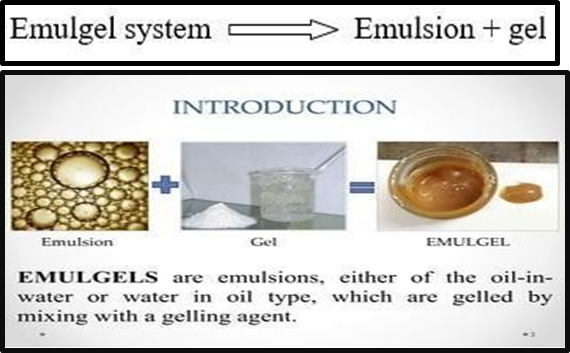
Fig no 1: - Emulgel
TYPES OF EMULGEL:
GELLING AGENTS:
Gelling agents play a vital role in nasal drug delivery. They help make the formulation thicker, which means it stays in the nose longer and is less likely to drip out or be cleared away too. Materials that respond to the body’s natural conditions to form a gel right where they’re needed. These polymers are not only safe and biodegradable but also highly effective when used for delivering drugs directly to the brain through the nose. Smart polymers like poloxamer, chitosan, ethyl cellulose, pectin, and xylulose (which respond to temperature), Carbopol (which reacts to pH), and guar gum (which responds to ions) are especially useful. What makes them unique is their ability to change from a liquid (sol) to a gel when they come into contact with the body’s natural environment— whether it’s heat, pH levels, or even specific enzymes. This change makes it easier to administer the drug as a liquid, which then turns into a gel once inside the nasal cavity, helping the drug stay in place and be absorbed more effectively. For example, Pluronic (PF127), a thermoresponsive polymer, was used in a study to deliver selegiline hydrochloride—a drug for Parkinson’s disease. The gel not only stuck to the nasal lining better but also released the drug steadily for up to 8 hours, significantly improving its effectiveness.
PROPERTIES OF GELLING AGENTS: -
Gels are semi-solid materials with characteristics ranging from soft and brittle to strong and tough.
The rationale of emulgel as topical drug delivery:-
Various semisolids and other preparations are available on the market for restoring the skin’s fundamental role or pharmacologically altering an operation to the underline tissue 18. The formulations, such as lotions, ointments and creams have several drawbacks, including being sticky, having a low spreading coefficient, and having stability issues. Only transparent gels have exposure in pharmaceutical and cosmetic preparations due to overall limitations within the semisolid preparations. As a result, an emulsion-based solution is used to address this limitation. Hence, the hydrophobic moiety of the drug should be incorporated and provided through gels. Drug/oil/water emulsions may be used to integrate hydrophobic drugs into emulgel. Since solubility acts as a barrier, most drugs cannot be inserted directly into gel bases, causing problems during drug release. The emulgel system helps to incorporate a hydrophobic drug into the oil phase, after which oily globules are easily dispersed into the aqueous phase, resulting in an oil/water emulsion. The emulsion can be mixed into the gel base. This may result in enhanced drug stability and release over simply incorporating the drug into the gel base[7].
ADVANTAGES:
KETOPROFEN
Ketoprofen is a non-steroidal anti-inflammatory drug. (NSAIDS)
Chemical name: - 2-(3-benzoylphenyl)-propionic acid
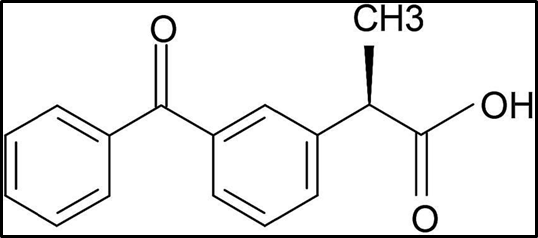
Fig No 2: - Structural formula of Ketoprofen
Molecular formula: - C16H14O3
Molecular Weight: 254.29
It has pKa of 5.94 in methanol: water (3:1) and an n-octanol: water partition coefficient of 0.97 (buffer -7.4)
Ketoprofen is a white or off white, odourless, non-hygroscopic, fine to granular powder, melting at about 95° C. It is freely soluble in ethanol, chloroform, acetone, and ethers and soluble in benzene and strong alkali, but practically insoluble in water at 20° C. Ketoprofen has a half-life of 1.5 hrs and the bioavailability of ketoprofen is 86%[9].
MECHANISM OF ACTION OF KETOPROFEN
It inhibits cyclo oxygenase enzymes both COX1 and COX2.These cyclooxygenase enzyme catalyses the synthesis of prostaglandins from arachidonic acid in the tissue. These inhibition produces its analgesic, antipyretic and anti-inflammatory effects. It can also stabilize the lysosomal membrane. It is a Non-Steroidal Anti-Inflammatory Drug. It is a propionic acid derivative.
Pharmacodynamics:
Class: Nonsteroidal Anti-inflammatory Drug (NSAID) — Propionic acid derivative.
Other Effects: Inhibits leukocyte migration and decreases bradykinin activity.
May stabilize lysosomal membranes and reduce vascular permeability.
Pharmacokinetics:
Absorption- Well absorbed orally; bioavailability ≈ 90%. Peak plasma concentration in 0.5–2 hours after oral dose.
Distribution- Extensively bound to plasma proteins (~99%). Widely distributed in tissues, including synovial fluid (important for arthritis).
Metabolism- Primarily metabolized in the liver by conjugation (glucuronidation).
Excretion- Excreted mainly in the urine as glucuronide conjugates (≈80%).
Half-life (t½)- 1.5 to 4 hours (short half-life, so often given 2–3 times/day)[10].
METHODOLODY:
Ketoprofen and Carbopol 934, HPMC K15M are obtained as a gift sample from SVCP Laboratory, Warora, India. All other chemicals used were of analytical grade.
Preparation of Ketoprofen emulgels:
Table No. 1:- Components of Ingredients
|
Ingredients (%w/w) |
F1 |
F2 |
F3 |
F4 |
|
Ketoprofen |
1 |
1 |
1 |
1 |
|
Carbopol 934 |
0.25 |
0.5 |
- |
- |
|
HPMC K15M |
- |
- |
2.5 |
5 |
|
Liquid paraffin |
7.5 |
7.5 |
7.5 |
7.5 |
|
Tween 20 |
0.5 |
0.5 |
0.5 |
0.5 |
|
Span 80 |
0.5 |
0.5 |
0.5 |
0.5 |
|
Propylene glycol |
5 |
5 |
5 |
5 |
|
Ethanol |
2.5 |
2.5 |
2.5 |
2.5 |
|
Methyl paraben |
0.003 |
0.003 |
0.003 |
0.003 |
|
Propyl paraben |
0.001 |
0.001 |
0.001 |
0.001 |
|
Water |
Q.S. |
Q.S. |
Q.S. |
Q.S. |
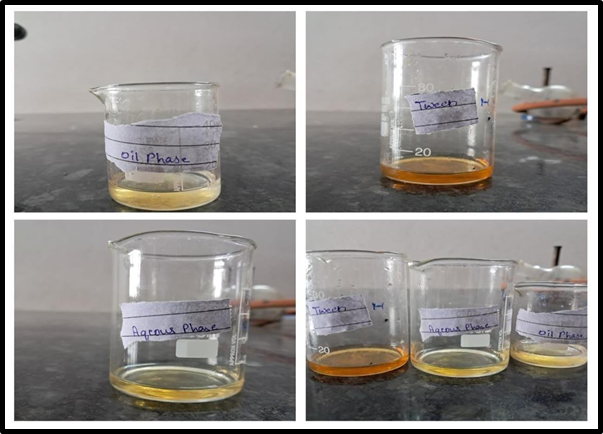
Fig No.3: - Preparation of aqueous phase and oil phase
EVALUATION OF EMULGEL
Physical evaluation of emulgels
The prepared ketoprofen emulgel formulations were inspected visually for their colour, clarity, homogeneity, pH and viscosity. All developed gels were tested for colour, clarity and homogeneity by visual inspection after the gels have been set in the container. They were tested for their appearance to identify the presence of any aggregates. The pH values of 1% aqueous solutions of the prepared emulgel were measured by a pH meter (Digital pH meter, Systronics). The pH of emulgel is adjusting to avoid the risk of irritation upon application to the skin and the acceptable pH is around 5.5. Viscosity measurements were carried out at room temperature (25- 27°C) using a Brookfield viscometer[11].
The spreadability of various formulations from F1-F4 was mentioned in Table 4: Spreadability determination. It shows that the F2 formulation shows a higher spreading coefficient as compared to other formulations. Spreadability was then calculated by using the formula:
S = M x L / T
Where, S = Spreadability; M = Weight tide to upper slide; L = Length of glass slide; T = Time taken to separate the slide completely from each other[14,16].
3. Swelling index: To determine the swelling index of prepared emulgels, 1 gm of gel is taken on porous aluminum foil and then placed separately in a 50 ml beaker containing 10 ml 0.1 N sodium hydroxide. Then samples were removed from beakers at different time intervals and put it on dry place for some time after it reweighed. Swelling index is calculated as follows:
Swelling Index (SW) % = [(Wt-Wo)/Wo] ×100
Where (SW) % = Equilibrium percent swelling, Wt = Weight of swollen emulgel after time t, Wo = Original weight of emulgel at zero time [15,16].
4. pH: pH values of all prepared formulations ranged from 5.5 to 6.5 near skin pH i.e., 5.5[17].
5. Viscosity: The viscosity of gel during preparation and stability should be given an almost importance [19]. Using Falling sphere viscometer the viscosity of different formulations were measured at 25°C[20].
6. Determination of drug content: The prepared emulgels were tested for the drug content uniformity. Accurately weighed quantity of formulation was transferred to a 100 ml volumetric flask containing 50 ml of methanol and allowed to stand for 5 h with intermittent sonication to ensure complete solubility of the drug. The mixture was made up to volume with methanol. The solution was suitably diluted and the absorption was determined by UV-Visible spectrophotometer at 260nm[18,16].
7. Stability studies: Formulation were kept at 40°C, 25°C & room temperature for 45 days & evaluated for following parameters[18,21].
8. In -Vitro Diffusion Study: The test was performed by using Franz diffusion cell. Egg membrane was plant between donor and receptor compartment. The receptor compartment was filled with 100 ml of 7.4 pH phosphate buffer maintained at room temperature and stirred by using magnetic stirrer. Pre weight (1.0 gm) emulgel was taken on the egg membrane. The sample (5ml) was collected for an interval of every one hour and analyse for drug content by UV visible spectrophotometer 1700 at 261nm after appropriate dilution[16,18].
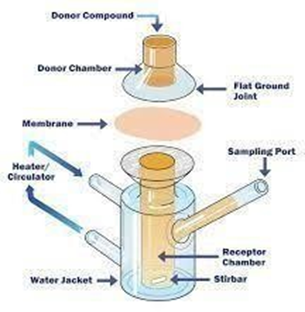
No.4: - Franz Diffusion cell
RESULT AND DISCUSSION
Physical evaluation of Ketoprofen emulgel
Table No. 2: - Physical evaluation tests
|
Formulations |
Clarity |
Colour |
Homogeneity |
pH |
Viscosity (cps) |
|
F1 |
+++ |
Off White |
Good |
5.1+/- 0.26 |
11200 |
|
F2 |
+++ |
Off White |
Good |
5.2+/- 0.16 |
13500 |
|
F3 |
+++ |
Off White |
Good |
5.3+/- 0.31 |
9400 |
|
F4 |
+++ |
Off White |
Good |
5.5+/- 031 |
9750 |
Melting point: -
The Melting point was determined using the capillary method and it was found to be as per the following
Table No. 3: Melting point determination
|
Sr.no |
Formulation |
Physical constants |
|
1. |
F1 |
141oC |
|
2. |
F2 |
140 oC |
|
3. |
F3 |
130 oC |
|
4. |
F4 |
132 oC |

Fig No.5: - Melting point
pH
The pH of ketoprofen emulgel formulation of F4 was found to be 5.5.
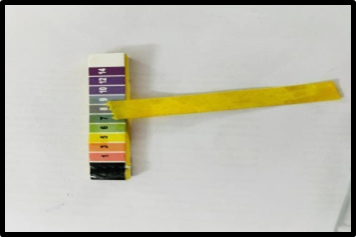
Fig No 6: - pH
Skin irritation test
No irritation occurred.
Centrifugation
The prepared emulgel were subjected to centrifugation test to determine the physical stability and there was no phase separation or creaming observed during this test which indicated that the formulation.
Viscosity
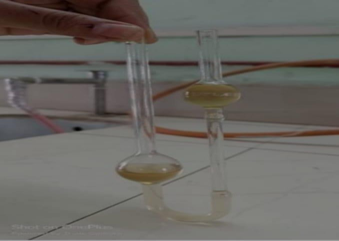
Fig No 7: - Oswald Viscometer
Spreadability:
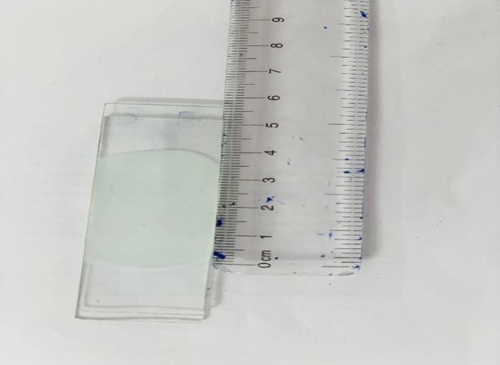
Fig No 8: - spreadability
Table No. 4:- Spreadability test
|
Sr no |
Formulation |
Spreadability |
|
1 |
F1 |
55cm |
|
2 |
F2 |
65cm |
|
3 |
F3 |
50cm |
|
4 |
F4 |
70cm |
Swelling index
Table No.5:- Swelling Index
|
Sr no. |
Formulation |
Swelling index |
|
1 |
F1 |
10 |
|
2 |
F2 |
14 |
|
3 |
F3 |
15 |
|
4 |
F4 |
17 |
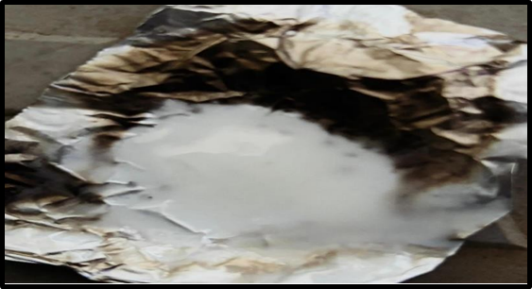
Fig No .9: - swelling index
Stability studies for f4 emulgel formulation- physical evaluation
Table No. 6:- Stability study test
|
Time Period |
Clarity |
Homogeneity |
pH |
Spreadability |
Viscosity |
% Drug content |
|
Before storage |
+++ |
Good |
5.5+/- 0.31 |
70+/-0.64 |
9750+/-11 |
99.87+/- 0.50 |
|
After 1 months |
++ |
Good |
5.00+/- 0.18 |
69+/-0.48 |
9749+/-11 |
99.12+/- 0.36 |
In vitro % Drug Release for Carbopol
Table No. 7:- In vitro % drug Release for Carbopol
|
Sr. No |
Time (min) |
Formulation F1 |
Formulation F2 |
|
1 |
0 |
0 |
0 |
|
2 |
20 |
10 |
15 |
|
3 |
40 |
25 |
20 |
|
4 |
60 |
40 |
35 |
|
5 |
80 |
61 |
55 |
|
6 |
100 |
75 |
70 |
|
7 |
120 |
97 |
95 |
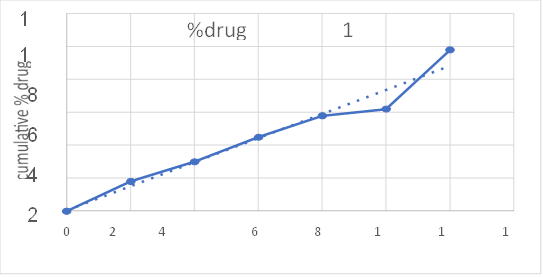
Fig No.10:- Batch 1

Fig No.11:- Batch 2
In vitro % Drug Release for HPMC
Table No. 8:- in vitro % drug Release for HPMC
|
Sr.no |
Time (min) |
Formulation F3 |
Formulation F4 |
|
1 |
0 |
0 |
0 |
|
2 |
20 |
10 |
18 |
|
3 |
40 |
20 |
30 |
|
4 |
60 |
75 |
45 |
|
5 |
80 |
63 |
58 |
|
6 |
100 |
78 |
62 |
|
7 |
120 |
96 |
98 |
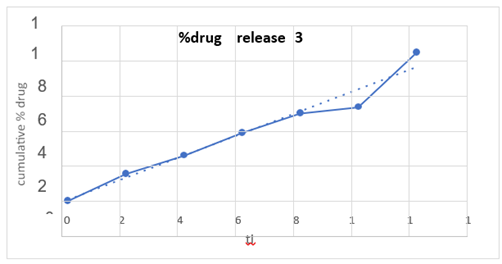
Fig No. 12:- Batch 3
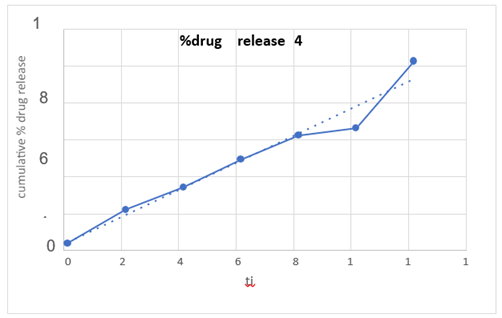
Fig No. 13:- Batch 4
CONCLUSION
To survey of the various literatures for selection of research domain and studied to get appropriate information about selected domain. Main aim of this study to formulation and evaluation of emulgel Ketoprofen, Emulgel was prepared by using super gelling agents i.e. Carbopol and HPMC. Prepared Emulgel of Ketoprofen (F1, F2, F3, F4,) was evaluated for test such as spreadability, viscosity, pH, swelling index, Skin irritancy, centrifugation, In vitro % drug Release, % drug content etc. In Conclusion, batch F4 showed the best result as compared to others. HPMC showed good absorbing properties in skin.
The topical emulgel of ketoprofen (F1, F2, F3, F4,) containing HPMC (hydroxy Propyl methyl cellulose) and Carbopol were use as gelling agent in the 1:1 ratio was prepared and evaluated. Where F4 shows better absorbance of drug. About 98.46% was released in 8 hours. There for based on evaluation parameter and in vitro Drug release profile, F4 containing HPMC is optimised as the best formulation with dissolution rate.
REFERENCES

Dr. Ritesh Bathe, Bhagyashri Latare, Rupal Kalbhut, Prachi Thak, Sweety Bawane, Formulation and Evaluation of Ketoprofen Emulgel, Int. J. of Pharm. Sci., 2025, Vol 3, Issue 11, 165-176. https://doi.org/10.5281/zenodo.17507684
 10.5281/zenodo.17507684
