
UG Department of Quality assurance SCS College of Pharmacy Harapanahalli, Karnataka 583131
Aims: The aim of the present study was to develop an emulgel formulation of Clindamycin Hydrochloride using carbopol 934 as a gelling agent. The influence of the type of gelling agent and the concentration of both the oil phase and the emulsifying agent on the release of the drug were investigatedMethodology: Within the major group of semisolid preparations, emulgel has emergedas a promising drug delivery system for the delivery of hydrophobic drugs. Different emulgel formulations were prepared using gelling agent carbopol 934, liquid paraffin (6% and 8 %) and emulsifying agent (Span 2 and 2.5% and tween 1 and 1.5 %). The prepared emulgel were evaluated for their physical properties, pH, drug content, rheological properties and in vitro release studies. Results: All the prepared emulgels showed acceptable physical properties concerning colour, homogeneity, consistency, and pH value. revealed that all formulations exhibited a shear thinning behaviour with thixotropy, indicating structural break down of intermolecular interaction between polymeric chains. The prepared emulgel exhibited higher release in F6 formulation. Stability studies revealed no significant differences before and after storage of formulation for a period of 3 months.Conclusion: It was suggested that Clindamycin Hydrochloride emulgel formulation (F6) prepared using carbopol as gelling agent, emulsifying agent in its high level and liquid paraffin in its high level was the formula of choice since it showed the highest drug release
There are two basic types of topical drug delivery products, external and internal topical. The external topical are spread, sprayed or otherwise dispersed on the tissue to cover diseased area, while the internal topical are applied to mucous membrane orally, vaginally or on the rectal tissues for local activity. Topical drug delivery system avoids the gastrointestinal metabolic degradation and irritation associated with oral administration The therapeutic efficacy of a topical formulation depends on both the nature of the vehicle and the physicochemical properties of the active substance. It is well known that vehicles used in the topically applied formulations can greatly influence the rate and extent of drug permeation into and across the skin1. Topical drug administration is simplest and easiest route of localized drug delivery Any where in the body by routes as ophthalmic, rectal, vaginal and skin. These are applied as wide spectrum of preparations in case of both cosmetic and dermatological, to the healthy or diseased skin 2. The main advantage of topical delivery system is to bypass first pass metabolism 3. Avoidance of the risks and inconveniences of intravenous therapy and of the varied conditions of absorption like pH changes, presence of enzymes, gastric emptying time are other advantages of topical preparations 4, 5. Gels being newer class of dosage form are created by entrapment of large amounts of aqueous orhydro alcoholic liquid in a network of colloidalsolid particles, which may consist of inorganic substances, such as aluminum salts or organic polymers of natural or synthetic origin6.
For dermatological use Emulgels show several favorable properties such as being thixotropic, greaseless, easily spreadable, easily removable, emollient, non staining, long shelf life, biofriendly, transparent & pleasing appearance 7.
ADVANTAGES OF EMULGEL
DISADVANTAGES OF EMULGEL
PHYSIOLOGY OF SKIN11-12.
Most of the topical preparations are meant to be applied to the skin. So, basic knowledge of the skin and its physiology function are very important for designing topical. The skin of an average adult body covers a surface area approximately 2m2 and receives about one third of the blood circulating through the body. An average human skin surface is known to contain, the average 40-70 hair follicles and 200-300 sweat ducts on every square centimeter of the skin. The pH of the skin varies from 4 to 5.6. Sweat and fatty acid secreted from sebum influence the pH of the skin surface. The skin can be considered to have four distinct layers of tissue as shown in figure 01
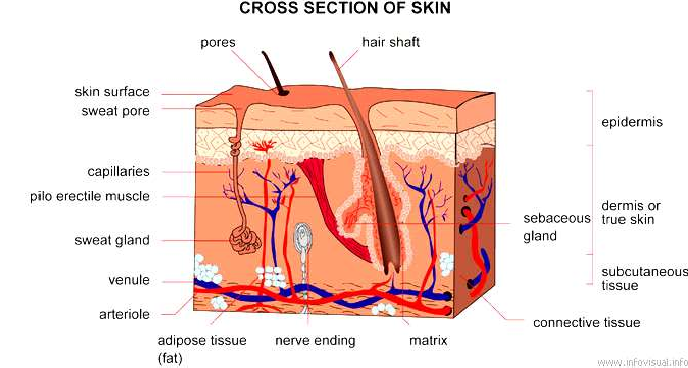
Fig:1. Cross Section of skin
CLASSIFICATION OF EMULGEL13
Emulgel is composed of two parts:
1. Emulsion.
2. Gel.
Emulsion: -
Emulsions are biphasic system in which one immiscible liquid is dispersed into other; due to this the system becomes unstable, which is stabilized by emulsifying agents. Emulsion can be either O/W or W/O, these are used as vehicles to deliver drug. Emulsions are stabilized by use of emulsifying agents. They can be easily washed off from skin and have good penetration capability.
Gel: -
The term “gel” represents a physical state with properties intermediate between those of solids and liquids. However, it is often wrongly used to describe any fluid system that exhibits some degree of rigidity. A gel consists of a polymer which swells in the presence of fluid and perhaps it within its structure. The rigidity of the gel is determined by the amount of fluid it entraps. These gels are wet and soft and look like a solid material. These are capable of undergoing large deformation in their physical state i.e. from solid to liquid.
Method of Preparation of emulsion:
Formulation of Emulsion either O/W or W/O based on which the oil phase is added to the aqueous phase or the aqueous phase is added to the oil phase. These two phases are heated at 70 0c prior to the mixing, and added while hot with continuous stirring and cooled.
Method of preparation of gel:
Gels are normally in the industrial scale prepared under room temperature. However, few of polymers need special treatment before processing.
Gels can be prepared by following methods.
1. Thermal changes
2. Flocculation
3. Chemical reaction
Thermal changes:
Solvated polymers (lipophilic colloids) when subjected to thermal changes causes gelatin. Many hydrogen formers are more soluble in hot than cold water. If the temperature is reducing, the degree of hydration is reduced and gelatin occurs. (Cooling of a concentrated hot solution will produce a gel). E.g. Gelatin, agar sodium oleate, guar gummed and cellulose derivatives etc. In contrast to this, some materials like cellulose ether have their water solubility to hydrogen bonding with the water. Raising the temperature of these solutions will disrupt the hydrogen bonding and reduced solubility, which will cause gelation. Hence this method cannot be adopted to prepare gels as a general method.
Flocculation:
Here gelation is produced by adding just sufficient quantity of salt to precipitate to produce age state but insufficient to bring about complete precipitation. It is necessary to ensure rapid mixing to avoid local high concentration of precipitant. E.g. Solution of ethyl cellulose, polystyrene in benzene can be gelled by rapid mixing with suitable amounts of a non-solvent such as petroleum ether. The addition of salts to hydrophobic solution brings about coagulation and gelation is rarely observed. The gels formed by flocculation method are Thixotropic in behavior. Hydrophilic colloids such as gelatin, proteins and acacia are only affected by high concentration of electrolytes, when the effect is to “salt out”, the colloidal and gelation doesn’t occur.
Chemical reaction:
In this method gel is produced by chemical inter action between the solute and solvent E.g. aluminum hydroxide gel can be prepared by interaction in aqueous solution of an aluminum salt and sodium carbonate an increased concentration of reactants will produce a gel structure. Few other examples that involve chemical reaction between PVA, cyanoacrylates with Glycidol ether (Glycidol), toluene diisocyanates (TDI), methane diphenyl Isocyanine (MDI) that cross-links the polymeric chain
EMULGEL PREPARATION:
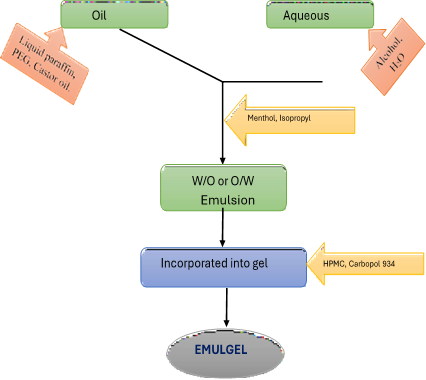
Fig : 2 . Preparation of Emulgel
PROCESS VALIDATION:
Process validation is establishing documented evidence which provides a high degree of assurance that a specific process will consistently produce a product meeting its pre- determined specifications and quality characteristics. It is beneficial to the manufacturer in many ways.
Objective of process validation:
METHOD AND MATERIALS
The materials used in the present study were procured from reputed manufacturers. Clindamycin Hydrochloride was obtained from Yarrow Chem. Ltd.. Carbopol-934, Light Liquid Paraffin, Ethanol, span 20, Tween 20, Propylene Glycol, Methyl Paraben, Propyl Paraben, and Sodium Hydroxide were purchased from S.D. Fine Chem. Ltd.. All chemicals and reagents used were of analytical grade.
PREFORMULATION
Prior to the development of a dosage form, it is essential certain fundamental physical and chemical properties of the drug molecule and other derived properties of the drug powder to be determined.
The preformulation studies are necessary because of two reasons:
Analytical: Involves identification of the active pharmaceutical ingredient, evaluating for pharmacopeial compliance and development of analytical procedure.
Formulation: The approved material of certain chemical identity and purity can have varied pharmaceutical properties that can have an impact over formulation and drug release patterns. So any batch-to-batch variations in these characteristics of the material and their effect on the performance of the dosage form are to be established.
Preformulation Studies of Terbinafine Hydrochloride
? Description.
? Identification: Melting point,
? Drug excipient compatibility studies.
Description: Description was done by visual appearance.
Identification
Melting point14:
Melting point of drug was determined by taking a small quantity of drug in capillary tube sealed at one end and placed in digital melting point apparatus and temperature range at which drug melt was noted.
Drug excipient compatibility studies
The successful formulation of a stable and effective topical dosage form depends on the careful selection of the excipients that are added to facilitate administration, promote the consistent release, improved bioavailability and protects from degradation.
ANALYTICAL METHODS15.
Preparation of reagents and buffers
Determination of λ max and construction of calibration curve of Terbinafine Hydrochloride
Preparation of stock solution (100 μg/ml)
From the standard stock solution, 1 ml was withdrawn into a 10 ml volumetric flask. The volume was made up to 10 ml with phosphate buffer pH 7.4. The resulting solution containing 10 μg/ml was scanned between 200 to 400 nm. The λ max was determined15.
From the above stock solution aliquots of 1, 2, 3, 4 and 5ml were withdrawn into separate 10 ml volumetric flasks and the volume was made up to 10 ml with phosphate buffer pH 7.4 to get the concentrations of 5, 10, 15, 20, 25 and 30μg/ml respectively. Absorbance of the above prepared solutions was measured using UV/Visible spectrophotometer. This procedure was performed on six sets of samples to validate the calibration curve15.
PREPARATION OF EMULGELS16
Preparation of Emulgels was done in 3 stages
STAGE 1: Preparation of W/O emulsion
The general method was employed according to literature6 for preparation of emulsion was as follows : The oil phase was prepared by dissolving certain amount of span 20 in liquid paraffin, while the aqueous phase was prepared by dissolving the required amount of tween 20 in purified water. One gram of Terbinafine Hydrochloride powder was dissolved in 2.5 gm of ethanol, while 0.03 gm of methyl paraben and 0.01 gm of propyl paraben were dissolved in 5 gm of propylene glycol and both were mixed with aqueous phase. Both the oily and aqueous phases were separately heated to 70-80° C. Then, the oil phase was added to the aqueous phase with continuous stirring at 50 rpm until cooled to room temperature.
STAGE 2: Preparation of gels using different polymers
Different polymers were selected as given in Each polymer was dissolved in 100 ml distilled water in a beaker separately. These polymeric dispersions were continuously stirred until formed viscous gels.
STAGE 3: Incorporation of W/O emulsion with gels to produce emulgels
The prepared W/O emulsions in Stage 1 were incorporated into gels by continuous stirring in a ratio of 1:1. The prepared emulgels were transferred into containers, sealed and stored till further use (Characterization).
Table No. 1 : COMPOSITION OF CLINDAMYCIN HYDROCHLORID EMULGEL FORMULATIONS (%W/W)
|
INGREDIENT (mg) |
F1 |
F2 |
F3 |
F4 |
F5 |
F6 |
|
Clindamycin Hydrochloride |
1 |
1 |
1 |
1 |
1 |
1 |
|
Liquid paraffin |
5.0 |
5.0 |
6.0 |
6.0 |
7.0 |
7.0 |
|
Carbopol-934 |
1 |
1 |
1 |
1 |
1 |
1 |
|
Ethanol |
5 |
5 |
5 |
5 |
5 |
5 |
|
Span20 |
2.0 |
2.5 |
2.0 |
2.5 |
2.0 |
2.5 |
|
Tween 20 |
1.5 |
1.0 |
1.5 |
1.0 |
1.5 |
1.0 |
|
Propyleneglycol |
4 |
4 |
4 |
4 |
4 |
4 |
|
Methyl paraben |
0.03 |
0.03 |
0.03 |
0.03 |
0.03 |
0.03 |
|
Propyl paraben |
0.01 |
0.01 |
0.01 |
0.01 |
0.01 |
0.01 |
|
Sodium Hydroxide |
0.02 |
0.02 |
0.02 |
0.02 |
0.02 |
0.02 |
|
Purified water |
QS. |
QS |
QS |
QS |
QS |
QS |
CHARACTERIZATION OF EMULGELS
The developed formulations were visually inspected for appearance and clarity
The surface pH of the formulations was determined in order to investigate the possibility of any side effects due to change in pH in-vivo, since an acidic or highly alkaline pH may cause irritation to the skin. The pH was noted by bringing the electrode of pen pH meter in contact with the surface of the formulations and allowing it to equilibrate for 1.0 min.
Rheology is the measurement of flow properties of liquid and semisolids. Viscosity is an expression of resistance of a fluid to flow; the higher the viscosity, the greater the resistance. The rheological properties of emulgels were measured using Brookfield Synchro electric Viscometer. 200 ml of the developed formulations were transferred into the beaker; temperature was maintained at 37 ± 0.5° C for all formulations throughout the experiment. Angular velocity was increased gradually from 5 to 100 rpm and the viscosity was measured at different RPM with Spindle No. 781.
Average of three readings was taken for calculation.
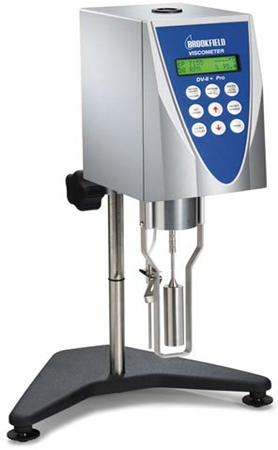
Figure 3. Brookfield viscometer
The drug content of Terbinafine Hydrochloride emulgel was measured by dissolving a known weight of the emulgel formulation (one gram) in 10 ml methanol, appropriate dilutions were made and the resulting solution was then filtering using millipore filter (0.45 μm). Absorbance was measured using UV- spectrophotometer (Shimadzu UV 1700). Drug content was calculated using the slope and the intercept obtained by linear regression analysis of standard calibration curve. Experiments were carried out in triplicates.
The In vitro release of drug from different formulations (F1 to F6) was studied through cellophane membrane using a modified in vitro permeation apparatus. The dissolution medium used was phosphate buffer pH 7.4. Cellophane membrane, previously soaked overnight in the dissolution medium, was tied to one end of a specially designed glass cylinder (open at both ends and of 3.4 cm diameter called as donor chamber). 1 gm of the formulation was taken on the membrane which was fixed on the donor chamber. The glass cylinder was attached to the metallic shaft and suspended in 50 ml of dissolution medium so that the membrane just touched the receptor medium surface. The temperature of the medium was maintained at 37 ± 0.5° C and was stirred at 50 RPM using a magnetic stirrer. Aliquots of 5 ml were withdrawn at specific time interval from the receptor medium. It was filtered, diluted if necessary and finally analyzed by UV spectrophotometer18.19. This was repeated for 3 times for all the formulations and the average was calculated.
Stability of a formulation defined as the time from date of manufacture of the formulation until its chemical or biological activity is not less than a predetermined level of labeled potency and its physical characteristics have not changed appreciably or deleteriously. Formulation and development of a pharmaceutical product is not complete without proper stability analysis, carried out on it to assess the physical and chemical stability and safety.
RESULT AND DISCUSSION
Melting point of Clindamycin Hydrochloride
The melting point of Clindamycin Hcl was found to be in the reported range of 141- 1432°C It complies within official standard. Thus indicating the purity of sample.
Analytical Method:
Scanning of Clindamycin Hcl in pH 7.4 Buffers:
The solution of 50 µg/ml of Clindamycin HCl in 7.4 pH buffers was scanned using UV spectrophotometer over the range between 200- 400 nm against 7.4 pH buffers as blank. The absorption spectra of Clindamycin HCl showed absorption peak at 210 nm, which represent the maximum absorption (210 nm) of the drug.
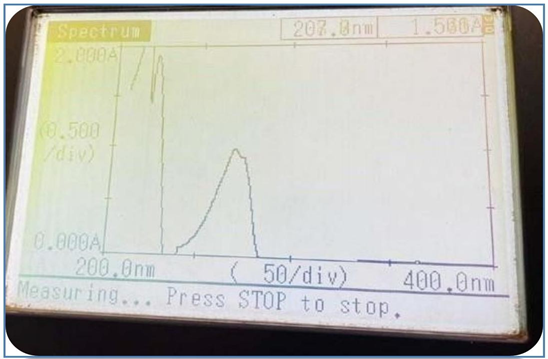
Figure no4: analytical wavelength of Clindamycin Hcl;
Standard Calibration Curve of Clindamycin HCl:
Standard graph for the Clindamycin HCl was done in pH 7.4 phosphate buffer. Table No.3 shows the concentration of Clindamycin HCl in pH 7.4 phosphate buffer and the respective absorbances. The different concentrations and corresponding absorbance were plotted against concentration and Repression analysis was done. The linear equation found in the form of Y=mx+c where m=slope, c=intercept. The
corresponding standard curve generated by linear Regression analysis along with the mathematical representing the curve.
Table no:2 Calibration data of Clindamycin HCl at 210 nm
|
Sl No. |
Concentration (mg/ml) |
Absorbance (at 210 nm) |
|
1 |
0 |
0 |
|
2 |
2 |
0.083 |
|
3 |
4 |
0.164 |
|
4 |
6 |
0.243 |
|
5 |
8 |
0.340 |
|
6 |
10 |
0.420 |
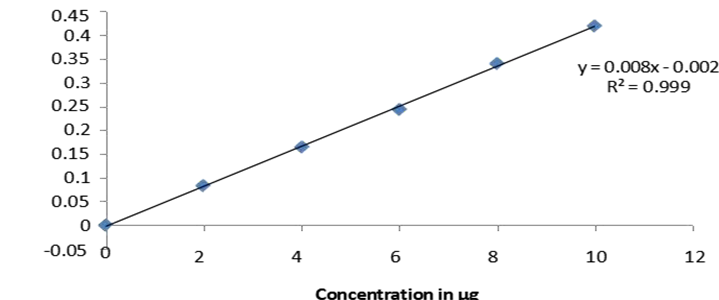
Figure No.5: standard graph of Clindamycin
Physical appearance:
Emulgel formulations were Light white viscous creamy preparation with a smooth homogeneous texture and glossy appearance. Results have been discussed
Table no:3 Physical appearance:
|
Formulation |
Color |
Homogeneity |
Consistency |
Phase Separation |
|
F1 |
White |
Excellent |
Excellent |
None |
|
F2 |
White |
Excellent |
Excellent |
None |
|
F3 |
Light white |
Excellent |
Excellent |
None |
|
F4 |
Light white |
Excellent |
Excellent |
None |
|
F5 |
White |
Excellent |
Excellent |
None |
|
F6 |
White |
Excellent |
Excellent |
None |
Surface pH of gel:
The pH values observed are in the range of 6.7 to 7 which is close to pH of normal human skin. Thus, the developed gels are expected to avoid the risk of irritation to the skin upon application on the skin surface
Spreadability:
Spreadability indicates that the emulgel is easily spreadable and comes out of containers by small amount of shear. Average spreadability values of different formulations
Table no: 4 Surface pH spreadability coefficient of formulation F1 to F6
|
Formulation code |
pH of gel |
Spreadability |
|
F1 |
6.8 |
3.9 |
|
F2 |
6.7 |
4.3 |
|
F3 |
6.7 |
4 |
|
F4 |
7 |
4.7 |
|
F5 |
7.2 |
4,8 |
|
F6 |
7.4 |
5 |
Determination of viscosity
In order to evaluate the rheological behaviour viscosity of the gel was evaluated using Brookfield viscometer using increased shear stress by varying the angular velocities. The obtained results are shown in Table no.5. All the formulation showed pseudoplastic flow with thixotropy. Increasing the concentration of polymer significantly increased the viscosity of the gels. The formulations prepared with Carbopol 934 having higher viscosity.
Table No. 5 Viscosities of formulations
|
Formulation code |
Viscosity(cp) |
|
F1 |
24120.12 ± 0.30 |
|
F2 |
19376.66 ± 0.115 |
|
F3 |
27270.00 ± 0. 432 |
|
F4 |
28010.34 ± 0. 432 |
|
F5 |
31850.33 ± 0.288 |
|
F6 |
32022.87 ± 0.057 |
Drug Content Estimation:
The drug content of all emulgel formulation is given in Table No :6 The drug content of different emulgel formulations (F1- F6) was estimated and the results were in official limits with range of 89.9% to 92.3 % which indicate uniform distribution of the drug throughout the emulgel.
Table No: 6 Drug content of formulations (F1 to F6)
|
Formulation code |
Content uniformity (%) |
|
F1 |
90.09% |
|
F2 |
89.9% |
|
F3 |
91.9% |
|
F4 |
92.3% |
|
F5 |
93.4% |
|
F6 |
93.8% |
In vitro release studies
Table no 07. In vitro dissolution data for Emulgel formulations (F1-F6)
|
Time (min) |
F1 |
F2 |
F3 |
F4 |
F5 |
F6 |
|
0 |
0±0 |
0±0 |
0±0 |
0±0 |
0±0 |
0±0 |
|
10 |
1.61±0.02 |
1.41±0.007 |
1.79±0.028 |
2.03±0.021 |
2.11±0.007 |
2.44±0.07 |
|
20 |
3.57±0.02 |
2.9±0.007 |
3.81±0.021 |
4.22±0.084 |
5.69±0.134 |
7.57±0.049 |
|
30 |
5.77±0.03 |
4.74±0.014 |
6.2±0.07 |
6.89±0.021 |
8.91±0.289 |
9.2±0.141 |
|
45 |
8.33±0.07 |
6.98±0.063 |
8.46±0.007 |
8.98±0.141 |
10.54±0.169 |
11.36±0.113 |
|
60 |
10.61±0.06 |
9.24±0.042 |
11.23±0.021 |
12.36±0.021 |
13.45±0.035 |
13.99±0.134 |
|
90 |
13.01±0.20 |
12.49±0.035 |
14.86±0.254 |
14.99±0.07 |
17.23±0.162 |
17.59±0.134 |
|
120 |
16.4±0.03 |
15.34±0.028 |
17.98±0.134 |
18.8±0.070 |
20.03±0.021 |
20.77±0.551 |
|
150 |
19.54±0.01 |
18.51±0.028 |
21.01±0.007 |
21.12±0.014 |
22.76±0.183 |
23.91±0.502 |
|
180 |
25.3±0.04 |
22.43±0.007 |
25.9±0.07 |
29.21±0.077 |
32.76±0.183 |
37.78±0.135 |
|
210 |
45.01±0.13 |
32.3±0.141 |
44.43±0.091 |
46.3±0.141 |
51.08±0.636 |
57.81±0.077 |
|
240 |
62.31±0.01 |
55.3±0.049 |
67.48±0.042 |
68.89±0.134 |
73.81±0.077 |
75.51±0.042 |
|
270 |
74.93±002 |
71.9±0.014 |
85.86±0.325 |
87.89±0.07 |
90.71±0.431 |
92.8±0.636 |
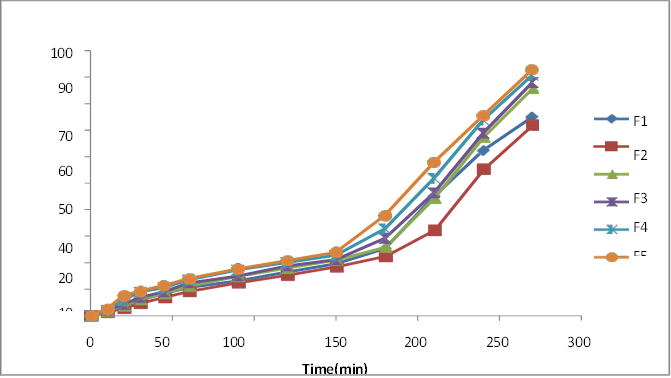
Figure No 5. In vitro dissolution profile
CONCLISION
From the results obtained, it can be concluded that emulgel is a promising and effective topical drug delivery system for Clindamycin Hydrochloride. The formulation prepared using Carbopol 934 demonstrated suitable physicochemical properties, desirable rheological characteristics, and satisfactory drug release behavior. Among the developed formulations, F6 was identified as the optimized formulation due to its superior in vitro drug release and stability profile. The study confirms that variation in oil phase and emulsifier concentration significantly influences drug release characteristics. Therefore, the developed emulgel formulation can be considered a stable, effective, and patient-friendly alternative for the topical delivery of Clindamycin Hydrochloride. Further clinical studies may be conducted to confirm its therapeutic efficacy.
REFERENCES
Sakarkar DM, Shrikhande VN, Vyas JV, Mahajan N, Jaiswal SB, Dorle AK. Studies on formulation development, characterization and transdermal permeation of nimesulide from emulgel. International Journal of Pharmaceutical Excipients 2004 Jul; 3(3): 57






Sriranga T., Vinayaka J., Akash B., Kiran B. U., Nandeesh A. S., B. Nandeesh Formulation And Process Validation of Clindamycin Hcl Emulgel., Int. J. of Pharm. Sci., 2026, Vol 4, Issue 3, 527-538. https://doi.org/10.5281/zenodo.18890109
 10.5281/zenodo.18890109
