
Department of Pharmaceutics, Pushpagiri College of Pharmacy
Mosquito-borne diseases such as malaria, dengue, and chikungunya remain significant public health concerns, particularly in tropical and subtropical regions. Conventional synthetic mosquito repellents, although effective, are often associated with issues such as skin irritation, toxicity, environmental hazards, and the development of resistance. These limitations have increased the demand for safer and eco-friendly alternatives derived from natural sources. The present study aimed to formulate and evaluate a herbal mosquito repellent ointment using plant-based ingredients with known repellent properties.The ointment formulation incorporated Azadirachta indica (neem) and Calendula officinalis (marigold) as the primary active ingredients due to their established insect-repellent and skin-protective properties. Essential oils such as lavender oil, clove oil, and lemongrass oil were included to enhance mosquito repellent activity and provide a pleasant fragrance. Petroleum jelly was used as the ointment base to ensure good consistency, skin adherence, and ease of application. Multiple formulations were prepared and evaluated to identify an optimized composition.The prepared ointments were assessed for various physicochemical parameters including colour, odour, texture, homogeneity, pH, spreadability, and stability. Mosquito repellent activity was evaluated using the cage method to determine the effectiveness and duration of protection. The results demonstrated that the optimized herbal formulation exhibited satisfactory physical properties, good stability, and significant mosquito repellent activity.The study highlights the potential of herbal formulations as safe, economical, and environmentally friendly alternatives to synthetic mosquito repellents. The developed herbal ointment may serve as a promising natural product for personal protection against mosquito bites, especially in regions highly affected by mosquito-borne diseases..
Mosquitoes are among the most significant vectors responsible for transmitting various infectious diseases such as malaria, dengue, chikungunya, Zika virus infection, and yellow fever. These mosquito-borne diseases continue to pose serious public health challenges, particularly in tropical and subtropical regions. According to global health reports, millions of people are affected annually by mosquito-borne illnesses, leading to considerable morbidity and mortality. Preventing mosquito bites remains one of the most effective strategies for reducing the transmission of these diseases. Mosquito repellents are substances applied to the skin, clothing, or other surfaces to prevent mosquitoes from landing or biting. They act by interfering with the mosquito’s olfactory receptors, which detect host-related cues such as carbon dioxide, body heat, and lactic acid.
Synthetic chemical repellents such as N,N-diethyl-meta-toluamide (DEET), picaridin, and permethrin are widely used for personal protection against mosquitoes. Although these products are effective, prolonged and excessive use may be associated with certain disadvantages including skin irritation, toxicity, environmental hazards, and the development of resistance among mosquito populations. These concerns have encouraged researchers to explore safer and environmentally friendly alternatives. In recent years, plant-based repellents have gained considerable attention due to their biodegradability, lower toxicity, and minimal adverse effects on humans and the environment.
Medicinal plants have long been used in traditional systems of medicine for their therapeutic and protective properties. Several plant species contain bioactive compounds that exhibit insecticidal, larvicidal, and repellent activities. Among them, Azadirachta indica (neem) and Calendula officinalis (marigold) are well-known medicinal plants widely used in herbal preparations. Neem contains several biologically active compounds such as azadirachtin, nimbin, and limonoids, which possess strong insect repellent and insect growth-regulating properties. Calendula officinalis, commonly known as marigold, contains flavonoids, carotenoids, and essential oils that contribute to its anti-inflammatory, antimicrobial, and insect-repelling activities. Previous studies have demonstrated that plant extracts and essential oils such as lemongrass oil, lavender oil, and clove oil possess significant mosquito repellent properties due to the presence of volatile aromatic compounds. Topical formulations such as ointments are widely used for the application of medicinal and cosmetic products on the skin. Ointments are semisolid dosage forms that contain medicaments dissolved or dispersed in a suitable base. They provide prolonged contact with the skin, enhance drug stability, and facilitate controlled release of active ingredients. Petroleum jelly and waxes are commonly used as ointment bases due to their emollient properties, skin compatibility, and ability to retain moisture. Incorporating plant extracts and essential oils into an ointment base can therefore provide an effective and convenient means of delivering natural mosquito repellents. Several studies have reported the development of herbal mosquito repellent formulations using plant extracts and essential oils. For instance, research on neem-based formulations has shown effective mosquito repellent activity due to the presence of azadirachtin and related compounds. Similarly, essential oils such as citronella, lemongrass, and lavender have demonstrated significant repellent effects against mosquito species like Aedes aegypti and Anopheles. These findings support the potential use of plant-derived ingredients in developing safer alternatives to synthetic mosquito repellents. Due to the increasing demand for natural and eco-friendly personal care products, the present study focuses on the formulation and evaluation of a herbal mosquito repellent ointment containing extracts of Azadirachta indica and Calendula officinalis. The ointment formulation aims to combine the insect-repelling properties of these plant extracts with essential oils to enhance repellent efficacy and provide a pleasant fragrance. The prepared formulations are evaluated for various physicochemical parameters such as colour, texture, pH, spreadability, homogeneity, stability, and mosquito repellent activity using the cage method.
The objectives of this study are:
REVIEW OF LITERATURE
MATERIALS AND METHODS
Materials
The materials used for the formulation of the herbal mosquito repellent ointment included plant extracts and excipients suitable for topical preparation. The primary active ingredients were Azadirachta indica (neem) extract and Calendula officinalis (marigold) extract [5], [6], selected for their known mosquito repellent and therapeutic properties. Essential oils such as lavender oil, clove oil, and lemongrass oil were incorporated to enhance repellent activity and provide a pleasant fragrance. Petroleum jelly was used as the ointment base due to its good emollient properties and compatibility with the skin. The experiment was conducted on 2025 on Pushpagiri College of Pharmacy, Thiruvalla.
Preparation of Herbal Mosquito Repellent Ointment
The herbal mosquito repellent ointment was prepared using the fusion method. Initially, the required quantity of petroleum jelly was weighed and melted in a water bath at a controlled temperature. The plant extracts of Azadirachta indica and Calendula officinalis were then incorporated into the melted base with continuous stirring to ensure uniform distribution. After achieving a homogeneous mixture, essential oils such as lavender oil, clove oil, and lemongrass oil were added gradually while stirring continuously. The mixture was then allowed to cool slowly with constant stirring until a smooth and uniform semisolid ointment was obtained. The prepared formulations were transferred into suitable containers and labelled appropriately. Four different formulations (M1, M2, M3, and M4) were prepared by varying the concentration of plant extracts and essential oils. [7]

Fig No.1: Herbal Mosquito Repellent
Table No 1: Formulation Of Mosquito Repellent Ointment
|
Sl.no |
Ingredients |
M1 |
M2 |
M3 |
M4 |
|
1. |
Neem Extract |
5 ml |
7 ml |
3 ml |
---- |
|
2. |
Marigold Extract |
5 ml |
3 ml |
7 ml |
---- |
|
3. |
Lemongrass Oil |
2.5 ml |
2.5 ml |
2.5 ml |
5 ml |
|
4. |
Lavender Oil |
1.5 ml |
1.5 ml |
1.5 ml |
1.5 ml |
|
5. |
Clove Oil |
0.5 ml |
0.5 ml |
0.5 ml |
0.5 ml |
|
6. |
Orange Oil |
0.5 ml |
0.5 ml |
0.5 ml |
0.5 ml |
|
7. |
Bees wax |
4.5 g |
4.5 g |
4.5g |
4.5 g |
|
8. |
Petroleum Jelly |
q.s. |
q.s. |
q.s. |
q.s. |
Evaluation of the Formulation
Organoleptic Properties
The prepared ointments were evaluated for physical characteristics such as colour, odour, texture, and homogeneity by visual inspection.
pH Determination
The pH of the formulation was determined using a digital pH meter to ensure that it was within the acceptable range for topical application on the skin. [8]
Spreadability
Spreadability was determined by placing a fixed quantity of ointment between two glass slides and applying a specific weight over the upper slide. The time required for the upper slide to move over the lower slide was recorded, which indicates the ease of spreading of the ointment. [9]
Washability
Washability was evaluated by applying a small amount of the ointment to the skin and observing the ease with which it could be removed with water. [10]
Extrudability
Extrudability of the formulation was determined by measuring the force required to extrude the ointment from a collapsible tube, indicating the ease of application. [11]
Stability Studies
Stability studies were conducted to evaluate the physical stability of the prepared formulations. The ointments were stored at different temperatures such as refrigeration temperature (3–5°C), room temperature (25°C), and elevated temperature (40°C) for a specified period. The formulations were periodically observed for changes in colour, odour, consistency, and phase separation.
Mosquito Repellent Activity (Cage Method)
The mosquito repellent activity of the prepared formulations was evaluated using the cage method. A defined area of skin or test surface was treated with the ointment and exposed to mosquitoes present in a cage. The number of mosquito landings or bites was observed and compared with an untreated control. The duration of protection and percentage repellency were recorded to assess the effectiveness of the formulation.
The collected data from these evaluations were analyzed to determine the most stable and effective herbal mosquito repellent ointment formulation. [12]
RESULTS AND DISCUSSION
The present study was carried out to formulate and evaluate a herbal mosquito repellent ointment using plant extracts of Azadirachta indica (neem) and Calendula officinalis (marigold) along with selected essential oils. Four formulations (M1, M2, M3, and M4) were prepared using different concentrations of plant extracts and essential oils in a petroleum jelly base. The prepared formulations were evaluated for various physicochemical parameters and mosquito repellent activity in order to determine the most effective and stable formulation.
Organoleptic Evaluation
The prepared ointments were examined for colour, odour, texture, and homogeneity. All formulations showed a smooth and semisolid consistency suitable for topical application.
Table no 2: PHYSIOCHEMICAL EVALUATION OF FORMULATED HERBAL MOSQUITO REPELLENT OINTMENT
|
Physical appearance |
M1 |
M2 |
M3 |
M4 |
|
Colour |
Lime green |
Olive green |
Lime green |
Pearl white |
|
Transparency |
Translucent |
Translucent |
Translucent |
Translucent |
|
Texture |
Smooth |
Smooth |
Smooth |
Smooth |
|
Odour |
Characteristic |
Characteristic |
Characteristic |
Characteristic |
|
Phase Separation |
Absent |
Absent |
Absent |
Absent |
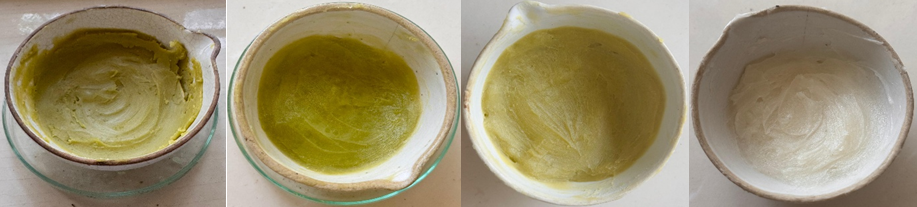
Fig No 2: Formulation of Mosquito Repellent Ointment
pH Determination
The pH of the ointment formulations was found to be within the acceptable range for topical application (approximately 5.5–6.5). This indicates that the formulations are compatible with the normal pH of the skin and are unlikely to cause irritation.
x
Table no 3: pH OF FORMULATED HERBAL MOSQUITO REPELLENT OINTMENT
|
Physiochemical property |
M1 |
M2 |
M3 |
M4 |
|
pH |
5.6 |
6 |
6.2 |
5.8 |

Fig No. 3: Determination of pH
Spreadability
Spreadability is an important parameter for topical formulations as it determines the ease of application on the skin. The spreadability values of the prepared formulations were found to be within an acceptable range, indicating that the ointments can be easily applied and evenly distributed over the skin surface
Table no 4: SPREADABILITY OF FORMULATED HERBAL MOSQUITO REPELLENT OINTMENT
|
Physiochemical property |
M1 |
M2 |
M3 |
M4 |
|
Spreadability |
26.5 sec |
29.3 sec |
30.2 sec |
31 sec |
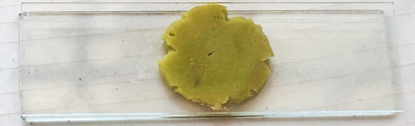
Fig No. 4: Spreadability testing of ointment
Presence of Foreign Particles:
The prepared herbal mosquito repellent ointment formulations were visually inspected for the presence of any foreign particles or impurities. A small quantity of each formulation was spread on a clean glass slide and observed under adequate lighting conditions. The examination revealed that all the formulations were free from visible foreign particles, dust, or other contaminants. This indicates that the ingredients used were pure and the preparation process was carried out under appropriate hygienic conditions, ensuring the quality and safety of the formulated ointment.
Table no 5: PRESENCE OF FOREIGN PARTICLES OF FORMULATED HERBAL MOSQUITO REPELLENT OINTMENT
|
Physiochemical property |
M1 |
M2 |
M3 |
M4 |
|
Presence of Foreign particles |
Absent |
Absent |
Absent |
Absent |
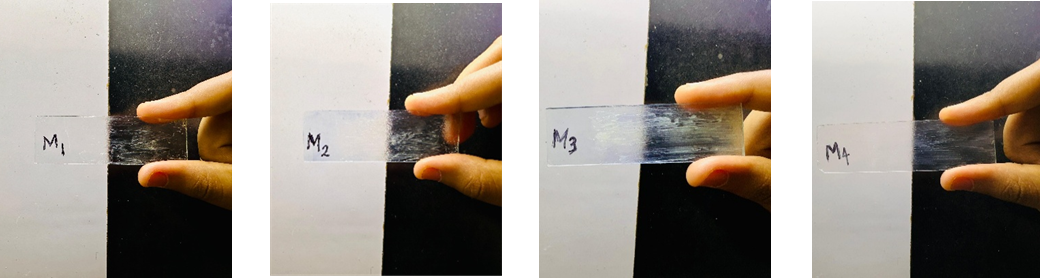
Fig No. 5: Presence of Foreign particles
Washability and Extrudability
All formulations were easily washable with water and showed satisfactory extrudability from collapsible tubes. This indicates that the ointments can be conveniently applied and removed from the skin without difficulty.
Table no 6: WASHABILITY OF FORMULATED HERBAL MOSQUITO REPELLENT OINTMENT
|
Physiochemical property |
M1 |
M2 |
M3 |
M4 |
|
Washability |
Greasy |
Greasy |
Greasy |
Greasy |
Table no 7: EXTRUDABILITY OF FORMULATED HERBAL MOSQUITO REPELLENT OINTMENT
|
Physiochemical property |
M1 |
M2 |
M3 |
M4 |
|
Extrudability |
0.4 g |
0.4 g |
0.4 g |
0.3 g |
Mosquito Repellent Activity (Cage Method)
The mosquito repellent activity of the formulations was evaluated using the cage method. The treated surface showed significantly fewer mosquito landings compared to the untreated control. Among the four formulations, M4 exhibited the highest repellent activity and provided longer protection duration. The improved repellency may be attributed to the synergistic effect of neem extract, marigold extract, and essential oils present in the formulation.
Table no 8: REPELLENCE TEST OF FORMULATED HERBAL MOSQUITO REPELLENT OINTMENT
|
Physiochemical property |
M1 |
M2 |
M3 |
M4 |
|
Exposure Time |
No. of Mosquitoes Adhered |
|||
|
0-20 minutes |
0 |
0 |
0 |
0 |
|
20-40 minutes |
0 |
0 |
1 |
1 |
|
40-60 minutes |
0 |
1 |
1 |
2 |
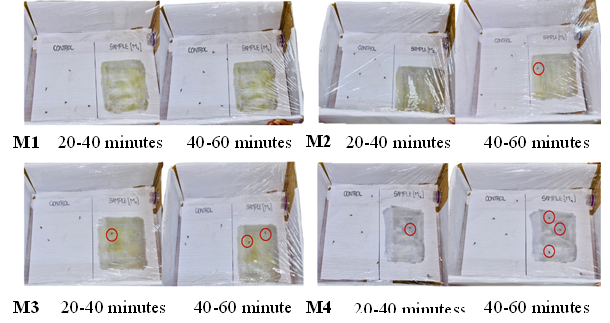
Fig No. 6: Repellence test (Cage test)
Stability Studies
The stability studies were carried out at refrigeration temperature (3–5°C), room temperature (25°C), and elevated temperature (40°C) for a period of one month. No significant changes in colour, odour, texture, or homogeneity were observed in any of the formulations. The results indicate that the prepared herbal ointments remained physically stable under different storage conditions.
Table no 9: STABILITY TEST OF FORMULATED HERBAL MOSQUITO REPELLENT OINTMENT
|
Formulations |
Colour |
Consistency |
pH |
Spreadability |
Presence of foreign particles |
|
Lime green |
Stable |
5.6 |
26.5 sec |
Absent |
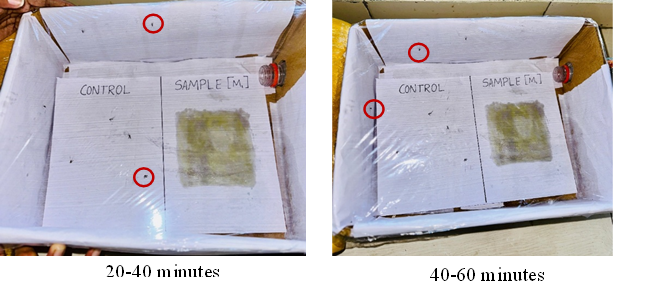
Figure 7: Repellence test (Cage test) after 30 days
DISCUSSION
The results obtained from the evaluation studies indicate that the formulated herbal mosquito repellent ointments possess suitable physicochemical properties for topical application. The presence of plant extracts and essential oils contributed significantly to mosquito repellent activity. The optimized formulation (M4) demonstrated better spreadability, stability, and enhanced mosquito repellency compared to other formulations. The synergistic action of Azadirachta indica, Calendula officinalis, and essential oils such as lemongrass, lavender, and clove oil likely contributed to the improved effectiveness of the formulation.
Overall, the study confirms that herbal ingredients can be successfully incorporated into an ointment base to develop an effective, safe, and eco-friendly mosquito repellent formulation
REFERENCES


Dr. Anjana M. N., Aleena Merin Abraham, Formulation And Evaluation of Herbal Mosquito Repellent Ointment, Int. J. of Pharm. Sci., 2026, Vol 4, Issue 3, 1685-1694. https://doi.org/10.5281/zenodo.19047437
 10.5281/zenodo.19047437
