
1,2,3,4,5,7Rungta Institute of Pharmaceutical Sciences,
6,8Rungta Institute of Pharmaceutical Sciences and Research, Bhilai Chhattisgarh
Paddy husk or Rice husk is an abundant natural product which are obtained from the milling of rice. Rice husk is often seen as the waste product. Rice husk, the outermost layer of the paddy grain is an abundant lignocellulosic3 biomass byproduct of the rice milling industry. Unfortunately, the husk obtained after milling rice was burned which play a significant role in air pollution. In order to utilize this waste product cellulose has been prepared from husk which also reduces the production cost of the tablet. The main component of rice husk is the cellulose 40-50%, hemicellulose 20-25%, lignin 25-30%, silica 15-20%. The derived cellulose from rice husk function effectively as a binder and diluent in pharmaceutical tablet formulation. The use of this agricultural waste product addresses environmental concerns and offers an economical alternative to conventional, often synthetic binders.Rice husk is grinded and sieved to obtain fine powder which then undergoes extraction by Alkaline treatment with Sodium hydroxide or Potassium hydroxide solution in presence of high temperature which breaks the link between lignin and cellulose and dissolve hemicellulose. Bleaching is then performed to remove the lignin impurity with Sodium hypochlorite solution or Hydrogen peroxide solution. While cellulose can be extracted from various source, rice husk is considered as cost effective and economical also it is synthetic binders. The cellulose extracted from the above method was of high quality and did not contain the impurity of lignin as lignin can increase the disintegration time of the tablet. The cellulose serves as an effective and cost-effective binder of the tablet. The cellulose can be used as bio-based adhesive, natural fiber composite, sustainable construction material.
Rice husk (RH) is generated in large volumes during rice milling and is a largely underutilized agricultural byproduct. Globally, rice production exceeds 700 million tonnes annually, producing about 140 million tonnes of husk waste per year. Disposal of this biomass poses environmental challenges, including air pollution from open burning and soil degradation. https://doi.org/10.1016/j.rser.2015.09.051Rice husk primarily contains cellulose (30–40%), hemicellulose (20–30%), lignin (15–25%), and an unusually high ash content (~15–20%) dominated by silica (Hoque et al., 2014). Owing to its high cellulose concentration, RH represents an attractive feedstock for bio-based materials. https://doi.org/10.1016/j.rser.2015.09.051Cellulose is a linear polysaccharide of β-1, 4-linked D-glucose units, renowned for biodegradability, mechanical strength, and chemical reactivity. Rice husk-derived cellulose has potential in composites, films, aerogels, adsorbents, and nanocellulosic materials.Drug products contain both drug substance (commonly referred to as active pharmaceutical ingredient or API) and excipients. The resultant biological, chemical and physical properties of the drug product are directly affected by the excipients chosen, their concentration and interactions. Binder excipients hold the ingredients of a formulation together, for example in a tablet. Binders ensure that tablets, powders, granules and others can be formed with the required mechanical strength. Moreover, they give volume to low active dose tablets.
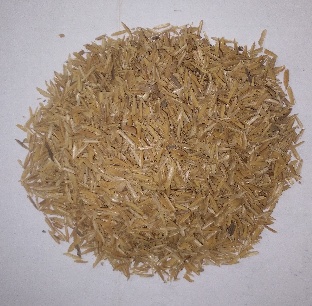
Img. Rice Husk
2. Extraction
Cellulose fibres and cellulose Nanocrystals were extracted from rice husk. Fibres were obtained by submitting the industrial rice crop to alkali (NaOH) and bleaching treatments. Nanocrystals were extracted from these fibres using sulphuric acid (H 2 SO 4) hydrolysis treatment. The material obtained after each stage of the treatments was carefully characterized and its chemical composition was determined. Morphological investigation was performed using scanning electron microscopy (SEM) and transmission electron microscopy (TEM). Fourier transform infrared (FTIR) spectroscopy showed the progressive removal of non-cellulosic constituents. X-ray diffraction (XRD) analysis revealed that the Crystallinity increased with successive treatments. The thermal stability of the rice husk fibres and cellulose Nanocrystals was also investigated using Thermogravimetric analysis (TGA).
TABLE 1 Rice Husk Composition
|
S.NO |
COMPONENT |
AMOUNT |
|
1 |
Cellulose |
40-50% |
|
2 |
Hemicellulose |
20-25% |
|
3 |
Lignin |
25-30% |
|
4 |
Silica |
15-20% |
3. Extraction Methods
3.1 Alkali Treatment
Alkali Pretreatment removes lignin and hemicellulose, improving cellulose accessibility. Sodium hydroxide (NaOH) is frequently used at concentrations ranging from 2–10% at 60–90°C. NaOH breaks ester bonds and dissolves non-cellulosic constituents.
3.2 Bleaching
Oxidative bleaching agents, such as sodium chlorite (NaClO?) or hydrogen peroxide (H?O?), further purify cellulose by removing residual lignin. A typical sequence includes NaOH treatment followed by bleaching at pH ~4–5.
3.3 Acid Hydrolysis
Strong acids such as Sulfuric acid (H?SO?) produce Nano-cellulose by Hydrolyzing amorphous regions of cellulose. Proper control of acid concentration and reaction time is essential to avoid cellulose degradation.
4. PROCEDURE
TABLE 2 FLOW CHART (Procedure)
5. FUTURE SCOPE
CONCLUSION
The above study concludes that rice husk waste can be used to extract out the cellulose by undergoing series of chemical reaction and mechanical treatment. This will produce the yield about 35-36%. FTIR report confirms the presence of cellulose and removal of toxic components as lignin and hemicellulose. These finding highlight the great use of rice husk as an eco-friendly source for production of cellulose which can be used in tablet for binding purpose. Further studies will explore the use of the extracted cellulose as a geopolymer, food additive, biopolymer composites and biodegradable packaging.
REFERENCES

Riya Dewangan, Twinkle Goyal, Siddhant Patel, Rohit Verma, Yogeshwari Nishad, Praveen Kumar Sahu, Nutan Sahu, Dr. Gyanesh Kumar Sahu, Extraction and Comprehensive Characterization of Cellulose from Rice Husk: A Sustainable Biomass Approach., Int. J. of Pharm. Sci., 2026, Vol 4, Issue 2, 3684-3687. https://doi.org/10.5281/zenodo.18740024
 10.5281/zenodo.18740024
