
1Research Scholar, Department of Botany, Jayoti Vidhyapeeth Women University, Jaipur
2Associate Professor, Department of Botany, Jayoti Vidhyapeeth Women University, Jaipur
The growth and biochemical composition of the freshwater microalga Chlorella vulgaris are assessed in the present investigation in relation to Pb and Cd stress, with a focus on biomass accumulation, protein content, and photosynthetic pigments. For two weeks, algal cultures were subjected to different amounts of lead chloride (PbCl?) and cadmium chloride (CdCl?) (0.5, 2, and 6 ppm). Fresh and dry biomass measurements were used to evaluate growth characteristics, and biochemical studies included estimations of total protein and chlorophyll (a, b, and total chlorophyll). The reaction to both metals was found to be concentration dependant. Growth and biochemical parameters were partially stimulated or maintained at low to moderate values (0.5 and 2 ppm), but biomass accumulation, protein content, and photosynthetic pigments significantly decreased at higher concentrations (6 ppm). Compared to lead, cadmium had a more noticeable harmful effect, especially on photosynthetic activity. The results demonstrate Chlorella vulgaris's susceptibility to heavy metal stress and highlight the possibility of its application as a bioindicator and as an option for phycoremediation of waters polluted with Pb and Cd.
The natural occurrence of heavy metal pollution in reservoirs is frequently triggered by the weathering of minerals, rocks, and aquatic habitats. It can also arise from the dumping of industrial effluents, wastes like sewage sludge, and mining effluents (Hussain et al., 2021). One of the most significant man made changes has been the addition of chemical, containing a huge amount of heavy metals to the water (Chugh et al., 2022).As the primary environmental contaminants, heavy metals are considered to be cytotoxic, mutagenic, or carcinogenic. Certain metals must be received from the outside environment in either the form of macro elements (K, Mg) or microelements (Co, Cu, Fe, Mn, Mo, Ni, V, Zn) for algae metabolism and physiology. Nevertheless, at large quantities, the necessary elements Cu, Mn, Ni, and Zn can be hazardous. As previously mentioned, these metals function as micronutrients in living things at low concentrations for their regular physiological processes; yet, at greater concentrations, they become hazardous to the majority of living forms. There is no known biological use for some metals, such Cd, Hb, and Pb, and they are always harmful.One of the most prevalent heavy metals in both terrestrial and aquatic ecosystems, Lead (Pb) is a non-essential element. One important cause of lead pollution has been the anthropogenic discharge of this element. Pb is emitted via mining, smelting, metal plating, papermaking, municipal sewage sludge disposal, and using paints, fuels, and explosives containing Pb. According to previous study, the primary harmful impact of Pb2+ is caused by a prolonged interaction with thiol groups that inhibits enzyme function. Additionally, Pb can interact with amine and carboxyl groups and remove other metals from metalloenzymes (Pourrut et al. 2011). Pb also has the harmful impact of disrupting the microtubule orientation on the mitotic spindle (DalCorso, 2012). Defect in mitosis in response to Pb-exposure occurs at low concentrations of its salts applied; therefore this effect was postulated to be environmentally the most relevant (Küpper 2017).Cadmium affects organs such as the heart, kidney, liver, and reproductive system after entering the food chain and entering the gastrointestinal tract (Genchi et al., 2020). It is thought to be carcinogenic and teratogenic. Humans can inhale cadmium, which damages the lungs and chest. Along with other issues, it induces nausea, vomiting, and cough. In plants and bacteria, it impacts growth, morphology, cellular metabolism, and photosynthesis, and occasionally results in mortality (Xie et al., 2021). The unicellular green eukaryotic Chlorophyta microalga Chlorella vulgaris has great attracted the curiosity of both scientists and industry. Along with removing heavy metals (such as Cd, Cu, and Zn) and pharmaceutical residues, C. vulgaris may assist in wastewater filtering through effective bioaccumulation and biosorption (Cardoso et al., 2022). In Chlorella, Cd had a much higher effect than Pb on physiological functions such as photosynthesis and respiration. Particularly, photosynthetic activity resulted strongly compromised by Cd treatment. According to Neelam and Rai (2003), a possible explanation for Cd effect on photosynthesis could be the inhibition of the PS II as a result of damage of thylakoid membranes and reaction centres. In fact, Chlorella cells showed an ultrastructural alteration in the shape and organization of thylakoid that confirm a damage of the photosynthetic apparatus. Chloroplasts and their arrangement represent a common target of toxic substances in algae and higher plants (Nacorda et al. 2007).
Methodology
Collection of algae
Algal samples were collected from Galtaji pond of Jaipur city (Rajasthan) and nearby sites. Different algal strains were harvested and purified from various water bodies and further they were maintained in suitable culture medium.
Experimental Design
Total two experiments carried out to observe impact of heavy metals and phytochemical variation in algae species.
Experiment- 1
The algal culture divided into three treatment groups with control also. Each flask containing 250 ml cultures treated with different concentrations (0.5ppm, 2ppm, 6ppm) of lead chloride (PbCl2).
Experiment - 2
The algal culture divided into three treatment groups with control also. Each flask containing 250 ml cultures treated with different concentrations (0.5ppm, 2ppm, 6ppm) of cadmium chloride (CdCl2).
Determination of growth
Growth followed through optical density, fresh weight and dry weight. OD was recorded with the help of photo colorimeter at 670 nm. For dry weight measurement, a known volume from culture samples filtered on pre weighed whatsman filter paper. The filter paper containing the algal biomass rinsed with distilled water and weighed after drying for 24 h at 80 ºC in hot air oven. The difference between the final and initial weight was the dry weight of algal biomass and calculated in terms of g/l.
Phytochemicals analysis
The alga material was used as the experimental material for further experimentation. Biochemical such as proteins (Lowry et al., 1951) and pigments like chlorophyll (Arnon, 1949) carried out both qualitatively and quantitatively. These biochemical parameters determined pre and post treatment of heavy metal.
RESULTS AND DISCUSSIONS
The active accumulation in the above-ground sections of hyper accumulator plants offers a potential method for both commercial metal extraction (phytomining) from naturally metal-rich (serpentine) soils and cleansing anthropogenically polluted soils (phytoremediation). Heavy metal pollution has emerged as one of the most significant environmental pollutants in recent years (Wang et al., 2021). Even minute amounts of heavy metals are harmful to both plants and animals.Each flask containing 250 ml cultures treated with different concentrations (0.5ppm, 2ppm, 6ppm) of lead chloride (PbCl2). This pattern highlights the dual reaction of algae to heavy metal toxicity: at low concentrations, tolerance and maybe adaptation, and at high concentrations, harmful biochemical and physiological disturbance. The findings unequivocally demonstrate that throughout a two-week incubation period, lead exposure affects the accumulation of both fresh and dry biomass in a concentration-dependent way. However, growth was significantly suppressed at the highest dose (6 ppm), as seen by the lowest fresh weight (322 mg) and dry weight (12.18 mg) following the first week. By the second week, the 6 ppm treatment showed only a little increase in biomass (338 mg fresh weight and 12.82 mg dry weight), but the other treatments continued to develop.
Table-1 Growth evaluation of Chlorella vulgaris treated with different concentrations of lead chloride (PbCl2)
|
Time |
Parameters |
Treatment |
|||
|
Control |
0.5 ppm |
2 ppm |
6 ppm |
||
|
Initial reading |
Fresh weight (mg) |
248 |
248 |
248 |
248 |
|
Dry weight (mg) |
9.26 |
9.26 |
9.26 |
9.26 |
|
|
After Ist week reading |
Fresh weight (mg) |
362 |
394 |
418 |
322 |
|
Dry weight (mg) |
13.88 |
14.98 |
16.12 |
12.18 |
|
|
After IInd week reading |
Fresh weight (mg) |
485 |
512 |
556 |
338 |
|
Dry weight (mg) |
18.22 |
19.58 |
21.8 |
12.82 |
|
Protein content followed a similar pattern: it increased in the control group and moderately increased in 0.5 ppm and 2 ppm treatments but declined significantly in the 6 ppm group. This decline may indicate protein denaturation, inhibited synthesis, or enhanced proteolysis caused by lead-induced oxidative stress. Lead exposure drastically affects photosynthetic pigment content in algae in a concentration-dependent way. Higher quantities (6 ppm) significantly block carotenoids and chlorophylls, but lower amounts (0.5–2 ppm) promote pigment production and may improve photosynthetic efficiency. It is evident that the pigment levels at 6 ppm are hazardous to algal physiology due to the significant damage of chloroplast structure, photosynthetic machinery, and antioxidant capacity. Because chlorophyll b is linked to membrane lipids that are vulnerable to Pb-induced degradation, it is frequently more negatively impacted than chlorophyll a.
Table- 2 Biochemical evaluation of Chlorella vulgaris treated with different concentrations of lead chloride (PbCl2)
|
Proteins (μg/g) |
||
|
Treatment |
Pre-treatment value |
Post-treatment value |
|
Control |
15.69 ± 1.157 |
19.05 ± 0.4404 ns |
|
0.5 ppm |
14.55 ± 0.5895 |
17.14 ± 0.4005* |
|
2 ppm |
15.35 ± 0.7426 |
16.68 ± 0.4184* |
|
6 ppm |
16.40 ± 1.322 |
12.98 ± 0.2730*** |
|
Chlorophyll a (mg/g) of wet weight |
||
|
Treatment |
Pre-treatment value |
Post-treatment value |
|
Control |
1.033 ± 0.06667 |
1.360 ± 0.06658 ns |
|
0.5 ppm |
1.133 ± 0.03333 |
1.240 ± 0.1301 ns |
|
2 ppm |
0.9000 ± 0.05774 |
1.213 ± 0.09333 ns |
|
6 ppm |
1.100 ± 0.05774 |
0.9033 ± 0.02728** |
|
Chlorophyll b (mg/g) of wet weight |
||
|
Treatment |
Pre-treatment value |
Post-treatment value |
|
Control |
0.4933 ± 0.04667 |
0.6033 ± 0.1362 ns |
|
0.5 ppm |
0.4700 ± 0.06557 |
0.5333 ± 0.02906 ns |
|
2 ppm |
0.4833 ± 0.1093 |
0.5500 ± 0.02887 ns |
|
6 ppm |
0.4867 ± 0.06333 |
0.3333 ± 0.02906 ns |
|
Total Chlorophyll of wet weight |
||
|
Treatment |
Pre-treatment value |
Post-treatment value |
|
Control |
1.527 |
1.963 |
|
0.5 ppm |
1.603 |
1.773 |
|
2 ppm |
1.383 |
1.763 |
|
6 ppm |
1.587 |
1.237 |
ns= Non-significantly changes
* Significant changes
** Highly Significant changes
*** Highly Significant changes
EXPERIMENT- 2
In this experiment, cadmium (Cd) heavy metal carried out in different concentration. Each flask containing 250 ml cultures treated with different concentrations (0.5ppm, 2ppm, 6ppm) of cadmium chloride (CdCl2). In lower treatments, fresh weight increased from 252 mg to 525–588 mg, but only to 318 mg at 6 ppm. Similar trends were seen in dry weight, which remained low under 6 ppm treatments but increased noticeably in control and lower dosages.
Table- 3 Growth evaluation of Chlorella vulgaris treated with different concentrations of cadmium chloride (CdCl2)
|
Time |
Parameters |
Treatment |
|||
|
Control |
0.5 ppm |
2 ppm |
6 ppm |
||
|
Initial reading |
Fresh weight (mg) |
252 |
252 |
252 |
252 |
|
Dry weight (mg) |
9.34 |
9.34 |
9.34 |
9.34 |
|
|
After Ist week reading |
Fresh weight (mg) |
352 |
398 |
438 |
307 |
|
Dry weight (mg) |
13.28 |
15.1 |
16.82 |
11.84 |
|
|
After IInd week reading |
Fresh weight (mg) |
495 |
528 |
588 |
318 |
|
Dry weight (mg) |
18.98 |
20.74 |
22.85 |
11.64 |
|
Protein content increased slightly in the control and low-to-moderate Cd groups but decreased significantly at 6 ppm exposure, indicating that extreme Cd stress may impair protein synthesis or promote protein breakdown. This decline might potentially be a sign of enzyme inactivation, compromised metabolic processes, and heavy metal interference with protein synthesis and enzyme activity, which would affect physiological processes essential for algae growth and repair (Filova et al., 2021).
Under control and low to moderate Cd treatments (0.5 and 2 ppm), the concentrations of chlorophyll a and b as well as total chlorophyll and carotenoids rose little or stayed constant, suggesting that the algae maintained or slightly modified their photosynthetic pigment production under mild stress. However, these pigments dramatically dropped at the highest dose (6 ppm), with carotenoids and chlorophyll an exhibiting the most loss, indicating considerable cadmium poisoning.
Table- 4 Biochemical evaluation of Chlorella vulgaris treated with different concentrations of cadmium chloride (CdCl2)
|
Proteins (μg/g) |
||
|
Treatment |
Pre-treatment value |
Post-treatment value |
|
Control |
15.69 ± 1.157 |
18.80 ± 0.4359 ns |
|
0.5 ppm |
14.55 ± 0.5895 |
16.15 ± 0.9364ns |
|
2 ppm |
15.35 ± 0.7426 |
16.57 ± 1.155 ns |
|
6 ppm |
16.40 ± 1.322 |
11.37 ± 0.5538*** |
|
Chlorophyll a (mg/g) of wet weight |
||
|
Treatment |
Pre-treatment value |
Post-treatment value |
|
Control |
1.033 ± 0.06667 |
1.383 ± 0.09280 ns |
|
0.5 ppm |
1.133 ± 0.03333 |
1.260 ± 0.03055 ns |
|
2 ppm |
0.9000 ± 0.05774 |
1.133 ± 0.06667 ns |
|
6 ppm |
1.100 ± 0.05774 |
0.8733 ± 0.02667** |
|
Chlorophyll b (mg/g) of wet weight |
||
|
Treatment |
Pre-treatment value |
Post-treatment value |
|
Control |
0.4933 ± 0.04667 |
0.6133 ± 0.05207 ns |
|
0.5 ppm |
0.4700 ± 0.06557 |
0.5400 ± 0.03055 ns |
|
2 ppm |
0.4833 ± 0.1093 |
0.5633 ± 0.02963 ns |
|
6 ppm |
0.4867 ± 0.06333 |
0.3067 ± 0.04372* |
|
Total Chlorophyll of wet weight |
||
|
Treatment |
Pre-treatment value |
Post-treatment value |
|
Control |
1.527 |
1.997 |
|
0.5 ppm |
1.603 |
1.800 |
|
2 ppm |
1.383 |
1.697 |
|
6 ppm |
1.587 |
1.180 |
ns= Non-significantly changes
* Significant changes
** Highly Significant changes
*** Highly Significant changes
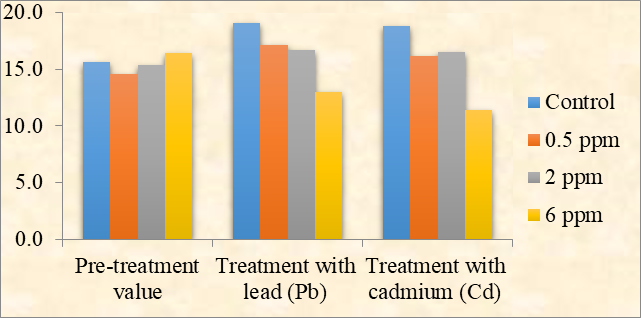
Fig.-1 Comparetive analysis of Proteins (μg/g) after treatment of lead and cadmium
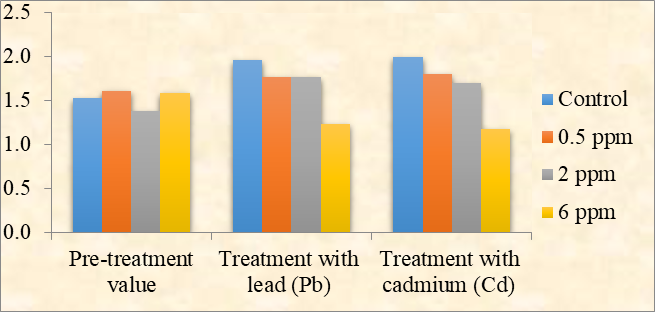
Fig.-2 Comparisons of Photosynthetic Total Chlorophyll (mg/g)
In our experiments, associated to ultra-structural alterations of plastids, we noted a significant reduction of the photosynthetic rate related to a decrease of total Chl and Chl contents that both pollutants Pb and Cd caused. Desouky (2011) reported that the respiration of pollutant Chlorella vulgaris cultures was considerably increased by heavy metal exposure: but these studies were conducted in algae treated with high (6 and 8 ppm) and low (2 and 4 ppm) concentrations of CoCl2 or NiCl2.Overall, the results support Chlorella vulgaris's sensitivity to Pb and Cd contamination and strengthen its appropriateness as a reliable bioindicator of heavy metal pollution in freshwater environments. The microalga's potential use in phycoremediation techniques targeted at reducing Pb and Cd pollution in aquatic environments is further highlighted by the reported tolerance at lower metal concentrations. Its use in environmental monitoring and bioremediation programs would be further strengthened by future research concentrating on long-term exposure, metal uptake processes, and molecular reactions.
REFERENCES

Savitri Garer, Dr Anupama Goyal, Evaluations of heavy metal toxicity in Chlorella vulgaris, Int. J. of Pharm. Sci., 2026, Vol 4, Issue 1, 2858-2864. https://doi.org/10.5281/zenodo.18365339
 10.5281/zenodo.18365339
