
1Research Scholar, Department of Botany, Jayoti Vidhyapeeth Women University, Jaipur.
2Associate Professor,Department of Botany, Jayoti Vidhyapeeth Women University, Jaipur.
The present investigation evaluates the antioxidant and antibacterial properties of methanolic extracts of the leaves, seeds, and stem bark of Albizia lebbeck (L.) Benth., a well-known medicinal tree that is commonly used in traditional Indian medicine. Methanol was used for Soxhlet extraction of plant materials, and ferric reducing antioxidant power (FRAP) and DPPH free radical scavenging evaluations were used to assess the antioxidant capacity. Zone of inhibition and activity index measurements were used to assess antibacterial efficacy against specific Gram-positive and Gram-negative bacterial strains. The DPPH assay displayed dose-dependent free radical scavenging activity, with seed extract exhibiting comparatively lower IC?? values (47.120 mg/mL) than leaves (48.987 mg/mL) and stem bark (50.373 mg/mL), though all were less effective than the standard ascorbic acid. According to FRAP analysis, seed extracts had the highest reducing power (IC²? = 10.136 mg/mL), which suggests that they have a better ability to donate electrons. According to antibacterial studies, methanolic extracts, especially those from stem bark, significantly inhibited the growth of Staphylococcus aureus, Escherichia coli, Bacillus subtilis and Pseudomonas aeruginosa, with Gram-positive bacteria being more susceptible. Overall, the results confirm the ethnomedicinal significance of Albizia lebbeck and demonstrate its potential as a promising source of natural antioxidant and antibacterial agents for pharmaceutical and nutraceutical industries.
Traditional medicines are still used in the basic healthcare systems of poor nations. In order to treat a variety of illnesses, natural products are now preferred over contemporary synthetic medications. In order to provide rural residents with effective healthcare support, it is now increasingly crucial to maximise the benefits of the traditional medicine system (Shafiq et al., 2023; Raks et al., 2018). Ethno medical validation combined with phytochemical and biological activity screening is an effective method for finding new drugs made from medicinal plants (Sharma et al., 2022).Bioactive chemicals with potential therapeutic benefits are largely derived from medicinal plants. The secondary metabolites of plants are the source of several phytochemicals that may be utilised to create novel medications. Secondary metabolites are a vast range of compounds from various metabolite families .These can be largely activated in response to stresses. The existence of secondary metabolites may be responsible for the antioxidant activity, and the distribution of secondary metabolites, which may vary among plant organs, may account for the variation in the IC50 value. The polarity of the solvents and, thus, the extractability of the antioxidative chemicals may be the cause of variations in the antioxidant activity of the extracts (Petrus et al., 2012). Albizia lebbeck (L.) Benth. is a deciduous, medium-lenth tree. The traditional therapeutic usage of Albizia lebbeck is supported by the relationship between biological activity and phytochemical makeup. Its potential use in pharmaceutical and nutraceutical compositions is suggested by the antioxidant and antibacterial qualities observed. The plant A. lebbeck (L.) Benth. has several therapeutic applications and is employed in the Indian medical system for both wood and medicinal purposes. The leaves are valuable and high in protein, and many different cultures use them as part of their diet. Rich in tannins, saponins, and other organic and inorganic materials, the bark is utilised for a variety of purposes, including the tannin industry and colours (Gull et al., 2024).The flavonoids isookanin, luteolin, geraldone, and catechin were isolated from the bark. Additionally, many triterpenoids and saponin compounds have been isolated from stem bark (Bajpai et al., 2024). Numerous phytochemicals, including phytosterols tocopherols, eight phenolic acids, mostly cinnamic acid, and eight flavonoids, including chrysoeriol, hesperidin, and quercetin, were found in the acetone extract of A. lebbeck stem bark (Ibrahim and Abdul-Hafeez, 2023).
Methodology
The various parts of the plant, such as the leaves, seeds, and stem bark of Albizia lebbeck (L.) Benth, were gathered from the Jaipur district. The various plant parts—leaves, seeds, and stem bark—were cleaned with tap water, let too dry at room temperature in the shade, crushed with an electronic grinder to a fine powder, and then placed in airtight containers. The experimental materials, each weighing 100 g, were soxhlet extracted after the 24 to 36 hours using methanol solvents.
Determination of Antioxidant activity
DPPH assay
The free radical scavenging activities of the methanol extract of different plant parts were evaluated by using the modified method of (Blois, 1958). 1.0 ml each of the different concentrations of extracts or standard (Ascorbic acid) was added to 1ml of 0.3 mM DPPH (in methanol). The mixture was vortexed, and after 30 minutes of incubation in a dark chamber, the absorbance at 517 nm was measured against a DPPH control that contained just methanol instead of the extract.
FRAP assay
In this test, methanol and chloroform extracts of various plant sections were used to measure the FRAP activity. Plant extracts were allowed to react with the FRAP solution for 30 min in the dark condition. Readings of the coloured product (ferrous tripyridyltriazine complex) were taken at 593 nm.
Identification of antimicrobial activity
The sequential extracts were raised to final concentration 10 mg/ml in dimethyl sulfoxide (10% sterile DMSO), before use to screened for antimicrobial activity. The media-containing petriplates was utilised for antimicrobial screening once they have dried. After being injected into nutrient broth, the bacterial cultures were cultured at 37°C for 24 hours. By measuring the width of the inhibitory zone surrounding the extract-filled well, the antibacterial properties of the extracts were assessed following incubation. The zone of inhibition, which is measured in millimetres, is a clearly defined region that is produced when plant extracts with antimicrobial properties prevent bacterial growth in the media around the wells.
Activity Index = Inhibition zone produced by extract/Inhibition zone produced by standard
RESULTS AND DISCUSSIONS
By using digital spectrophotometer, DPPH scavenging demonstrated in dose-dependent inhibition (2–10 mg/mL), with IC50 values suggesting potency: ascorbic acid (33.834 mg/ml) compared to seeds (47.120 mg/ml), leaves (48.987 mg/ml), and stem bark (50.373 mg/ml).
Table-1 DPPH scavenging activity and IC50 value of different plant parts at various concentrations
|
Conc. (mg/ml) |
||||||
|
2 mg/ml |
4 mg/ml |
6 mg/ml |
8 mg/ml |
10 mg/ml |
IC50 mg/ml |
|
|
Leaves extract |
3.753 |
4.912 |
6.457 |
8.554 |
10.430 |
48.987 |
|
Seeds extract |
7.119 |
9.216 |
10.486 |
12.583 |
14.625 |
47.120 |
|
Stem bark extract |
0.331 |
4.470 |
5.740 |
7.009 |
9.272 |
50.373 |
|
Ascorbic acid |
35.541 |
38.852 |
40.728 |
41.832 |
43.046 |
33.834 |
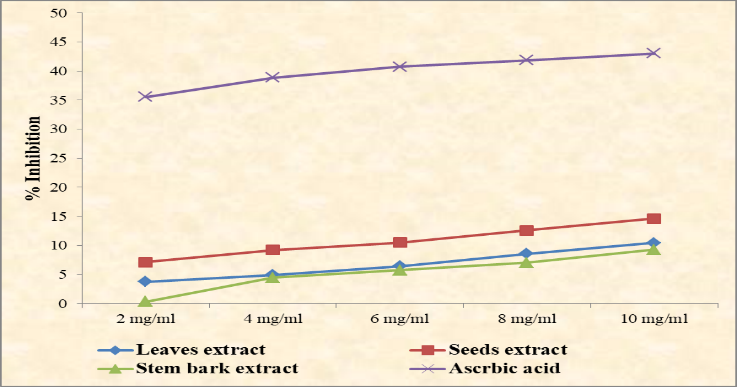
Fig.-1 Percent radical scavenging activity of different plant parts at various concentrations
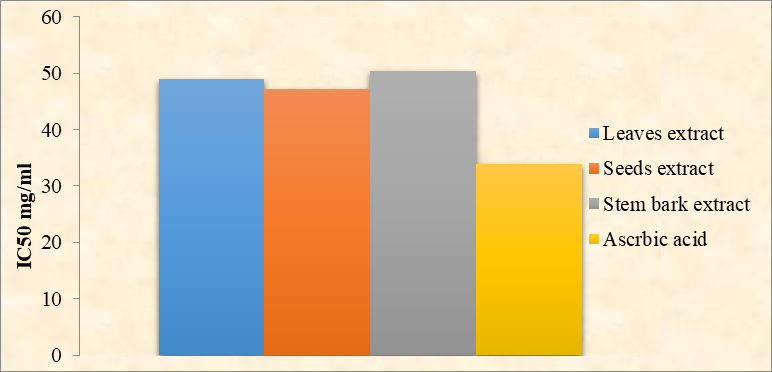
Fig.-2 IC50 value of different plant parts
The ferric reducing antioxidant power (FRAP) technique relies on antioxidants in an acidic media reducing a ferroin analogue, the Fe3+ complex of tripyridyltriazine Fe(TPTZ)3+, to the highly blue-colored Fe2+ complex Fe(TPTZ)2+. The use of various solvents may be the cause of the notable variations in the FRAP activity of the extracts.
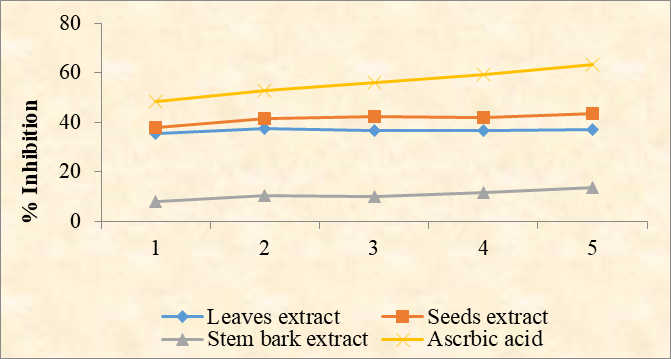
Fig.-3 Percent FRAP activity of different plant parts at various concentrations
FRAP results suggested reducing power of extracts. In comparison to leaves (58.135 mg/mL) and stem bark (34.925 mg/mL), seeds had the highest FRAP lowering capability (IC50 10.136 mg/mL). Seed extract exhibited the most significant reducing ability and the lowest IC50 value. The activity of leaf and stem bark extracts was modest. The high protein and lipid content of seeds, which may stabilise free radicals, is correlated with their considerable FRAP action.
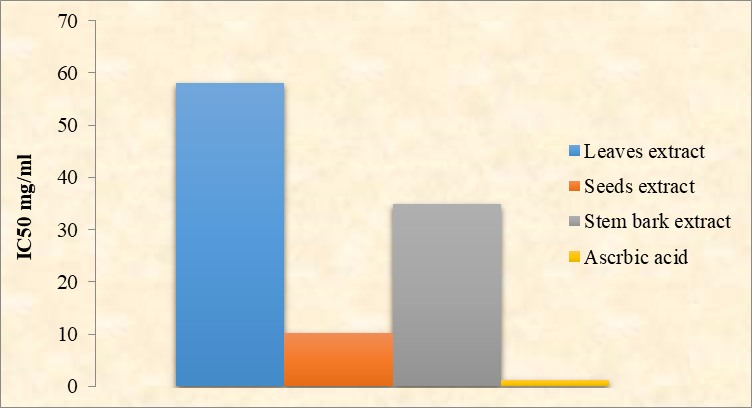
Fig.-4 IC50 value of different plant parts
Table-2 FRAP activity and IC50 value of different plant parts at various concentrations
|
Conc. (mg/ml) |
|
|||||
|
2 mg/ml |
4 mg/ml |
6 mg/ml |
8 mg/ml |
10 mg/ml |
IC50 mg/ml |
|
|
Leaves extract |
35.514 |
37.584 |
36.724 |
36.569 |
37.226 |
58.135 |
|
Seeds extract |
37.799 |
41.359 |
42.483 |
41.920 |
43.531 |
10.136 |
|
Stem bark extract |
8.100 |
10.403 |
10.172 |
11.700 |
13.592 |
34.925 |
|
Ascorbic acid |
48.460 |
52.920 |
56.218 |
59.390 |
63.095 |
1.316 |
Previous phytochemical screening of these plants revealed that the extracts had antimicrobial properties and were positive for a variety of primary and secondary compounds, including proteins, lipids, carbohydrates, tannins, and alklaoids extracted by various solvents (Ahad et al., 2021). A. lebbeck extract was biologically active as an antibacterial agent against B. subtilis and S. marcescens and had moderate activity against A. johnsonii and A. tumefaciens, while E. carotovora and E. coli were the least affected (Ibrahim and Abdul-Hafeez, 2023). The antibacterial activity of methanolic extracts was often stronger than that of aqueous extracts. The antimicrobial potential of methanolic extracts of Albizia lebbeck was evaluated against Staphylococcus aureus, Escherichia coli, Bacillus subtilis, and Pseudomonas aeruginosa. Overall, stem bark performed exceptionally well against S. aureus (12.5 mm), E. coli (14 mm), B. subtilis (11.5 mm), and P. aeruginosa (10.5 mm). Higher zones of inhibition were observed in stem bark, especially against B. subtilis and E. coli. Bacteria B. subtilis and E. coli showed the highest activity index values. Leaves/seeds were comparable but weaker (in seeds E. coli 12.5 mm). Mild effectiveness is indicated by activity indices (AI range 0.3-0.6). All bacteria were consistently inhibited by leaf extracts. The bactericidal activity of seed extracts was moderate. Gram-positive (B. subtilis, S. aureus) When plant extracts disrupt peptidoglycan over lipopolysaccharide, their sensitivity surpasses that of Gram-negative.
Antibacterial activity of methanol extract was better than aqueous extract, but P.aeruginosa was found to be most resistant (Suganya et al., 2011) bacterial pathogens of humans. The antibacterial activity of the methanol extract was greater than that of the other two solvents. According to Kumawat et al. (2012), the methanolic extract of stems has strong efficacy against B. subtilis and S. typhi. According to Sharma et al. (2013), Gram-negative bacteria were more susceptible than Gram-positive ones.
Table-3 Comparisons of Zone of Inhibition and Activity index for different bacterial strains.
|
Microorganism
|
Plant part used |
||||||
|
Leaf |
Seed |
Stem bark |
|||||
|
Replica-I |
Replica-II |
Replica-I |
Replica-II |
Replica-I |
Replica-II |
||
|
Staphylococcus aureus |
Zone of Inhibition (mm) |
11 |
12 |
10 |
11 |
13 |
12 |
|
Activity index |
0.354839 |
0.521739 |
0.416667 |
0.611111 |
0.419355 |
0.521739 |
|
|
E. coli |
Zone of Inhibition (mm) |
13 |
15 |
11 |
14 |
14 |
14 |
|
Activity index |
0.371429 |
0.46875 |
0.366667 |
0.636364 |
0.583333 |
0.451613 |
|
|
Bacillus subtilus |
Zone of Inhibition (mm) |
11 |
15 |
14 |
13 |
13 |
10 |
|
Activity index |
0.314286 |
0.625 |
0.451613 |
0.619048 |
0.565217 |
0.333333 |
|
|
Pseudomonas aeruginosa |
Zone of Inhibition (mm) |
12 |
9 |
11 |
11 |
10 |
11 |
|
Activity index |
0.333333 |
0.45 |
0.366667 |
0.52381 |
0.47619 |
0.52381 |
|
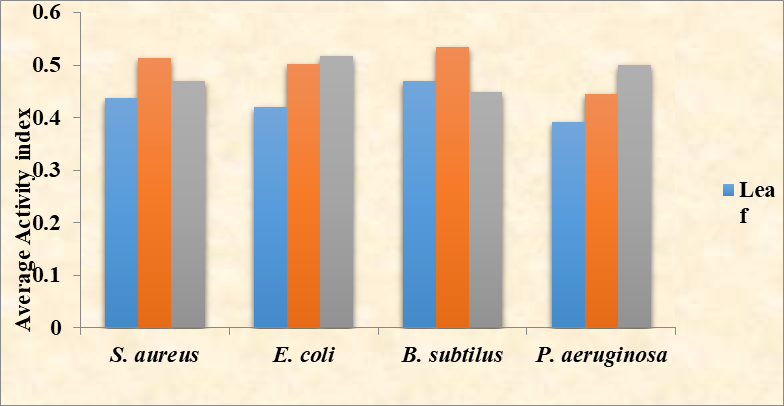
Fig.-5 Compare Average Activity index for different bacterial strains.
CONCLUSIONS
The current study supports the traditional medical usage of Albizia lebbeck (L.) Benth. by showing that it has significant antioxidant and antibacterial properties. In the FRAP test, methanolic extracts of leaves, seeds, and stem bark demonstrated dose-dependent ferric reducing power and DPPH radical scavenging activity, with seed extracts displaying the most antioxidant efficiency. Stem bark extracts were very efficient against both Gram-positive and Gram-negative bacteria, including Staphylococcus aureus, Escherichia coli, and Bacillus subtilis, according to antibacterial screening. The higher tendency of Gram-positive bacteria indicates that phytochemicals in A. lebbeck may especially disrupt peptidoglycan-rich cell walls. To enable its sensible application in current therapies, additional studies need to focus on the isolation, characterisation, and mechanistic assessment of individual bioactive chemicals as well as in vivo validation.
REFERENCES

Poonam Kumari Dr Anupama Goyal , Evaluations of antioxidant and antibacterial activities of plant Albizia lebbeck (L.) Benth., Int. J. of Pharm. Sci., 2026, Vol 4, Issue 1, 2896-2903. https://doi.org/10.5281/zenodo.18365782
 10.5281/zenodo.18365782
