We use cookies to make sure that our website works properly, as well as some ‘optional’ cookies to personalise content and advertising, provide social media features and analyse how people use our site. Further information can be found in our Cookies policy
The cosmetic industry is witnessing a significant shift toward natural, multifunctional formulations that combine aesthetics with skin benefits. Beaded cosmetic blush is an innovative approach that encapsulates natural pigments within polymeric beads, offering controlled release, improved stability, and enhanced visual appeal. Beetroot extract, a natural colorant rich in betalains, provides vibrant red color while delivering antioxidant and anti-inflammatory properties. Encapsulation of beetroot extract in sodium alginate beads protects the pigment from photodegradation, oxidation, and environmental stressors, ensuring long-lasting color and uniform distribution. When incorporated into a gel or cream base, these beads improve spreadability skin adhesion, and consumer acceptability. This review highlights the rationale, formulation strategies, preparation methods, mechanism of action, characterization, advantages, limitations, influencing factors, cosmetic applications, regulatory considerations, and future perspectives of beaded cosmetic blush
Keywords
Cool Tint Beads, Microencapsulated Betanin Blush, Refreshing Peppermint Gel
Introduction
Modern cosmetics demand products that are not only visually appealing but also safe and multifunctional. Traditional blush formulations, including powders, creams, and mousses, often face challenges such as uneven color distribution, rapid fading, and potential skin irritation due to synthetic dyes and preservatives. The increasing consumer preference for natural and herbal ingredients has led to the exploration of plant-based pigments for cosmetic applications. Beetroot extract, obtained from Beta vulgaris, is an attractive natural pigment due to its bright red color and bioactive properties, including antioxidant and anti-inflammatory activity.The concept of beaded formulations involves encapsulating natural pigments within polymeric beads, which provides several advantages. Encapsulation protects the pigment from degradation due to environmental factors such as light, oxygen, and temperature. It also allows for controlled pigment release during application, resulting in even, long-lasting color. Beaded blushes can be integrated into gels, creams, or emulsions to enhance texture, spreadability, and skin feel. This approach aligns with the modern trend of functional cosmetics that offer both aesthetic appeal and skin benefits.
Key considerations in this domain include:
Overcoming the limitations of conventional blush, such as poor stability and uneven application.
Utilizing natural pigments like beetroot extract for safe, eco-friendly formulations.
Employing polymeric carriers like sodium alginate for bead formation.
Designing formulations that offer controlled release, improved stability, and aesthetic superiority.
1.Skin Structure and Barrier Function
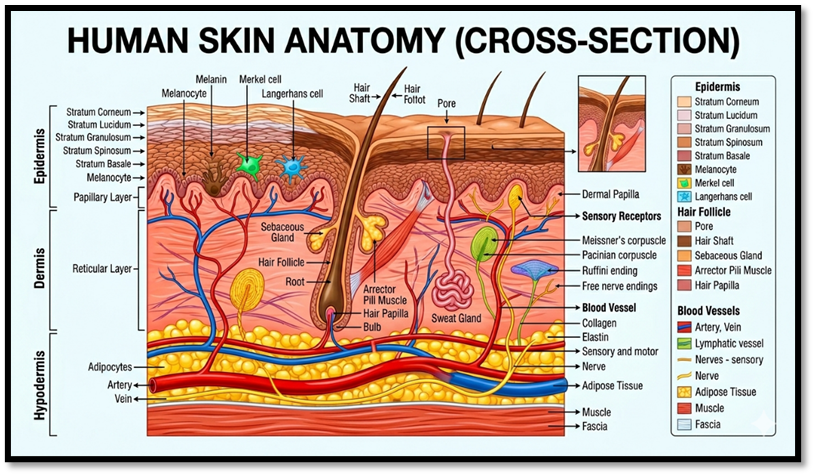
The human skin is a complex organ consisting of multiple layers, each with distinct functions. Understanding the skin structure is essential for designing effective topical cosmetic formulations. Cosmetic blush primarily acts on the epidermis, particularly the stratum corneum, to impart visible color without significant penetration into deeper layers.
1.2 Anatomy of skin:
The skin consists of three primary layers:
Fig. no.1 – human skin anatomy ( cross -section)
Epidermis: The outermost layer composed of keratinocytes arranged in multiple sub-layers. The stratum corneum, part of the epidermis, serves as the primary barrier, regulating water loss and limiting the penetration of chemical substances. For blush application, pigments primarily adhere to this layer, and bead-based systems ensure uniform distribution.
Dermis: Beneath the epidermis, the dermis contains connective tissue, collagen, elastin, and fibroblasts. While cosmetic blush does not penetrate the dermis, the integrity of this layer affects the overall appearance and texture of makeup.
Hypodermis: The subcutaneous layer composed of adipose tissue provides cushioning and insulation. Though it interacts minimally with topical cosmetics, it influences the skin’s contour, affecting blush spread and visibility.
Stratum corneum barrier: The outermost skin layer determines the efficacy and performance of topical cosmetics. Beaded blushes are designed to adhere to this barrier, releasing pigment gradually and ensuring longevity without causing irritation. (1-2)
2. Rationale for Beaded Cosmetic Blush
The rationale behind using beads in cosmetic blush formulations is to combine aesthetic appeal with functional advantages. Conventional blushes often suffer from fading, streaking, and inconsistent application. Encapsulating pigments in polymeric beads offers multiple benefits:
Controlled release: The beads release pigment gradually upon application, maintaining uniform color and preventing over-application.
Protection of pigments: Beetroot extract is prone to degradation due to light, oxygen, and pH changes. Encapsulation stabilizes the pigment and preserves its vibrant color.
Improved stability: Beads reduce chemical interactions between pigments and other ingredients, maintaining texture and consistency over time.
Enhanced aesthetics: Visible beads create a unique texture in gel or cream formulations and contribute to a smooth, radiant finish on the skin.
Consumer preference for natural ingredients: The use of beetroot extract aligns with consumer demand for herbal, eco-friendly, and safe cosmetics, which is a growing trend in the global market. (3)
3. Formulation of Beaded Blush Beaded cosmetic blush typically consists of polymeric beads dispersed in a gel or cream base. The selection of ingredients influences bead formation, pigment stability, and overall cosmetic performance. (4-5)
Additives (Aloe vera, Vitamin E, Hyaluronic acid): Provide additional skin-soothing and antioxidant benefits.
5. Method of Preparation
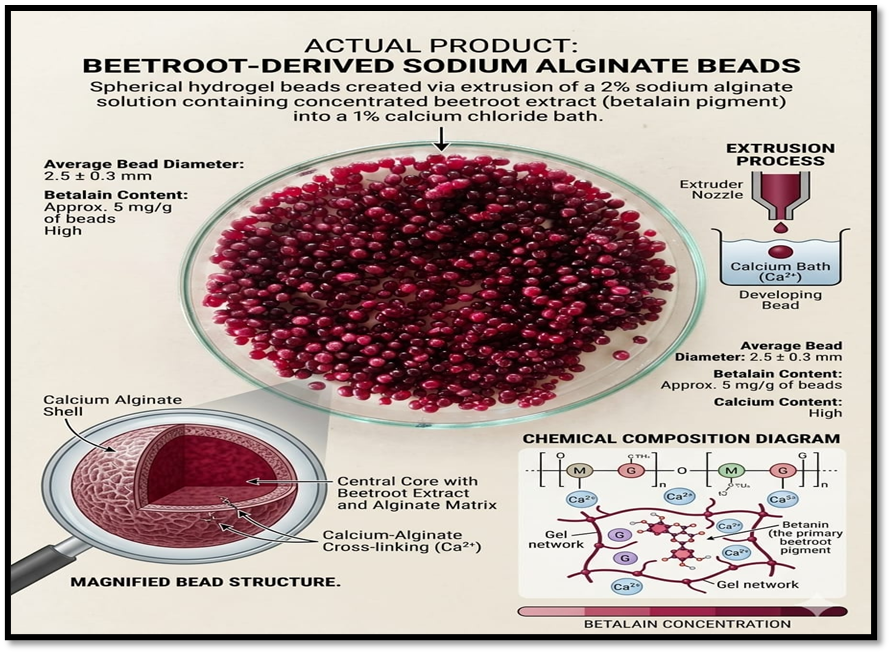
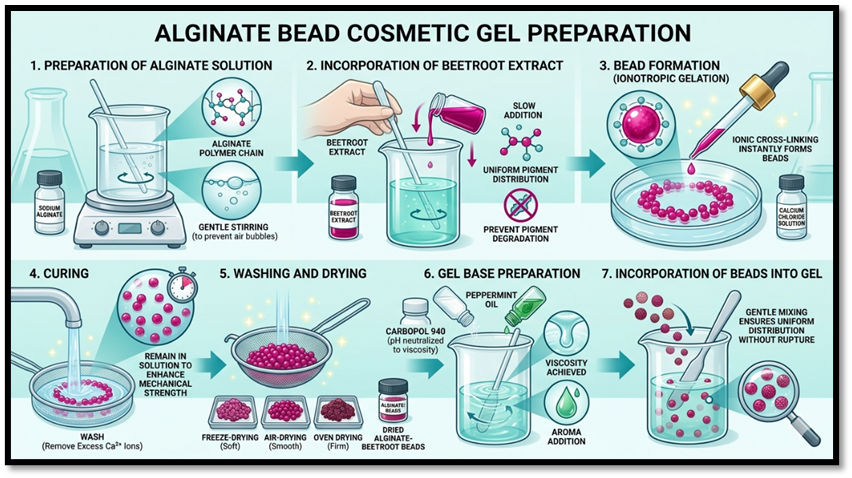
Beads are generally prepared using the ionotropic gelation technique, a simple and cost-effective method that does not require organic solvents. The process involves dissolving sodium alginate in water, incorporating beetroot extract, and dropping the solution into a calcium chloride bath to form beads. (6-7)
Fig. no.3 -Alginate bead cosmetic gel preparation
Detailed steps:
Preparation of alginate solution: Sodium alginate is dissolved in distilled water under gentle stirring to prevent air bubble formation.
Incorporation of beetroot extract: The pigment is added slowly to maintain uniform distribution and prevent degradation.
Bead formation (Ionotropic gelation): The alginate-pigment solution is dropped into a calcium chloride solution, where ionic cross-linking instantly forms spherical beads.
Curing: Beads are left in the cross-linking solution to enhance mechanical strength. (8)
Washing and drying: Excess calcium ions are removed, and beads are dried using freeze-drying, air-drying, or oven drying depending on the desired texture.
Gel base preparation: Carbopol 940 solution is neutralized to achieve desired viscosity. And add peppermint oil for aroma.
Incorporation of beads into gel: Beads are gently mixed to ensure uniform distribution without rupture. (8)
6. Mechanism of Action
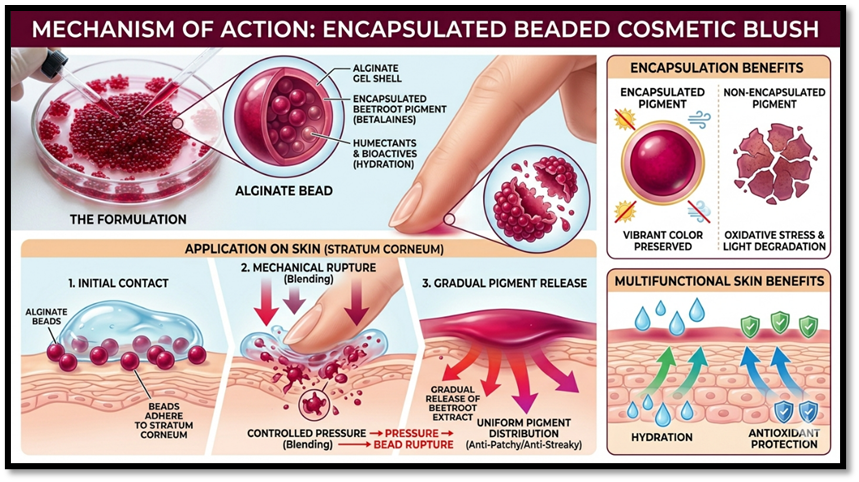
Beaded cosmetic blush works primarily through controlled mechanical and chemical release of the pigment. When applied to the skin, the beads undergo mechanical rupture due to the pressure exerted during rubbing or blending, releasing the encapsulated beetroot extract gradually. This ensures uniform pigment distribution and avoids patchy or streaky appearance, which is a common problem in conventional blushes. (9-10)
Fig. no.4 – Mechanism of action: encapsulated beaded cosmetic blush
The gel or cream base acts as a supportive medium, helping the beads adhere to the stratum corneum and facilitating even spreading across facial contours. The encapsulation also protects the beetroot pigment from oxidative stress, light, and environmental degradation, preserving the vibrant color during application and throughout wear. Additionally, humectants and bioactive additives in the formulation enhance skin hydration and provide antioxidant benefits, making the cosmetic multifunctional.
7. Characterization of Beads
Characterization of the beads is essential to ensure stability, performance, and aesthetic appeal. (11)
Particle size analysis: Determines uniformity of beads, which influences color intensity and release kinetics. Smaller beads release pigment faster, whereas larger beads provide sustained release. Normal size range: 0.5 mm – 2 mm.
Shape and morphology: Spherical, smooth-surfaced beads are preferred for cosmetic applications to ensure even color and tactile feel.
Entrapment efficiency: Indicates the proportion of beetroot extract successfully encapsulated, affecting both color intensity and functional performance. Normal range: 70% – 95%.
Swelling index: Beads must absorb some moisture to facilitate pigment release but not dissolve prematurely, maintaining integrity during application. Normal range: 100% – 300%.
In-vitro release studies: Evaluate pigment release kinetics, simulating skin contact conditions, and help optimize formulation parameters for long-lasting color. Initial release: 20–40% in first 30–60 min.
Mechanical strength testing: Ensures beads withstand handling during manufacturing, storage, and application without rupture. Beads should withstand mild pressure (0.5 – 2 N force approx) .
8. Characterization of Beaded Blush
Once incorporated into a gel or cream, the overall cosmetic product requires comprehensive evaluation to ensure performance, safety, and consumer acceptability. (11-12)
pH determination: Maintains skin-friendly pH (5–7) to prevent irritation.
Spreadability: Evaluates how easily the blush spreads on skin for uniform coverage.
Stability studies: Assess changes in color, texture, and microbial growth under varying environmental conditions over time.
Color uniformity: Critical for consumer appeal; ensures consistent pigment distribution during application.
Skin irritation testing: Confirms the product is safe and suitable for sensitive skin.
Shelf-life prediction: Uses accelerated aging tests to determine the formulation’s longevity while maintaining functional and aesthetic properties. (13)
9. Advantages
Beaded cosmetic blush offers multiple benefits over traditional formulations.
Controlled pigment release: Provides consistent and even color during application.
Improved stability: Encapsulation protects beetroot extract from light, heat, and oxidation.
Reduced skin irritation: Use of natural pigments and herbal additives reduces the risk of allergic reactions.
Enhanced aesthetics: Smooth texture, radiant finish, and visually appealing beads contribute to superior cosmetic appeal.
Multifunctionality: Added antioxidants, humectants, and bioactive compounds improve skin health while providing color.
Eco-friendly and safe: Biodegradable polymers and plant-based pigments meet consumer demand for natural and sustainable products. (14)
10.Disadvantages
Despite the benefits, there are certain challenges associated with beaded blush formulations.
Complex preparation: Requires skilled handling, precise control of polymer and cross-linker concentrations, and optimization of drying techniques.
Higher production cost: Compared to conventional blushes due to additional processing steps and use of natural pigments.
Pigment sensitivity: Beetroot extract is sensitive to light, pH, and temperature, making handling and storage critical.
Bead rupture risk: Improper handling during formulation or packaging can cause beads to break, affecting color uniformity.
Equipment requirement: Manufacturing at scale requires specialized equipment for bead formation and gel incorporation. (15)
11. Factors Influencing Formulation
The performance of beaded cosmetic blush depends on multiple formulation parameters.
Polymer concentration: Higher alginate concentrations increase bead rigidity but may slow pigment release.
Cross-linker concentration: Calcium chloride concentration affects bead strength and stability.
pH of system: Impacts bead formation and stability of beetroot pigment.
Stirring speed: Influences bead size and uniformity; excessive stirring may cause irregular shapes.
Temperature: High temperatures during preparation can degrade pigments and affect bead integrity.
Drying conditions: Affects bead hardness, mechanical strength, and shelf-life.
12. Factors Influencing Performance
The cosmetic performance of beaded blush is influenced by external and biological factors:
Skin type: Oily, dry, or sensitive skin may affect adhesion and color intensity.
Environmental conditions: Heat, UV light, and humidity can degrade pigments over time.
Moisture content: High water content in the formulation can lead to premature bead swelling or rupture.
Pigment stability: Beetroot extract is naturally prone to degradation, requiring careful formulation and storage.
Interactions with other products: Layering with foundations, powders, or sunscreens may affect color intensity and spreadability. (16-17)
13. Therapeutic / Cosmetic Applications
Beaded blush formulations provide both cosmetic and functional benefits.
Facial blush: Provides vibrant and long-lasting color on cheeks.
Skin hydration: Incorporation of humectants improves moisture retention.
Antioxidant effect: Beetroot extract protects skin from free radical damage.
Herbal cosmetic applications: Suitable for sensitive skin and consumers preferring natural ingredients.
Multifunctional cosmetics: Can be combined with moisturizer, sunscreen, or serum for enhanced skin care benefits.
14. Regulatory and Safety Aspects
Cosmetic products must comply with regulatory guidelines to ensure safety, quality, and efficacy. (18)
Safety testing: Includes skin irritation, sensitization, and microbial contamination tests.
Stability requirements: Ensure color retention, texture, and shelf-life under various conditions.
Regulatory compliance: Adherence to FDA (USA), EU Cosmetic Regulation, and other local regulations is mandatory.
Labelling requirements: Proper listing of ingredients, batch numbers, and expiry dates.
Documentation for herbal claims: Source and quality of beetroot extract must be verifiable.
FUTURE PERSPECTIVES
The field of beaded cosmetic blush is evolving with innovations in technology, smart delivery systems, and personalized cosmetics.
Beaded formulations: Smaller beads may offer better pigment release control and smoother texture.
Integration with herbal and organic ingredients: Increases multifunctionality and appeal to eco-conscious consumers.
Smart delivery systems: Stimuli-responsive beads that release pigment based on pH, temperature, or friction.
Personalized cosmetics: Tailored formulations for different skin tones, types, and ethnic backgrounds. (19-20)
CONCLUSION
Beaded cosmetic blush using beetroot extract represents a significant advancement in the cosmetic industry. Encapsulation of natural pigments within polymeric beads offers controlled release, improved stability, and enhanced aesthetics, while simultaneously providing functional skin benefits such as hydration and antioxidant protection. Despite challenges in production and pigment sensitivity, the demand for natural, multifunctional, and eco-friendly cosmetics is driving research and development in this field. Future innovations are likely to focus on nanotechnology, smart delivery systems, and personalized formulations, solidifying the role of beaded blush as a safe, effective, and consumer-preferred cosmetic product.
REFERENCES
Bajpai, S. K., & Sharma, S. (2004). Investigation of swelling/degradation behaviour of alginate beads crosslinked with Ca2+ and Ba2+ ions. Reactive and Functional Polymers, 59(2), 129–140.
Pawar, S. N., & Edgar, K. J. (2012). Alginate derivatization: a review of chemistry, properties and applications. Biomaterials, 33(11), 3279–3305.
Draget, K. I., Smidsrød, O., & Skjåk-Bræk, G. (1997). Alginate based new materials. International Journal of Biological Macromolecules, 21(1-2), 47–55.
Torres, M. D. T., et al. (2019). Sodium alginate and its derivatives as a renewable platform for wound dressings: A review. Carbohydrate Polymers, 206, 637–651.
Lee, K. Y., & Mooney, D. J. (2012). Alginate: properties and biomedical applications. Progress in Polymer Science, 37(1), 106–126.
Mahdavinia, G. R., et al. (2014). Preparation and characterization of alginate beads for sustained release of diclofenac sodium. Journal of Applied Polymer Science, 131(1), 39712.
George, M., & Abraham, T. E. (2006). Polyionic hydrocolloids for the intestinal delivery of protein drugs: alginate and chitosan—a review. Journal of Controlled Release, 114(1), 1–14.
Torres, M. D., et al. (2020). Sodium alginate-based hydrogels for biomedical applications: a review. Carbohydrate Polymers, 248, 116774.
Chen, X. G., & Park, H. J. (2003). Chemical characteristics of O-carboxymethyl chitosans related to the preparation conditions. Carbohydrate Polymers, 53(4), 355–359.
Sahana, T. G., & Rekha, P. D. (2014). Microencapsulation of drugs: a review. International Journal of Pharmaceutical Sciences Review and Research, 27(2), 59–67.
Veiga, F., et al. (2007). Preparation and characterization of alginate microspheres by emulsification/internal gelation. European Journal of Pharmaceutics and Biopharmaceutics, 65(2), 270–279.
Dhamecha, D., et al. (2017). Formulation and evaluation of alginate beads of metformin HCl for sustained drug delivery. International Journal of Pharmaceutical Sciences and Research, 8(5), 2091–2097.
Balakrishnan, B., et al. (2005). Evaluation of an in situ forming hydrogel wound dressing based on oxidized alginate and gelatin. Biomacromolecules, 6(3), 1453–1461.
Vashisth, P., et al. (2020). Preparation, characterization and optimization of sodium alginate-based mucoadhesive microspheres of levetiracetam. Advanced Pharmaceutical Bulletin, 10(2), 248–255.
Woranuch, S., & Yoksan, R. (2013). Preparation, characterization and application of carboxymethyl chitosan-alginate beads for metronidazole delivery. International Journal of Biological Macromolecules, 62, 720–726.
Tavakoli, J., & Klar, A. S. (2020). Advanced hydrogels as wound dressings. Biomolecules, 10(11), 1487.
Rees, D. A., & Smith, A. (2010). Physical Chemistry of Polysaccharides. Springer.
Sultana, K., & Arora, P. (2017). Alginate-based drug delivery systems: an overview. Journal of Drug Delivery Science and Technology, 41, 59–67.
Mandal, A., & Bissoyi, A. (2020). Preparation and evaluation of alginate beads containing 5-fluorouracil for colon targeting. Journal of Drug Delivery Science and Technology, 55, 101467.
Rinaudo, M. (2008). Main properties and current applications of some polysaccharides
Reference
Bajpai, S. K., & Sharma, S. (2004). Investigation of swelling/degradation behaviour of alginate beads crosslinked with Ca2+ and Ba2+ ions. Reactive and Functional Polymers, 59(2), 129–140.
Pawar, S. N., & Edgar, K. J. (2012). Alginate derivatization: a review of chemistry, properties and applications. Biomaterials, 33(11), 3279–3305.
Draget, K. I., Smidsrød, O., & Skjåk-Bræk, G. (1997). Alginate based new materials. International Journal of Biological Macromolecules, 21(1-2), 47–55.
Torres, M. D. T., et al. (2019). Sodium alginate and its derivatives as a renewable platform for wound dressings: A review. Carbohydrate Polymers, 206, 637–651.
Lee, K. Y., & Mooney, D. J. (2012). Alginate: properties and biomedical applications. Progress in Polymer Science, 37(1), 106–126.
Mahdavinia, G. R., et al. (2014). Preparation and characterization of alginate beads for sustained release of diclofenac sodium. Journal of Applied Polymer Science, 131(1), 39712.
George, M., & Abraham, T. E. (2006). Polyionic hydrocolloids for the intestinal delivery of protein drugs: alginate and chitosan—a review. Journal of Controlled Release, 114(1), 1–14.
Torres, M. D., et al. (2020). Sodium alginate-based hydrogels for biomedical applications: a review. Carbohydrate Polymers, 248, 116774.
Chen, X. G., & Park, H. J. (2003). Chemical characteristics of O-carboxymethyl chitosans related to the preparation conditions. Carbohydrate Polymers, 53(4), 355–359.
Sahana, T. G., & Rekha, P. D. (2014). Microencapsulation of drugs: a review. International Journal of Pharmaceutical Sciences Review and Research, 27(2), 59–67.
Veiga, F., et al. (2007). Preparation and characterization of alginate microspheres by emulsification/internal gelation. European Journal of Pharmaceutics and Biopharmaceutics, 65(2), 270–279.
Dhamecha, D., et al. (2017). Formulation and evaluation of alginate beads of metformin HCl for sustained drug delivery. International Journal of Pharmaceutical Sciences and Research, 8(5), 2091–2097.
Balakrishnan, B., et al. (2005). Evaluation of an in situ forming hydrogel wound dressing based on oxidized alginate and gelatin. Biomacromolecules, 6(3), 1453–1461.
Vashisth, P., et al. (2020). Preparation, characterization and optimization of sodium alginate-based mucoadhesive microspheres of levetiracetam. Advanced Pharmaceutical Bulletin, 10(2), 248–255.
Woranuch, S., & Yoksan, R. (2013). Preparation, characterization and application of carboxymethyl chitosan-alginate beads for metronidazole delivery. International Journal of Biological Macromolecules, 62, 720–726.
Tavakoli, J., & Klar, A. S. (2020). Advanced hydrogels as wound dressings. Biomolecules, 10(11), 1487.
Rees, D. A., & Smith, A. (2010). Physical Chemistry of Polysaccharides. Springer.
Sultana, K., & Arora, P. (2017). Alginate-based drug delivery systems: an overview. Journal of Drug Delivery Science and Technology, 41, 59–67.
Mandal, A., & Bissoyi, A. (2020). Preparation and evaluation of alginate beads containing 5-fluorouracil for colon targeting. Journal of Drug Delivery Science and Technology, 55, 101467.
Rinaudo, M. (2008). Main properties and current applications of some polysaccharides as biomaterials. Polymer International, 57(3), 397–430.
Komal Kasegaonkar
Corresponding author
Department of Pharmaceutics / Ashokrao Mane College of Pharmacy, Peth-Vadgaon / Shivaji University 416112, Maharashtra, India.




 10.5281/zenodo.19550545
