
Neotech Institute of Pharmacy, Neotech Campus, Virod , Vadodara, Gujarat.
Chemometrics has become an indispensable tool in spectroscopic pharmaceutical analysis, enabling rapid, non-destructive and multi-component evaluation using Fourier Transform Infrared Spectroscopy (FTIR), Near-Infrared Spectroscopy (NIR), Raman and Ultraviolet-Visible spectroscopy (UV–Vis techniques). Despite significant advancements, the integration of chemometrics into routine quality control laboratories remains limited. Key barriers include inadequate model validation, lack of harmonized guidelines, inconsistent reporting practices and insufficient regulatory acceptance. This review highlights the current landscape of chemometric applications in pharmaceutical spectroscopy and critically examines gaps in standardization. Challenges related to model overfitting, spectral pre-processing variability, poor transferability across instruments and the absence of unified acceptance criteria are discussed. Emerging solutions such as automated pre-processing pipelines, model lifecycle management, spectral databases and AI-assisted chemometrics are presented. Strengthening validation protocols and establishing international consensus standards are essential for broader adoption in regulatory environments broader adoption in regulatory environments.
Spectroscopic methods such as FTIR, Attenuated Total Reflectance Fourier Transform Infrared spectroscopy (ATR-FTIR), Raman, NIR and UV–Vis have gained increasing relevance in pharmaceutical quality control due to their minimal sample preparation, low environmental impact and suitability for real-time monitoring [1–4]. Chemometrics enhances these techniques by extracting meaningful patterns from complex spectra through multivariate modelling, enabling simultaneous quantification, classification, authentication and adulteration detection [5,6].
Despite strong evidence supporting its analytical power, chemometrics remains underutilized in routine pharmaceutical practice. While advanced models such as Principal Component Analysis (PCA), Partial Least Squares (PLS), Partial Least Squares Discriminant Analysis (PLS-DA), Support Vector Machine (SVM) and Artificial Neural Network (ANN) are frequently reported in academic research, pharmaceutical industries hesitate to implement them due to limited standardization in validation, transferability and quality assurance [7–10].
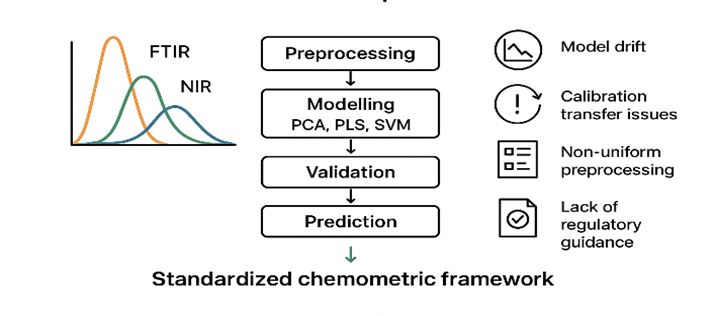
Figure 1 : Chemometrics in Spectroscopic Pharmaceutical Analysis with standardization Gaps and Future Prospects
2. Role of Chemometrics in Spectroscopic Pharmaceutical Analysis
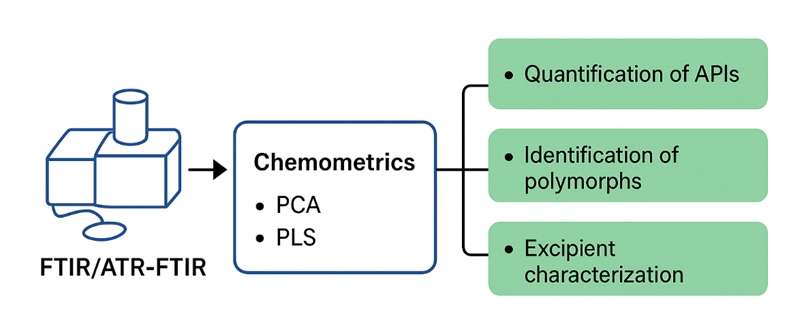
FTIR/ATR-FTIR with Chemometrics: Coupling FTIR and ATR-FTIR spectroscopy with chemometric tools such as PCA and PLS enables robust quantification of APIs, identification of polymorphs and excipient characterization[11–13] while enhancing sensitivity, resolving spectral overlap and supporting reproducible, real-time and green analytical workflows [14].
Near-Infrared (NIR) Chemometrics: NIR spectroscopy is extensively applied for raw material identification, moisture analysis and blend uniformity. Chemometric tools such as PLS regression and cluster analysis enhance quantitative and qualitative assessment.[15,16]. NIR models rely heavily on robust preprocessing steps (e.g., SNV, MSC, spectral derivatives) which can complicate calibration transfer and method validation. [17,18]
Raman Chemometrics: Raman spectroscopy offers high molecular specificity, enabling reliable polymorphic discrimination and detection of counterfeit pharmaceuticals.[19–21] Chemometric approaches improve signal extraction and effectively handle fluorescence affected spectra, thereby enhancing overall analytical performance.[22]
3. Why Chemometrics is Underutilized
Lack of Regulatory Clarity: While ICH Q2(R2) provides guidance for analytical method validation, it does not explicitly address validation of chemometric models. Regulatory bodies such as the EMA and FDA acknowledge the use of chemometrics but require case-specific justification, leading to uncertainty and inconsistent adoption across the pharmaceutical industry. [23,24]
Insufficient Standard Operating Procedures (SOPs): Chemometric workflows differ significantly across laboratories including preprocessing choices, model selection, evaluation metrics and reporting formats resulting in poor reproducibility and limited standardization.[25,26]
Expertise Gap in QC Laboratories: Effective chemometric model development demands knowledge of spectroscopy, multivariate statistics, and machine-learning principles; however, many QC chemists lack formal training or software proficiency, limiting successful implementation in routine analysis.[27]
Risk of Overfitting and Data Leakage: Inadequate dataset splitting, excessive or inappropriate preprocessing, and limited sample diversity increase the risk of overfitting, while many reported models lack proper external validation, reducing their reliability for real-world pharmaceutical applications. [28–30]
4. Standardization Challenges
Variability in Spectral Preprocessing: The absence of universal guidelines for selecting preprocessing steps—such as Standard Normal Variate (SNV), Multiplicative Scatter Correction (MSC), smoothing, derivatives, baseline correction, or normalization leads to significant variability in workflows, ultimately affecting model robustness, comparability and reproducibility across laboratories. [31–33]
Calibration Transfer and Instrument Variability: Differences in instrument resolution, optics, detectors and environmental conditions make it difficult to transfer calibration models between spectrometers.[,34,35] Although methods like Direct Standardization (DS), Piecewise Direct Standardization (PDS) and Orthogonal Signal Correction (OSC) can help but they are not yet well standardized and limiting their routine use in pharmaceutical analysis.[36]
Lack of Universal Acceptance Criteria: Industries require clear benchmarks for evaluating chemometric models such as Root Mean Square Error of Prediction (RMSEP), Coefficient of Determination (R²), Residual Predictive Deviation (RPD), and acceptable residual limits but no universal consensus exists, resulting in inconsistent validation and performance assessment across pharmaceutical applications.[37]
Poor Documentation and Transparency: Many studies do not fully report essential details such as preprocessing steps, sample selection criteria, cross validation methods, or raw spectral data making it difficult to reproduce, verify or build upon existing chemometric models.[38]
5. Recent Advances Aiming to Improve Standardization
Automated Preprocessing and Machine Learning Pipelines: AI-driven workflows can automatically optimize preprocessing, feature selection and model parameters, reducing subjectivity, minimizing human error and improving overall consistency in chemometric analysis.[39–41]
Standardized Spectral Libraries and Databases: Shared FTIR, NIR and Raman spectral libraries are being developed to improve calibration transfer. This enables benchmarking and enhance consistency of chemometric models across laboratories.[42]
Model Lifecycle Management (MLM): In alignment with Process Analytical Technology (PAT) frameworks, chemometric models are managed as dynamic systems that require continuous monitoring, periodic recalibration, performance verification and proper documentation throughout their entire lifecycle. [43]
AI-Enhanced Chemometrics: Advanced hybrid approaches—such as Partial Least Squares combined with Artificial Neural Networks (PLS-ANN) and convolutional neural network (CNN)–based spectral models—enhance prediction accuracy, robustness, and noise tolerance, significantly improving chemometric performance.[44,45]
6. Future Directions for Standardization
Clear opportunities includes:
CONCLUSION
Chemometrics significantly strengthens spectroscopic pharmaceutical analysis but remains underutilized due to poor standardization in pre-processing, validation and calibration transfer. Recent advances such as AI-assisted pipelines, spectral libraries, and model lifecycle management offer strong potential, but global harmonization and clear regulatory frameworks are essential for broader adoption.
REFERENCES


Puja Vyas, Katheriya Raj, Himanshu Kushwaha, Vishakha Parmar, Chemometrics in Spectroscopic Pharmaceutical Analysis: Underutilization, Standardization Gaps and Future Prospects, Int. J. of Pharm. Sci., 2025, Vol 3, Issue 12, 2050-2054. https://doi.org/10.5281/zenodo.17909381
 10.5281/zenodo.17909381
