
Pravara Rural College of Pharmacy, Pravaranagar, Loni bk, Ahilyanagar, Maharashtra, India
The review examines the two main types of catalysts—homogeneous and heterogeneous—explaining their mechanisms and practical uses. It further explores catalytic mechanisms, detailing key steps such as adsorption, desorption, and the formation of intermediates on catalyst surfaces that guide reaction pathways. Catalyst applications across petrochemicals, chemical synthesis, energy production, and environmental remediation are highlighted, showing their broad importance. The review also addresses catalyst design, existing challenges, future prospects, and advanced characterization techniques, supported by real-world case studies. In conclusion, it emphasizes the transformative role of catalysts in thermal reactions and encourages continued research in this rapidly evolving field. Overall, the review portrays catalysts as essential tools that enhance efficiency and innovation in chemical processes.
Over the past decade, rapid industrialization has led to significant environmental damage and an increase in pollution-related disasters. Industrial activities often discharge untreated chemical waste into water bodies, introducing pollutants such as dyes, pharmaceuticals, phenolic compounds, heavy metals, pesticides, and other hazardous substances. These contaminants have serious adverse effects, including carcinogenic and mutagenic impacts on humans as well as on aquatic ecosystems.To address this issue, several waste-removal methods are used, among which photodegradation, adsorption, and advanced oxidation processes (AOPs) are the most common.
Currently, only about 9% of total waste is recycled. Mechanical recycling is the most widely used method for plastic waste, but it often leads to deterioration of plastic properties, causing a cyclic loss of material value. Ultimately, much of the waste still ends up in landfills or is incinerated.
The chemical industry faces increasing pressure to reduce environmental pollution, which has led to the development of various strategies to reuse and recycle industrial waste. Efficient waste management requires well-planned processes that optimize energy consumption and raw material usage, minimizing waste generation. This is achievable through the application of systematic catalytic technologies.
Additionally, strict regulations now govern the manufacturing, transportation, storage, and use of toxic or hazardous substances—such as chlorinated hydrocarbons—which are increasingly restricted. Catalytic processes that generate harmless by-products are preferred for sustainable industrial practices.
DEFINITION OF CATALYSTS :-
Catalysts are often referred to as “chemical matchmakers” because they facilitate reactions by lowering the activation energy required for them to occur. By providing an alternative reaction pathway with reduced energy barriers, catalysts allow chemical reactions to proceed more easily and at faster rates. They play a crucial role in many chemical processes, enabling reactions that would otherwise be too slow or energetically unfavorable under normal conditions.
The significance of catalysts has led to extensive research focused on their development and improvement for industrial applications. For example, Silva et al. designed a novel catalyst with promising potential for alcohol oxidation in the pharmaceutical sector. Similarly, Feng and Didier Astruc worked on enhancing catalyst performance for the oxidation of organic compounds, contributing to advancements in environmental remediation and pollution control.
Example :-
HISTORY:-
The term “catalyst” originated from the field of chemistry and entered the English language mainly in the early 20th century. It is derived from the concept of catalysis, referring to substances that accelerate or modify chemical reactions. In chemical processes, catalysts quickly bring about change and enhance reaction rates. The word began to be used more commonly in a literal sense around the 1940s.
Industrial Role-
Catalysts play an indispensable role in industrial chemical reactions, enabling enhanced efficiency, selectivity, and economic viability in the production of various chemicals and materials. For instance, catalytic processes are fundamental to fuel refining, where they facilitate the conversion of raw hydrocarbons into essential transportation fuels such as diesel and gasoline. Likewise, the synthesis of key industrial chemicals—including methanol and ammonia, which serve as precursors for fertilizers and numerous chemical products—relies heavily on well-designed catalytic systems. In addition to their manufacturing relevance, catalysts are integral to environmental technologies, contributing to air pollution reduction and the effective treatment of wastewater.
TYPES OF CATALYST:-
In the field of thermally driven chemical reactions, catalysts—substances that accelerate reaction rates—exist in multiple forms, each offering distinct advantages and presenting specific challenges. Broadly, catalytic systems used in such reactions are classified into two major categories:
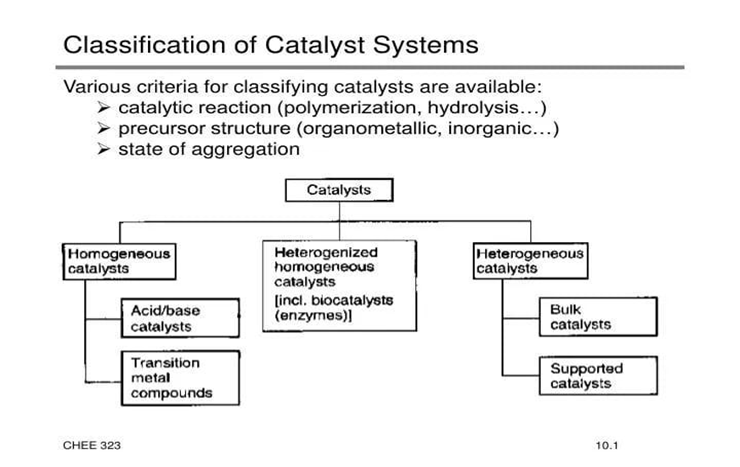
1. Homogeneous catalysts
2. Heterogeneous catalysts
1. Homogeneous catalysts:- Homogeneous catalysts—often referred to as solution-phase catalysts—serve as highly effective agents of molecular transformation. Unlike heterogeneous catalysts, they dissolve completely in the reaction medium, allowing intimate molecular-level interaction with the reactants. This single-phase uniformity provides a favorable environment in which new chemical bonds can form and existing ones can reorganize, thereby enabling reactions that would otherwise be too slow or energetically unfavorable.
The efficiency of homogeneous catalysis arises from precise molecular interactions facilitated by the catalyst, which guides the reorganization of atoms and promotes productive collisions between reactive species. In this sense, the catalyst acts not only as an accelerator but also as a mediator that bridges the energetic and spatial gaps between reactants, aligning them optimally for the reaction to proceed.
A wide variety of homogeneous catalysts are used across numerous chemical transformations, each displaying unique reactivity and functional versatility. From Wilkinson’s catalyst, which enables hydrogenation reactions, to rhodium-based asymmetric catalysts employed in pharmaceutical synthesis, these systems demonstrate the essential role of homogeneous catalysis in both laboratory research and industrial processes.
2. Heterogeneous catalysts:- Heterogeneous catalysts differ markedly from their homogeneous counterparts, as they exist in a distinct phase from the reactants, most commonly as solid materials. These solid catalysts provide well-defined surfaces on which reactants can adsorb, creating active interfaces where chemical transformations take place. Such surfaces contain a variety of active sites and structural features, contributing to the complexity and diversity of heterogeneous catalytic mechanisms.
These catalysts are especially important in high-temperature industrial processes. Their solid-state nature offers significant advantages, including thermal stability, tunability, and the ease of separating the catalyst from the reaction mixture after the process is complete. The catalytic pathway in heterogeneous systems typically involves the adsorption of reactants onto the catalyst surface, followed by surface-mediated reactions and the desorption or release of the final products.
A classic example is the use of zeolites in fluid catalytic cracking during petroleum refining. Their crystalline framework contains ordered channels and cavities that promote the selective cracking of hydrocarbons into more valuable fractions. Another well-known application is the automotive catalytic converter, which relies on heterogeneous catalysts to convert harmful exhaust gases into less toxic compounds.
Overall, heterogeneous catalysts play a critical role across various sectors—from large-scale
These catalysts are especially important in high-temperature industrial processes. Their solid-state nature offers significant advantages, including thermal stability, tunability, and the ease of separating the catalyst from the reaction mixture after the process is complete. The catalytic pathway in heterogeneous systems typically involves the adsorption of reactants onto the catalyst surface, followed by surface-mediated reactions and the desorption or release of the final products.
Industrial operations such as petroleum refining to essential environmental protection technologies.
The difference heterogeneous catalysts along with their respective applications:-
A variety of heterogeneous catalysts are employed across industrial and environmental applications, each offering distinct structural features and functional advantages:
1. Zeolites – These crystalline aluminosilicate materials are widely used in fluid catalytic cracking within petroleum refineries. Their ordered pore structures facilitate the selective conversion of heavy hydrocarbons into lighter, more valuable products.
2. Automotive catalytic converters – Commonly installed in vehicles, these systems utilize heterogeneous catalysts to convert harmful exhaust gases such as carbon monoxide and nitrogen oxides into less toxic substances like carbon dioxide and nitrogen.
3. Metal oxides – Metal oxide catalysts are frequently applied in selective oxidation reactions, enabling controlled transformation of organic molecules with high efficiency.
4. Transition metals – Transition metals act as versatile catalysts in numerous reactions, often promoting pathways that generate valuable intermediates or final products in chemical manufacturing.
5. Supported nanoparticles – These catalysts play a significant role in environmental remediation processes, including water purification and air pollution control. Their high surface area allows for the effective degradation of hazardous pollutants into benign compounds.
Mechanisms in thermal reaction :-
Catalysts participate in a sequence of molecular interactions that lower the activation energy of a reaction without being consumed in the process. This catalytic action generally proceeds through three fundamental mechanistic steps:
1. Adsorption and Desorption: Reactant molecules first approach and adsorb onto the catalyst surface through weak interactions such as van der Waals forces or hydrogen bonding. This adsorption forms a catalyst–reactant complex that facilitates molecular transformation by increasing the likelihood of successful collisions. The catalyst thus provides an energetically favorable pathway that directs the reactants toward the formation of desired products. Once the reaction occurs, the products desorb from the catalyst surface, making the active site available for another cycle.
2. Formation of Reaction Intermediates: During the catalytic cycle, short-lived intermediates are often generated, serving as transitional species between reactants and products. These intermediates—such as carbocations, carbanions, or free radicals—exist only briefly but offer a lower-energy pathway that accelerates the overall reaction. Their formation and subsequent transformation depend on the nature of both the reactants and the catalyst involved.
3. Role of Active Sites: The catalyst’s active sites—specific regions on its surface including pores, edges, and defects—provide the necessary environment for molecular interaction and transformation. These areas concentrate reactant molecules, enhance their mobility, and ultimately facilitate the chemical steps required for product formation.
In thermally driven reactions, these coordinated mechanistic steps illustrate the precision with which catalysts guide molecular transformations. Much like a choreographed dance responding seamlessly to rhythm, catalysts interact dynamically with the thermal energy of the system, enabling complex chemical reactions to proceed efficiently.
APPLICATION :-
Catalysts have profoundly evolved within thermally driven reaction systems, transforming industrial practices by improving efficiency, strengthening sustainability, and redefining the boundaries of what can be achieved in chemical manufacturing. In the complex landscape of chemical synthesis—ranging from energy production to environmental stewardship—catalysts function as the central architects that direct and optimize thermal reactions.
Within the extensive petrochemical sector, where hydrocarbons form the foundation of numerous processes, catalysts serve as essential agents for molecular restructuring. One of their most significant contributions lies in the advancement of hydrocarbon conversion and cracking technologies. Zeolite-based catalysts exemplify exceptional precision, enabling selective cleavage of large hydrocarbon molecules to generate high-demand products such as gasoline and olefins. These catalysts reshape hydrocarbon frameworks to increase octane ratings and enhance hydrogen production. Additionally, advanced catalytic systems incorporating metals like platinum and palladium meet the rigorous requirements of modern fuel production, ensuring higher efficiency and cleaner-burning fuels.
In the domain of chemical synthesis—where simpler molecules are transformed into complex, value-added products—catalysts play a pivotal role. Under thermal conditions, catalysts guide reaction pathways in processes such as oxidation and reduction. For example, oxidation reactions are made more efficient through catalytic systems that bridge the energy gap between reactants and products, as seen in the conversion of sulfur dioxide to sulfuric acid. Similarly, catalytic hydrogenation, facilitated by metals such as palladium and platinum, enables the reduction of unsaturated compounds to saturated ones, representing a cornerstone technique in industrial and pharmaceutical synthesis.
Catalysts greatly contribute to waste minimization by lowering activation energies, thereby allowing reactions to occur at reduced temperatures and pressures. This results in lower energy consumption, decreased operational costs, and fewer greenhouse gas emissions. Their ability to enhance reaction selectivity minimizes the formation of unwanted byproducts and maximizes yields of the desired product, directly supporting the goals of green chemistry. Catalysts also facilitate the conversion of waste materials into valuable chemicals—for instance, in the catalytic depolymerization of plastics, where polymers are broken down into reusable monomers. Moreover, catalytic processes often rely on less hazardous reagents and generate fewer toxic byproducts, aligning strongly with environmentally responsible manufacturing.
Catalysis is indispensable in energy-related applications, enabling cleaner and more efficient chemical reactions that reduce waste and support sustainable energy systems. Catalysts minimize energy input requirements, suppress the formation of harmful byproducts, and allow renewable feedstocks to be used more effectively. A prominent example is the automotive catalytic converter, which transforms pollutants such as carbon monoxide and nitrogen oxides into less harmful gases, significantly reducing vehicular emissions.
It including enzymes and microorganisms, offer an environmentally benign alternative to conventional chemical catalysts. They operate under mild conditions, generate minimal waste, and often exhibit remarkable specificity, making them highly attractive for sustainable chemical manufacturing.
Catalysts also enable the conversion of surplus renewable energy into storable chemical forms, such as hydrogen or other energy-rich molecules. This catalytic transformation plays a critical role in energy storage technologies and biosynthetic pathways, supporting the transition to cleaner and more resilient energy systems.
CHALLENGES AND FUTURE DIRECTION
As the field of catalysis continues to evolve, expanding its influence across scientific and industrial domains, it simultaneously encounters a range of significant challenges that demand innovative solutions. The future direction of catalytic research is shaped by these obstacles, many of which reflect the inherent complexity of thermally driven reactions. This section highlights the major limitations and emerging pathways that guide efforts toward improving catalytic performance, enhancing sustainability, and ensuring long-term viability.
1. Spent Catalyst Waste:-
A substantial portion of industrial catalysts—particularly those used in petrochemical refining—become non-recyclable waste after their operational lifespan. These spent catalysts often contain hazardous substances, including heavy metals and toxic residues, making their disposal both environmentally sensitive and economically burdensome. Strict environmental regulations necessitate specialized treatments and waste-handling procedures, significantly increasing operational costs and complicating waste management.
2. Leaching and Toxicity Concerns:-
In homogeneous catalytic systems, metal ions may leach into the reaction medium, potentially contaminating wastewater and posing environmental risks. Even heterogeneous catalysts can exhibit leaching under harsh reaction conditions or prolonged use, releasing toxic components into the environment. Comparative assessments show that toxicity varies widely among commonly used catalytic metals—for example, nickel and copper tend to exhibit higher toxicity relative to noble metals such as platinum or ruthenium—highlighting the need for safer catalyst alternatives.
3. Catalyst Deactivation and Regeneration:
Catalysts are prone to gradual loss of activity due to mechanisms such as poisoning, fouling, sintering, or structural degradation. Restoring catalytic activity often requires regeneration processes that may be energy-intensive, such as high-temperature treatments or chemical washing. These methods are not always feasible for all catalyst types and may create additional waste, increase operational costs, and necessitate frequent catalyst replacement.
4. Resource Depletion and Environmental Impact:-
Many widely used catalysts rely on finite, non-renewable metals, whose extraction and refining carry significant ecological consequences. Mining operations can lead to habitat destruction, soil degradation, and water contamination. As global demand for these metals increases, concerns regarding resource depletion, supply vulnerability, and environmental damage grow more urgent, motivating the search for abundant, low-toxicity alternatives.
5. Applications and Broader Implications:-
Catalysts remain indispensable in processes that support global industries and societal needs. For example, the production of ammonia via the Haber–Bosch process—where nitrogen and hydrogen gases react over an iron-based catalyst at elevated temperatures—has enabled dramatic increases in agricultural productivity worldwide. Similarly, catalytic technologies enhance reaction efficiency, reduce waste, and improve product yields across a wide range of thermal processes.
In environmental applications, catalytic systems such as selective catalytic reduction (SCR) play a crucial role in reducing nitrogen oxide emissions, helping industries and transportation sectors meet stringent air-quality standards. By shaping the energy landscape of thermal reactions, catalysts contribute to both economic efficiency and environmental protection.
CONCLUSION
The catalyst may be viewed as a transformative agent—an essential facilitator that orchestrates chemical processes with remarkable precision. Across the chemical industry, catalysts consistently prove indispensable, particularly in reducing waste, enhancing thermal efficiency, and improving overall production outcomes. This review highlights that catalysts function as intermediates between reactants and products in thermal reactions while simultaneously acting as effective waste-minimizing agents.
In the realm of homogeneous catalysis, their industrial applications continue to expand, demonstrating substantial potential for process intensification and sustainability. However, this review does not exhaustively address waste-management challenges or the full scope of catalytic applications across key sectors such as petrochemicals, energy production, and chemical synthesis. What is evident, however, is the significant contribution catalysts make toward improving energy efficiency and promoting cleaner production pathways.
Ultimately, the exploration of catalysts as waste-reduction tools reinforces the enduring value of scientific innovation. This review provides foundational insight for future research focused on optimizing catalytic processes and further advancing their role in industrial waste mitigation.
REFERENCES


Sakshi Solunke, Pradnya Murade, Catalysis in Thermal and Chemical Transformations: A Technical Review, Int. J. of Pharm. Sci., 2026, Vol 4, Issue 2, 986-993. https://doi.org/10.5281/zenodo.18509438
 10.5281/zenodo.18509438
