
Department of Pathology, Department of pathology, KVNNSPS's Institute of Pharmaceutical Education and Research
Blood group detection is an essential part of healthcare, especially in situations like blood transfusions, organ transplants, and medical emergencies. Traditionally, blood groups are identified using laboratory-based methods that require blood samples, chemical reagents, and trained personnel. These methods, while effective, can be time-consuming, invasive, and prone to human error.In recent years, advancements in technology have introduced artificial intelligence (AI) techniques that can detect blood groups through fingerprints, providing a non-invasive, faster, and more accurate alternative. AI-based finger machines analyze patterns and features in fingerprints to predict blood group types without the need for drawing blood.This review paper explores both traditional and AI-based methods for blood group detection. It explains how AI finger machines work, compares them with old methods, discusses their advantages and limitations, and highlights potential applications in hospitals, blood donation camps, and personal healthcare monitoring. The paper also looks at the future prospects of integrating AI blood detection systems with modern healthcare technology to improve efficiency and accessibility.
Blood is a vital component of the human body, responsible for transporting oxygen, nutrients, and removing waste. Blood group identification is very important in healthcare, especially during blood transfusions, organ transplants, pregnancy, and emergency treatments. If a person receives incompatible blood, it can lead to serious health problems or even death [1]. Traditionally, blood group detection involved laboratory-based methods like the slide test, tube test, and gel card method. These methods require blood samples, reagents, and trained personnel. Although accurate, they are time-consuming, invasive, and sometimes prone to human error [2]. With the development of technology, artificial intelligence (AI) has started to play a role in healthcare diagnostics. AI can analyze complex patterns and large datasets, making medical procedures faster and more accurate [3]. One of the recent innovations is the AI-based finger machine, which can predict blood groups by analyzing fingerprint patterns. This method is non-invasive, fast, and user-friendly, reducing the need for drawing blood and laboratory testing [4] The main goal of this review is to explain how AI finger machines work, compare them with traditional blood group detection methods, discuss their advantages and limitations, and highlight their applications in modern healthcare. This paper also explores the future prospects of AI-based blood group detection technology.
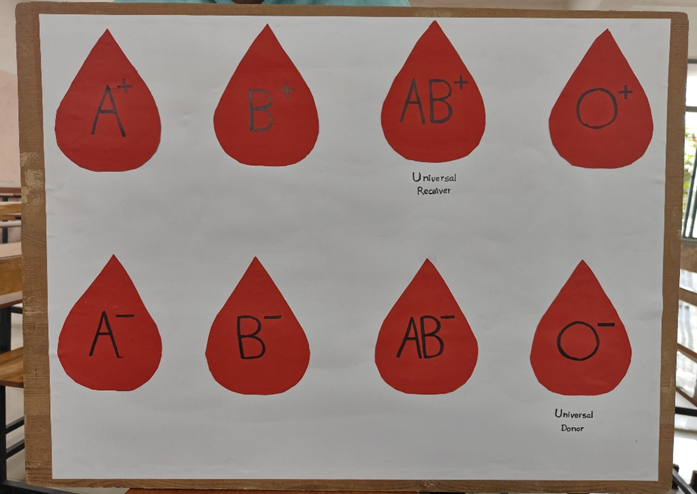
Fig no 1 “Blood Group Types and Universal Donor/Receiver Chart”
Blood groups are classifications of blood based on the presence or absence of specific antigens and antibodies in red blood cells and plasma. Understanding blood groups is very important because compatible blood transfusions save lives, while incompatible transfusions can cause serious reactions [5].
1.1 ABO Blood Group System
1.2 Rh Blood Group System
The Rh system classifies blood based on the presence or absence of the Rh antigen (also called D antigen):
Combining the ABO and Rh systems gives eight possible blood types: A+, A-, B+, B-, AB+, AB-, O+, and O-.
1.3 Importance of Blood Group Knowledge
Understanding these systems is the foundation for both traditional and AI-based blood group detection methods. In the following sections, we will discuss how these methods work and their processes.
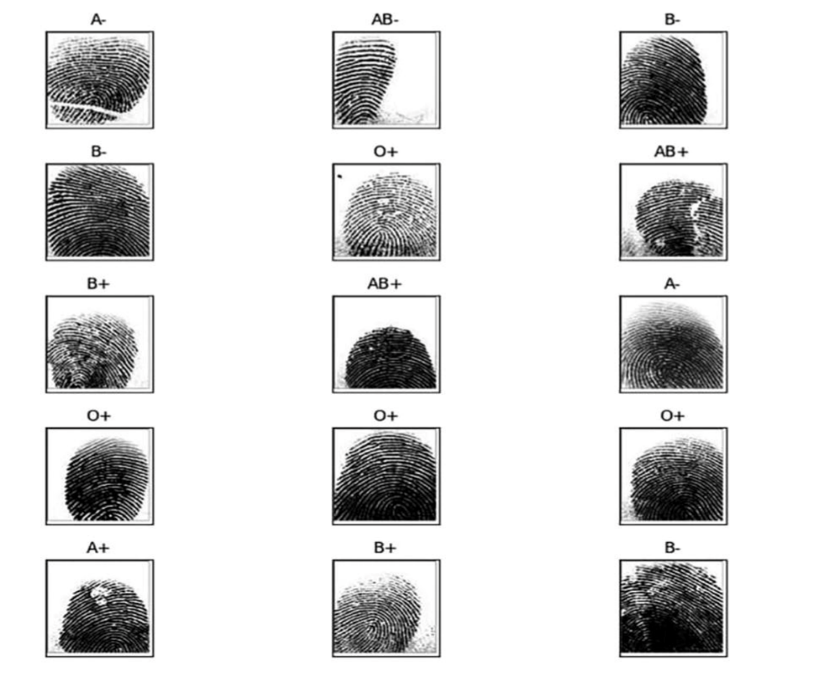
Fig no 2: Fingerprint Pattern
Before the invention of AI-based detection systems, blood groups were determined using manual laboratory methods. These methods are still widely used in hospitals and blood banks because they are accurate and reliable.

Fig no 3: Traditional Blood Group Detection Methods
2.1 Slide Test Method
The slide test is a quick and simple method for blood group detection.
Process Steps:
Advantages:
Quick and simple.
Requires minimal equipment.
Limitations:
Less accurate than tube method.
Requires careful observation; human error possible.
2.2 Tube Test Method
The tube test is more accurate and commonly used in laboratories.
Process Steps:
Advantages:
More accurate than slide test.
Can detect weak reactions.
Limitations:
Requires laboratory setup.
Time-consuming compared to slide test.
2.3 Gel Card Method
The gel card method is a modern version of traditional methods and widely used in blood banks.
Process Steps:
Advantages:
Highly accurate and reliable.
Minimal human error.
Can be automated for large-scale testing.
Limitations:
More expensive than slide and tube tests.
Requires specialized equipment.
2.4 Summary
Traditional methods are effective and widely accepted but are time-consuming, require blood samples, and sometimes need skilled personnel. These limitations led to the development of AI-based, non-invasive blood group detection systems, which are discussed in the next section [12].
AI-based finger machines are a modern, non-invasive technology that can predict a person’s blood group by analyzing fingerprint patterns. This technology uses sensors, artificial intelligence, and machine learning algorithms to make accurate predictions without the need for blood samples [18].
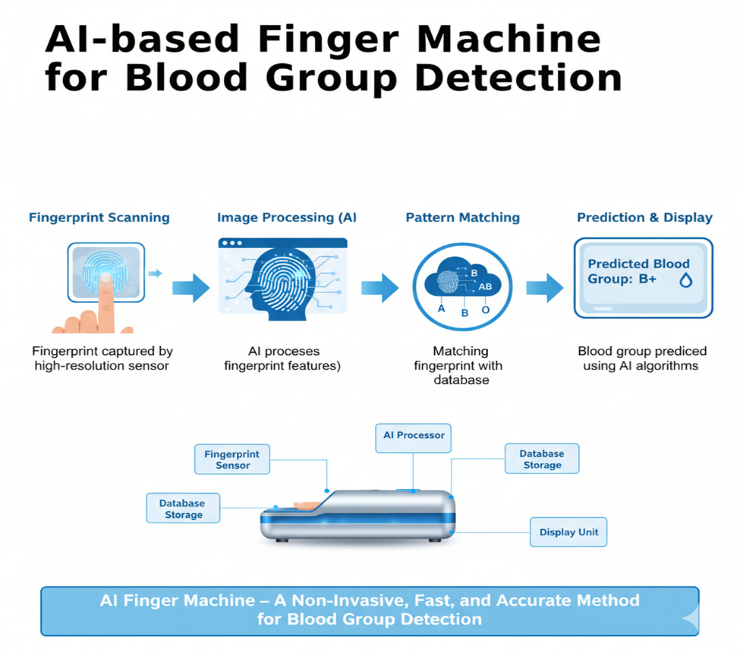
Fig no: 4 Al-based Finger Machine for Blood Group Detection
3.1 Working Principle
3.2 Process Steps (Short)
3.3 Components of AI Finger Machine
3.4 Advantages Over Traditional Methods
3.5 Limitations
AI-based finger machines are an innovative alternative to traditional blood group detection methods, combining speed, safety, and convenience. In the next section, we will compare traditional and AI methods to highlight the differences [21].
Blood group detection has evolved from traditional laboratory methods to modern AI-based finger machines. Comparing these methods helps understand the advantages, limitations, and suitability of each approach.
4.1 Comparison Table

4.2 Explanation of Comparison
Sample Required & Invasiveness: Traditional methods need blood collection, which can be uncomfortable or risky. AI finger machines do not require blood, making them painless and safer [22].
In summary, AI-based finger machines provide a faster, safer, and more convenient alternative to traditional methods. However, traditional laboratory methods are still reliable and widely used, especially in controlled medical settings.
AI-based finger machines for blood group detection offer many benefits compared to traditional methods. These advantages make them suitable for hospitals, blood donation camps, and personal healthcare monitoring [27].
5.1 Non-Invasive Method
Unlike traditional methods, no blood sample is needed.
Reduces pain, risk of infection, and discomfort for the patient.
5.2 Fast Results
Provides blood group and Rh type within seconds.
Useful in emergencies where time is critical.
5.3 User-Friendly
Requires minimal training to operate.
Can be used by nurses, volunteers, or non-specialized staff.
5.4 Portable and Convenient
Compact design allows use in remote areas, mobile blood donation camps, and small clinics.
No need for a fully equipped laboratory [28].
5.5 Accurate and Reliable
AI analyzes complex fingerprint patterns to predict blood groups.
Reduces human error compared to manual methods.
5.6 Cost-Effective in the Long Run
Although initial investment is high, AI machines reduce labor costs and testing time over time.
Suitable for high-volume blood testing in hospitals or blood banks [29].
5.7 Hygienic and Safe
Non-contact process reduces the chance of cross-contamination.
Safe for multiple users in blood donation drives or hospital settings.
5.8 Ideal for Large-Scale Screening
Can quickly test many people in a short time.
Useful for blood donation camps, school health programs, and community health check-ups [30].
In summary, the AI finger machine is faster, safer, and more convenient than traditional methods, making it a valuable tool in modern healthcare.
While AI-based finger machines offer many advantages, they also have some limitations and challenges that need to be considered [31].
6.1 Initial High Cost
The machines and AI software require a significant investment.
Smaller clinics or rural areas may find it expensive to adopt initially.
6.2 Dependence on Database
AI predicts blood groups by comparing fingerprints with a pre-existing database.
If the database is small or incomplete, accuracy may decrease.
6.3 Technical Issues
Fingerprint smudges, dirt, or injuries can affect scanning.
Sensor malfunctions or software glitches may lead to incorrect results [32].
6.4 Limited Research in Diverse Populations
Most AI models are trained on specific populations.
Accuracy may vary for different ethnic groups or age categories, requiring further research.
6.5 Training and Maintenance
Operators need basic training to handle the machine properly.
Regular software updates and maintenance are necessary to ensure accuracy.
6.6 Privacy Concerns
Fingerprints are biometric data, which may raise data security and privacy issues.
Proper data protection measures are needed to prevent misuse [33].
6.7 Not a Complete Replacement for Traditional Methods
In critical medical situations, laboratory confirmation may still be required.
AI finger machines are currently used as a supplementary tool rather than a full replacement.
In summary, while AI-based finger machines are innovative and convenient, addressing these challenges is necessary for wider adoption and reliable use in healthcare systems.
AI-based finger machines for blood group detection have a wide range of applications in healthcare and related fields. These uses make the technology practical, efficient, and beneficial for both medical professionals and the general public [34].
7.1 Hospitals and Clinics
Used for quick blood group determination during emergencies.
Helps doctors and nurses avoid delays in blood transfusions.
Reduces manual work and dependency on laboratory staff.
7.2 Blood Donation Camps
Can screen donors quickly and safely without taking blood samples.
Ensures that donated blood is compatible and reduces the risk of errors.
Speeds up the process for large numbers of donors.
7.3 Emergency Medical Services
In ambulances or emergency rooms, AI machines provide instant blood group results.
Useful in accident cases or urgent surgeries where time is critical [35].
7.4 Personal Health Monitoring
Can be integrated with personal health devices or apps for self-monitoring.
Useful for individuals who need frequent blood group checks, like patients with chronic conditions.
7.5 Research and Forensic Science
AI finger machines help in medical research by collecting large-scale blood group data.
Can be used in forensic investigations where blood samples are limited or unavailable.
7.6 Remote and Rural Healthcare
Portable AI machines allow blood group testing in rural areas with limited laboratory facilities.
Beneficial in mobile health camps and community health programs.
7.7 Integration with Smart Healthcare Systems
Can be connected to hospital management systems or electronic health records for automatic data updating.
Helps in tracking blood group information for patients efficiently [36].
In summary, AI-based finger machines have diverse applications that improve speed, safety, and accessibility in healthcare and related fields.
The use of AI-based finger machines for blood group detection is still evolving, and its future holds many exciting possibilities. As technology improves, these machines could become even more accurate, affordable, and widely available [37].
8.1 Integration with Wearable Devices
In the future, AI blood detection could be integrated into smartwatches or wearable health devices.
People could check their blood group anytime without visiting a hospital.
8.2 Smart Hospitals and Telemedicine
AI finger machines could be connected to hospital databases for real-time patient monitoring.
Doctors could access blood group information remotely, improving telemedicine services [38].
8.3 Large-Scale Deployment
Portable machines could be used in schools, workplaces, and community health programs for mass blood group screening.
Could help maintain accurate population blood group databases.
8.4 Improved Accuracy with Big Data
With larger fingerprint databases and advanced AI algorithms, prediction accuracy will improve.
AI could also identify rare blood types more reliably.
8.5 Combination with Other Health Diagnostics
AI machines could evolve to detect other health conditions from fingerprints, such as blood sugar levels or genetic markers.
This will make health monitoring faster and non-invasive [39].
8.6 Cost Reduction and Accessibility
As technology becomes cheaper, AI finger machines could be affordable for small clinics and rural healthcare centers.
Could make blood group testing accessible to everyone.
8.7 Research and Development
Continuous R&D can improve machine sensors, AI algorithms, and database management.
Could lead to fully automated, highly reliable, and user-friendly systems in the near future [40].
In summary, the future of AI-based finger machines is promising. They are expected to become faster, more accurate, affordable, and integrated into daily healthcare systems, revolutionizing blood group detection.
CONCLUSION
Blood group detection is a critical aspect of healthcare, essential for safe blood transfusions, organ transplants, and emergency medical treatments. Traditional methods like the slide test, tube test, and gel card method are reliable but time-consuming, invasive, and require skilled personnel [41].The development of AI-based finger machines has introduced a fast, non-invasive, and user-friendly alternative. These machines use fingerprint patterns, AI algorithms, and databases to predict blood groups accurately within seconds [42]. Compared to traditional methods, AI machines are safer, more convenient, portable, and suitable for large-scale screening [43].While AI finger machines have challenges such as high initial costs, dependence on database quality, and privacy concerns, ongoing research and technological advancements are addressing these issues [44]. Their applications in hospitals, blood donation camps, emergency services, personal health monitoring, and research demonstrate their potential to transform healthcare [45].In the future, AI-based blood group detection is expected to become more accurate, affordable, and widely integrated with wearable devices and smart healthcare systems. Overall, this technology represents a significant advancement in medical diagnostics, offering efficiency, safety, and accessibility to both healthcare providers and patients.
REFERENCES



Krushi Pradhan, Pratik Bhabad, Janvi Patil, Varsha Chavan, Blood Group Detection Using Artificial Intelligence, Int. J. of Pharm. Sci., 2026, Vol 4, Issue 2, 2311-2322. https://doi.org/10.5281/zenodo.18649562
 10.5281/zenodo.18649562
