
School of Pharmacy, G H Raisoni University, Saikheda, Tah. Sausar, Dist.-Pandhurna, Madhya Pradesh, India – 480337
Avaleha represents a classical Ayurvedic semi-solid formulation prepared using herbal decoctions, sweeteners, ghee, and honey, traditionally consumed by licking. In recent years, this dosage form has gained renewed attention due to its alignment with the global nutraceutical concept, which emphasizes food-derived bioactives with preventive and therapeutic benefits. Avaleha preparations are inherently rich in phytoconstituents such as polyphenols, flavonoids, alkaloids, tannins, and essential oils that demonstrate antioxidant, anti-inflammatory, immunomodulatory and restorative actions. The incorporation of nutrient-dense ingredients—including Amla, Ashwagandha, Draksha, ghee, and honey—further contributes to digestive, immune, and metabolic support. Modern analytical tools such as organoleptic evaluation, physicochemical testing, and chromatographic profiling are crucial for improving standardization and safety. With rising scientific interest in plant-based functional foods, Avaleha holds strong promise as a holistic nutraceutical; however, further clinical validation, dosage-form innovation, and global regulatory harmonization remain essential.
Nutraceuticals
Nutraceuticals—products positioned between food and medicine—are increasingly recognized for their ability to provide physiological benefits beyond basic nutrition. They encompass a wide spectrum of preparations, including dietary supplements, herbal products, and fortified foods, which contain bioactive compounds capable of supporting health or mitigating disease progression. The term “nutraceutical” was introduced in 1989 by Dr. Stephen DeFelice, reflecting a convergence of nutritional science and pharmacotherapy. Global consumer interest continues to rise, driven by preventive healthcare trends and expanding scientific evidence for food-derived therapeutics.[1]
Global Demand for Nutraceuticals
The nutraceutical market has expanded rapidly, with herbal products, natural supplements, and functional foods constituting its major sectors. Herbal and natural formulations have shown annual growth rates exceeding 11%, while dietary supplements have grown at nearly 20%, underscoring increasing public preference for natural and traditional health solutions.
Avaleha
Avaleha (or Leha) is a classical Ayurvedic semisolid dosage form designed for internal administration. It is prepared by concentrating herbal decoctions or fresh juices with sweetening agents such as jaggery or sugar, followed by the incorporation of ghee, honey, and fine herbal powders. The term originates from the Sanskrit root “lih,” indicating “to lick,” reflecting its intended mode of intake. Owing to its palatable nature and nutritive composition, Avaleha is widely prescribed for both preventive and therapeutic purposes. The presence of readily absorbable sugars ensures early digestion and bioavailability, while its compatibility and long shelf-life contribute to its widespread use across age groups.[2]
Synonyms
Lehya, Rasakriya, Ghana, Avaleha—terms used depending on consistency and method of preparation.
Importance of Avaleha
Avaleha offers several advantages over other traditional formulations:
Relevance of Integrating Ayurveda with Nutraceutical Science
Ayurveda’s longstanding emphasis on food as both nourishment and medicine parallels modern nutraceutical philosophy. Ayurvedic Rasayana formulations, designed to strengthen immunity, enhance longevity, and support physiological resilience, share significant overlap with contemporary functional foods. Ingredients such as ghee, honey, Amla, and Ashwagandha have well-documented nutritional and adaptogenic properties, supporting their classification as natural nutraceuticals.[4]
2. HISTORICAL BACKGROUND AND CONCEPTUAL FRAMEWORK
Origin of Avaleha
Avaleha Kalpana has deep roots in classical Ayurvedic pharmaceutics (Bhaishajya Kalpana). References appear throughout ancient texts including Charaka Samhita and Sushruta Samhita, particularly in contexts related to respiratory care, rejuvenation, wound healing, and systemic disorders. The Sharangadhara Samhita provides the most detailed and systematic description of Avaleha preparation, including guidelines for boiling, sweetening, and identifying Paka Lakshana (endpoint indicators for processing).[2]
Classical References
Charaka and Sushruta mention paste-like medicated preparations resembling Avaleha in therapeutic chapters, while Sharangadhara elaborates precise preparation steps using sugar, decoctions, ghee, honey, and fine herbal powders (Prakshepa Dravya). Techniques such as one-thread syrup consistency highlight the sophistication of early pharmaceutics.[5]
Evolution into the Modern Era
Traditional Avaleha formulations have evolved to suit contemporary needs, giving rise to innovations like granules, capsules, and low-sugar variants. Popular examples include Chyawanprash as an immune-enhancing supplement and Kushmanda Avaleha modified into granules for improved stability and patient compliance. This adaptability underscores the relevance of Avaleha in modern nutraceutical markets.[3]
3. NUTRACEUTICAL PERSPECTIVE
The foundational principle of nutraceuticals—that food and health are intimately connected—has existed within Ayurveda for millennia. Avaleha formulations embody this concept by combining nutritive substances with potent herbal actives. Classical Ayurvedic texts classify foods into twelve categories based on their nutritional and medicinal qualities, emphasizing dietary diversity for health maintenance.Comparative assessments reveal that specific Avalehas (e.g., Jeevantyadi for maternal health, Kushmanda for nourishment, Kalyana for respiratory support) demonstrate functional roles consistent with modern nutraceutical classifications.[1]
4. DESIGN OF NUTRACEUTICAL AVALEHA
Principles of Formulation
A nutraceutical Avaleha integrates:
The formulation aims to balance doshas, enhance therapeutic potency, and support palatability while maintaining the integrity of bioactive compounds.
A. Nutritional Assessment of Key Ingredients
Avaleha formulations combine nutrient-rich base materials with pharmacologically active herbs, giving them a dual character as both functional foods and therapeutic preparations. The nutritional profile of the formulation is largely determined by foundational ingredients such as Amla, Ashwagandha, ghee, honey, and jaggery, while specialized herbs impart targeted therapeutic effects. These components offer vitamins, minerals, carbohydrates, bioactive phytochemicals, and adaptogenic compounds that contribute to immunity, metabolic regulation, digestive wellness, and antioxidant protection.[3]
A concise overview of important nutraceutical ingredients and their functional roles is shown below:
|
Ingredient |
Key Nutrients |
Therapeutic Attributes |
Functional Role |
|
Amla |
Vitamin c, Polyphenols, Minerals |
Immunity booster, Antioxidant |
Core Rasayana; Major component in Chyawanprash |
|
Ashwagandha |
Withanolides, Alkaloids |
Adaptogenic, Antistress, Revitalizing |
Enhance stamina & vitality |
|
Ghee |
Essential fatty acids, CLA, Fat-soluble vitamin |
Digestive & Anti-Inflammatory |
Improves nutrient absorption |
|
Honey |
Natural sugars, Minerals, Antioxidants |
Energetic, Antimicrobial, Digestive enhancer |
Yogavahi- enhance herb potency |
|
Sugar/ Jaggery |
Carbohydrates, Minerals |
Provides energy & Improves taste |
Acts as preservative and binding medium |
These combined nutrients make Avaleha an easily accepted, palatable, and physiologically beneficial formulation for all age groups.
B. Biochemical Integration of Bioactive Compounds
The therapeutic properties of Avaleha are attributed to the synergistic interaction of diverse plant-based bioactive molecules:;
1. Polyphenols and Flavonoids
Compounds such as emblicanin (from Amla), glycosides (from Guduchi), and glabridin (from Yashtimadhu) neutralize reactive oxygen species and modulate oxidative stress pathways. They stabilize cellular membranes, protect biomolecules, and regulate transcription factors involved in inflammation.[5]
2. Terpenoids and Alkaloids
Herbs like Pippali and Haridra contain piperine and curcuminoids, which exhibit anti-inflammatory and immunomodulatory effects. Piperine enhances the bioavailability of several herbal actives, amplifying overall therapeutic efficacy [3,5].
3. Saponins, Tannins, and Glycosides
Steroidal saponins in Shatavari support reproductive and lactation health, while tannins and glycosides from herbs like Draksha contribute antioxidant and anti-inflammatory activities, relevant for metabolic and musculoskeletal conditions.Through these bioactive groups, Avaleha supports redox homeostasis, reduces chronic inflammation, and strengthens immune responses.
C. Raw Material Selection
Ensuring botanical authenticity is a crucial step in Avaleha preparation. Quality control begins with proper identification of plant materials at the source, including botanical name, habitat, harvest conditions, collector identity, and organoleptic markers. Variations in harvesting, storage, and processing can significantly alter the phytochemical composition and efficacy. Therefore, stringent raw material verification and standardized storage practices are fundamental to producing safe and effective nutraceutical-grade Avaleha.[3], [6]
D. Formulation Design Model
Avaleha exemplifies the principle of synergy, where sweeteners act as stabilizers and carriers, ghee enhances bioavailability of lipophilic compounds, and honey contributes its own antioxidant value while amplifying the effect of herbs. Modern nutraceutical science supports this multi-component delivery model as a holistic approach to improving therapeutic effectiveness.[2]
5. DEVELOPMENT APPROACHES
Traditional Preparation Methodologies
Equipment
Traditional preparation uses:
Modern industrial setups employ steam-jacketed kettles, automated mixers, mechanical sifters, and duplex filters to enhance scalability and hygiene.[3]
Method of Preparation
This method achieves a uniform semisolid formulation with preserved phytochemical activity.[3]
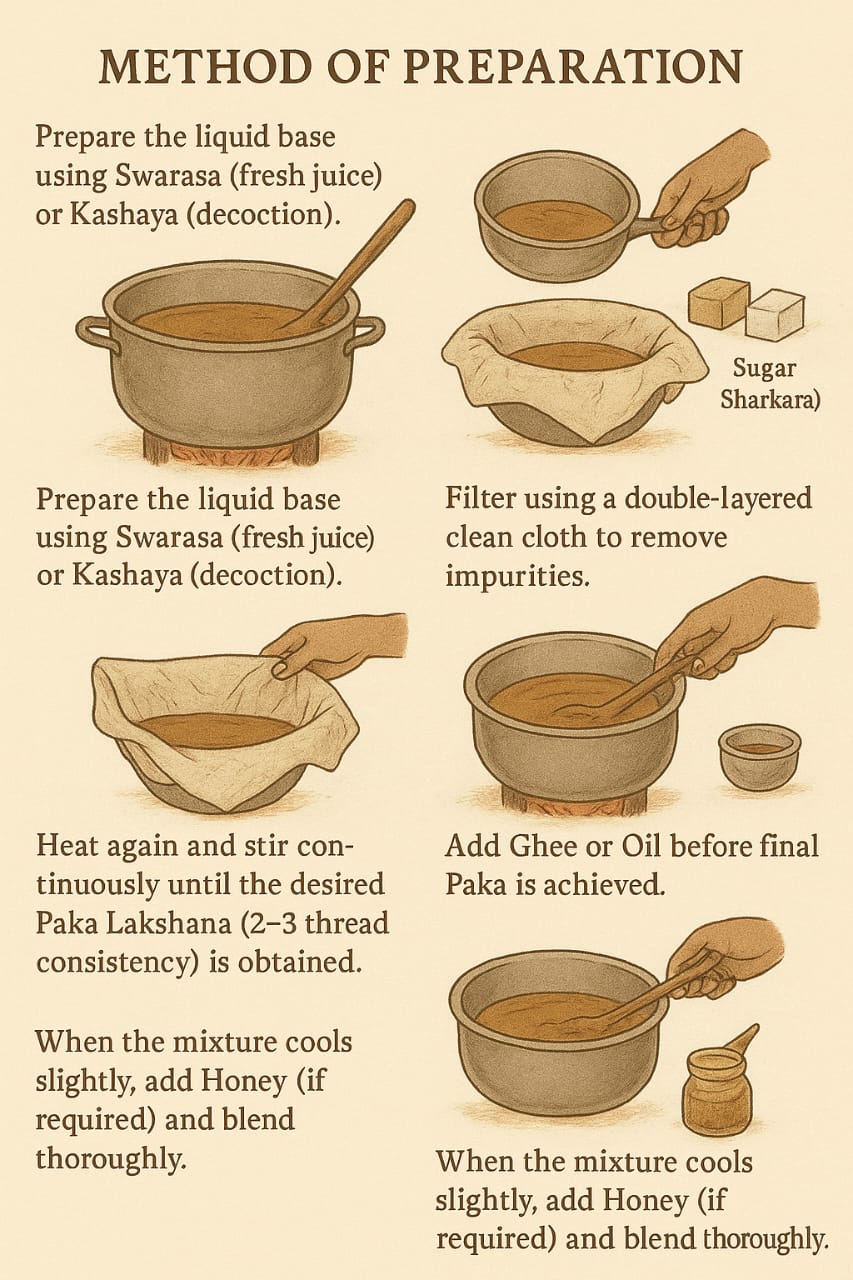
(Step-by-step preparation process of Avaleha)
Avaleha Storage Conditions
To maintain potency and safety, Avaleha should be stored:
Changes in smell, consistency, or color indicate possible degradation and the need for quality reassessment.
6. ANALYTICAL LABORATORY AND QUALITY CONTROL
Quality control ensures standardization and reproducibility in nutraceutical Avaleha formulations.
A. Organoleptic Evaluation
Color, odor, taste, and texture are evaluated to ensure consistency with classical descriptions (e.g., brownish color in Kushmanda Avaleha).[7]
B. Physicochemical Parameters
Common parameters include:
C. Chromatographic Analysis (TLC)
Thin-layer chromatography is used to fingerprint chemical constituents.
For example, in Kushmanda Avaleha, TLC under 365 nm revealed three major spots (Rf = 0.20, 0.33, 0.81), reflective of varying polarity and phytochemical diversity.[9]
Such profiling supports:
7. THERAPEUTIC APPLICATIONS AND CLINICAL RESEARCH
Avaleha preparations address multiple modern health challenges due to their antioxidant, immunomodulatory, and adaptogenic characteristics.
1. Management of Oxidative Stress Disorders
Oxidative stress contributes to chronic diseases such as diabetes, cancer, cardiovascular dysfunction, and neurodegeneration.
Amla, Guduchi, Draksha, and Haridra—commonly included in Avaleha—exhibit strong radical-scavenging actions that benefit endothelial health, neuronal function, and glucose metabolism.[10]
2. Anti-inflammatory & Immunomodulatory Actions
Chronic low-grade inflammation underlies conditions like obesity, arthritis, and metabolic syndrome.
3. Adaptogenic & Nutritional Support
Avaleha plays a major role in supporting individuals with stress-related disorders, undernutrition, or recovery needs.
4. Lifestyle Disorders
With rising global prevalence of metabolic diseases, Avaleha offers:
5. Rasayana Role in Preventive Healthcare
Rasayana Avalehas, such as Chyawanprash, support longevity, tissue nourishment, and immune competence. Regular consumption enhances systemic antioxidant capacity, making it a preventive supplement with cross-generational use.[3]
6. Global Functional Food Potential
Due to global interest in herbal nutraceuticals, Avaleha—especially in modern forms such as granules, capsules, bars, or syrups—has strong international market potential. Its natural, polyherbal, antioxidant-rich profile aligns with current consumer preferences for plant-based preventive health solutions.
8. FUTURE PROSPECTS
Avaleha is well-positioned to emerge as an internationally recognized nutraceutical, provided key developmental pathways are strengthened.
1. Clinical Evidence Expansion
Randomized controlled trials are urgently required to verify efficacy for oxidative stress, inflammation, respiratory disorders, and metabolic conditions. Long-term clinical studies will improve global credibility and regulatory acceptance.
2. Innovation in Dosage Forms
Novel delivery options including sugar-free Avalehas, ready-to-eat bars, sachets, nanoformulations, and bioenhancer-enriched products can enhance accessibility for diabetic and health-conscious consumers.
3. Personalized Nutrition and Nutrigenomics
Advances in nutrition science allow for customizing Avaleha formulations according to genetic predispositions, oxidative stress markers, and metabolic needs. This creates scope for “precision Ayurveda” integrated with modern diagnostics.
4. Global Regulatory Standardization
Developing pharmacopeial standards, fingerprint-based quality markers (HPTLC, HPLC, LC-MS), and toxicological safety parameters will facilitate approvals by regulatory bodies such as FDA, EFSA, and FSSAI.
5. Consumer Awareness & Market Positioning
Positioning Avaleha as a plant-based, antioxidant-rich functional food and leveraging modern branding strategies can enhance acceptance among younger and global consumers. Integration into energy bars, fortified beverages, and health supplements could significantly expand its reach.
CONCLUSION
Avaleha represents a unique intersection of traditional Ayurvedic pharmaceutics and contemporary nutraceutical science. Its semisolid polyherbal structure provides therapeutic, nutritional, and preventive health benefits owing to abundant antioxidants, adaptogens, immunomodulators, and bioactive plant compounds. Modern research supports its role in managing oxidative stress, inflammation, and lifestyle disorders, while innovations in dosage forms and analytical standardization enhance its global relevance. Despite challenges such as high sugar content and limited clinical evidence, advancements in formulation science, bioavailability enhancement, and personalized nutrition offer promising future directions. Avaleha stands as a powerful example of how ancient wisdom can converge with modern scientific approaches to create evidence-based, holistic health solutions.
REFERENCES



Saurabh Bonde, Khushal Ghugal, Manish Baheti, Ayurvedic Avaleha As Nutraceutical: Review on Design, Development and Future Prospects. , Int. J. of Pharm. Sci., 2026, Vol 4, Issue 2, 1473-1481. https://doi.org/10.5281/zenodo.18584894
 10.5281/zenodo.18584894
